
THE CONTINENTAL NAVY
- westmohney

- Jul 21, 2023
- 9 min read
...without a Respectable Navy, Alas America! ~ John Paul Jones

creating a navy
While most of the fighting in the Revolutionary War took place on land, a Continental Navy did come into being early in the war. According to historian Joel W. Thurman, much debate went on between our founding fathers about the wisdom of creating an American navy. Britain, at the time, was the indisputable master of the seas. A ragtag fleet of ships, hastily cobbled together, could harldy hope to compete. But powerful men such as Samuel Adams, Benjamin Franklin and John Hancock all promoted the idea of at least some naval support for land troops.
In October of 1775, thirteen frigates were proposed with a budget of £866,000. Thurman describes the initial plan:
This ambitious budget was allotted to create five frigates with thirty-two guns, Hancock, Raleigh, Randolph, Warren, and Washington; five with twenty-eight guns, Effingham, Montgomery, Providence, Trumble, and Virginia; and three with twenty-four guns, Boston, Congress, and Delaware. Thirteen ships, one for each of the colonies, a symbolic gesture considering the Declaration of Independence would not be created and signed for nine more months.
The ships were to be built at three different location around the colonies, ensuring jobs at more than one location. That would also avoid the ducks in a row debacle that happened at Pearl Harbor. Thurman maintains that "[t]he dry-docks would be equivalent to the scaffolds around today’s skyscrapers, truly remarkable feats of engineering and construction that any developing nation should be proud of."
Cousin Jonathan Greenleaf
In his article "The Revolution told by one of the Navy’s Greatest Ships," Thurman uses a lesser known frigate that sailed during the Revolution as a "window into the nascent navy." The ship he chose to use as an example, the USS Boston, was built by our cousin Jonathan Greenleaf (4C7X) in partnership with two other men.

Cousin Jonathan was born in the coastal town of Newburyport. His father, Daniel Greenleaf (3C8X), was a sailor who died by drowning when Jonathan was only seven. Shortly after the death of his father, Jonathan was apprenticed to the prosperous ship-builder Edward Presbury and, by 1750, Jonathan had become an accomplished ship-builder in his own right. His chosen profession would gain him both wealth and prestige in his hometown of Newburyport.
In 1752, only two years into his shipbuilding career, it appears that Cousin Jonathan collaborated on the construction of a vessel with well known master builder Thomas Cottle. That year, for their efforts, both men were given "virtually identical Liverpool punch-bowls."
Jonathan's punch bowl is shown below:

Jonathan would remain in Newburyport for the rest of his life. He built a large home there and was able to buy part interest of a wharf near his house. Today, Jonathan's former home on Green Street is a funeral parlor.

Newburyport, about forty miles from Boston, was chosen as one of the locations where ships would be built for the new United States Navy. Jonathan, along with Stephen and Robert Cross, was commisioned to build two frigates, the Boston and the Hancock. With this commission, the pressure was on. Failure to build a ship properly could result in “the penal sum of Two Thousand pounds.” By late May, 1776, however, both ships were completed properly with no apparent penalties.

tragic encounters
While the thirteen frigates in the Continental Navy were woefully undermatched with the British fleet, it was hoped they would be useful to at least "reduce or disrupt British command of the seas" and take some pressure off of the ground forces. On June 3, 1776, the Boston and the Hancock were launched "into the waters of the Merrimack River in the view of a great number of Spectators" to try and do just that. They were fitted with 24 and 31 cannon respectively along with “a proper number of swivel guns, good muskets, Blunderbusses, cutlasses, Pikes and other arms and instruments suitable" for these ships.
The siege of Boston ended on March 17, 1776, with the British retreat from that city. The Royal Navy then made its way north into Canada and Newfoundland to stategize the occupation of New York which was handily accomplished in August. In October of that year, the Continental Congress, looking for some sort of retaliation, ordered the frigates Boston, Hancock and Raleigh to Rhode Island to “take, sink, or destroy” any “British men of war” in the region. Those first forays for the American Navy, however, were far from successful.
American ships were definitely out and about in the water but their main endeavor turned out to be struggling to avoid capture by British Admiral Richard Howe's fleet of seventy ships that regularly patrolled the coast from Georgia to Maine. Finally, in May of 1777, the Boston and the Hancock got their first real taste of warfare action. Off the coast of Newfoundland, the frigate Hancock was able to capture the "28 gun-frigate HMS Fox." The Boston hovered nearby in support mode. Historian Sam Willis contends that without the Boston there, the Hancock would probably have been defeated.
Below is a drawing of the Continental frigates Hancock and Boston capturing British frigate Fox. According to Wikipedia, "the drawing is the is a work of a sailor... of the U.S. Navy, taken or made as part of that person's official duties."
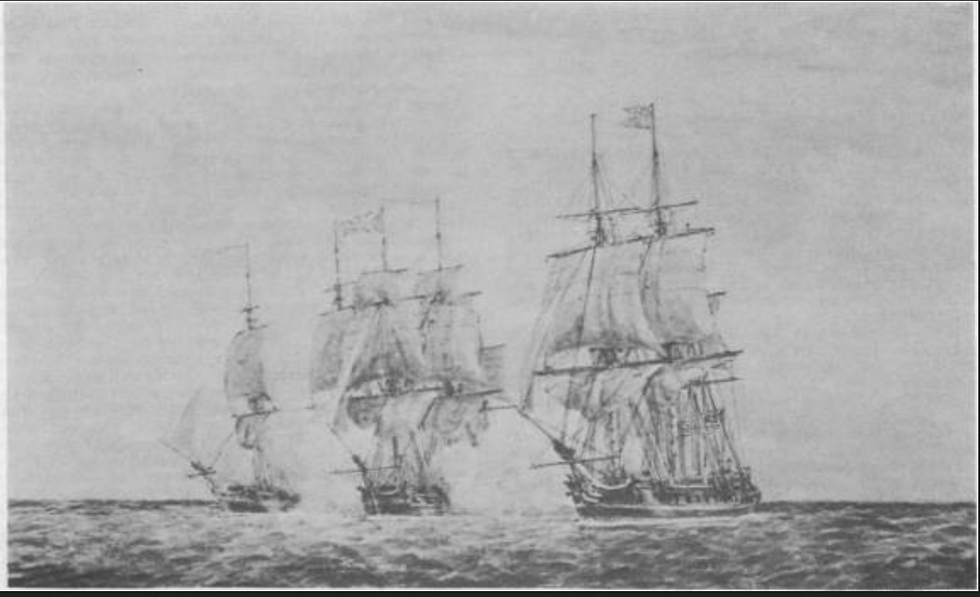
The men on both ships celebrated their prize. But their joy was short-lived. The forty-gun HMS Rainbow took up pursuit of the three vessels and succeeded in retaking the Fox and adding the Hancock to the British arsenal as a bonus. The Boston escaped into the Sheepscot River in Maine. Most probably had the Boston engaged, she too would have been taken. But Congress, ever looking for a scapegoat, blamed Captain McNeill of the Boston who was summarily court-martialed and dismissed from service.
And so it went with the ill-fated Continental Navy. By the end of 1777, the Delaware had also been captured and the Washington, Effinham, Congress and Montgomery had been scuttled and burned. The remaining six frigates were either trapped behind British blockades or had yet to be completed.
the Boston prevails
The fledgling Continental Navy was desperately in need of a successful campaign and the little frigate Boston was able to provide just that. In December of 1777, Samuel Tucker was given command of the vessel. Two months later, he was given a very special assignment. Tucker was to transport to France two future presidents of the United States, John Adams and his son John Quincey Adams. While Adams could have taken any ship to France that he wanted, Thurman surmises that "he wanted to be on one of the original ships that he helped to create." Adams himself wrote to Abigail that sailing on the Boston was "[a]n Honour, that I make it a Rule to boast of...”
After setting out to sea on 14 Feb 1778, the ship was almost immediately discovered by the British. Captain Tucker’s journal notes that on the 19th they spotted what appeared to be three large ships. Since Tucker was a new captain, he did what many men would not. He "asked the honorable John Adams and his fellow officers 'what was best.'" Asking Adams and his crew for advice would become a pattern throughout the voyage and it turned out to be wise. Adams, no weak willed man, advised the captain to make a run for it.
The Boston was able to outrun two of the ships but one stayed close, following them for days. When, finally, they were able leave their pursuer behind, the ship was hit by a ferocious storm that threatened to break the Boston apart. The little ship managed to survive the storm and the damage was repairable. Then, on March 10, the crew spotted another Brtitish vessel. This time, Captain Tucker decided to give chase and managed to capture the smaller British ship, Martha, which was sent back to America with a small crew.
Finally, On April 1st, the Boston sailed into Bordeaux, France with all passengers and crew safe and sound. In the next few months, three more British ships would be captured in European waters by the Captain Tucker and his little frigate. During the period of Adams' voyage to France, two more of the six remaining American ships had been lost, one captured the other sunk, killing 311 sailors with only four survivors. As Captain Tucker began his voyage back to America in the fall of 1778, he described his ship, the Boston as “a ship more valued. . . than all [in] the American Navy. . .”
In 1779, the Boston saw action in Newfoundland, capturing several prizes. Thurman describes an encounter with "Boston disguising itself as a British vessel by flying their flag until it was in position to strike. When they came within range, Boston hoisted the "'stars and stripes' and captured the ship."
It was probably on this voyage that our cousins Samuel Haseltine (4C8X) and John Crosby (5C8X) were part of the crew of the Boston.
the fateful siege of Charleston, SC
By early 1780, only three of the original thirteen American ships remained, the Providence, the Trumbull and the Boston. By this time, action in the war had mainly turned to the South. In January of that year, most of the Continental Navy ships, including the Boston, received orders to sail south to try and protect Charleston, South Carolina from British attack. The defense of that city turned out to be "a complete disaster." The month-long siege of Charleston resulted in one of the worst defeats of the entire Revolution.
The Boston, as part of the strategy to defend the city, was abandoned by Captain Tucker and his crew. Woefully for Tucker, he and his men were taken prisoner and the Boston was taken by the British. Then flying under the Union Jack, the the poor little ship was renamed HMS Charlestown. Thurman believes the renaming was "an intentional jab at the colonies who named the ship after their rebellious town only to see it sail away under the name of their worst defeat."
After the capture of the Boston, the Trumbell was the only ship remaining of the original thirteen built for the Continental navy.
According to Thurman, however, Boston was the ship "that carried two future Presidents safely to France and even taking a prize along this way, that had taken 'more guns from the enemy during the Revolutionary war than any other.'" The Boston continued to sail as HMS Charlestown through the remainder of the war but was finally released to the Americans when the war was over. Thurman maintains that "the Boston embodies the naval story of the American Revolution."
The Penobscot Expedition
Maine had a lot to offer the colonies with its rich fisheries, abundant timber and lucrative fur trade. Its location in the far northeastern corner of New England, however, left the province not only vulnerable to invasion from the northeast, but also often forgotten and neglected by the rest of the colonies. In multiple posts we've written of the trials and tribulations of our Littlefield family whose progenitor, the immigrant Edmund Littlefield (11GGF), first settled in Maine in 1640.
The years leading up to the revolution had been particularly difficult financially for the residents of Maine. The British had imposed such severe regulations on Maine's lumber industry that its citizens had difficulty securing lumber for their own use. Then, the Patriot nonimportation agreements, in effect from 1765-75, caused even more financial woe for Maine merchants. In spite of their troubles, the colony readily adopted the Patriot cause.
The citizens of Maine were not rewarded for their loyalty. Still under the yoke of Massachusetts when the war began, Maine had to rely on that province for its protection. However, the old adage, out of sight out of mind, definitely applied in this case. Maine received little military support despite the fact that British forces were housed just across the border in Canada and the British navy regularly patrolled the Maine coastline .
It was during the revolution years, when their mother colony appeared unable or unwilling to protect its wards, that the idea of a split from Massachusetts first came up. Some of Maine's eastern towns, unwilling to fight for either side, began circulating "proclamations of neutrality." It wasn't until 1779 that the United States congress began taking the defense of Maine seriously. The Penobscot Expedition not only failed to secure Maine's coastline, it has been referred to as the "the worst naval disaster until Pearl Harbor." We'll here more about that struggle in a future post.
Note: Maine wasn't able to split from her mother colony of Massachusetts until 1819.
Our relatives who participated in the defense of the Maine seacoast and at Penobscot were all Littlefields:
Daniel Littlefield (3C9X) was in Cambridge during the siege of Boston. He was later made a captain and, at the time of the Penobscot Expedition, he was a major. Daniel was killed on July 28, 1779 during the fighting at Penobscot. He was just 30 years of age. Daniel's brother was Lt. Colonel Noah Moulton Littlefield (3C9X) who was with George Washington at Valley Forge. We'll hear more about Noah in a future post.
Wikipedia gives this account of Daniel's death:
On July 26, Lovell sent a force of Continental Marines to capture the British battery on Nautilus Island (also known as Banks Island), while the militia were to land at Bagaduce. The marines achieved their objective but the militia turned back when British shot overturned the leading boat, drowning Major Daniel Littlefield and two of his men.
In Daniel Littlefield's regiment were two of his distant cousins:
Richard Littlefield (4C8X) was a quartermaster. He died at sea in 1787 at age 32.
Joel Littlefield (5C7X)
Peter Littlefield (3C9X)
Stephen Littlefield (3C9X)
I can't place Francis Littlefield with any family
Next up: Jeduthan's Baldwin's ship and our relatives that served in the in the Continental Navy.


Comments