
Frontier Life Part 1
- westmohney

- Sep 2, 2021
- 9 min read
Updated: Apr 5, 2022
...fifty years after its incorporation Chelmsford was still mentioned as a frontier town ~ Henry S. Perham, History of Chemlsford

the chosen one
Richard Hildreth (9GGF) of Chelmsford had eleven children with two wives. He made it very clear in his will that, due to his hand "infirmity," he had nothing to leave to his children. But just six years before he died, he had no less than seven pieces of property. What happend to all that land? It turns out that, in 1687, Richard deeded every bit of his property over to one chosen child, his oldest son with his second wife. From court records on 1 Feb 1687:
"...upon good consideration and causes, especially for that he is my natural and well loved son, Ephraim Hildreth (6U) of the town of Stowe is given several parcels of land lying within limits of town of Chelmsford, including house and lot on which I now dwell, 7 acres north of the great pond, 18 acres south by great pond, 17 acres bounded north by great pond east by Gersham Proctor's, etc..."
Note: Gersham Proctor (7U) was Robert Proctor's (8GGF) son and Ephraim Hildreth's cousin.
Most probably there was some sort of furor amongst the rest of the kiddies because, two months later on 6 Apr 1687, Richard added this codicil: "This gift ...ws in return for life support."
At the time of the gift, Ephraim was living on his father's property in Stowe, MA, about 20 miles south west of Chelmsford. It appears, however, that shortly after receiving his gift, Ephraim left the property in Stowe and moved back to Chelmsford. He most probably returned to fulfill his end of the bargain and help poor Richard out on the farm when his assistance was most needed.

Ephraim in Chelmsford
In 1688 and again in 1690 Ephraim served as Surveyor of Highways. Then, during the bad times of King William's War, he had charge of "Benj. Haywood's garrison."
Note: Our uncle Benjamin Heywood (7U), son of John (8GGF) and Sarah Symonds Heywood (8GGM), was born in Concord but moved to Chelmsford with his wife, our cousin Hannah Kidder (1C8X).
Ephraim Hildreth was active in town affairs, serving as Tythingman and Selectman as well as on various juries. When Ephraim's brother James (8U) died in 1695, James' son, also named Ephraim (1C8X) chose his uncle Ephraim as his guardian. It's possible that the elder Ephraim still took care of his lands in Stowe because the record reads: "Ephraim, the son of Lieut. James (Hildreth), made choice of his Uncle Ephraim (of Stow) as his guardian, he then being fourteen years old, A. D. 1695."
From 1705-7, Ephraim served as chairman of the town committee for laying out roads and was also on a committee in 1710 to finish the new meetinghouse. When the meetinghouse was complete, he served on the committee to seat the townspeople.
Note: The highway to and from the coastal towns to Groton was placed right through Ephraim's property, making his land more valuable and he more prosperous. I wonder if being chairman of the road commitee had anything to do with that. Grandpa Richard's property, which he left to his son Ephraim, was located in the section of Chelmsford which, in 1729, became the town of Westford.
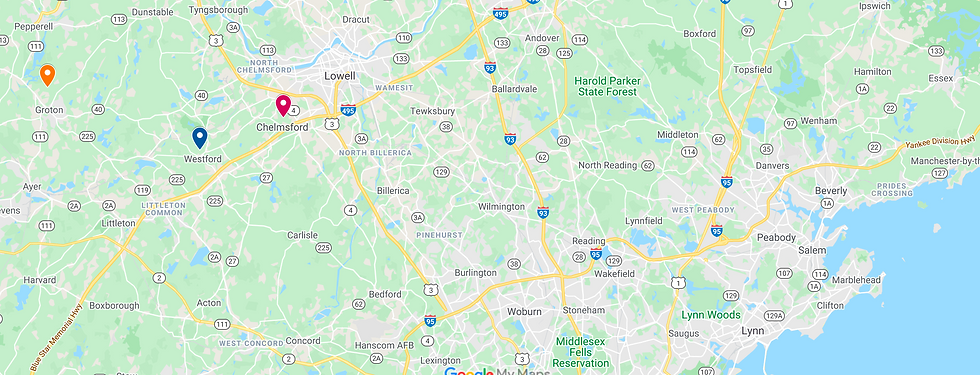
Ephraim and his wife Anna followed in the footsteps of father Richard Hildreth and began conveying land to their "dutiful" children, starting in 1724, seven years before Ephraim died in 1731.
trouble visits the Proctors
Richard Hildreth's oldest child was our grandmother Elizabeth Hildreth (8GGM), Ephraim's older sister. In 1645, Elizabeth married Robert Proctor (8GGF) in Concord and by 1654, they were in Chelmsford with the rest of the Hildreth clan. All went well for a while but Robert, like his father-in-law Richard, did not appear to have a lot of faith in the good Reverend Fiske. In February of 1658, four years after ariving in Chelmsford, Robert and his family were still members of the Concord Church. According to Fiske's trusty notebook, Robert "expressed himself to desire only to live with us by way of recommendation and not to be dismissed unto us. His reason being he desired to leave his children rather under the watch and care of the church of Concord than this." Evidently Robert attended the Chelmsford Church only when it suited him. Reverend Fiske was not happy.
Two years later, when Grandpa Robert got himself embroiled as a witness in a town squabble, Fiske decided to use the situation to turn the townspeople against their wayward neighbor. He leveled four charges against Brother Robert:
Charge 1. That he refused to adjoin to our covenant and gave no satisfactory reason for it... this seems a reflection upon this poor church where we hope God is present and to impart some dissatisfaction and dislike towards us.
Charge 2. His over lax liberty he hath taken amongst us in being present at our church meetings and absent at his pleasure...
Charge 3. It hath been too frequent a thing for him to offer to speak and to speak out his mind in our church meetings undesired and uncalled for, yea without leave.
Charge 4. ...the too disorderly liberty he hath used was this in that of late he so peremptorily denied and stiffly refused to answer in a case wherein he professed himself a witness.
Fiske then called for a vote amongst the brethren (male church members) and they "Voted the suspending of Brother Proctor and returning him to the church at Concord for his not attending the rule in joining...because they conceive, as he professes, he will attend a remove back unto them."
In the end, Fiske evidently had a change of heart. He took a few of the brethren, Robert's father-in-law Richard Hildreth among them, to reason with Robert. According to Fiske, the matter was finally laid to rest when "in fine he (Robert) confessed he was sorry he had spoken concerning this church and promised silence for the future."
But more woes were in store for the Proctor family.
daughter Elizabeth in the family way
About twelve years after the squabble with the Reverend Fiske, a new squabble broke out for Robert, this time with his father-in-law, our Grandpa Richard Hildreth. The two traded barbs for five exhausting months until Richard finally asked the Reverend for leave to remove back to Cambridge in June of 1673.
And so all was quiet for a time with the Proctors. By the year 1680, Robert and Jane Hildreth Proctor had twelve children ranging in age from thirty-four years old to nine. That year, their daughter Elizabeth (7A) celebrated her twenty-fourth birthday. In The Early Hidreths of New England, Arthur Hildreth writes:
"Troubles now came upon Robert Proctor. In these can be seen but too plainly the hand of God rebuking him for too great forwardness in judging his neighbor, especially in loading him with unfounded charges...Elizabeth, then 24 years of age, the daughter of Robert and Jane Proctor, and the apple of their eye, became a mother outside the bonds of wedlock..."
This matter was, of course, brought before the Puritan Courts. The Chelmsford townspeople must have made their peace with the Proctors because they stood firmly behind Elizabeth. From court records: "This humbly informs this honored courtte that wee whose names are underwritten can testify that Elizabeth Proctor, who is brought before your honors to receive condign punishment for her sin that God hath left her unto the commission of, to the great dishonor of God and grief of all her friends, did, according to our best observation of her during her living ampong us, carry herself very civilly, so that shee had a good report among us, and obliged the love of such by her good conversation as had occasion to make observation thereof."
This document was signed by some of the most prominent men and women of Chelmsford. At the head of the list was Reverend Fiske's widow, "an exemplary old lady."
As is often the case, we can find nothing in the records as to Elizabeth's punishment. Whatever her punishment, Robert Proctor was not about to let the matter end there. He filed suit against the father of Elizabeth's child.
Note: Robert Proctor and his father-in-law must have repaired their relationship after their earlier squabbles because, at the trial, Richard Hildreth's wife Elizabeth testified that she was the "midwife during Elizabeth Proctor's confinement."
Below are the records of the case. Thomas Marrable was ordered to pay for the cost of birthing, 3 shillings a week for the "maintenance of said child" and a payment of a 20th of his estate to the selectmen of Chelmsford for security "for ye paying of the future charges of ye sd child."

When Robert died in 1697, his daughter Elizabeth was forty-one years old and still unmarried. It wasn't until she was almost fifty that Elizabeth finally snagged a husband. In 1705, Elizabeth Proctor married Samuel Fletcher as his third wife. They had no children together.
Note: Samuel Fletcher's brother Joshua Fletcher was the man excommunicated from the church by Reverend Fiske that our Grandpa Richard Hildreth defended in our last post.
Still more trouble would make it's way to the Proctors but Robert didn't live to see it. Robert Proctor died in 1697 at age 73. He and Jane had twelve children and all of them but one were still alive at his death and mentioned in his will. He had already divided and deeded most of his property to his six sons before his death. Certain lands were set aside for his seventh son Thomas (8U) who had gone to sea but, it appears, never returned. So, as geneaologist Elizabeth Rixford so poetically put it, "Robert Proctor (8GGF) took the long journey to the land where meadow boundaries are of little consequence." He was 73 years of age.
I can find no death record for Grandma Jane Hildreth Proctor. She was still alive in 1697 when her husband Robert died.
murder at the mill
Uncle Israel Proctor (8U), Robert and Jane's second to last son, celebrated his forty-first birthday in late April of 1709. A few weeks later, on May 11th, Israel evidently spent part of the day with his nephew, Thomas Chamberlain (1C8X), and other men at Thomas' mill in Groton. Thomas Chamberlain was dead before the end of the day. Below is the scene of the crime as it looks today:

Note: The victim, our cousin Thomas Chamberlain, was the son of Ephraim's sister Sarah Proctor (8A) but, because of a wide gap in Ephram and Sarah's ages, just happened to be born one year before his uncle Ephraim.
Eight men were present that day but, before the murder took place, all had left but two, Uncle Isreael Proctor and his nephew Thomas Chamberlain. Samuel Barnes and Isaac Barnes testified at the trial that that when they departed for home, "there was peace among the two men." It's impossible to know what happened between Ephraim and Thomas after their friends left but, at the end of the day, Thomas Chamberlain lay dead of multiple stab wounds. The fatal stab entered "so far into the body of the said Thomas Chamberlain that he then and there died instantly of said wound or wounds”
I can find no records that tell how Israel was apprehended or how they ascertained that he was, in fact, the murderer. One record of the trial relates the finding of "a piece of neck cloth, one that matched the torn piece found bloodied under the body of Thomas Chamberlain, they being a match to the one that Mr Proctor was wearing that day..." Straight out of Murder She Wrote. The records of the trial tell at least part of the story:
"At court of Assize and General goal...The Jurors of our Sovereign Lady, the Queen (Anne) upon their oaths of present Israel Procter of Chelmsford...afore said on the eleventh day of May last, not having the fear of God before his eyes, but being instigated by the Devil and of his malice aforethought with force and arms, and against the peace, an assault made on the body of Thomas Chamberlain of Groton afore said miller. Then in the peace of God of the Queen, being and with a bayonet or short sword of the value of five shillings, he the said Israel Proctor feloniously made several mortal stabs or strokes on the body of the said Tho. Chamberlain, viz. on or near the groin, ye right side, the bayonet or short sword entering so far into the body of the said Thomas Chamberlain that he then and there instantly died of the said wound or wounds, and so the Jurors, afore said say that the afore said Israel Proctor feloniously and willfully murdered the said Thomas Chamberlain against the peace of our Sovereign Lady the Queen, her crown and dignity and the law."

An unusual sentence
The court found Israel Proctor guilty of manslaughter, which seems quite a leap from "malice aforethought" and "willfully murdered." Then, a rather unique punishment was meted out to him. Israel was taken to the gallows and the hangman placed a noose around his neck. He was left to ponder his fate for one hour. Mercifully, after that hour, he was spared the ultimate punishement. The thirty stripes he then received on his bare back while "tied to a cart's tail" probably didn't feel so bad.
At the time of her husband's death, Abigail Chamberlain had five children under ten and was expecting another who would be born three months later. In addition to his gallows scare and whipping, Israel was ordered to pay compenstion to widow Chamberlain for the support of her and her family. The Court may have kept him alive for just that reason.
Uncle Israel Proctor died in Chelmsford on June 9, 1755, forty six years after the murder. He was 87 years old.
Next up: Chelmsford in the war years.


Comments