
OUR NORTHERN ROOTS

Updated: Apr 30, 2025
“The Arabella arrived at Salem the 12th of June. The common people immediately went ashore, and regaled themselves with strawberries...
~ Thomas Hutchinson

the Winthrop Fleet
During the month of April, 1630, 11 ships left the harbor at Yarmouth, England. Their destination: the newly founded colony of Massachusetts Bay in the New World. The Winthrop Fleet, so named for John Winthrop, a major emigrant proponent and future Governor of the new colony, transported seven hundred Puritan immigrants across the waters to Massachusetts Bay. Four of these Puritans were our ancestors. About 200 people died soon after arrival and another 100 would sail back within months on the returning ship.
Early in the morning on 12 June, 1630, the flagship Arabella neared Salem harbor. This was a welcome sight for the passengers who had been tossed about on the Atlantic waves for ten long weeks. But this area “pleased them not.” According to Governor Tom Hutchinson’s History of Massachusetts:
“The first news they had, was of a general conspiracy, a few months before, of all the indians as far as Narragansett, to extirpate the English. Eighty persons out of about three hundred had died in the colony the winter before, and many of those that remained were in a weak, sickly condition. There was not corn enough to have lasted above a fortnight, and all other provisions were scant.”
A quick decision was made to move overland 20 miles south to Charlestown. There they settled for a brief time before discovering there was a lack of fresh water enough to sustain the group. They then made their way across the Charles River and finally decided on Boston as their final destination.
Boston was "the city upon a hill" immortalized by John Winthrop who warned his flock that "the eyes of all people are upon us."
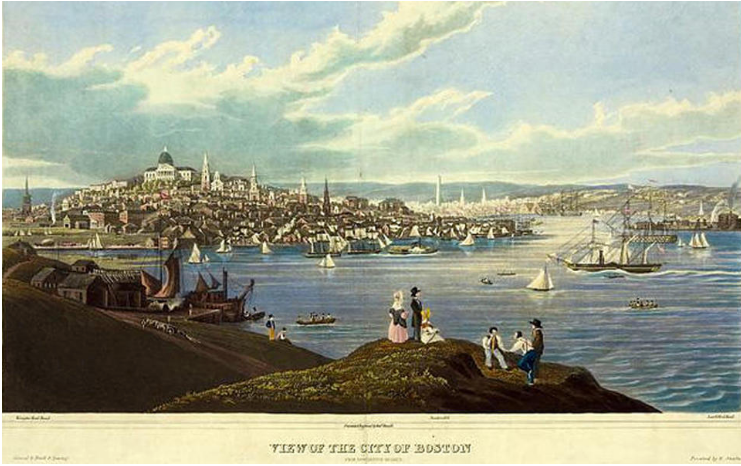
Ah, Massachusetts
Massachusetts is the cradle of Parrish family civilization in America. All told, 28 families of Parrish ancestry came during the Great Migration and another 11 came between 1641 and 1670. The Puritan migration was overwhelmingly a resettling of families, unlike other immigrations to early America which were composed largely of young unattached men. Although other towns had already been settled, Boston became the hub to which everyone flocked, at least occasionally. That’s where the First Church of Boston was established in 1630 and it is still in existence today.
The Church was the most important element of the Puritan Massachusetts Bay Colony society, but the Puritans were a difficult lot. Early Puritan colonists believed that their Boston community had a special covenant with God, and this influenced every facet of colonial New England life. The settlement leaders legislated morality and strictly enforced church attendance. For many years the Church elders also exercised complete political control. They had no time for unorthodox religious ideas, and they exiled or punished dissenters.
In order to become a freeman with the right to vote and own land, church membership was required, but it wasn't an easy thing to become a church member. Those seeking to become part of the congregation had to testify that they were “divinely selected for salvation” and also submit to rigorous interrogation. Our first four ancestors must have made the grade, because all four were listed in the early records of the Church of Boston.

our first ancestors to touch New England soil
Conditions were not exactly peachy when Thomas Howlett (9GGF), Thomas French (10U), Alice French (9GGM) and Ezekiel Richardson (10U) stepped onto American soil. But they were all card-carrying Puritans, as exemplified by their early acceptance into the Church of Boston, and they would weather the storm.
While these four ancestors are all listed on the Winthrop Fleet roster, conflicting information about passengers on the various ships and dates of arrival has made it impossible to ascertain exactly when they arrived. We do know that it was before September 1632 because they are all listed as members of the First Church of Boston prior to that time.
Ezekiel Richardson (10U) eventually removed to Woburn where his brothers Thomas (10GGF) and Samuel (10U) later joined him. More on that family later.
It appears that Thomas Howlett (10GGF) made the journey to Massachusetts Bay alone, while Thomas French (10U) traveled with his wife Mary and his sister Alice (9GGM). There is nothing to suggest that these two families knew each other before their journey, but the history of these three early arrivals became intertwined with the marriage of Thomas Howlett and Alice French sometime before 1637 when their first child was born. They all settled first in Boston.
Then, in 1633, Thomas Howlett helped to found a little town called Ipswich. That is where five sets of our grandparents settled.


Comments