
FRONTIER LIFE PART 2

Updated: Mar 24, 2022
...every malle person with in our towne Above the Age of Fiueten years shall provid a good Clube of Fouer or Fiue Foot in lingth
~ Chelmsford Council orders

Chelmsford in the war years
As a frontier town, Chelmsford had more than its share of trials and tribulations during the two wars fought in the last half of the seventeenth century. In the History of Chelmsford, Massachusetts, Wilson Waters writes about the first stirrings of fear:
"In 1671 we find the first intimation of danger from the Indians, with whom the people had thus far been at peace. Evidently, the Indians were manifesting symptoms of uneasiness at the growing strength of their white neighbors...The record reads: '25the 5th mo 1671 It is ordred...For severall Considerations espetialy For the preseruation of peace That...every malle person with in our towne Above the Age of Fiueten years shall provid a good Clube of Fouer or Fiue Foot in lingth with a knobe in the end and to bringe the same to the meeting house ther to leave the same untill ocation fore use of it.'"
Then, on the 1st day of September in 1674 every able-bodied man was sold powder for their muskets in preparation for the war that broke out six months later. Most men received one pound six ounces. Our grandfather, Robert Proctor (8GGF), was one of the few men in town to purchase more. He received three pounds.
A training place was set aside for soldiers and five houses were fortified as garrisons. Each garrison was assigned its share of heavily armed soldiers and town milita. Every person in Chelmsford, as in all frontier towns, was assigned a garrison where they could find shelter during an assault. Most residents decided to stay the course, though some fled to the safety of coastal towns. And thus the residents of Chelmsford spent the next twenty-five years suffering through two wars and constant fear of attack.
Grandpa Nathaniel Hill
The story of our grandfather Nathaniel Hill begins in Billerica and ends in Chelmsford. When Nathaniel's father, Ralph Hill (9GGF) of Billerica died in 1663, he was quite a wealthy man with extensive property to leave to his sons. His son Nathaniel (8GGF), was to have "the land toward Concord" and one third of "my improvable land until he has broken and fenced up land of his own; also 5 acres of meadow next to Ralph's (8U) (Nathaniel's brother)." The year he recieved his inheritance, Nathaniel's tax for the minister was the highest in the town of Billerica, so his father left him quite well off.
In 1667, Nathaniel married Elizabeth Holmes (8GGM), daughter of Robert Holmes (9GGF) of Cambridge. Elizabeth most probably inherited her father's Billerica property when he died in 1663. When King Philip's War broke out, Nathaniel and Elizabeth had five children under eight years old. Nathaniel was assigned to his brother Ralph's garrison.
Most men did their part in the war by defending their hometown garrisons. In February of 1676 Nathaniel, his brother Jonathan Hill (8U), our cousin Simon Crosby (1C12x) and our grandfather John Kittredge (9GGF), all of Billerica, are additionally credited with service in Captain Thomas Wheeler's company.
Note: Grandpa Nathaniel was generally referred to as Cornet Hill. By the 1690's, this was already an archaic, seldom used title. According to Wiki Military: "Cornet was originally the lowest grade of commissioned officer in a British cavalry troop, the modern equivalent being a second lieutenant. The rank was abolished by 1871."
tragedy and a new life
During and after the war, Grandma Elizabeth gave birth to six more children for a grand total of eleven. By 1683, Elizabeth had given birth to eleven children in just fifteen years! Less than two years after her last child was born, Elizabeth died at age forty-one, possibly from sheer exhaustion.
Two of their children had died young so Nathaniel was left with nine children ranging in age from seventeen to two years old. He stayed in Billerica for four more years after Elizabeth's death, probably recieving help from his family with the young children.
In 1689, Nathaniel moved to Chelmsford, about six miles northwest of Billerica. By this this time, the first of the French and Indian Wars had begun and, in 1692, Nathaniel was again assigned to one of the garrison houses.

life in Chelmsford
Evidently Nathaniel's property in Chelmsford butted up against Moses Fiske's property. In 1693, Moses sued Nathaniel for intruding onto his property. Nathaniel lost that suit, but in a few years time, he would win the wife of Moses' brother, John Fiske.
Moses and John Fiske were the sons of that controversial town minister, the good Reverend John Fiske, who had given our grandfathers Richard Hildreth (9GGF) and Robert Proctor (8GGF) so much grief. There are no records showing the year John Fiske died and I can find no record of Nathaniel's marriage to Lydia Fiske. The only proof we have of this marriage is from Nathaniel's will where he leaves to his wife "the buildings lands and all the estate that my beloved wife Lydia had left to her by her first husband Mr. John Fiske..."

Then, a red-letter year. In 1695, Grandpa Nathaniel got an inn! Only a year into it, however, trouble came to the inn in the form of a murder. We wrote of this tragic incident in our Not So Petty Crimes post. Our cousin, the contrary Eziekiel Richardson (2C9X), was killed with a blow (and some well placed kicks) by Edward Spaulding and his cronies. One of the cronies involved in the coverup was Nathaniel's son, our uncle Jonathan (7U). Whether Jonathan participated in the drubbing we have no way of knowing. Nathaniel and Jonathan were called to Boston to testify in that case which resulted in a verdict of ignoramus.
The entire decade of the 1690's had seen the colony in the throes of King William's War. Chelmsford, still a frontier town, was in the direct line of fire. In 1697, Nathaniel along with others in the town, sent a petition to the Boston Council asking that additinal defense be sent to their outlying town. Our uncle Joseph Hildreth (8U), constable at the time, delivered the petition. The Council agreed and the request was granted.
civic duty
Grandpa Nathaniel served as a selectman in Chelmsford for eleven straight years until the year right before his death. In 1698, he was chosen as one of a commitee to oversee the building of a new bridge on the Concord River where the old bridge had washed out. And,
in 1701, Nathaniel became the town treasurer. You can be sure that he paid himself for all that was due to him. From the town records:
To Cornet Hill for nailes and Boards used about the meeting Hous.
To Cornet Hill for Drink
To Cornet Hill for Minesters Entertainment at sundrey times
To yourself for four jornys to Ipswitch one to Cambridg one To Woburn To Acompany Minesters to preach with us
To yourself for mony Lent the Towne
Early in 1706, probably knowing his death was imminent, Nathaniel divided and deeded all of his Billerica lands to his sons. His sons having been taken care of, the bequests in his will were soley for his wife, Lydia, and two of his daughters. He begins his bequests thus: ...and for the little portion of the good things of this life which God hath gratiously lent unto me I doe thus dispose of..."
Below is the bottom portion of Nathaniel's will with his signature:

Part of those "good things of life" Nathaniel bequethed were his "armes & amunition" which he left to his wife Lydia "for the defence of the house."
Josiah Richardson
Josiah Richardson (1C10X) and his younger brother James (1C10X) were sons of our uncle Ezekiel Richardson (9U) of Woburn. Ezekiel died in 1647. Most probably the bulk of his estate went to Ezekiel's oldest son, Theophilus (1C10X), because the two remaining sons, Josiah and James, decided to seek their fortunes in Chelmsford. The brothers were in Chelmsford by 1658 when Josiah's name appears on the petition asking the Council permission to trade with the Praying Indians who lived in the area. Permission denied.
In 1658, Josiah would have been 23 and James 17. According to Henry S. Perham who wrote The History of Chelmsford, "There is a tradition also that Josiah Richardson's first shelter was partly formed by digging into a bank." If the brothers came with little money to their name, a little ingenuity goes a long way.
In 1659, Josiah married Remembrance Underwood. In 1663, he and another man were chosen to help lay out the main road going from town to town and into Boston. Then in 1669, he built a saw mill with two other men. This was only the second sawmill in Chelmsford and badly needed to produce wood for the building of new homes.
Josiah also asked leave to join the Chelmsford church. From the notebook of the good Reverend Fiske:
"Jan 30 1673 ~ Josiah Richardson, he having been propounded 3 weeks to the church and a fortnight to the mixed congregation after the relation of the work of God in drawing his soul to Himself, and his assent manifested to our church confession and covenant...he was I say, received into the church in full fellowship. In month second his children baptized."
Josiah, along with his brother James, was well loved by the Wamesit tribe living in the Praying Village near to Chelmsford. In 1668 The Wamesit gave Josiah a parcel of land. From the deed:
"This present Indenture witnesseth an agreement between Josiah Richardson, Senr...on ye part, & John Naberha, Joseph Line & Samuel Naberha of Wamasseck, we for ye love we bear to ye before said Josiah, have lett unto him one parcell of land lying at ye mouth of Concord River...and partly upon Merrimack river...for ye space of One Thousand and one years..."
The deed was witness by three of Josiah's sons, Jonathan (2C9X), John (2X9X) and Samuel 2C9X).
Almost twenty years later, Josiah would get an even bigger piece of the Wamesit village. In 1686, twelve years after King Philip's War which would displace the Wamesit from their home:
"Know ye that Jonathan Tyng...for the sum of one hundred and fifty pound sterling grant to Major Thomas Hinchman, Ensign John Fisk and Sergeant Josiah Richardson...all of that part of Indian plantation called Weymessitt." The area that once was Wamesit eventually became the town of Lowell.
The Reverend John Eliot, Apsostle to the Indians, had secured for the Wamesit the most desireable property near the river. That situation continued to vex the English settlers until the war drove the Wamesit from the area. The only silver lining to be found in the whole sad affair is that two of the the men who purchased the property, Thomas Hinchman and Josiah Richardson were friends of and well loved by the Wamesit.
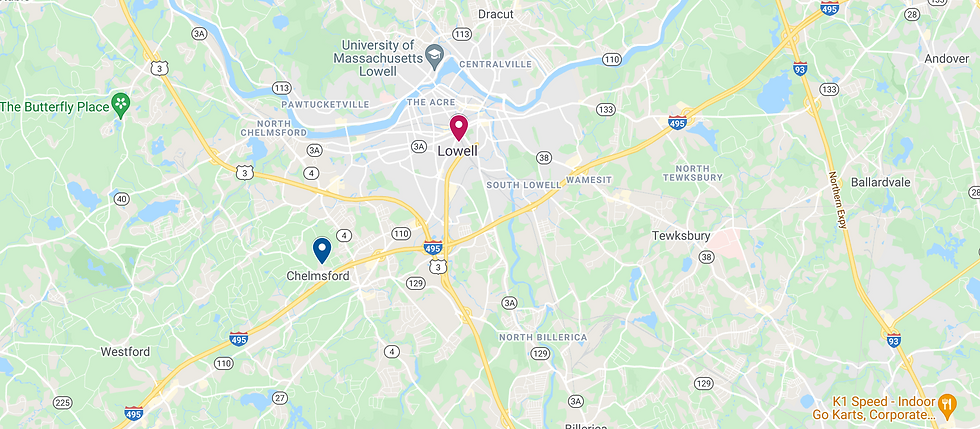
In 1689, Josiah was promoted to full Captain. He may have seen action in King William's War which had just begun that year. It's even possible that he died of wounds from that war which didn't end until 1697. Josiah died intestate in 1695, indicating that his death was not expected. He was 60 years of age. Josiah, a self-made man, did well for himself in Chelmsford. His estate was valued at almost £1,000, quite a sum in those days.
James Richardson
Josiah's brother James Richardson (1C10X) was only nineteen when he married Bridget Henchman in 1660. She was the daughter of Thomas Henchman who would become James' mentor and fellow soldier in the defense of Chelmsford during King Philip's War. James and Bridget would would have eight children before James' untimely death seventeen years later at age 36.
Note: One of these children was the unfortunate Ezekiel (2C9X) who was killed at Grandpa Nathaniel's inn in 1696.
James lived near to his father-in-law, Thomas Hinchman, right on the border of the line that separated the Native lands from Chelmsford. We know this from a description of the land laid out for James: "48 acres east by tree joining upon the Indian line... through the midst of the said Thomas Hinchman's house."
James and Bridget lived a fairly uneventful life for the next fifteen years raising their family in Chelmsford. Then came the war. Chelmsford records mentioning James Richardson show no military title until he is mentioned in King Philip's War as Lieutenant James Richardson. Whether he held other military ranks prior to 1775 is unknown but, his new post put him in the thick of the war in Chelmsford.
Over the years, James and his father-in-law, Lieutenant Thomas Henchman, had developed a warm relationship with the Wamesit from the Praying Town near Chelmsford. The Natives considered James and Thomas friends and turned to them in times of trouble. The two men worked tirelessly through the war to try and protect both their townspeople in Chelmsford and the Natives of the Praying town near them.
Next up: the story of the Chelmsford Wamesit Praying Indians whose lives became intertwined with that of our cousin James Richardson.


Comments