
HENRY PALMER IN HAVERHILL

The town of Haverhill, Essex County, Massachusetts is situated on the northerly side of the Merrimack ~ the fourth in size but perhaps the most beautiful river in New England... ~ George Wingate Chase

the ever expanding colonies
By 1638, the influx of immigrants to the New World had created the need for more land and new settlements. Much of the expansion happened in Northern Massachusetts where Ipswich and Newbury in particular felt the strain of crowded conditions and scarcity of land.
In 1639, a petition was received by the Boston Court for permission to "begin a new plantation on the Merrimack River. In 1640, sixteen men were "conditionally allowed" to form a settlement at Pentuckett, later called Haverhill. Our grandfather Henry Palmer (10GGF) was one of these men.

faded away
It seems there was little evidence of native people living in the area at the time Haverhill was founded. The "pestilence" that swept through Native American villages shortly after the first settlers had arrived may have accounted for a large part of that situation. Of course, the Puritans credited God with this good fortune.
It was common for the founders of new settlements to purchase the land from the indigenous bands living there and so be assured of an all important deed. The Haverhill purchase, however, was made two years after the founding of the town. George Wingate Chase, in his book The History of Haverhill, surmises that a few scattered members of the band originally living there wandered back "to their old hunting and fishing grounds...and laid claim to the land."
The deed written in 1642 still exists. Chase writes, “The rude marks upon this deed are the only memorial we have left of the aboriginal inhabitants of Pentuckett. They have faded away. As leaves before the chilling frosts, so have they fallen and withered before the breath of civilization, and silently sunk into the graves of their fathers."

Henry Palmer
The first mention of Henry Palmer (10GGF) in the New World appears to be on a list of the men "conditionally allowed" to found the new plantation of Haverhill in 1640. He is named as one of eight town founders who had previously lived in Newbury (where our Phelps, Adams and Ballard families lived), but I can find no record of him there.
We also have no record of Henry's marriage to Elizabeth (10GGM) or the birth of his three daughters, Mehitable (9GGM), Elizabeth (10A) and Bathsua (10A). His name figures prominently, however, in the historical records of Haverhill. In 1646 he was chosen as one of the first six selectmen of the town. In 1647 he was one of three men chosen to try "small cases" (similar to small claims court).
Then in 1654, a red letter year, Grandpa Henry got a tavern! And better than that, only two people in all of Norfolk County were "thus liscenced" to sell "strong liquors of any sort" to "any Indian or Indians." Henry Palmer was one of those two.
Henry lived his life out in Haverhill, acquiring land and serving his community. He was chosen as representative to the Court in Boston in 1667, 1674, and 1676-80. He died in 1680 at the age of about 80. After his death, in 1681, the town voted to buy "the house where Henry Palmer lived and died, for use of the ministry forever."
Henry and Elizabeth's daughter Mehitable (9GGM) married Samuel Dalton (9GGF) of Hampton, NH. Henry remembered them handsomely in his will:
"I Doe Give unto my Son Samuell Dalton & to my Daughter Mehetabel his wife my Dwelling house & my House lott and orchyard as itt is bounded in the Towne book of haverill..."
Henry's record of excellence in Haverhill may have gone unblemished except for two incidents. One happened in 1670 when he was chosen to serve as constable and refused the office. According to town records, he "was fined according to law!" (exclamation point, theirs). In his defense, he must have been almost 70 at the time.
The other incident involved another relatives of ours, Robert Swan (10U).
a Puritan "inquiry"
The Puritans were a petty lot. Court records are filled with defamation suits, arguments over swine and accusations of trespass to name only a few. We have our share of relatives who were right in the thick of things. According to information gleaned from a Council held in Boston in 1656, it seems that there was some sort of altercation between our Grandpa Henry (10GGF) and our Uncle Robert Swan (10U) (these two are not related). The furor began over a cow. Uncle Robert and another man in town, embroiled in a fierce court battle, claimed that they owned the same cow. This case, which began in Haverhill, was so contentious that it went through the Haverhill town meeting, the Salisbury General Court and finally all the way to the Boston Council.
The citizens of Haverhill soon began taking sides in the matter. Grandpa Henry was definitely not on Robert's side. He bandied about town that Robert "had gone very sinfully to work in getting the heifer..." In return, Robert smacked Henry with a defamation suit. The next thing Henry knew, he was being censured by the arbitrators in Haverhill "as delinquent in point of Defamation of Rob Swan..."
The case, unable to be resolved in Haverhill, was then sent to the Salisbury Quarterly Court to decide whether Henry should also be censured by the Church. The Court decided that even though "there was great appearance of much iniquity on Goodman Swans part..." in the matter of the cow, "Goodman Palmer charging of Goodman Swan with Sin...was not without Sin." In other words, they were both at fault.
The Court did not leave it at that, however. There are always those in town who are favored and those who are not. As we'll see in future posts, our uncle Robert Swan was not among the favored. But Henry Palmer was. The Court softened their decision against Henry by stating that they hoped the verdict "will not be grievous unto our Broth. palmer" and that his "Infirmity herin (too common unto ye Best) be forgiven." No such statement for Uncle Robert. So Brother Palmer's squeaky clean reputation got him off with a slap on the wrist.
The Court adjourned with hopes that all would eventually be forgiven. It appears that was the case. When Henry Palmer wrote his will he chose Robert Swan as one of the witnesses. All's well that ends well in Puritan America.
a tale of two towns
A smidgen less than twenty miles lies between Hampton, New Hampshire and Haverhill, Massachusetts. In 1650, when Mehitable Palmer (9GGM) of Haverhill married Samuel Dalton (9GGF) of Hampton, the two towns were still part of the same county, Norfolk, MA. It wasn't until 1679 the New Hampshire was made a separate colony.
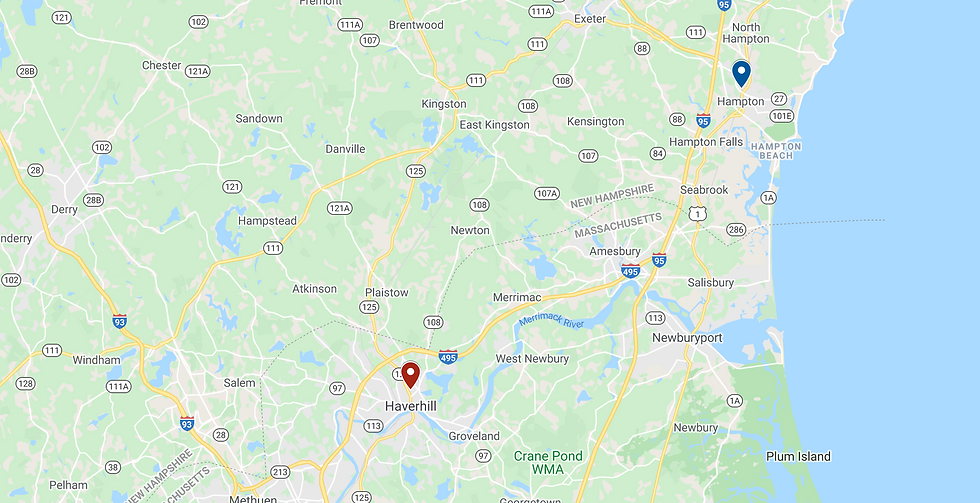
There is, of course, no record of how Mehitable and Samuel met, but 20 miles was not such a large distance to breach in colonial America. The colonists traveled by foot, on horseback and by boat. As population increased, trails were widened into tote roads and bridle paths, and then into carriage roads.
Samuel and Mehitable raised their family in Hampton, but when Samuel died in 1681 (age 52), eight of their 13 children were under 18, the youngest only four. Though both her parents had died, Mehitable must have moved back with her children to Haverhill, the town of her birth. There, in 1683, she married the Reverend Zechariah Symmes. She died in Haverhill in 1695 at age 67.


Comments