
THE SECOND GENERATION

...but if he be pleased to give us melting hearts for our former miscarriages, and renew us with a more zealous courage...it is very like he hath more glorious works by far for us yet to do... ~ Edward Johnson, Wonder Working Providence

the second generation in New England
Immigration from England to New England never again reached the heights of the first wave seen during the Winthrop Fleet years, 1630-1642. Still, the population in the Massachusetts Bay colonies grew rapidly into the second half of the 17th century. New England experienced much lower rates of mortality than either England or her Southern colonies. The Infant mortality rate remained incredibly low for the time and life expectancy for men was 71.8 years, for women 70.8. These two factors sent the population surging upwards. Within a generation, the population of New England had doubled.
Studies of New England towns have shown another unique characteristic. Puritans came to America not just for religious reasons. They were also profoundly unhappy with the state of English society and the crown's ever increasing intrusion into local affairs, both civil and religious. The Puritan settlers, in contrast, founded towns that were relatively independent communities, free to apply rules specific to their needs. Gathering like-minded people in the establishment of a town was one of the most important elements and greatly enhanced the success of a settlement. In spite the numerous petty lawsuits and bickering that went on in New England villages, for the most part they worked as a peaceful, cohesive group.
By the middle of the century, approximately fifty towns had been established in the Massachusetts Bay Colony. Our immigrant ancestors had settled in seventeen of these. Many of their children, however, did not stay in the towns of their birth. For various reasons, they moved either to other already established towns or out to newly founded frontier towns. As the colony expanded, our grandparents, aunts, uncles and cousins were part of that expansion.
Three major events in the second half of the 17th century, however, defined that time period and tested the mettle of all the Colony's inhabitants. In 1675, an extremely destructive war between the Native people and the settlers erupted. King Philip's War would be the most injurious event of the period for both the settlers and Natives. The last decade of the 1600's brought further misery in the form of the Salem Witch Trials and the first of the French and Indian Wars.
While the second half of the 17th century brought its share of trial and heartache to the fledgling colony, their stable beginning made it easier for them to weather the storms and continue strong into the 18th century.
in Ipswich
Ipswich, one of the first towns founded in the Massachusetts Bay Colony, had grown by leaps and bounds. By 1650, over 140 families called Ipswich home. The town had the distinction of being only the second town, after Boston, chosen to house a prison. In 1675, the year King Philip's War broke out, there were about 500 men living in Ipswich. While the town itself survived relatively unscathed through the war, Ipswich militia men marched out to protect frontier towns and villages in the west and south. General Dennison of Ipswich was chosen Commander-in-Chief of all the forces in the Colony.
Our very first immigrant grandfather Thomas Howlett (9GGF), one of the founders of Ipswich, was almost seventy years old when the war began. He died in 1678 just two years after the war's end. Three of Thomas' five sons died before him. In his will, Thomas first made sure that his second wife, Rebecca, would be taken care of. He also left bequests to his daughters and quite generous bequests to the wives and children of his three deceased sons. That left his two remaining sons, our grandfather Samuel (8GGF), and Thomas' youngest son William (8U).
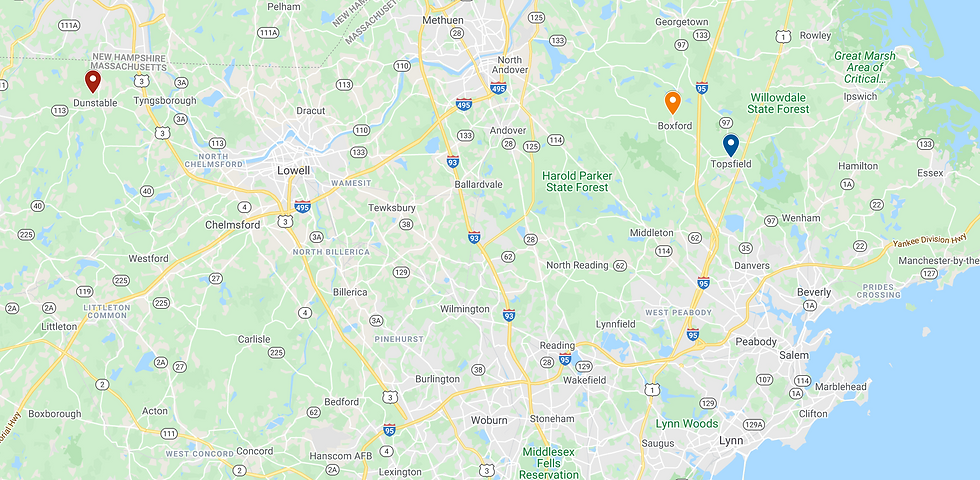
William was given the homestead with the stipulation that he care for his step-mother Rebecca. Our Grandpa Samuel, who had moved to Topsfield ten years earlier, was given acreage in both Ipswich and Topsfield.
Note: A minor altercations occurred between Uncle William and his step-mother in 1680. Just before her death, Rebecca Howlett sued William for "meddling" with her geese and turkeys. William was acquitted by the Court.
In Topsfield
In 1645, what was known as the "New Meadows" section of Ipswich was "sett off" and became the town of Topsfield. Only seven miles west of Ipswich, Topsfield lay in the more protected zone of towns nearer the coast and, like Ipswich, suffered no attacks during the war.

Note: In the lower left corner of the map, you'll notice Richardson's Ice Cream. I googled it. The original farm was started by our cousin David Richardson (2C8X). The land has been in the Richardson family for over three hundred years.
By the time King Philip's War began, Grandpa Samuel Howlett had been living in Topsfield for seven years. In 1668, he had been offered a blacksmithing position by the town. The town's records state that "At a lawful Towne meeting ye 15 January 1668 the Inhabitants of ye Towne hath given Samuel Howlett an invitation to come to the town and set up his trade of smithing to do ye Townes worke. Upon consideration ye Samuel Howlett promiseth to ye towne to Come and set up his trade in ye towne and doe there worke, they have given him four acres of land upon the Common Hill next to William Smith and John Frainch (1C10X) land."
Note: The John French mentioned in the record was Samuel's first cousin, son of our uncle Thomas French of Ipswich.
Samuel Howlett and John French lived on property which now lies on either side of Howlett Street in Topsfield. John French sold his property to Joseph Andrews who built a house known today as the French Andrews House. It was listed on the National Register of Historic Places in 1919. Today Howlett Street is a lovely, secluded, wooded lane. Below are two photos of the French Andrews house. Samuel Howlett lived on a plot of land next door to his cousin John French.


blacksmithing
The profession that our Grandpa Samuel took up was one of the most important in all colonial towns. He was probably apprenticed at fourteen or fifteen to an experienced blacksmith in Ipswich. Apprenticeships generally lasted five to seven years. Beginners would first observe their master before being given easy tasks. As time went on, the apprentice would learn how to heat and bend iron. Before being released to his own practice, an apprentice would generally be given a final task of his own creation.
Blacksmiths forged indispensible items such as horseshoes, pots, pans, hammers, axe heads, nails, plowshares and tools of all kinds. Most of the blacksmith’s work was done in his personal forge in which scalding bars of iron were hammered with heavy sledges to fashion the iron into various shapes.

a civic life
In 1668 Grandpa Samuel was only twenty-two years old and had probably just completed his apprenticeship when he got the call from Topsfield. Most likely Ipswich already had a working blacksmith and Samuel was lucky to find work so close to his family. After two years in Topsfield, Samuel married Sarah Clarke (8GGM), daughter of that incorrigible tavern-keeper, Grandpa Daniel Clarke (9GGF), who had been in Topsfield since 1645. Like his father Thomas, Samuel Howlett was active in town affairs, holding the offices of constable, tythingman, assessor, grand juror, moderator of the town meeting, overseer of the poor and Deacon of the church.
On 20 Sep 1701 the town records show that "Sejeant Thomas Dorman and Ensign Samuel Howlett were chosen to be deacons although the church voted to have but one deacon chosen; but the number of votes for each being equal the church passed the vote to have both of them." Samuel served as Deacon for five years. He served as a town selectman sixteen times. In the town militia he was a sergeant and later ensign and possibly saw some action in King Philip's War.
In 1701, the sad fact remained that two wars, which effectively denied Native Americans any rights at all, still was not enough for the greedy English. Our grandfather Samuel, in that year, was overseer of a committee to deal with the "Indians as lays Claime to our Lands."
Samuel and Sarah had seven children, five of them daughters. The witch trials would touch the families of two of these daughters, Sarah Howlett Averill (7A) and Mary Howlett Wildes (7A). More on that in a later post.
the Sherwins
Samuel's daughter, our grandmothr Susannah (7GGM), married Ebenezer Sherwin (7GGF), son of the our immigrant grandfather John Sherwin (8GGF) who died in 1726. The inventory of John's estate showed him to be a relatively poor man. He had thirteen children born to his two wives, five of them sons. At the end of John's life, only one of these sons remained in Ipswich. Two of his sons had moved on to the greener pastures of Virginia and Connecticut and two of his sons had died before him. That left only his son William (7U) who inherited the bulk of his small estate.
Sadly for William, when John Sherwin died his entire estate was worth a mere £46. £34 went to William and the remaining £12 was divided amongst his ten siblings. By contrast, John's neighbor Thomas Howlett (9GGF) left an annuity of £5 a year to his wife, £50 to his each of his daughters, £45 to both of his grandchildren and well over 300 acres of land to his sons as well as housing, goods, cattle, utensils of all sorts and whatever outstanding debts were still owed to him.
John Sherwin's son, our Grandpa Ebenezer Sherwin and his wife, Grandma Susannah Howlett Sherwin, had moved to Boxford, MA where the two of them led entirely uneventful lives. Ebenezer died young in 1712 at age 42, fourteen years before the death of his father, John, who left Ebenezer's small share of his estate to Susannah. Susannah died in Boxford in 1762 at age 83. That was a full fifty years after her husband Ebenezer's death but no records indicate that Susannah ever married again.
Susannah's aunt Sarah Howlett (8A) and her husband John Cummings joined the Sherwin's in Boxford for a time before moving on to the frontier town of Dunstable.
John and Sarah Howlett Cummings
Sarah Howlett (8A) was the daughter of Thomas Howlett (9GGF) of Ipswich. In 1656, Sarah married John Cummings of Topsfield where Sarah's brother, our Grandpa Samuel, worked as blacksmith for the town. Two years later, John and Sarah moved to neighboring Boxford, where their ten children were born. John inherited his fathers farm in 1677, but sold the property and, in 1680, moved his family to the frontier town of Dunstable. Founded in 1673, the town lay in the northwestern reaches of the colony with a location prime for attack.
Dunstable
Sarah Howlett's husband John Cummings and Samuel French, who married their daughter Sarah (1C8X), were on the list of petitioners for the new settlement close to the New Hampshire Border. The petition was granted in 1673. The survey was completed in 1674. The very next year, the start of the great war with the Native Americans put a monkey wrench in their plans.
Note: Cousin Sarah's husband, Samuel French, is no relation to us. He does not belong to either of our two French families
Realizing that the newly formed town of Dunstable could provide protection for the entire colony, many residents of less vulnerable inland towns submitted a petition to the Assembly asking that a garrison be built in Dunstable as a safeguard against warriors coming into Massachusetts from the northwest. This petition was signed by, among others, our grandfather James Kidder (8GGF) of Billerica. The garrison was built but apprehension and insecurity amongst the townspeople was so great that most abandoned the town until after the war.
The town of Dunstable survived King Philip's War and their situation improved somewhat when the war ended in August of 1676. Still, Dunstable's remote location made the threat of attack ever present. While many tribes had been culled and subdued after the war, several outlying tribes still presented a constant threat.
uneasy days
A mere eleven years had passed when a new war broke out in New England. When King Williams War began in 1688, Dunstable had the least population of any settlement in the colony with only twenty families. Not surprisingly, an attack on the town had been planned for July of that year by tribes still angry after their defeat a decade before. Luckily for the settlers, there were friendly Natives who had a continuing alliance with the English. Dunstable was fortuitously warned of the impending attack in advance and took steps to avert the disaster. Still, at harvest time, the anxious residents were worried enough to send a petition to the Council asking for "twenty footmen for the Space of a month to scout about the towne while we get our hay."
In September of 1688, two of John and Sarah's Cummings' sons died, Isaac (1C8X), 22 and Ebenezer (1C8X), 20. Most accounts I've seen attribute their deaths to a Native attack on the town. The vital records of Dunstable show that both boys died in September but one on the 2nd and the other on the 28th. Those records make it seem much more likely that they died of an illness making the rounds.
In 1691, the raids on Dunstable became more frequent, with two in the month of September. In all seven people were killed and one taken captive. Two thirds of the inhabitants decided to leave Dunstable and wait the war out in the safer environs around Boston. Sarah and John, however, opted to stay and protect their property.
The residents that remained spent six uneasy years with sporadic attacks on the town. Finally a peace treaty was signed in 1697. John and Sarah Cummings had raised their 11 children through the chaos of two wars. They stayed the course in Dunstable and lived to tell the story. John Cummings died on 1 Dec 1700 at at 70. Aunt Sarah followed her husband six days later on 7 Dec 1700 at age 61.
Shortly after their deaths, in 1702, another deadly war, Queen Anne's, would wreak havoc in Dunstable and the Cummings children and grandchildren would be there in the thick of it. That story in a future post.
ice cream!!
Check out the website for Richardson's Farm where Richardson's ice cream is made. If you ever find yourself in Massachusetts, take a trip out to the farm, only twenty miles from Boston proper.



Comments