
EARLY MARYLAND

Heaven and earth never agreed better to frame a place for man’s habitation... ~ Captain John Smith, writing of Chesapeake Bay
founding Maryland
By 1632, Virginia had been well established as a successful and profitable colony for England. That year, a royal charter for a new colony in the South was granted by Charles I to Cecil Calvert, Baron of Baltimore. The colony was named Maryland in honor of Queen Henrietta Maria, the wife of King Charles. The name in the charter was phrased Terra Mariae, anglice, Maryland.
The first settlers departed for Maryland from the Isle of Wight, England, on 22 November 1633. They landed on 25 March 1634 at St. Clement's Island, a tiny island in the Potomac River. The Potomac marks a boundary between Virginia and Maryland. Included in the group were 17 gentlemen and their wives. The rest, about two hundred, were mostly indentured servants.
Note: Cecil Calvert was a Catholic. This landing on St. Clement's Island was notable for having the first Catholic mass performed in Maryland. Over the years, the colony of Maryland became attractive to Catholics for its open-door policy towards them.

A tract of land was summarily purchased from the Yaocomico tribe living in the area (remember the English obsession with deeds) and the settlers settled in. The aristocrat gentlemen first tried a feudalistic system of government. This met with strong resistance from the commoners, many of whom had come across the ocean to escape that way of life. By way of appeasement, a colonial assembly much like Virginia's was put together. This comforted the riff raff and still left governing pretty much where it belonged in the hands of the upper class. Also like Virginia, Maryland used the headright system to encourage new settlers into the budding colony.
Note: The Yaocomico Tribe left Maryland shortly after the arrival of the colonists. Other, more powerful tribes in the area had been relentlessly attacking their villages. It worked in the Yaocomico's favor to get some money from the English before moving on.

the battle for Maryland
Two notable incidents occured in Maryland's early history. One was the seizure of a trading post on Kent Island in 1638 and the other a subsequent retaliatory uprising of Maryland Protestants against the Catholics in 1644.
William Claiborne, a Virginian, had established a trading post on Kent Island in 1631. In 1632, King Charles granted that very same land to Lord Baltimore, Cecil Calvert. In 1634, when Baltimore came to claim his land, Claiborne refused to leave. A battle ensued and Claiborne was shown the door. But Claiborne wasn't done. In 1644, he was able to raise a militia of Virginia Protestants, unhappy with the Catholics who had move in next door. Claiborne's militia forced Calvert out of Maryland to the safety of Virginia. Calvert, however, had the last laugh. He returned to Maryland in 1646 with paid soldiers from Virginia and reasserted his rule. Maryland continued to be one of the few predominantly Catholic regions among the English colonies in North America.
Note: As we'll find when we read our future post about the Thomas family in Maryland, William Claiborne's brother-in-law, Thomas Butler, received 600 acres for transporting himself and eleven others from Virginia to Maryland in 1639. Named among Butler's headrights was our uncle, Christopher Thomas (7U).
Slavery in Maryland
As in Virginia, tobacco was the main export crop in Maryland. However, although slavery existed, it was not well established when the colony was settled in 1634. At that time, most Africans were considered indentured servants who could eventually earn their freedom. It wasn't until 1664 that Maryland passed a law making Africans and their children slaves for life.
Indentured Africans who had served their time and gained their freedom, however, had a completely different experience than white indentured servants. Life was almost as difficult as for them as plantation life had been. Rules and regulations applied to them that did not apply to the general population. African men and women had to carry papers with them at all times proving that they were free and that they were employed. Unemployed Africans could be sold back into servitude or slavery. They were not allowed to sell goods they had produced without a license. They could not leave the state for more than thirty days without telling the authorities. Children of a freeman married to a slave were born slaves. The consequences of not following the rules set out for them would result in jail time or being sold back into slavery.
Many of these restrictions were placed on freed Africans because the state and counties wanted to limit the number of blacks – free or enslaved – in Maryland. These restrictions were just the beginning of four hundred years of control enforced on black peoples' lives in America.
the dividing colony and a divided peninsula
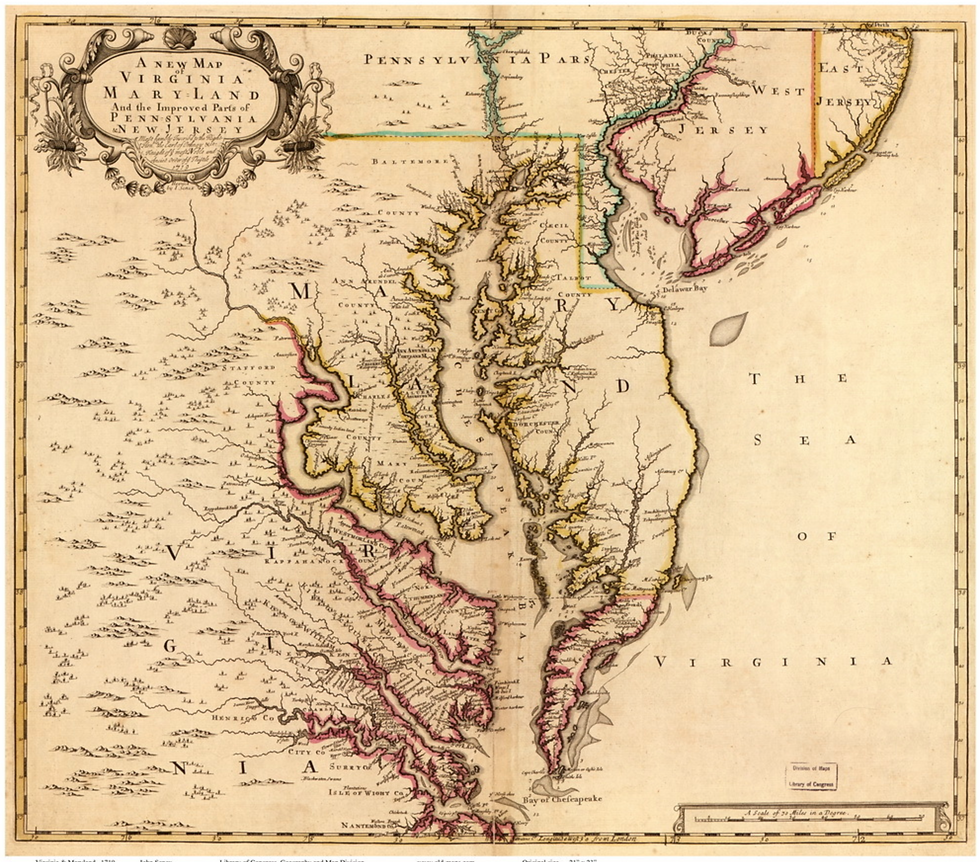
Maryland, which lies between Virginia and Pennsylvania, holds the unique position among the early colonies as the division between North and South. Its northern border with Pennsylvania is the famous Mason and Dixon Line. The Potomac River, instrumental in the Civil War, forms much of its southern boundary with Virginia. It was no accident that Washington D.C., our nation's capitol, lies within the original boundaries of Maryland.

Our first relatives in Maryland all settled in Talbot County which lies on the Delmarva Peninsula, shown above with the purple marker. How did the Delmarva get its name? This peninsula is distinctive for the three states which make up its land mass, Delaware, Maryland and Virginia. The entire state of Delaware is contained within the bounds of the peninsula. Virginia claims the narrow bottom portion and the rest belongs to Maryland. The portion of Maryland that lies within the peninsula along the Chesapeake Bay is known as the Maryland's Eastern Shore.
Note: Delmarva Peninsula is actually an island because Back Creek (near Elkton) spans the narrowest part of the peninsula in the north from Chesapeake Bay to Delaware Bay.
Note: Today the Delmarva Peninsula is the top vacation destination in the Mid-Atlantic States.
religious squabbles
Maryland was a veritable melting pot of religions. In the beginning you had your Roman Catholics and your Protestants. Puritans got into the act when Anglicanism became the official religion of Virginia. The Puritans fleeing to Maryland founded a town called Providence, later Annapolis of Naval Academy fame. And, by the 1650's, the Quakers had gained an enormous foothold there as well.
In 1649, Maryland voted into law An Act Concerning Religion, also known as the Toleration Act, which granted freedom of worship for all Christians. While an important step toward religious freedom in the United States, it didn't hold up well at first. In 1650, the Puritans revolted. They were able to set up a new government which prohibited all other religions. It wasn't until 1655 that Cecil Calvert was able to send an army in an attempt to usurp the Puritans. It was a no go and the pesky Puritans held on until 1658 when the Calvert family finally regained control and re-enacted the Toleration Act. But much damage had been done in the meantime. The Catholics had been severely persecuted and every one of their churches burnt to the ground.
the Quakers in Talbot County, MD.
Our earliest families in Maryland settled in Talbot County. Five out of eight of these families belonged to the Quaker faith and two of the others married into the faith. The Society of Friends, founded by George Fox, believed that the presence of God exists within every person and, therefore, everyone had the ability to develop a personal relationship with God. This belief was in direct opposition to the prevailing Calvinist teaching that humanity was unable to come to Christ unaided. The Quakers put aside the rigmarole of elaborate religious ceremonies, they did not have official clergy and they believed in spiritual equality for men and women. By 1650, there were large numbers of Quakers in Talbot County, Maryland. Quaker meetings started much the same as in New England with some brave soul hosting a meeting in their home. This practice turned out to be much less dangerous in Maryland.
Later, communal Meeting Houses were contructed for the gathring of the faithful. Many of our Maryland families attended The Third Haven Meeting House in what is now Easton, MD and all were affiliated with it. This meeting house is generally considered the oldest surviving meeting house of the Religious Society of Friends, and it is a cornerstone of Quaker history in Talbot County. Much of the information on our Quaker families come from the copiously kept records of the Third Haven Meeting House. These records began in 1676.
The wooden building below was first built in 1684. In 1797, the east and west wings of the building were removed and the entire structure widened by 10 feet. The brick winter building was built in 1880.


A brief span of Quaker persecution by the Puritans and Anglicans took place in Maryland from 1658-1661 but following that period, the Friends (as they came to be known) met with growing acceptance throughout the colony, even serving as burgesses and justices.
Fellow Maryland citizens began to view the Quakers as “Good Samaritans.” The provincial Court even turned to them on several occasions to take under their care indentured servants who were ill or being neglected by their masters.
Native American relations
The Piscataway tribe were close relatives of the Yaocomico who had sold land to Lord Calvert. Initial encounters with the English were friendly. The Piscataway even allowed the newcomers to set up a Catholic altar in one of their wigwams. Though relations between these two groups would subsequently break down over the years, the principal problem at the time for the Piscataway were the mighty and warlike Susquehanna who battled for control of the area.
The Susquehanna were the most powerful tribe in the Chesapeake Bay area. John Smith drew a picture of one of the warriors with the caption "The Susquehannocks are a giant-like people and thus attired."

George Alsop, an English author who wrote A Character of the Province of Mary-Land in 1666, reported that the Englishmen regarded the Susquehanocks as “the most noble and heroic nation of Indians that dwell upon the confines of America” and that the other Indians “by a submissive and tributary acknowledgment” held them in like esteem.
The Piscataway rightly feared the forceful Susquehanna, but the arrival of the English settlers only made a bad situation much worse for them. Over time, they were driven from their best lands, hunted by slave-catchers, decimated by smallpox and endured frequent field crop loss due to cattle and hogs belonging to the colonists. In 1666, they had reached their wit's end. They sent a petition to the Maryland government which read in part:
“We can flee no further. Let us know where to live, and how to be secured for the future from the hogs and cattle.”
Soon after receipt of the petition, reservations were established for the Piscataway.
With the weaker Piscataway tribe more or less subdued, the Englishmen could concentrate on the greater threat to their expansion, the Susquehanna. In an attempt to control the tribe, a law was passed in 1641 which prohibited any person "to harbour or entertain any Indian" and declared it "lawful to any inhabitant whatsoever of the Isle of Kent to shoot, wound or kill any Indian whatsoever coming upon the said Island."
Finally, war was declared against the Susquehanna in 1642. After two years of battle, in what was to become a very rare occurrence, the tribe prevailed against the English and kept their lands. Eight years of peaceful relations followed. Then into the territory came the even more powerful and fearsome Iroquois. The Susquehanna quickly sought a lasting peace treaty with the English in return for arms and protection. Next to the Iroquois, the English must have looked to the Susquehanna like the lesser of two evils. The treaty was an "article of peace and friendship treated and agreed upon the 5th day of July, 1652, between the English nation in the province of Maryland...and the Indian nation of Susquesahanough." After listing the provisions of the treaty, a pledge for "perpetual peace" which was "to endure forever, to the end of the world" was agreed upon. However, if either party grew weary of peace and desired war, twenty days notice, in writing, must be given. Pretty civilized!
Two tribes in the area, the Nanticock and Choptank, were proficient farmers. They grew lush gardens of corn, beans, squash, pumpkins, sunflowers, and tobacco. They gathered nuts, berries, birds’ eggs, and edible plants in season and dined on sumptuous seafood from the rivers. These tribes were allied with the Powhatan Confederacy in Virginia. That alliance allowed the small bands some protection from enemy tribes.
Protection from the English was another story. The settlers were particularly harsh to the Nanticock and Choptank. Any attempt by the natives to protect their land led to severe reprisals by the English. In 1642 and again in 1647, Maryland Governor Thomas Greene ordered the village and gardens of the Nanticock destroyed to try and force them out of the area. Five treaties, all unfair to the Native Americans, were signed. In spite of the treaties, settlers continued to illegally seize lands belonging to the Choptank and Nanticock. Finally the two tribes, like the Piscataway, asked the Maryland authorities to grant them specific tracts of land.
By the end of the 17th century, the Piscataway and Susquehanna had been driven out of Chesapeake Bay by the English and the Iroquois. Only two tribes remained, Nanticock and Choptank. 3,000 acres was set aside for their reservations with a stipulation that the native people could not leave their specified land. Remaining year round on the reservation, however, severely restricted the tribes' food and shelter needs. When the bands left to seek food, they came back to find squatters building homesteads on their land.
In the end, only the Nanticock survived two hundred years of travail. In 1881, the tribe was recognized by the state of Maryland as a legal entity and in 1921 the Nanticock Indian Association was granted non-profit status.
For the English settlers, however, the Eastern Shore of Maryland remained a paradise and our ancestors living there took full advantage.


Comments