
MOVING INLAND
- westmohney

- Sep 10, 2020
- 6 min read
Updated: Nov 28, 2022
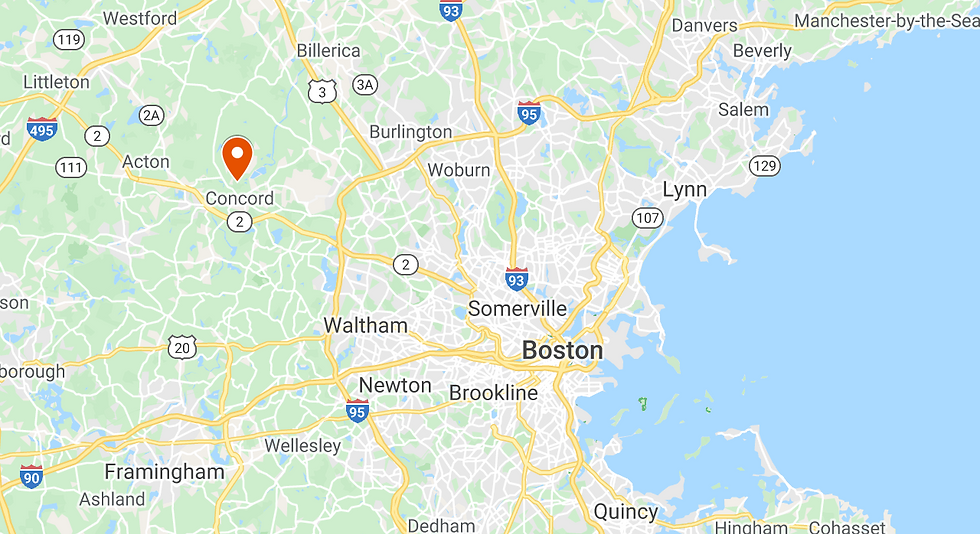
The town of Concord ~ incorporated in 1635 as the first inland settlement in the Massachusetts Bay Colony.

pressing issues
By 1634, the established coastal settlements in New England were already beginning to feel space and resource constraints. One example we've written about was Cambridge, which lost more than half its population to a more suitable Connecticut. By 1635, a more urgent worry cropped up. Relations with the Native American population were coming to a head and government officials worried about the vulnerability of their coastal settlements. To address these issues, the General Court issued orders for the establishment of two inland towns. The idea was to add breathing room while creating a defensive buffer zone. The first of these towns was Concord.
a slow start
In 1635, Concord was forested country with pockets of meadowland. The area was known as Musketaquid which, to the indigenous people living there, meant "the place where the waters flow through the grasses." Those waters flowing through the grasses contained fish in abundance and attracted a wide variety of wildlife, a veritable paradise to the new settlers. Then came the rains.
The Concord River turned out to be not only the greatest source of life, but also the greatest trial. The area wasn't called "wet grass" for nothing. The river frequently overflowed its banks, soaking the meadows to the point of being worthless for crops. In 1640 the residents sent a petition to the General Court, looking to remove to other sites. They complained that they found "the lands very barren, and the meadows very wet and unuseful." Early on, many residents moved. Those that stayed struggled with the problem for years.
The years between 1645 and 1650 showed the lowest population since the town had been founded, with only about 50 families remaining. These 50 decided they'd had enough. They petitioned the Court for permission to leave. The Court's answer? Owing to the "great danger that Concord, Sudbury, and Dedham will be exposed to" from being inland and thinly populated, "no man...shall remove to any other town without allowance of the magistrates..." In other words, these outlying towns represented a buffer zone, protecting the more populated coastal towns. Those were the dark days of Concord.
Happily, over time, more land was granted to Concord and the townspeople were even able to tame the river. Concord became a valuable asset to the colonies and has always held the distinction of being the first inland settlement in the Massachusetts Bay Colony.

The North Bridge, shown above, is an historic site in Concord. On April 19, 1775, the first day of the American Revolutionary War, minutemen and militia companies engaged the British at this location. The significance of the historic events at the North Bridge inspired Ralph Waldo Emerson to refer to the moment as the "shot heard round the world." Many of our ancestors responded to the alarm sounded on that day. Our posts on that war, however, are still quite a few moons away.
The current wooden bridge is an approximate replica of the bridge that stood at the time of the battle.
Just passing through
Our grandfather William Symonds (9GGF) passed through Concord briefly on his way to his permanent home in Woburn. According to court testimony, William was in New England as early as 1630, though his name doesn't appear on the Winthrop Fleet rosters. He lived for a short time in Charlestown in 1639 before moving on to Concord. He is listed in The History of Concord as "one of the first settlers; his wife d. 1641." After the death of his first wife, William departed to Woburn in 1642. There he married our grandmother and lived out the rest of his life. His story will be told in the Woburn post.
That William retained connections in Concord seems clear as three of his daughters, though born in Woburn, married men from Concord and moved there.
Our grandfather Robert Proctor (8GGF) was in Concord by 1645 when he and Jane Hildreth (8GGM) were married there. Their first four children were born in Concord, the last eight in Chelmsford where they removed in 1654.
John Heywood in Concord
Confusion between the names Hayward and Heywood has made our grandfather John Heywood's (8GGF) story difficult to piece together. According to The History of the Town of Concord by Lemuel Shattuck, John came to Concord sometime before 1650. We know he was there in 1656 when he married Rebecca Atkinson.
John and Rebecca had five children. Their first child, a daughter born in 1657, lived only 18 days. Their last child, a son named Benoni (8U), was born in 1665. Rebecca died five days after his birth and Benoni died seven days later.
life goes on
Rebecca died on 5 Aug 1665. Only three months later, John married our grandmother Sarah Symonds (8GGM) of Woburn. He must have gotten to know the Symonds family from their short sojurn in Concord. The very next year after his marriage, Grandpa John got a tavern! According to some sources, the name of his establishment was the Black Horse Tavern. In 1670 the selectmen of the town requested that John Heywood be allowed "to keep a house of entertainment for strangers for nights loging, beer and sider.." His inn and tavern were on present day Main Street in Concord.
On the map below, the red marker is the approximate spot of John's tavern. The blue marker next to Heywood St. is a present day park called Heywood Meadows. One of John's grandsons, Dr. Abiel Heywood (3C6X) moved to that location and the meadow was named after him. The orange marker is the home of Ralph Waldo Emerson who was a neighbor of Abiel's.

constabulary
John Heywood (8GGF) was chosen constable in the year 1676. Constables were elected to keep the peace and were often in charge of town militia. Below is a letter he sent to the governor about an incident that happened under his watch. He's asking for military support and also to be absolved of any blame that might be attributed to him for an incident involving "three old squaws."
Concord this 13: June 1676
Hono'rd Governo'r Levert,
Inasmuch as heare has been a sad accident befallen us through the ocation of nedglegent persons; which had trust Imposed to them; to keep sentry over three old squas & one papoose, these watchmen fell all asleep, and in the meantime ye squas made their escape; from them; which may produce a great deale of damage to us yt are resident in Concord; because we are afraid they are acquainted with ye Condition of our towne, and what quantyty of men we have gone out; & which way they are gone; which may prove obstructive to our army in their design; we had a Capt. appoynted over the magasine; which I thought to be sufficient to give a Charge of 12 men; to keep senternalls over three old squas; I hope your honor will be pleased to take it into consideration & send us some more strength to support us from our enemies; for we are in dayly fear; yet they will make an assault; so hopeing your honor Cannot Impute any Blame to him; who wish to your honor ye best yet may be;
by your Honor most Humble Servant, John Haywood, Constable.
family
John and Sarah Heywood had nine children. It appears that four of these children died young because I can find no trace of them beyond birth records. The other five all married and moved to either Billerica or Woburn. Sarah (8A) married one of our our uncles, John Baldwin (8U) from Billerica. Benjamin (8U) married our cousin, Hannah Kidder (1C8x), from Billerica. Abigail (8A) and Judith (8A) both married men from Woburn.
Note: John Heywood's daughter Rebecca (8A) from his first marriage married our uncle Benjamin Symonds (9U) from Woburn. Before their marriage, Benjamin would become embroiled in a rape trial. Stay tuned for that.
John and Sarah's daughter Mary (7GGM) married Enoch Kidder (7GGF) from Billerica. They were our 7th great-grandparents. On the tree below you can trace Enoch Kidder down five generations to his namesake, Enoch Kidder Parrish (2GGF).
In 1835, Enoch and Mary's great-great-granddaughter Susannah Sherwin Parrish (3GGM) (daughter of Azariah and Sarah Kidder Sherwin) and her husband Ezra Parrish (3GGF) began a journey that took them 2,700 miles across the mountains and plains of America. They left New York with five small children, ages 7, 5, 4, 2 and our grandfather, baby Enoch Kidder Parrish (2GGF). Susannah would give birth to four more children as they made their way across the nation, finally ending up in Oak Glen, California.


Comments