
The Incorrigible Daniel Clarke

Updated: Sep 5, 2022
Not your average Puritan
Daniel Arrives in Ipswich
We know Daniel Clarke (9GGF) was in Ipswich by 1634 because town records state that there was “given and granted unto Danyell Clerk six acres of land more or less lying on this neck of land in equal share with John Manning and others.”


newlywed blues
Daniel turned out to be one of our more interesting relatives. Rather than pick a wife from the fair lasses in town, in 1639, Daniel got on a boat and sailed back to England where the records show that “Thomas Beane (10GGF) appeared at the proper office of the London diocese on 2 Mar 1639 and alleged that Daniel Clark, carpenter, bachelor, aged 26, intended to marry his daughter Marie (9GGM), aged 17” (she was really only 15). He asked for a license, which was granted and they were married the next day.
By June 1639, the happy couple was back in Ipswich where, on 4 Jun 1639, newlywed Daniel was referred to the Ipswich Court. On 3 Sep 1639 “Daniell Clarke, being found by the jury to be an immoderate drinker was fined 2 pounds, whereof 3s was paid by the jury, & the 37s paid I.N.” (No clue what I.N. stand for, but Daniel must have been popular if the jury paid for part of his fine.)
more trouble in Topsfield

As Ipswich lands became scarce, the town of Topsfield, 7 miles to the southwest, was settled. In 1645, Daniel moved to the newly created town. In 1646, Evan Morris, servant of George Carr, was accused of threatening to kill his master, of running away from the constable and of "an action of a high nature done in England." Daniel became bondsman for Morris who was "soon, and for many years thereafter" Daniel's servant. Quite magnanimous.
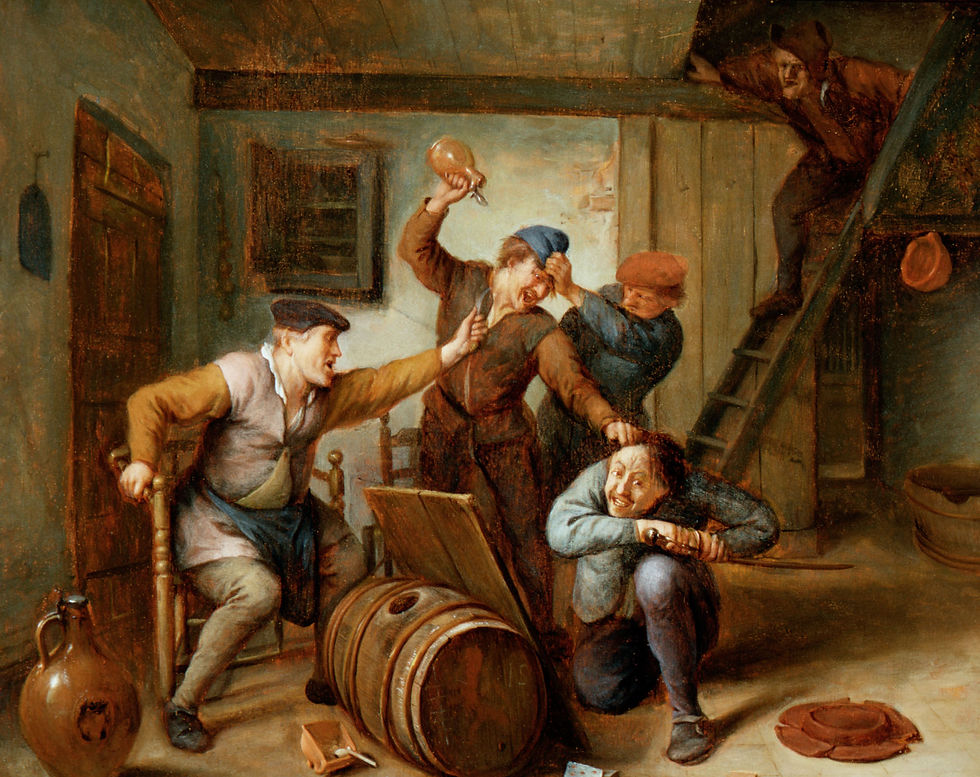
Still, trouble lay ahead for for Daniel. By 1660, he had a license to keep a “house of entertainment” (basically a tavern). According to town records that same year, the town meeting was held at the tavern and people stayed after to drink. An argument arose over the bill and Daniel was attacked by Francis Urselton and his friends. Edmund Bridges testified that Daniel “laid violent hands” on Urselton, “calling them cowards and challenged them to the field, saying ‘Come Urselton let us go behind ye hill & I will try a touch with thee.”
The skirmish was “punctuated with the screems of Goodwife Clarke, Goodwife Urselton, Goodwife Bates and a neighbor who came in haste on hearing a great noise.” Commands from Constable Symonds to cease and desist were futile. The brawl lasted three hours. As a result, Daniel was served with a warrant from "worshipful Mr. Symonds," tried and fined 10s for "provoking speeches", imprisoned for selling liquors without a license, and “prohibited from keeping an ordinary any longer for disorders in his house.”
Note: The "worshipful Mr. Symonds" will figure prominently in our next post. He married the widow of our uncle Daniel Eppes (10U), brother to William and Francis Eppes of Virginia.
Perhaps the Puritan law of the land was more lax in Topsfield, but Daniel was soon free. With no hard feelings from the townspeople, he had his tavern back and was made constable himself in 1661. He served on the jury in 1662.
Jeremiah Indian
The incorrigible Daniel found himself in hot water again in 1668. According to The History of Topsfield, the General Court ordered that no one could either sell or give strong drink to the Native Americans, as they were “shiftless and indolent and easily became drunkards.” Evidently two townsmen saw “Jeremiah Indian, the tinker come from Daniel Clarke’s so disguised with drink that he could not goe: but fell down in the hi way.” They went to Daniel and “told him he did not do well to let Indians have drink: for the Indian said he had five gills of rum last night. Daniel Clarke said ‘I let him have one Gill and no more;’ further he told us that som sider and kake and small bere I made, made him drunk today.” Since Daniel as well as owned that the allegation was true, he was fined 20s.
Daniel and Mary had 11 children. They lived their lives out in Topsfield where Mary died in 1688 at age 63. Daniel died in 1690 about age 76. His youngest son, Humphrey (9U), may have been his favorite. In his will, he left to Humphrey "whom God hath wonderfully preserved, both at his birth and also of late" his bed and his old mare. Daniel's son, John (10U), not so glowingly described, received the "mare that is in the woods or wheresoever she may be."
Daniel and Mary's daughter Sarah (8GGM) married Samuel Howlett (8GGF), son of Thomas (9GGF) and Alice French Howlett (9GGM).
The Sad Story of the Beane Family
The wife that Daniel Clarke traveled all the way back across the ocean to marry was the daughter of Thomas (10GGF) and Elizabeth (10GGM) Beane. On some ancestry sites, Elizabeth's maiden name is listed as Clarke, but I can find no proof of that. A family connection, however, between Mary Beane and Daniel would explain why he went all the way back to England to marry her.
Thomas and Elizabeth Beane, like their daughter Mary, had 11 children. Sadly, only two of them lived to adulthood, Mary (9GGM) and her brother Humphrey (10U). Thomas died at 2, Anne at 1, Elizabeth at 12, Catherine at 11, Sarah at 7, Hannah at 1 and John at 5. I can't find the death dates for Simon or Martha but, since there are no further records of them, I assume they also died young.
All of the children were baptized at St. Katherine's Coleman in London.

Uncle Humphrey Beane
It was due to a letter from Humphrey Beane (10U), then living in London, to his sister Mary (9GGM) and her husband Daniel Clark (9GGF) in New England that I was able to finally ascertain that Daniel's wife Mary in fact belonged to the Beane family of London. The letter was written in 1670 and given to a fellow citizen of Topsfield, MA to deliver. It was addressed to "Brother and Sister Clarke." Humphrey also sent them "five pieces of Red pennistone and (a) kittle and a barrel of good fine powder." He expressed displeasure about their children "craveing from beyond your will...and would have them all submit to their parents will all due obedience and would have you so Govern yourself as to be Father over them in all Righteousness."
Perhaps Humphrey felt he could counsel his sister and brother-in-law in this way because he had become a fairly wealthy man in England. In addition, he had taken Daniel and Mary's son, Samuel (9U), to raise in England. He treated Samuel as his own son, trained him for employment and left him a fair portion in his will.
Humphrey's daughter Elizabeth (1C10x) married Sir John Parsons who owned the Red Lion Brewery in Aldgate, evidently famous for it porter known as "Parson's black champagne." Sir John also served for a brief time as mayor of London.
the cordwainers
Humphrey (10U), his father Thomas (10GGF) and his uncle Humphrey (11U) were all cordwainers. The term "cordwainer" is basically a high falutin' word for shoemaker. The word was derived from the city of Cordoba in the south of Spain. The cordwainers of London were known for using only the finest leather.
A distinction preserved by cordwainers since the earliest times is, that a cordwainer works only with new leather, whereas a cobbler works with old. When these shoemakers organized, they showed a clear preference for the title cordwainer, conscious of the distinguished history and tradition it conveys. The first English guild who called themselves cordwainers was founded at Oxford in 1131. "Cordwainers" was also the choice of the London shoemakers, who organized a guild before 1160, and the Worshipful Company of Cordwainers has used this title since receiving its first Ordinances in 1272.


Comments