
Native American enslavement

We are few and powerless before them. These meadows they shall turn with the plow; these forests shall fall by the axe. ~ Passaconaway, chief of the Pennacook

the beginning
The story of Native American enslavement doesn't begin in Jamestown or Boston. The first vestige of the practice which would become so widespread in the New World began with Christopher Columbus and Spanish forays onto the continent. Coupled with devastating disease epidemics and continual war, the enslavement of native people contributed to the drastic decline of indigenous populations in the Americas.
As the centuries wore on, slavery of Native Americans would intertwine with African slavery during the first decades of colonization. The aftermath of the Pequot War, fought from 1636-1638, was a continuation of the age-old practice of enslaving defeated enemies. Three hundred Pequot were massacred and those who survived faced a different disasterous fate. The captured or surrendered Pequot, too unruly for Massachusetts Bay colonisist, were often shipped to the Carribean in exchange for enslaved Africans.
The tragic record of Native enslavement can be found in correspondence, shipping records, court cases, town records, and even contemporary official histories of the war. They all point to the same thing: Indians were enslaved en masse and either distributed locally or sent overseas to a variety of destinations. The practice escalated during King Philip's War, fought in 1675-6. In November of 1675, a New England merchant reported to correspondents in Kent that the English “do take And kill many of them (Natives), & those yt thay Take thay send A way: for barbados & Neves & Jamecco & Spaine & sell them.”
myriad benefits
There were several reasons why New Englanders began selling captured and surrendered Natives on the Atlantic slave market as opposed to keeping them local. First and foremost, of course, was money. King Philip's war had been extermely costly and compensation by any means seemed like a good idea. As John Cronne noted after the war: "...much more then will reimburse the New England People the charges they have been at in their warrs with the Indians if the money they have gained by the Sale of many thousands of Indians be added..."
Another reason to get rid of the indigenous people was equally obvious. Fewer Natives equalled more land for the settlers to settle. Enslavement was part of a larger strategy to depopulate the land to make way for more European settlers. In this arena, the guilty conscious of Southerners was easy to sooth but the pious Northerners needed rationalization. Since one of the Puritans goals was to "help" the idigenous people in the land they had invaded, they were eventually able to wholly vindicate themselves. Those pesky Natives simply refused to civilize according to God's will. The settlers were left with no choice but to ship them away.
Selling natives abroad was definitly easier and less risky than keeping them local. It was far too easy for enslaved indigenous peoples to free themselves when living in their home territory. As opposed to African slaves, the Natives were able to slip away and blend into the woodwork, finding refuge among other indigenous peoples living in the area.
In both the northern and southern states, it was infintely more productive and lucrative to ship them far from their homeland. In fact, between 1670 and 1717, southern states exported more indigenous people than imported Africans. Also in the South, more Natives were exported than died due to disease or war. Major ports used for transport included Boston, Salem, Mobile, and New Orleans. From those ports, indigenous peoples were shipped to Barbados by the English, Martinique, and Guadalupe by the French and the Antilles by the Dutch.
The casualties on these voyages were high, so high, in fact, that in 1676 Barbados banned indigenous enslavement as "too bloody and dangerous an inclination to remain here."
King Philip's War
In the period following the early Pequot War, only small numbers of Natives were forced into slavery and servitude. It wasn't until King Philip’s War that the number of enslaved Natives rose to unprecedented levels.
Throughout the war, English officials encouraged the Natives to surrender in hopes of lowering the number of active enemy. Naturally, promises of mercy went hand in hand with their entreaties. The English also used Native spies to inflitrate enemy camps to promote the idea of surrender. At the beginning of the war, these attempts were mostly in vain because Native Americans had become well aware of the consequences.
Christian Indian James Quannapaquait, after a spying mission for the English, reported that “he understood by the cheefe men & old men [that] they were inclinable to have peace again with the English, but the young men say we will have no peace wee are all or most of us alive yet & the English have kild very few of us last summer why shall wee have peace to bee made slaves, & either be kild or sent away to sea to Barbadoes &c. Let us live as long as wee can & die like men, & not live to bee enslaved.”
However, as the war trudged on and hopes for victory faded, even the remote possibility of leniency began to look good to the beleaguered Natives. On 9 Jun 1676, when the outcome of the war seemed clear, the colony of Massachusetts promised that "enemy Indians who surrendered themselves" would receive mercy. Hundreds, if not thousands of Natives turned themselves in hoping their action would elicit goodwill in the hearts of the English. But "leniency" in the minds of the English did not correlate at all with the Native idea of the word. Most magistrates agreed with the Plymouth War Council, who decreed that all Natives had been"implicitly complicit, and therefore engaged in treasonous rebellion." Certainly being sold into slavery was a more than apt punishment for treason.
Note: The government of Massachusetts Bay considered the indigenous people living in the land that the English had invaded to be "subjects" of the king, justifying the charge of treason.
precursor to enslavement
Much like the internment camps created for Japanese Americans in World War II, the English used islands in the Boston Harbor to "safeguard for their own protection" indigenous people not actively participating in the war. The camps on those islands would, today, be recognized as concentration camps. It is estimated that about 1,000 Native people were forced onto the islands. This number, however, is probably quite low as the colonists only documented the Praying Indian population that was displaced.
The two islands most commonly used were Long Island and Deer Island (actually a peninsula).
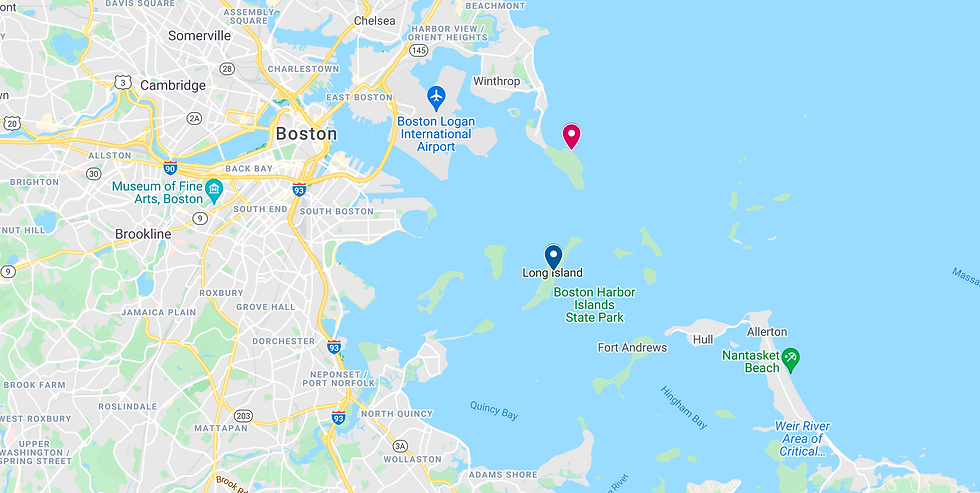
Colony records show that the majority of indigenous people forced onto the islands were women and children while men were sold or conscripted for "service to the country." Settlers were encouraged to “kill and destroy them as they best may or can” any person attempting to leave these islands. Over the harsh winter of 1676, hundreds of the interred Natives died of starvation and exposure to extreme temperatures.
When the Native people were released from Long island in 1676, only 167 had survived. Due to such loss of life, ten of the fourteen Praying Towns were disbanded after the war. The rest were placed under the supervision of the Massachusetts government.
Today, local and regional Native American Tribes have a vested interest in what happens on these islands that they consider sacred grounds. They would like to protect Long Island as a Native burial ground and a memorial to the "acts of genocide" committed in the 1670s.
resettlement
Governments tend to do what is expedient rather than what is right. Colony Councils gave little thought to the disruption in Native family lives when making decisions about their fate. Families were more often than not separated. Surrending men and older boys were considered dangerous to the future tranquility of the Colony. It was standard policy to send them overseas while women and children were often times resettled locally, either in designated areas or distributed as servants for English families.
Another common practice was to place Native children in English homes "as pledges for their fydelity...after which terme they may be returned to their parents, upon the proofe of the fidelity of both children and parents; otherwise to be forfeited to slavery.” This practice was little more than an indocrinization period in an attempt to "civilize" these children.
Eventually, land was set aside for for Native people displaced by the war as long as they would “be ever under the English government of this colony.” That meant that Natives who decided to stay in their homelands remained under the thumb of the colonists. Many, finding that way of life abhorant, fled to join other tribes and their French allies in the far north and west. They would never, however, forget the injustices that had been meted out by the English colonists. This would have tragic consequences for both the Natives and the New Englanders as war, in one form or another, would be waged between them over the next seventy-five years.


Comments