
THE LITTLEFIELDS

On the receipt of this license Edmund Littlefield...and others entered on the land and began to make it subservient to the uses of man.
~ Edward Bourne, History of Wells and Kennebunk

the Reverend John Wheelwright
Very early on the Littlefield family had attached itself to the star of John Wheelwright, one of the most notorious religious dissenters in the early days of the Massachusetts Bay Colony.
Wheelwright left England in 1636 and settled in Boston. His brother-in-law's wife, Anne Hutchinson, had already begun to attract negative attention for her religious views as a follower of John Cotton whose theology came to be known as antinomianism. The antinomians rejected the socially accepted morality of the Puritan Church. The controversy basically came down to deeds versus faith. The Puritans believed that a moral life was essential for salvation while the antinomians believed that faith alone would lead to redemption.
Their dissension came to a head in 1637 when both Hutchinson and Wheelwright were banished from the Massachusetts Bay colony. Wheelwright moved north with a group of followers to an area that would eventually become New Hampshire. He founded the town of Exeter and lived quietly there with his congregation. Unfortunately, shortly afterwards, Massachusetts laid claim to those lands and Wheelwright was forced to move on once again. He and his flock traveled even further north to Maine. Among the faithful that followed Wheelwright to Exeter and finally to Maine was our grandfather Edmund Littlefield (11GGF) and his family.

Edmund Littlefield's early life
Edmund Littlefield (11GGF) was born in 1592 in in Titchfield, Hampshire, England. He married Annis Austin (11GGM) and together they had ten children, all born in Titchfield. Edmund made his living as a tailer. We know this because, in 1635, he found himself in a wee bit of trouble. A Titchfield court record shows that a lawsuit was filed against Edmund, his wife Annis Littlefield (11GGM) and his brother Nicholas (11U) for non-payment of wool received. Perhaps conveniently, the following year, Edmund left England for the New World and the bright prospects he might find there. Annis remained in England until 1638 when she is listed sailing to America on the ship "Bevis" with six of her children.
Also listed on the "Bevis" is a Richard Austin with his wife and two children. It seems that no armchair genealogists have shown any interest in finding out whether Annis and Richard were related, though they had the same last name, so I did a little digging. Annis' father was Richard Austin (12GGF) and she did have a brother named Richard. I was able to find the Richard Austin who came on the "Bevis" listed in Genealogy: A Weekly Journal of American Ancestry. There it says that he came from Bishopstroke, Hampshire, England, which is only ten miles from Titchfield where Annis' family lived. I believe these circumstances are persuasive enough evidence that the Richard who came across with Annis and her children was, in fact, her brother and our 12th uncle. Richard (12U) settled in Charlestown, MA.
Edmund Littlefield (11GGF), along with the Reverend Wheelwright, settled first in Boston. But, soon after their arrival, the outspoken Reverend Wheelwright gave what the Puritans felt was a "bitterly uncharitable sermon." Wheelwright was forthwith banished from the colony. Edmund faithfully followed his minister to New Hampshire where the group founded the town of Exeter. Edmund was one of 35 men who signed the "Exeter Combination," a document which sought to establish a government entirely separate from the colony of Massachusetts. Unluckily for the congregation, however, the Bay Colony was able to acquire a settlement at Hampton, only seven miles from Exeter. Exeter soon fell under the authority of Massachusetts as well.
In response, Wheelwright obtained a lease on 400 acres of land thirty five miles further north at a location on the shores of the Atlantic. In 1641, he moved his flock to their new settlement which they named Wells. Today, the town of Wells lies in the state of Maine.

the long tentacles of the Massachusetts Bay Colony
It seems that, even before the esteemed reverend's move to Wells, the Bay Colony began to have pangs of regret over losing him. In 1642, an application for reconciliation was made in his behalf. Five years later, Wheelwright received an invitation from the church and town of Hampton, (now New Hampshire but then under the jurisdiction of Massachusetts) to join the Reverend Timothy Dalton (10U) as a pastor of the church there.
Note: Wheelwright's move to Hampton is covered in our Dalton's of Hampton post.
The citizens of Wells, however, were not quite so willing to embrace reconciliation. When the holder of the town's lease, Fernando Gorges, died in 1647, Massachusetts quickly moved in to lay claim to that territory as well. For six years, the town of Wells fought this takeover, with our Littlefield relatives as some of the last holdouts. In 1653, however, the town was forced into submission and all the adult males of the Littlefield family signed an oath of allegiance to Massachusetts.

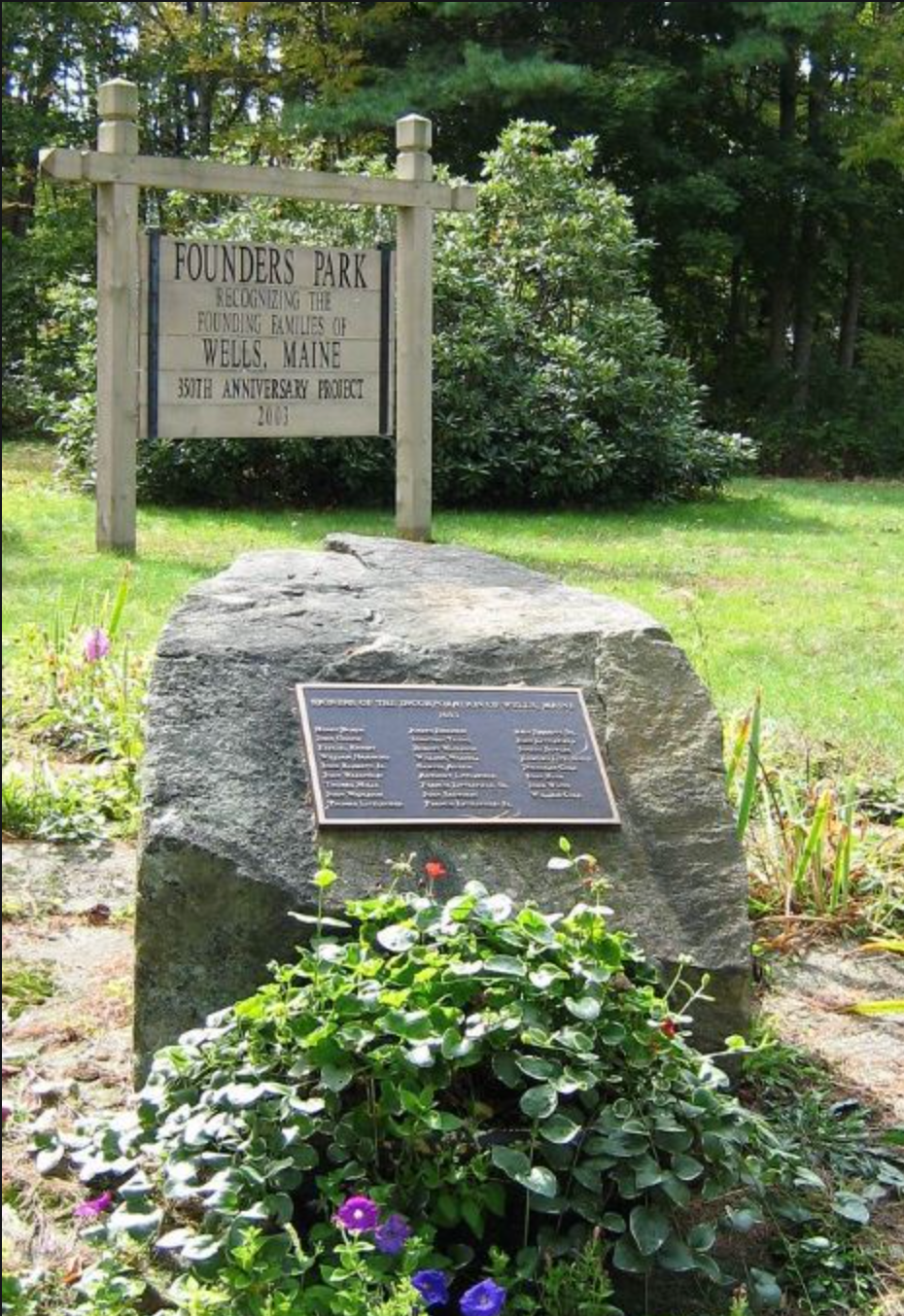
Note: On the incorporation plaque, both Francis Littlefield, Sr. and Francis Littlefield, Jr. are Edmund's sons (the story on that below) and Samuel Austin listed on the plaque is most probably Annis' nephew.
life in Wells
While our grandfather Edmund Littlefield (11GGF) was certainly not the first settler in Wells, he has the distinction of being known as the "Father of Wells." In 1641, immediately upon his arrival, Edmund built a permanent home, a saw mill and a grist mill at the falls on the Webhannet River. Below is a plaque commemorating his achievement.

In 1654, Edmund was licensed to run a tavern and to sell wine and strong liquor to the Native Americans "to such an extent as he thought for their good." The Court did not give out those licenses freely. They made clear their abhorrence of the the "free use of ardent spirits and sinfulness of the practice" and prohibited the sale of liquor by anyone besides Edmund.
provisions
Edmund became a wealthy man in Wells. He had buried two children in England, but his remaining eight sons and daughters had benefited from his efforts to better himself in America. When he died in 1661 at age 69, however, Edmund must have been worried about how his sons would behave after his death. In an effort to stave of any bad behavior, he included a couple of provisions in his will:
"If...Thos & Francis Littlefield junior do both of them pay Annes my wife foure bushs of corne yearely for 7 yeares then my wife shall have nothing to do with itt, otherwise if they do not pforme that yearely, then my wive shall have pour (power) to lett it to others, & espell them quitte out of it all."
"And if soe bee yt Fran: Littlefield & Thomas Littlefield, & Fran: Littlefield my youngest sun bee loveing & helpfull to yr mother my wife, then they shall have all after her desease, otherwise if they bee not loveing & helpfull to her shee shall have power to dispose of itt, wr shee thinkes good herselfe."
Annis died in 1677 at age 81. Evidently only Thomas was good to her. She left most of her property to him:
"I give unto my sonn Thomas Littlefield, who hath taken a great deale of care of mee, all the rest of my household goods Corne & Chattles, & I do make my sd sonn Thomas Littlefield, my whoole & soole executor, & to receive all debts comeing to mee, & pay all If any thing there bee that I do ow, & to take all the remaindr to him selfe, & to see my will fullfilled."
fact or fiction?
There is a romantic story about one of Edmund's sons, our grandfather Francis, that appears to have its roots in Edward Bourne's History of Wells and Kennebunk. The story, while completely unsubstantiated, seems likely to have been conjured up to explain why Edmund named two of his sons Francis. The legend says that Francis the elder left home at an early age (like ten or twelve) and was not seen again for many years. The family, sadly waiting for his return, finally concluded that he was surely dead and thus named another of their sons in his honor. Then, miraculously, the long lost son turned up on the shores of the New World and the family was happily reunited once again.
We'll never know why Edmund named two of of his sons Francis but, forever afterwards, they were known as Francis, Sr. and Francis, Jr.
the wandering Francis, Sr.
The elder Francis Littlefield (10GGF) was born in Titchfield in 1619. When he came to America is unknown. It's probable that he and his brother Anthony came with their father ca. 1636. Two of the Littlefield children died in Titchfield and the other six came with their mother in 1638. Francis must have had wandering feet as it is difficult to track him in his early years in New England. The first record we have of him is in Wells NH in 1643 where he was granted 50 acres of land. We next find him in Woburn MA where, in 1646, he married Jane Hill (10GGM). In December of 1646, Jane gave birth to their daughter Mary but, sadly, Jane died just six days after the child was born.
Two years after the death of his wife, we find Francis in Dover, NH, where he was was elected representative in the legislature. He married his second wife, Rebecca in Dover. By 1650, however, he was back in Wells where he remained for the rest of his life. In 1653, he purchased a house in Charlestown but it appears, from his involvement in Wells town affairs, that he spent most of his time in Maine.

what happened to the child?
We know that Francis (10GGF) and Jane's (10GGM) child, Mary Littlefield (9GGM) who was born in Woburn, survived. She was remembered in her grandfather, Ralph Hill's (11GGF) will and there is a record of her marriage to John Kittredge (9GGF) in Billerica. What we don't know is where she was from the time of her birth in Woburn in 1646 until her marriage in Billerica in 1665. By 1648, Mary's father had left Woburn and was living in Dover where he remarried that year.
While it's possible that Francis took Mary with him to Dover and Wells, it seems more likely that Mary was raised by her mother's family, the Hills. Ralph Hill moved with his family from Woburn to Billerica in 1654. And it was in Billerica that Mary was married and in Billerica that she spent the rest of her life.
Francis Sr's, later life
Francis, Sr. married his second wife, Rebecca, in 1648. Together they had eleven children.
Like his father, Edmund, Francis was a licensed inn-holder for many years. He was on the grand jury for the County of York, Maine in 1666, 1667, 1673 and 1687. He was the county treasurer in 1676, 1678, and 1681 and selectman in 1677.
In 1685, Rebecca died and Francis married his third wife, Mary Wade Symonds, in 1689. He then lived out his years in Wells with Mary. He died 1712 at the ripe old age of 93. Not bad.
The Bridge of Flowers in Wells, Maine
From the Town of Wells, Maine official site:
"The Bridge of Flowers is a collaborative effort between the Webhannet Garden Club and the Historical Society of Wells. The historic site pays tribute to the parcel of land where Edmund Littlefield established the first permanent mill on the Webhannet River banks in 1640-41."

Below is Founder's Park with the plaque commemorating the founding of Wells.


Comments