
Captain Francis Poythress and the final Powhatan War

Updated: Oct 27, 2021
You take our land. Our bloodlines. Our honor. What kind of friends are we? ~ Chief Opechancanough
Francis Poythress ~ beginnings in Virginia
Francis Poythress (8GGF) arrived in Virginia when relations between the English and the Powhatan were relatively peaceful. A peace treaty had been signed in 1628 that created a temporary truce. We know that Francis was in Virginia by 1632 because he was mentioned in the Minutes of the Council of Virginia on 9 Feb of that year: "Uppon ffrauncis Poythres his peti’con (peticion) there is graunted unto him a l’re (letter) of Administra’con uppon the estates of Thomas Hall & Robert Kidd deceased."
There is no further record of Francis in the Americas until 1637 when he was granted 400 acres of land for eight headrights, himself included. The original record still exists. There is a copy in the first volume of Virginia Land Office Patents and Grants:

The grant gives "unto Francis Poythress four hundred acres of land...lying and being in the County of Charles City County lying North upon the (unreadable) of the land now in the possession of the senior Francis Poythress." He is granted fifty acres "for his own personal adventure into this Colony, and three hundre/'';d and fifty acres for the transportation...of seven persons..."
Subsequent records say he owned in total 750 acres so the land mentioned above already in his possession must have been 350 acres. From the boundaries of Baileys Creek on the west and John Woodlief's land on the east listed in the grant, I was able to find the approximate location of Francis' land. Since Bailey's Creek is the dividing line between Francis Poythress' land and Francis Eppes' (9GGF) Hopewell Plantation, our two grandfathers were next door neighbors.

That Francis married and had children is well established. What is more fuzzy are dates and places. Francis married a woman named Mary (8GGM) possibly a Sloman, but that family connection is unsubstantiated. We can find records for only three sons, Francis, Jr. (8U), Thomas (8U) and John (7GGF).
Note: We know at least one child was born before 1644. The first mention we have of a child of Francis Poythress' is in a will dated 12 Jan 1644. Thomas Pawlett, probable relation to our grandmother Marie Eppes (9GGM), left to his godchild Thomas "Poythers," one silver spoon and one sow shote (baby pig).
the lawsuit
Lawrence Evans, a merchant in London, had good reason to believe he had been swindled.
In a letter to the Governor and Council of Virginia dated September 19, 1637, he laid out the facts to the Governor and Council of Virginia. The previous year, Lawrence had sent goods to America in three different ships over the course of a few months. His agent in Virginia was our grandpa Francis Poythress. His other agent, a captain on one of the ships, had died during the voyage. The value of the merchandise Evans sent was £2,000. The amount received by Evans from Francis Poythress, a mere £150.
Evans evidently did not get any satisfaction from the governor because, in 1638, he filed suit against Grandpa Francis charging him with "abuses in trust." The Virginia Council directed four of the "ablest merchants in Virginia," to arbitrate the suit. The merchants determined that the missing goods had been taken by the ships' crew and captains and that Francis Poythress was blameless. Not only did Evans lose his lawsuit, he was additionally ordered to pay Francis Poythress £10 "for goods sold and tobacco received." It's possible that the determination by the Virginia merchants was fair and correct. It's also very possible that the merchants favored an up-and-coming fellow Virginian over a London merchant.
Note: While an agent for Evans, Francis evidently made at least one trip back to England. He is named as a headright in a land grant awarded to Robert Eyres in 1642. According to policy, a man could travel to England countless times and every trip back to Virginia counted as a headright worth 50 acres. This misuse of the system was very common.
the final Powhatan war
The peace treaty declared between the Powhatan and the English settlers in 1628 was merely an agreed upon breather. Nothing had been resolved to any degree of satisfaction. Mistrust and fear continued to fester on both sides. To make matters worse, the influx of settlers, along with their expanding need for more land, drove the colonists ever further into Native American territories.
In response to this encroachment, Chief Opechancanough, now almost 100 years old, attempted once again to rid his people of the foreign scourge. A coordinated attack, similar to their 1622 assault, was launched on 18 Apr 1644. In Powhatan’s World and Colonial Virginia, anthropologist Frederick Gleach wrote that "...the 1644 coup can be best understood as an attempt by Opechancanough to correct the colonists’ inappropriate behavior and to stay their ceaseless expansion.”
In the attack, more than 400 colonists were killed. The response by the Virginia government this time was swift and brutal. They declared all out war, with an ultimate goal of driving the Powhatan out of all territory the settlers felt to be rightfully theirs. New forts and walls were built to protect their lands and to keep the enemy away. After two years of war, the English had accomplished most of what they set out to do. A peace treaty favorable to the colonists was discussed at the Grand Assembly in 1645. Lt. Francis Poythress featured heavily in their proposed actions.
"GRAND ASSEMBLY – Holden at James Cittie The Second of March 1645/6 – 21st Charles 1st. Manuscript in the Library of Congress and compiled in Hening’s Statutes Vol. 1, pp. 317-318. ACT XVIII
WHEREAS the Governor, Council and Burgesses of this present Grand Assembly have maturely weighed and considered the great and vast expence of the collony, in prosecuting the warr against our common enemies the Indians, and the almost impossibility of a further revenge upon them, they being dispersed and driven from their townes and habitations, lurking up & downe the woods in small numbers, And that a peace (if honourably obtained) would conduce to the better being and comoditie of the country, have enacted, and be it therefore enacted by the authority aforesaid, That three-score men be forthwith raised on the north side of James River, well provided with fixed guns, shot baggs and swords... All which said men shall march under and be obedient to the command of Leift. Fra: Poythers in the manageing of any occasionall warr, And that upon all emergent occasions in the treaty for the accomodation of a peace, the said Leift. ffrancis Poythers shall follow the advice of Capt. Henry Fleet... And if it shall soe happen that a peace may not or cannot be concluded, that then they the said Fleet and Poythers shall erect and build a forte in any convenient place in Rappahannock River, or before if they shall soe think fitt, And follow such further instructions as shall be given them, by this Grand Assembly or the Governour and council."
On April 20, 1646, sixteen men were assembled at York County as ordered by the Burgesses at James City. These men were placed under the command of Lieutenant Poythress. Provision was made for the protection of the individual militia members' crops while they were gone and they were to be paid £100 of tobacco for every "wasted day."
Since most of the Native American tribes had been driven from their homes and dispersed into the wilderness the fort on the Rappahannock River no longer appeared necessary. Openchancanough was captured shortly after the Grand Assembly met. The English treated him as a novelty side show, displaying him to curious English colonists. At this point, the chief was old and frail, barely able to walk on his own but Governor Pierce still considered sending him to England where he could be paraded before the king. Before any decision could be made on Opechancanough's fate, however, one of the men guarding him took matters into his own hands. He shot the elderly leader in the back.
The death of Opechancanough was also a death blow for the Powatan people. In November of 1646, Necotowance, Opechancanough's successor, signed a treaty as “king of the Indians.” This treaty effectively removed every Native American nation away from English settlements. The Powhatan were relegated to lands, basically reservations, more suitable to the colonists' liking.
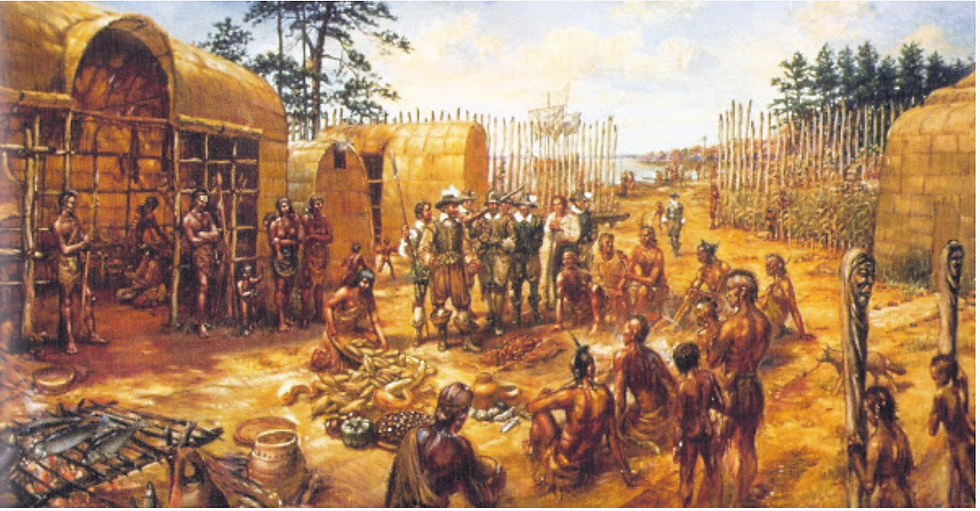
Over the next 100 years, Powhatan numbers dwindled to near-extinction. Below is a painting of the James River where Native Americans had lived for more than 12,000 years. Less than forty years after the arrival of the English, the Powhatan were effectively banished from their ancestral home.

After his involvement in the final Powhatan war, Francis Poythress turned his sights toward governance in the Colony. He was elected burgess from Charles City in 1644, 1645, and 1647. One of his colleagues also serving from Charles City County was our grandfather John Bishop (9GGF). John Bishop's granddaughter, Christian Peebles (7GGM), married Francis' son, John Poythress (7GGF).
in Northumberland County
In 1648, the Colony of Virginia created Northumberland County where the Potomac River emptied into Chesapeake Bay. That meant that the Native Americans living in that area needed to be dealt with immediately. From the Assembly records for that year, we learn that the Colony proposed action for "reducing inhabitants of Chickoun." By 1652, they were effectively removed to a small corner the newly founded county and given, in compensation, 50 acres of land "per fighting man" on a reservation of 4,400 acres. The Chicacoan chose not fight battles with the English. Instead, they tried fighting them in court but to no avail. Though they won numerous court battles, they lost a greater share of land than they managed to keep. By 1720, their land had dwindled to 1,700 acres.
On the map below the lines indicate the approximate border of Northumberland County.

The newly created county on the Chesapeake, free of strife with the Natives Americans living there, must have looked attractive to the recently promoted Captain Francis Poythress. He left Charles City County for the open space of Northumberland County. That same year, Francis was appointed by the assembly to levy and collect taxes in Northumberland County and represented that county as burgess. It is believed that he received land in that county for his service in the Powhatan War.
The last record of Francis Poythress is on September 20, 1651, in the inventory of Mr. Robert Sedgrave's estate in Northumberland County. The administrator reported that he had paid debts due from Sedgrave's estate in tobacco to several individuals, including Francis Poythress. It is assumed that Francis died in early 1652 at about 50 years of age.
the Poythress and Wynne families
Because of the destruction of records in the Civil War, we don't know the birth or death years of Francis Poythress (8GGF), his wife Mary (8GGM), or any of his children. Their history has been pieced together mainly from wills, land grants and government service.
We know that Mary Poythress was at least ten years younger her husband, Francis. Shortly after his death, she remarried and started a new family. Her three sons, Francis (8U), John (7GGF) and Thomas (8U), were probably early to middle teens at the time. With her new husband, Robert Wynne, Mary had three sons and a daughter. She died ca. 1675, age unknown.
a changed landscape
Francis Poythress' span of years in Virginia proved to be the most crucial and destructive for the Native Americans living there. Two decades of intermittent war, disease and continual home displacement proved to be the undoing of the Powhatan and every other tribe living along the James River. Their traditional way of life had been taken from them forever. Loss of their lands forced many to work for the English as guides or servants. By the end of the 18th century, only two tribes, the Pamunkey and the Accomac, were officially recognized by the government of Virginia.
In 1787, Thomas Jefferson wrote in his book Notes on the State of Virgina that "the Pamunkies are reduced to about 10 or 12 men ... The older ones among them preserve their language in a small degree, which are the last vestiges on earth, as far as we know, of the Powhatan language."
Despite their setbacks, however, the Powhatan somehow managed to survive as a people. Today there are eight tribes descended from the Powhatan that are recognized by the state of Virginia.


Comments