
CRIME AND PUNISHMENT

Marvelous it may be to see and consider how some kind of wickedness did grow and break forth here ~ William Bradstreet, governor

the iron fist
Break the law, go to jail. A common adage for our times. But in Puritan Colonial America, it was break the law and be put in the stocks, be pilloried or bilboed. Break the law and be branded, whipped or dunked. Break the law and be hanged, excommunicated or banished from the colony. In Puritan society, religion permeated all aspects of life, including crime and punishment. Since the Puritans believed they were doing God's work, harsh punishment was inflicted on those who were seen as straying from the righteous life. The Puritans felt no remorse about administering punishment because they were, of course, saving sinners from God’s retribution which would surely be far worse.
observing the Sabbath
The law in Puritan New England required church attendance. It also required church goers to stay awake in church, strictly observe Sabbath rules and avoid any rude, profane, or unseemly conduct. The general punishment for non-observance of these rules was a fine, large or small depending on the transgression. A large transgression? A well-known case involved Captain Thomas Kemble of Boston. His position of wealth and influence in society couldn't save him from spending several hours in the public stocks for his "lewd and unseemly behavior" on the Lord's day. Poor Captain Kemble simply couldn't help himself. He had just returned from an absence of three years and made the unfortunate blunder of kissing his wife "publicquely" on their doorstep.

crimes worse than kissing your wife in publique
Completely and one hundred percent disallowed in Puritan America: Sodomy, Rape, Buggery, Adultery, and Fornication. These crimes were punished using various methods, depending on the severity of the transgression. The most common of these crimes was fornication. The established punishment for sex without benefit of marriage was a fine, public humiliation, or whipping, as our grandparents Richard (9GGF) and Mary Benson Hall (9GGM) may have experienced first hand.
Adultery often resulted in more severe whippings, public shaming, and in some cases the wearing of a symbol to represent the perpetrators crime. Some adulterers might have been forced to wear a scarlet "A." They were lucky the lucky ones, evidently. At least three known adulterers were executed in Massachusetts Bay Colony and execution could never be ruled out for the mores serious crimes of rape, sodomy and buggery.
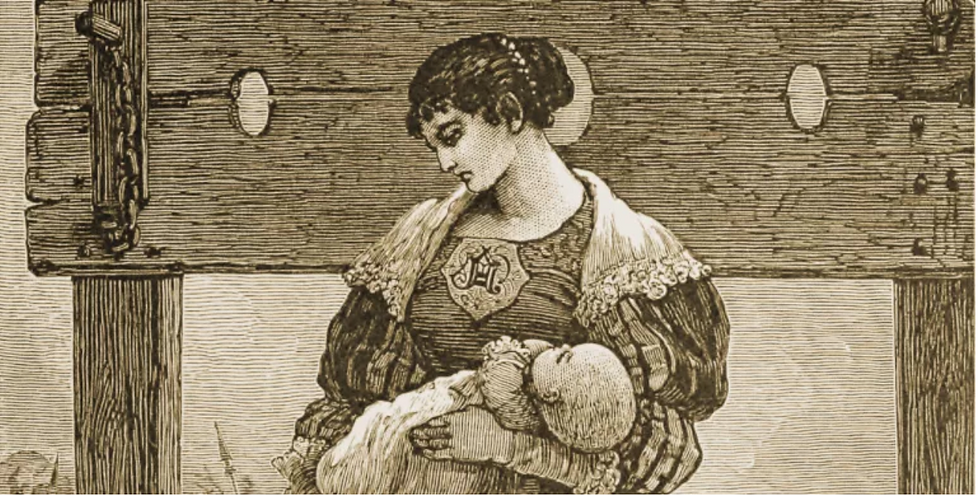
various crimes and punishments
Every colonial town was required to build and maintain sturdy stocks, one of the most common forms of punishment. Prior to stocks, however, the magistrates had the keep-'em-on-their-backs bilboes imported from England. These were long heavy bars of iron with sliding shackles and padlocks that held the miscreant by the heels. Like the stocks, they were used for a variety of transgressions.

Then there were the ever-popular dunking stools, seen today at carnivals and fairs. Fun! In colonial times, not so much. These stools were generally used for "scolds." A scold was a type of public nuisance, a troublesome and angry person who annoyed everyone by habitually "chastising, arguing and quarrelling with their neighbours." For some reason, women were most often the unhappy dunkees. Quarreling spouses sometimes got dunked tied together. One "infamous scould & breaker of the peace," was punished for calling Goody Mendum an "Indian Hoare." Not allowed.
The dunking stool was known to have been used for brewers of bad beer, bakers of bad bread, brawlers and "unruly paupers."

Freedom of speech wasn't a thing in Colonial America until our founding fathers, in the 1770's, decided it might be a good idea. Often the punishment for slanderers, nags, and gossips, when simple gagging wasn't enough, was the brank, also called a "gossip's bridle" or "scold's helm." This was a heavy iron cage-like device that covered the head. A flat tongue of iron was shoved into the mouth over the tongue. In some cases, the iron tongue was spiked. If towns couldn't afford the real deal, they made do with a simple cleft stick pinched onto the tongue.

The pillory has been called "the essence of punishment." It stood in the main squares of towns scattered throughout the colonies. It consisted of an upright board, hinged or divided in half with a hole in which the head was set. Generally there were two openings for the hands as well. Sometimes the ears of the subject were nailed to the wood on either side of the head hole. In 1648, an extreme example of pillorying involved John Goneere who was convicted of perjury. He was "nayled by both eares to the pillory 3 nailes in each eare and the nailes to be slitt out, and whipped 20 good lashes." Ouch.
Offenders were pilloried for every misdeed in the book: treason, rabble-rousing, arson, blasphemy, perjury, wife beating, cheating, forgery, slander, fortune-telling, and drunkenness, among other offenses.

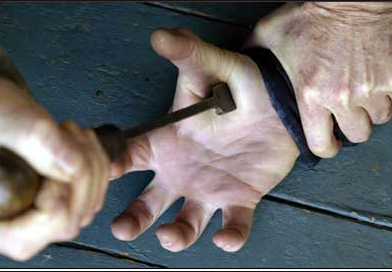
And finally, my personal un-favorite, branding and maiming. Shocking as might seem to us, it was not uncommon in colonial America to see men or women with lopped ears, slit nostrils or seared brands. Quakers and Jesuits, those "blasphemous Hereticks," were most often the victims of these extreme punishments. When branded, generally a letter representing the crime was used. Burglary was punished in all the colonies by a scalding capital B in the right hand. If the burglar was stupid enough to get caught on a second offense, the B was branded then onto the left hand. Worse yet, "...if either be committed on the Lord's Daye his Brand shall bee sett on his Forehead as a mark of infamy.” Never on a Sunday!



Comments