
SLAVERY IN NEW ENGLAND

Updated: Mar 7, 2024
...the heinos and crying sinn of man stealing ~ Boston General Court

freemen, commoners and indentured servants
Society in the Massachusetts Bay Colony was hierarchical as most societies are. Almost immediately upon arrival, the powers that be set about determining standards for new citizens of the colony. The gold standard was taking the oath to become a Freeman. Freemen, on the top rung of society, were the only colonists authorized to vote and the only ones involved in governmental functions. The opportunity to become a Freeman was not open to everyone so that class of men actually represented a fairly small percentage of the Colony's population.
Note: Of our thirty-four grandfathers who came to Massachusetts in the 1600's, twenty three achieved the status of Freeman.
Commoners, on the second rung, were allowed to purchase property but were not part of the governing body and generally considerably less wealthy than their freemen neighbors.
Indentured servants sat on the third rung. These men and women were voluntarily working off the debts they had incurred to get to America. After serving our their indentures, usually three to five years, they were then free to become productive members of society as commoners or even, hopefully, (for men only, of course) freemen.
The men and women on the fourth rung of the New England societal hierarchy were not so fortunate. Slavery, while relatively rare in the early days, was definitely a practice in the Massachusetts Bay Colony.
slavery in New England
The date was 26 Feb 1638. That day, the first African slaves arrived in Boston aboard a ship called "Desire." The Pequot War had ended the year before, but the vanquished Native Americans were proving themselves a tad too recalcitrant for enslavement. Worried that their captives"would not endure the yoke," the victors summarily packed them up and sent them to the West Indies where they would become someone else's problem. In return, enter the "Desire" loaded with cotton, tobacco and an extra bonus of kidnapped African men and women.
The slave trade in New England had a slow start. By 1700 there were only about 400 African slaves in the entire colony. Through the first half of the 18th century that number would grow by about 4,500. That represented 2.3% of the population, still a far cry from the 40% found in much of the South. The plantation economy of the southern states created a necessity for the kind of inexpensive labor that slavery provided. In the north, however, where small farms and professional trades were the norm, there was little need for large labor forces.
In addition, The Puritans were a little wary about the practice of humans owning humans. Indentured servitude, widely practiced in New England, provided light at the end of the tunnel. The indentured settlers were given an agreed upon time frame to work off their debt and there was little stigma attached to them once their stint was up. They were free to buy land and become productive members of colonial society. But slavery was a whole new ball game.
caveats
In 1641, the leaders of the Massachusetts Bay Colony realized it was time to deal with the slavery issue. The General Court instituted this Body of Liberties:
“There shall never be any bond slaverie, villinage or Captivitie amongst us unles it be lawfull Captives taken in just warres, and such strangers as willingly selle themselves or are sold to us. And these shall have all the liberties and Christian usages which the law of god established in Israell concerning such persons doeth morally require. This exempts none from servitude who shall be Judged thereto by Authoritie.”
While the Massachusetts General Court decried the "heinos and crying sinn of man stealing," the "unles" within the above paragraph looms large. The "warres" going on at the time were exclusively with the indigenous people of America whose lands they were seizing. The "strangers" traded for the Native Americans were perfectly allowable as slaves. The line about "liberties and Christian usages" is ambiguous at best. And the last line is the kicker. It "exempts none from servitude," placing that power directly in the hands of the "Authoritie."
The so called "Body of Liberties" while appearing to denounce "slaverie, villinage, or Captivitie" is a thinly disguised approval of all three. God's authority and the Christian life they professed to be living made rationalization for their own wicked deeds imperative for the Puritans.
slavery in Woburn
Woburn lies 10 miles from Boston, the hub of the slave trade in the late 1630's and early 1640's. Well established by 1650, the population in Woburn had doubled in ten years. There were approximately 60 families living there by 1652. Two of most prominent and powerful families in Woburn were the Richardsons and the Wymans. Both of these families dabbled in the slave trade, as did at least one member of our Baldwin family.
According to Charles Brooks’ History of Medford (then a part of Woburn), in 1754 there were 34 slaves in Woburn held by 20 owners. One of the earliest slave owners in Woburn was our cousin (and possible grandfather) Francis Wyman (1C10x). While the circumstances of purchase are unknown, Francis owned at least one slave. In his will, dated 1699, he left “a Negro girl named Jebyna” to his wife. He was also in possession of several Scottish prisoners of war as indentured servants in his tannery.
Francis' brother John Wyman (1C10x) owned a "negro servant." It is unclear whether this servant was a slave or indentured. According to town records, "in 1672, a negro servant belonging to John Wyman, Senior, being convicted 'of abuse offered to two of Wamesit Indians wounding them on the head and elsewhere' is sentanced to pay the Indians ten shillings."
By 1750, there were four Wyman households with a “servant for life.”
Another cousin of ours, William Richardson (2C8x), owned the slave Loran who he sold to James Dolbeare in 1732. Below is the bill of sale transferring ownership of Loran from William to James.
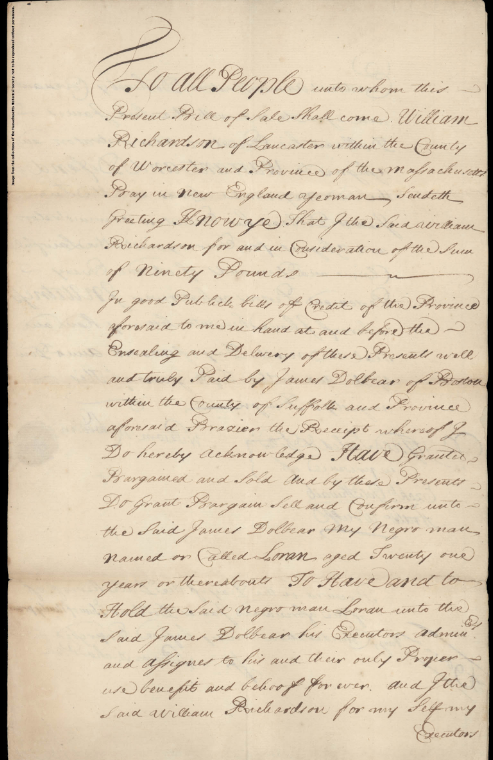
Thankfully, the list of slaveowners in our Northern families is very small. But we did have one quite famous slave owner in the Richardson family. Ichabod Richardson (3C8x) purchased Amos Fortune in 1643. Amos Fortune was one of the most renowned slaves in the northern states.
Amos Fortune
Because of my many years working in the Pachappa Elementary School library, I was well acquainted with Amos Fortune many years before discovering that one of our relatives actually owned him. Amos Fortune, Free Man won the Newbury Medal for excellence in children's literature in 1951. Written by Elizabeth Yates, it tells the story of Amos who bought, not only his own freedom, but that of other slaves as well.

Amos Fortune was born in Africa. He was brought to this country in the early in 1725 and was purchased at the auction block by a Quaker named Caleb Copeland who owned him for fifteen years. When Caleb died in 1740, Amos was purchased by our cousin Ichabod Richardson (3C8x). The first written record that exists for Amos is a "freedom paper"dated December 30, 1763, in which Ichabod “tanner of Woburn, in the province of Massachusetts-bay in New England ‘agreed’ to and with my Negroe man, Amos, that at the end of four years next insuing this date the said Amos shall be Discharged, Freed, and Set at Liberty from my service power & Command for ever….”
Icabod Richardson was a tanner, a trade passed down through the Wyman generations. He did right by teaching this trade to Amos. But, by other accounts, he was not as magnanimous. Icabod died in 1768 at just about the time Amos should have been "Discharged, Freed, and Set at Liberty.” But, in his will, Ichabod does anything but that.

Icabod's new provision was obviously intended to help out his sister-in-law Hannah Locke Richardson (W3C8x). Her husband Asa (3C8x), brother to Icabod, had died twelve years earlier. But the bequeath totally disregarded Icabod's earlier agreement with Amos. The stipulation in the will not only dictated that Amos serve his sister-in-law for six more years, it also came with the condition of a bondsman. Sadly, Ichabod was perfectly within his rights to do so as the slave owner.
As it turned out for Amos, he was able to make a new agreement with Hannah Richardson. In 1670, after serving only two of his six years, he paid off his bond to her and became a free man. He was 60 years old and had spent all but fifteen of those years as a slave. Amos stayed in Woburn for the next few years. He bought land and built a house. He purchased his first wife, Lydia, for fifty pounds from another Woburn resident. Lydia died shortly afterwards and in 1779, he purchased Violate. Violate just happened to belong to another cousin of ours, James Baldwin (2C8x). And James Baldwin just happened to be married to Ruth Richardson (3C8x), first cousin to Ichabod (3C8x). The record of sale reads:
“This Day Received of Amos Fortune Fifty pounds in full for a Negro woman named Vilot being now my property which I do Sell and Convay to the aforesaid Amos.” Signed by James Baldwin.
Amos and Violate moved to the town of Jaffrey, New Hampshire, where his fortunes took a decided turn for the better. He adopted a daughter, ran a successful tannery, became a full member of the First Church and helped found the Jaffrey Social Library, an organization devoted to collecting and discussing books on history and travel.
Amos died in 1801 at the age of 91. Violate died the next year in 1802. They are buried side by side in the Old Burying Ground in Jaffrey.

white wash (no pun intended)
I have read Amos Fortune, Free Man and it definitely depicts a very sunny side to the ugly practice of slavery. Everyone in the book is kind to Amos. His success in life is largely credited to the help and encouragement he receives from his two masters. Ichabod Richardson (3C8x) is portrayed as a kindly man who makes a freedom agreement with Amos but dies before he can carry it out. In the book, Amos has a particularly loving relationship with Icabod's wife, bringing her presents from Boston when he is sent there on tannery business. The problem with all this is that Icabod Richardson had no wife. In his will, he leaves all his possessions to his brothers and sisters, their wives and their children. Elizabeth Yates description of Amos winning his freedom is pure fantasy:
"Soon after the tanner's death, Mrs. Richardson saved Amos further investment in his freedom by a quitclaim of her interest in the fund into which Amos was paying. She drew up a paper of her own, brief and clear, in which she said, 'In consideration of the many faithful services Amos Fortune did perform to the said deceased Ichabod in his lifetime and hath since performed to us respectively whereby our several interests have been greatly increased, I do grant unto Amos Fortune the full and free liberty of his person from and after the ninth day of May, 1769.'"
I would hope that in this day and age, Amos Fortune, Free Man is no longer required reading for elementary school children.
the not so fortunate
Christy Clark-Pujara, a professor of history and Afro-American studies at the University of Wisconsin-Madison says that “there is a strong fiction that slavery was mild in the North. There is absolutely no historical evidence to support that. Bondage was bondage… People were beaten and tortured in the North, just like they were beaten and tortured in the South, and it was just bad in different ways.”
Historical documents tell of the extreme loneliness of northern slaves who did not have family support like slaves in the south. They also wrote about the "horror of having to live in the same dwelling and sleep in the doorway" of the very people who had enslaved them.
While efforts were made into the 18th and 19th centuries to abolish the practice of slavery in the northern states, the enslavement of people of African descent continued there until the ratification of the 13th Amendment in 1865.


Comments