
TOBACCO!

Hail thou inspiring plant! Thou balm of life,
Well might thy worth engage two nations' strife
~ Doctor William Vaughn, 1617

trying to make a go of it
The first efforts by the English Crown to found a colony in North America began in 1607 with Jamestown. The Spanish and French were forging ahead in that arena and King James couldn't afford to be left behind. Many disasters would befall the first brave settlers who made initial forays across the ocean. Starvation, illness and battles with the less than thrilled native people already living there, made for a bleak looking future.
The Virginia Company, however, made a good case for life in Virginia and wave after wave of new settlers threw their hats into the ring. Though most died or turned back in those first few years, those who survived explored a variety of ways to create a thriving economy. Trade was the thing. Without a healthy trade business, colonies had little hope of surviving. By 1615, tobacco looked promising, but the land requirement was hefty. And, not wanting to put all their eggs in one basket, the settlers experimented with a few other methods of turning a profit. The citizens of Jamestown attempted to make of go of glassblowing, growing grapes for wine, agriculture, even silkworm farming. Despite all efforts to diversify, there was only one thing drawing a fair market price in England. Tobacco.

origins of the stinky weed
Tobacco was introduced to Europe by the Spanish in the 16th century. They had adopted the practice from Native Americans in both North and South America. Europeans, however, were actually quite late to the party. It is believed that tobacco cultivation began ca. 5000 BC in central Mexico along with the development of maize. From there, the plant was widely distributed throughout the Americas. Tobacco is not native to Virginia, but it was being grown there by Native American farmers 4,000 years before Jamestown was settled.
One of the first mentions of tobacco in Virginia was from an Englishman who made an expedition to the New World in 1586. Thomas Harriot was an astronomer, mathematician, ethnographer and translator. He had learned the Algonquin language before the voyage so he was vital to the success of the expedition. He wrote a book about his experience, A Brief and True Report of the New Found Land of Virginia. Here is what he says about tobacco:
"There is an herb called uppowoc, which sows itself. In the West Indies it has several names, according to the different places where it grows and is used, but the Spaniards generally call it tobacco. Its leaves are dried, made into powder, and then smoked by being sucked through clay pipes into the stomach and head. The fumes purge superfluous phlegm and gross humors from the body by opening all the pores and passages. Thus its use not only preserves the body, but if there are any obstructions it breaks them up. By this means the natives keep in excellent health, without many of the grievous diseases which often afflict us in England."
This glowing report didn't sit well with the King. Here was his rebuttal:
"Smoking is a custom loathsome to the eye, hateful to the nose, harmful to the brain, dangerous to the lungs, and in the black, stinking fume thereof nearest resembling the horrible Stygian smoke of the pit that is bottomless.
~ James I of England, A Counterblaste to Tobacco (1604)"
Note: Tobacco is in the same botanical family as eggplant, tomatoes, potatoes and chili peppers.

John Rolfe finds a more marketable product
Perhaps John Rolfe can be credited with saving the struggling colony. Early attempts to sell Virginian tobacco weren't going well. Smokers in England didn't care much for the harsh Virginian tobacco, Nicotiana rustica, that was grown there. In 1611, fortuitously for the colony, Rolfe found a sweeter strain of tobacco while on a trip to Trinidad. He brought seeds of the new strain, Nicotinia tabacum, back with him to Virginia. Conditions were perfect and sales went through the roof. By 1630, over a million and a half pounds of tobacco were being exported from Jamestown every year. The seeds of Nicotinia tabacum were instrumental in creating a huge economic empire that lasted until the middle of the nineteenth century.
Note: John Rolfe's other claim to fame? He married Chief Powhatan's daughter Pocahontas!
shaping a society
With the discovery of Nicotiana tobacum, the colony of Virginia would flourish. But the plant itself dictated the need for those immense plantations that became the norm. Because Tobacco quickly drains the soil of nutrients and minerals, the land had to lay fallow after a mere three seasons. It sometimes took as much as twenty years for a field to be ready for replanting. The government of Maryland realized the folly of depleting the soil in this way. In 1649 an act was passed that required two acres of corn be planted by every taxable citizen growing tobacco. The fine for non-compliance was 50 lbs. of tobacco for every half acre falling short.
The old adage that it takes money to make money held true in Virginia. Only the colonists who were in a position to acquire vast tracts of land became quite wealthy. These large plantation owners were able to abandon used up fields for a time and plant in fresh soil that would produce great quantities of the crop.
Much more so than in the northern states, the South was a society of wealth vs. poverty. Growing tobacco is an extremely labor intensive proposition, with many hands required. As with many employers today, the plantation owners' wanted cheap labor. The cheaper the better. A virtually free labor practice evolved from the headright system. The indentured servants and African slaves brought to Virginia were paid nothing except meager room and board for their toil. In this way, the plantation owners were able to greatly expand their land holdings.
Conditions for the labor force were abysmal. Only half lived to complete the terms of their contracts. Considered chattel, indentured servants were frequently overworked, underfed, punished with beatings and ultimately often cheated out of land promised them at the end of their servitude. The ones who were actually granted land frequently received barren, uninhabitable tracts.
The inability of the working class to obtain farmable land led to an armed rebellion in Virginia in 1676. Bacon's Rebellion is commonly thought of as the first armed insurrection by American colonists against Britain and their colonial government.
Another damaging effect of the plantation system was, of course, the displacement of Native Americans living in the area. Then there were the runaways.
runaways
Throughout the history of indentured servitude and slavery in the South, it was common for contracted and enslaved people to try and free themselves from the plantation holding them. There were obviously a number of reasons to take flight. Some fled masters that physically or sexually abused them. Both indentured servants and slaves were subject to either having their contracts sold or being sold themselves. This often caused painful separations from family members. Fleeing a plantation to find absent family members was a fairly common event. And for some, the mere fact of being owned was more than they could bear. For whatever reason, large numbers of plantation "chattel" tried making the great escape.
Punishments for runaways were generally harsh, meant to serve as a deterrent. Whippings and years added to the the length of the indenture were most common. Not surprisingly, however, the sentences meted out were surely not the same for blacks and whites. In 1640, as an example, three servants belonging to Hugh Gwyn ran away to Maryland. When they were captured, Victor and James, white servants, were whipped and four years added to their indentures. The third, "a negro named John Punch," was made a slave for life. Many scholars believe that this single decision represented the first legal distinction between Europeans and Africans to be made in the Virginia court system.
big business
In the early years of the tobacco trade, the large Viriginia plantations owners worked on developing personal relationships with the English merchants they did business with. This allowed planters to receive payment immediately instead of waiting for the tobacco to be sold in Europe. Large auctions at coffee houses allowed smaller merchants in England to obtain tobacco from the importers.
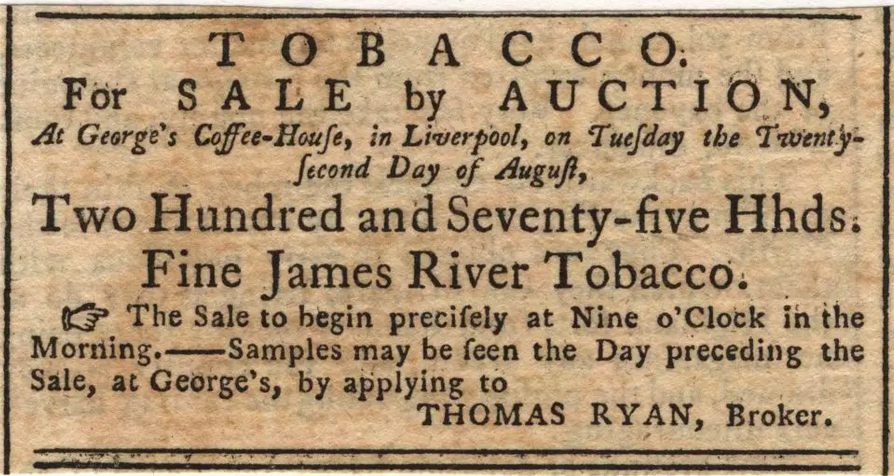
In 1680, to better facilitate Virginia's booming tobacco business, the General Assembly passed the first act to create port towns and warehouses, where imported goods and those intended for export would be stored. Now that the "inconvenince" of Native Americans had been solved, planters moved further into the interior of the colony. Towns grew up at Norfolk, Urbanna, and Yorktown by the early years of the eighteenth century. By midcentury, Alexandria, Fredericksburg, Petersburg, and Richmond had also grown into important port towns. Tobacco was indeed king.

But planters soon found themselves with a whole new set of problems. Many of them had acquired far more land than they could plant with tobacco. This caused a need for more labor (in the form of Africans) and a glut of tobacco on the market. Prices fell dramatically in the 1680's and 90's. To try and turn a profit, planters began shipping at their own risk without being paid up front. By 1730 approximately 40 percent of Chesapeake tobacco was being shipped by the consignment system.
slow decline
Prices remained stable and even increased steadily during the 1740's and 1750's but, by early in the 1760's, fluctuations in the British economy had caused the large planters to have trouble meeting their obligations. Because colonists now traded primarily on credit, most Americans tobacco growers were in debt to British merchants. Then disaster. English banks collapsed in 1772 and merchants pressured Virginia planters to settle their accounts. Beyond that, England began looking to its colonies as a cash cow to stave off a financial calamity. Historian T. H. Breen contends that this credit crisis of 1772 probably did as much to bring about the American Revolution as the regulation acts of Parliament.
Through all the travails, tobacco continued to be the lifeblood of the southern colonies and their main export until just after the War of 1812. After the war, tobacco sales declined sharply, leading to the prediction that slaves would no longer be needed and the practice would slowly die out as it had throughout Europe.
In America, that was not to be. A revolutionary invention in 1793 insured that slavery as an institution in the United States would continue on. The cotton gin, invented by Eli Whitney,
transformed cotton into a hugely profitable crop by reducing its processing time and making large-scale cultivation possible. By 1850, cotton, not tobacco, accounted for more than half of the value of U.S. exports and there were more enslaved people living in the United States than ever before.


Comments