
FOUR SARAHS

Sarah Cole Said that She Believed the Cow was bewitched..." ~ testimony of our grandmother Mary Eaton
it's a family affair
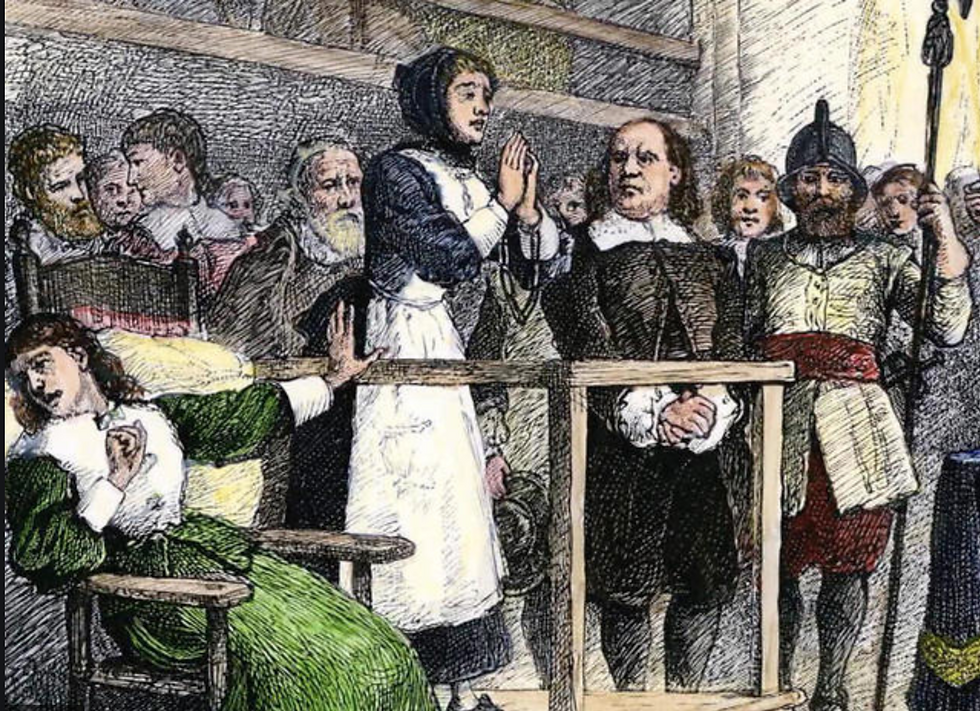
The witch hysteria was not confined to the towns of Salem and Andover and accusations of multiple family members wasn't rare. The Cole and Davis families of Lynn and Reading were no exception.
All three women on the trees below were accused of witchcraft. To make matters confusing all three were named Sarah. And to make matters even more confusing, two of the women married grandfathers of ours but were no relation to us.
Sarah Davis Rist (right tree) was the second wife of our grandfather, George Davis (10GGF). George and Sarah had a daughter, Sarah Davis Cole (9A) (both trees) who married the brother of our grandfather John Cole (8GGF). Then, Grandpa John Cole took for his second wife Sarah Aslett Cole (left tree), making her a sister-in-law of our aunt, Sarah Davis Cole.
While the relations between these three women may be confusing, it's clear that they were tied together either by marriage or by blood. Those connections led to the common bond of a witch accusation.


Sarah Clarke Davis of Reading
Sarah Clarke married Grandpa George Davis when she was 22 years old and they had eight children together. George died in 1667 when Sarah was 57 years old and a few years later she married Nicholas Rist.
Sarah Rist was the first of our trio to become embroiled in the witch affair. On 16 May 1692, she was accused of witchcraft by three of the afflicted girls prominent in the witch trials, Mary Wolcott, Ann Putnam and Abigail Williams. Twelve days later, an arrest warrant was issued:
"To the Constables in Reding.
You are in theire Majesties names hereby required to apprehend and bring before us, Sarah Rist the wife of Nicholas Rist of Reding on Tuesday next being the 31st day of this Instant moneth...who stand charged with having Committed sundry acts of witchcraft on ye Bodys of Mary Walcott and Abigail Williams & others to theire great hurte &c, in order to her Examination Relateing to ye premises above said faile not. Dated Salem May 28th 1692."
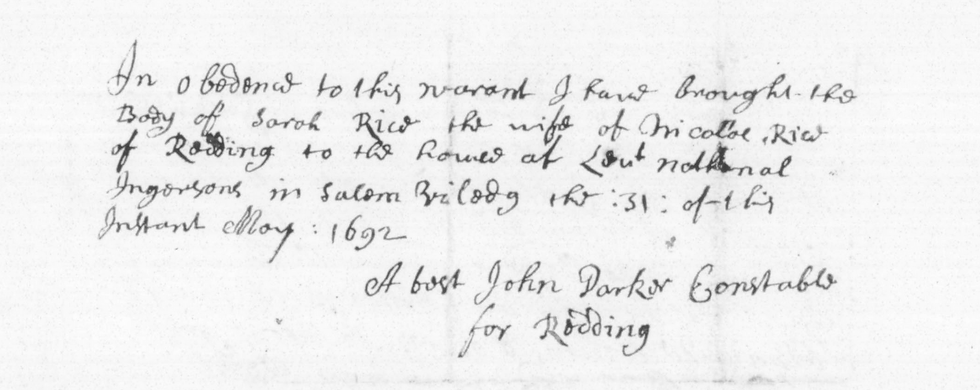
Sarah was summarily apprehended and taken into custody:
"In obediance to this warant I have brought the Body of Sarah Rist the wife of Nicholas Rist of Redding to the house of Leut. Nathanial Ingersons in Salem Viledg the 31 of this instant: May 1692: Attest John Parker Constable of Redding."
Sarah was then dispatched from Salem to Boston Prison, according to the following order:
"To Mr. John Arnold, Keeper of the Prison in Boston, in the County of Suffolk.
Whereas Captain John Aldin (Alden) of Boston, Marriner, and Sarah Rice, Wife of Nicholas Rist of Reding, Husbandman, have been this day brought before us...being accused and suspected of perpetrating divers acts of Witchcraft...These are therefore in Their Majesties, King William and Quen Marys Names, to Will and require you, to take into your Custody, the bodies of the said John Alden, and Sarah Rist, and them safely keep, until they shall thence be delivered by due course of Law; Given under our hands at Salem Village, the 31st of May, in the Fourth Year of the Reign of our Sovereign Lord and Lady, William and Mary Anno Dom. 1692."
Note: John Alden, arrested with Sarah Rist, was the son of the John Alden of Mayflower fame.
It wasn't until five months after her arrest, in October of 1692 that Sarah's husband, Nicholas Rist, was able to petition to the court for her release.
According to Court records: "The humble petition of Nicholas Rist of Reading...that whereas Sarah Rist...was taken into custody, the first day of June last, and hath since lain in Boston Jail for witchcraft, though in all that time nothing has been made to appear, for which she deserved imprisonment or death. The petitioner has been a husband to the said women above twenty year, all all which time, he had never reason to accuse her of any impietie or witchcraft, but the contrary, she lived with him as a good, faithful, dutiful wife...while her strength remained...and it is deplorable that in old age the poor decrepit woman should lie under confinement for so long in a stinching goal (stinking jail) when her circumstances require that a Nurse attend her. May it therefore please your Honors to take this matter into your present consideration, and direct some speedy method, whereby this ancient and decrepid person may not forever lye in such misery, wherein her life is made more afflictive to her than death. And the petitioner shall, as in duty bound, ever pray."

Soon after her huband's petition, Sarah was finally discharged from prison. It doesn’t appear that she was ever tried in the courts. Nicholas was obliged to pay the costs of her imprisonment in order for her to be released. That was the practice at the time, even for those found to be innocent or or pardoned. Sarah died on May 3, 1698 in Reading at age 75.
the scold Sarah Aslett Cole of Lynn
Our grandfather, John Cole (8GGF), married our grandmother Mary Knight (8GGM) in 1667. They had four children before Mary died in 1675, one year after her last child was born. Shortly afterwards, Grandpa John married Sarah Aslett. It seems he might have lived to regret that decision as Sarah appeared to be a good candidate for the "scold's helm." It was her mouth that got her into trouble.

On 1 Oct 1692, Sarah was accused of witchcraft by Mary Browne of Reading. Two days later, a warrant was issued for her arrest. Sarah was put through the usual examinations and jailed.
Mary Browne, her original accuser, told the Court that Sarah’s specter would appear to her night and day, tormenting her and causing her pain. Several people testified against her, including our grandmother Mary Eaton (8GGM) of Lynn and Sarah's own husband, Grandpa John Cole.
Grandma Mary Eaton's testimony shown below says in part: "Sarah Cole wife of Jno Cole of Lyn and myself had some Difference and with in a verry Litle time I had a Cow taken in a Strange maner...Sarah Cole Said that She Believed the Cow was bewitched --"

Grandpa John Cole testified that from the time his wife "had seen strange sights...his house hath been troubled w'th cats & Dogs & one night he thinks he saw a ball of fire..." He said that he thought some of his children had been afflicted by witchcraft as well and "for this 3 nights he had not lodged in his own house being so affrighted...& was sorely handled...in his head & belly as if a string had been twisted about his head."

John Brown testified that Sarah "broke out into these expressions, that all Church members were Devills & that her husband was going to be a Devill too hee was then going to Joine with the Church."
Isaac Wellman said that "I have often heard the Wife of Jno Cole of Linn, wish harm to her Husband, & one time being both at my house having some words, s'd Sarah Cole wished her Husband might Dye if ever he came within Daniell Eattons Doore any more."
Note: Daniel Eaton, Mary Eaton's husband, is our 8th great-grandfather
In all, six people testified against Sarah. In the end, however, she like most of the accused witches, was acquited of the charges. Though he may not have wanted to, I'm sure Grandpa John had to pay the requisite fees for Sarah's release. Hopefully, the experience taught her a lesson. In spite of their differences, Grandpa John and Sarah lived together for eleven more years. John died in 1703 at age 67. There is no record of sharp-tongued Sarah marrying again though she lived for thirty-seven years after Grandpa John died. She died in 1640 at age 78.
Sarah Davis Cole of Reading
Our Grandpa John Cole had a brother Abraham (8U). Abraham married our aunt, Sarah Davis (9A), who was the daughter of our our grandfather George Davis (10GGF) of Reading. It was really no surprise that the witch accusers pegged Aunt Sarah, another member of the Cole family. The accusation by Henry Brage attested that Sarah Cole did "feloniously afflict Torture & Torment William Brage Son of Henr' Brage by that Diabollicall art of witchcraft..." On 10 Sep 1692, a warrant was duly issued for Sarah’s arrest. She was imprisoned and indicted. As was fairly common in the day, Uncle Abraham was able to pay good cash money and spring her after only four months. After Sarah's release, she was acquitted of all charges. She died in 1714 at age 62. Abraham followed a year later at age 66.
Below, the warrant for Sarah's arrest.

Sarah Wildes Bishop of Salem
Last we come to Sarah Wildes Bishop, sister-in-law of our aunt, Mary Howlett (7A) who was the daughter of Ipswich founder Thomas Howlett (8GGF). Sarah married Edward Bishop in 1670. In 1690, the couple made a fateful decision to move to the town of Salem. Two years later, all hell broke loose for the Bishops. in April of 1692, Sarah and Edward were accused of witchcraft and arrested. The complaint against them was made by none other than Thomas Putnam, father of one of the witch trials main players, Ann Putnam.
Note: Thomas Putnam was brother-in-law of our cousin William Wyman (1C9X)
The Bishops' case is perfect example of how town squabbles, which in the past had been settled fairly amicably in the county courts, suddenly became dangerous. Suffleboard was at the heart of Sarah Wildes Bishop and her husband's accusations. Sarah and Edward were innkeepers. Shuffleboard was an activity highly favored by the tavern-loving crowd and highly frowned upon by the Puritan Church as a "time-wasting" activity.
An incident from years before the witch trials began proved to be the undoing of the Bishops. Minister John Hale, main deponent for the prosecution, gave testimony about a complaint he had received six years prior from neighbor of the Bishops. Hale testified that Christian Trask had come to him asking that that that "Goodwife Bishop... might not be permitted to receive the Lords Supper in our church...because the said Bishop did entertaine people in her house at unseasonable houres in the night to keep drinking and playing at shovel-board whereby discord did arise in other families & young people were in danger to bee corrupted... And indeed by the information...I doe fear that if a stop had not been putt to those disorders Edw. Bishop's house would have been a house of great prophainness & iniquity."
Note: John Hale was one of the most prominent and influential ministers associated with the witch trials. He initially supported the trials but later changed his mind and published a harsh critique of them. Hindsight is 20/20.
Further testimony by Reverend Hale revealed another, more damning string of events. According to Hale, the complaining Christian Trask became "distracted." In other words, she took leave of her senses. When "...asking her husband Trask when she was so taken [he told] mee shee was taken distracted that night after shee [came from] my house when shee complained against Goody Bishop." Hale testified that Goody Trask was restored to "the used of her reason" again after a period of fasting and prayer.
Tragedy struck, however, in 1689 when Goody Trask "being violently asalted by the temtations of satan, cut her owne throte with a paire of sisers to the astonishment and grief of all, especially her most nere relations." Just prior to her suicide, Goody Trask had been very anxious to make amends with the Bishop's for her accusations against them.
Helpful Reverend Hale had much to say in his testimony at the Bishop's trial about Goody Trask's wound. "As to the wounds she dyed of I observed 3 deadly ones; apeice of her wind pipe cutt out. & another wound above that threww (through) the windpipe & Gullet & the veine they call jugular. So that I then judge & still doe apprehend it impossible for her w'th so short a pair of cissars to mangle her selfe so without some extraordinary work of the devill or witchcraft."
Ill will towards the Bishop's festered for two years until opportunity knocked in April of 1692 when the witch furor began gaining steam. One day in town, Edward Bishop witnessed an "afflicted Indian fall into a fit." Taking a stick, Edward beat him with it until the man recovered his senses. Edward then foolishly bragged that he could "cure them all." Not surprisingly, someone tattled to the authorities and both Edward and Sarah were accused of witchcraft and arrested. They were transferred to the Boston jail on 13 May 1692 to await trial.
While the Bishops languished in jail, the accusations against them began to magically escalate. In the end, Edward and Sarah Bishop were found to have also committed witchcraft against three of the main players in the witch trials, Ann Putnam, Mercy Lewis, and Abigail Williams.
Somehow, before October of 1692, the Bishop's managed to escape the jail. They hightailed it to Rehoboth, near the Massachusetts/Rhode Island border. For whatever reason, the authorities chose not to pursue them. They were, however, required to pay the requisite ten shillings per week for their board in the prison. When they didn't pay up, their property was seized. In 1710, when attempts at restitution were being made for the witchcraft victims, the Bishop's son Edward sought "to gain recompense for the damages they'd suffered and to clear their names," claiming they had been "prisnors for thirtiey seven wekes..."
After all the furor, the Bishop's evidently carried on their merry way. They were cited the very next year for running an inn without a license in Rehoboth.
Next we'll have the sad story of Sarah Wildes Bishop's stepmother, Sarah Averill Wildes. Sarah Averill Wildes was also the mother-in-law of our aunt Mary Howlett Wildes (7A).


Comments