
IPSWICH REVISITED

Updated: Jul 10, 2024
Birthplace of American Independence

growing Ipswich
By the mid-1640's, the Howlett's and the Clark's had moved seven miles northwest to Ipwich's sister town of Topsfield. Thomas French (10U) remained in Ipswich until his death in 1680. Ipswich continued to grow. Even as others moved on, new families moved in. There may have been as many as 100 families living in Ipswich in the 1640's. Two of our families were among these later arrivals to Ipswich.
from vague beginnings
Very little is known about the origins of Edward Loomis (9GGF) and John Sherwin (8GGF), the heads of our other two Ipswich families. They came late to Ipswich, Edward in the late 1640’s and John in the mid 1660’s, when the the town was already well established.
the weaver
Details about Edward Lummus/Lomas/Loomis/Lumas (all of these spellings and more are used in records for him and his descendants) (9GGF) are sketchy. According to The Great Migration Begins 1620-1635, there are two records for Edward sailing from England in 1635: on 13 April 1635, “Edward Lummus,” aged 24, was enrolled at London for passage to New England on the Susan & Ellen; on 17 April 1635, “Edward Loomes,” aged 27 was enrolled at London for passage to New England on the Elizabeth. That he came to Massachusetts in 1635 seems assured.
The first we see of Edward in New England is from the General Resister of the Society of Colonial Wars where he is listed as serving in the Pequot War in 1637 along with our uncle Thomas French (10U). He was in Ipswich as early as 1641 but he was not admitted to the Ipswich church and made freeman, however, until Nov 1645, 10 years after his arrival in New England.
There is a record of his marriage to Mary (last name unknown) (9GGM) in 1640, but that date seems to be uncertain. Very little remains of early Ipswich birth records, so we have no exact birth records for his children either. What we do know, is that Edward and Mary Loomis lived in Ipswich and raised their four children there. They lived "near where the depot is now situated in Ipswich." The old depot is now gone and in that spot sits The Institute for Savings at Depot Square.
Edward was a weaver by profession. While Edward's English origins are unproven, there is strong evidence that he may be related to the Loomis family from Thaxted. Joseph Loomis of that family, who settled in Connecticut, was a woolendraper, and the Thaxted Loomis family had a long history of working in the textile business.
On 1 May 1672, “Edward Lomas, upon his presentment, was ordered to audibly publish the acknowledgment set by the court the next lecture day or pay a fine.” What got him into trouble? He passed on gossip he had heard regarding the Presbyterian ministers at Newbury and “alleged communications between those ministers and the Archbishop of Canterbury.” Hard times in Puritan America.
Edward and Mary's youngest child and only daughter, Francis Loomis (8GGM), married John Sherwin (8GGF) in 1667.
Mr. Sherwin
Even less is known about John Sherwin (8GGF). We know he was born in England and immigrated to New England sometime shortly before his marriage to Francis Loomis (8GGM) in 1667. John and Francis joined the church in full communion 12 Apr 1674. They had 7 children.
Francis Loomis Sherwin died in 1691 at age 44 and that same year John Sherwin married Mary Chandler. John and Mary had 6 children, making 13 in all for John.
Note: The early death of a spouse was a common occurrence in Colonial America. Equally common was the remarriage of the widow or widower, often within a few months, generally within the year.
John Sherwin died in 1826 at 82 years of age. His estate paper still exists shown below. John did not die a wealthy man. After all his just debts were paid and £33 went to his wife Mary, the estate was left with just £11. This money was divided among his 10 still living children with a double share going to the oldest, Robert, Jr.

John and Francis' son Ebenezer Sherwin (7GGF) married Susannah Howlett (7GGM), granddaughter of the immigrant Thomas Howlett (9GGF).
Ebenezer and Susannah’s lineage leads us four generations later to Susanna Sherwin Parrish (3GGM), born in 1808, who married Ezra Parrish (3GGF). In 1836, the Parrish family began a journey that would take them across a vast continent, New York to California.
Note: Among the descendants of John Sherwin (8GGF) was Henry Alden Sherwin (3C3x), born in 1842 in Baltimore, MD. He was one of the founders of the Sherwin-Williams Paint Co. which still exists to this day.
the story of three sisters, an uncle and a governor's son
That it was a small, convoluted world in colonial America can be proven by the story of our uncle Daniel Eppes (10U). Daniel was brother to the scoundrel William Eppes (10U) and our slave-owning grandfather Francis Eppes (9GGF) who settled in Virginia. Daniel lived in London and, in 1621, married a woman named Martha Reade (W10U). Her father, Colonel Edmund Reade, was wealthy, well-connected and the father of three daughters. He also happens to be a grandfather of Odos Clanin III, husband of Kenny West Clanin.
Note: Martha Reade Eppes is Odos' aunt. Daniel Eppes is our uncle. That's right. Odos' aunt married our uncle.
The bulk of the players in this story all ended up in Ipswich, Massachusetts. How, you wonder? The story begins with two deaths. In 1630, our uncle Daniel Eppes died in London. He left a widow, Martha Reade, and two children, Elizabeth (1C10x) and Daniel Jr. (1C10x). A few years later, in 1634, the wife of John Winthrop, Jr. died. John Winthrop was yet another wealthy, well-connected man. He, along with our grandfather Thomas Howlett (9GGF), founded the town of Ipswich. His father organized the Winthrop Fleet and became governor of Massachusetts. Later, John Winthrop, Jr. would become governor of Connecticut.
With the two deaths, the stage was set. The three sisters, Martha Reade Eppes, widow, Elizabeth Reade, unmarried, and Margaret Lake, Odos' grandmother who married a cad, were all living quietly in London.
To ease his broken heart, John Winthrop, Jr. took a trip back to England. There he met the lovely, unmarried Elizabeth Reade. The courtship was brief and by June 1634, John and Elizabeth were married. When he sailed back to England John took with him his new wife and his wife's niece, our cousin Elizabeth Eppes (1C10x) who was thirteen at the time. Their names are listed on the passenger roster of the ship Abigail which sailed from Plymouth, England on 4 Jun 1635 and arrived in Boston on 8 Oct 1635.
It was only a matter of time before the two sisters followed. Daniel's widow Martha (W10U) married Samuel Symonds in 1637. Correspondence between Samuel and John Winthrop, Jr. shows that Winthrop had already conveyed land to Samuel and was helping to have a house built for him and his family.
Margaret Reade Lake, Odos' grandmother, had no reason to stay in England. Her husband had left her a few years before. Taking her two youngest daughters, she skedaddled to the New World and settled in Ipswich with the rest of the clan.
On the tree below, Daniel Epes (born 1690) is our 10th uncle, Martha Read Epes is Odos' 9th aunt and Margaret Reade Lake is Odos' 8th great-grandmother. Everyone on the tree below ended up in Ipswich with the exception of Daniel Eppes and John Lake. The Eppes and Symonds are our lineage and the Lakes and Winthrops are Odos' lineage. Martha Lake Harris, cousin to Daniel Eppes, Jr., is Odos' 7th great-grandmother.

The move turned out to be fortuitous for all involved. Margaret Lake and her daughters were well taken care of by the Symonds and Winthrops. Samuel Symonds became a rich man in in own right. He became the town clerk of Ipswich. All town records from 1639-1645 are "written in his round beautiful hand." He served as a judge, and later became Deputy-Governor of the Colony. He amassed much property in Massachusetts, Rhode Island and Connecticut. The property he owned in Ipswich is known today as Argilla Farm.
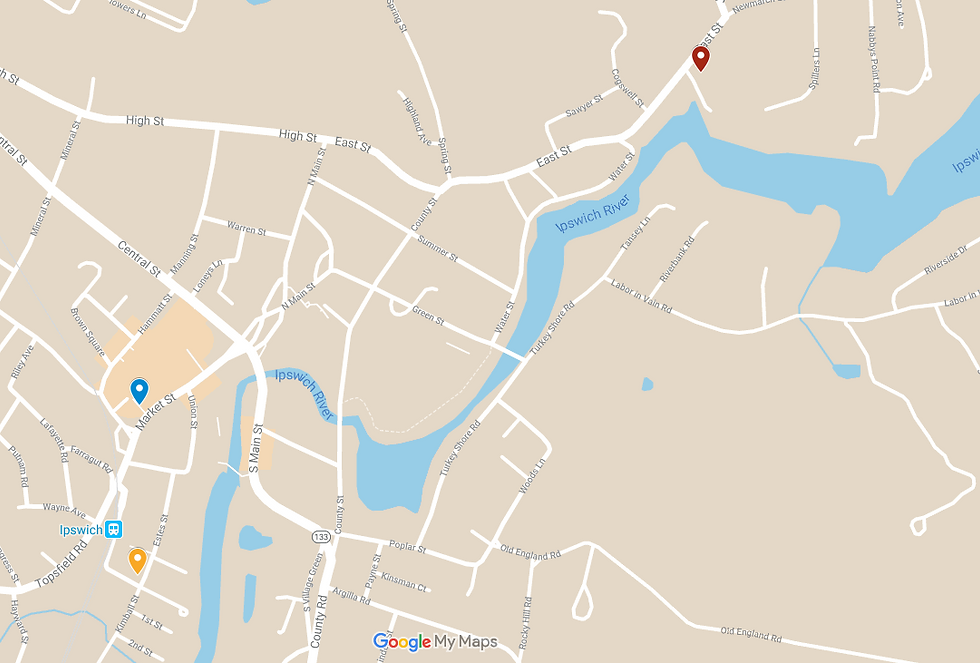
Below, the red marker is Thomas Howlett's house in Ipswich. The blue marker is Samuel Symonds property near the marsh.

Our cousin Daniel Eppes, Jr. (1C10x) made a smart move as well. In 1644, he married his step-sister, Elizabeth Symonds. In his will, Samuel Symonds left to Daniel Eppes, Jr. a double portion of his inheritance. Daniel was the owner of a large farm in Ipswich and died there in 1692.
Irish bondage in America
The ‘curse of Cromwell’ is a phrase made famous from a poem by William Butler Yeats. The curse refers to the brutal seventeenth-century conquest of Ireland. One aftermath of that conquest was the kidnapping and transporting of Irish citizens to the American colonies. These citizens were sold into a term bondage which lasted much longer than that of other indentured servants.
In 1654, the ship Goodfellow arrived in Boston with human cargo which Samuel Symonds was quick to take advantage of. Philip Welch and William Downing, two young Irish orphans, were sold to Samuel in exchange for corn and cattle. The bill of sale was dated May 10, 1654. It specified that the boys would serve their new master until they reached the age of majority.
After seven years, the boys rebelled. They told Samuel that they would not work any longer under the bondage terms. They demanded to finally be paid for their work on Symonds land. Samuel not only refused, he had them arrested. The case went to court and, of course, the boys were the losers. The jury required the boys to serve the Symonds family until May, 1663, a full nine years of servitude.
Note: Our grandfather William Symonds (9GGF) arrived in Massachusetts in 1630 and settled in Woburn. It's possible that William and Samuel were related but I can find no family connection between the two.
Note: The indentured Irish field hands referred to themselves as slaves because they were the chattel property of the planters who purchased them. They were even itemized as chattel in estate inventories, as were African slaves. The extreme difference in African slavery and Irish bondage should be noted, however. The long-term bondage of the Irish, while extreme compared to other indentured servants, was still finite. It simply cannot compare to the perpetual bondage that the African slaves endured for two hundred and fifty years.
heroic opposition
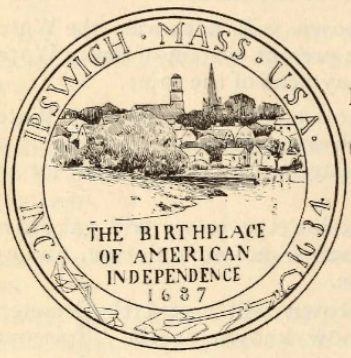

The seal of the Town of Ipswich and a mural in the Ipswich Post Office commemorate the legendary resistance by the people of Ipswich to a tax imposed by the Crown in 1687. This act of opposition has been called ‘the foundation of American Democracy.’ and served as a warning for future events that came to a climax with the Revolutionary War.
In 1685, King Charles II of England revoked the charter of the Massachusetts Bay Colony in an attempt to bring the colonies more closely under crown control. The town Of Ipswich voted unanimously on Feb 11, 1685 against the surrender of this charter.
When King James succeeded to the throne a few months later, his new court-appointed governor of the colony, Sir Edmond Andros, advised that a new tax be assessed on the colonists. Ipswich wasted no time. A town meeting was organized the very next day. The council voted, again unanimously, that “no taxes should be Levied upon the Subjects without consent of the Assembly chosen by the Freeholders.” The town refused to appoint a tax collector.
For this act, our cousin Thomas French, Jr. (1C10x) and five other leaders of the community were arrested and tried before the court in Boston. They were imprisoned for several weeks, fined up to £50 each, and eventually released under £500 bond for each individual, an extremely hefty amount for those days.
Happily for the colonies, in 1688, William and Mary overthrew King James and seized the throne. Order was restored in the colonies...for a while.
Our cuz, Thomas French, exemplifies the revolutionary spirit that still beats in West/Mohney hearts today!
Note: Thomas French, Jr. (1C10x) was the son of our uncle, the immigrant Thomas French (10U).


Comments