
LATECOMERS TO VIRGINIA

Updated: May 5, 2022
The streams, which make into the land from the river, are often bold and navigable streams ~ Colonel E. M. Morrison on Isle of Wight

Isle of Wight County
The area that now comprises Isle of Wight County was one of the earliest explored by the English. In 1608, the settlers at Jamestown were starving. In search of food, Captain John Smith sailed down the James River and found the friendly Warrasquyoake, a tribe of the Powhatan Confederacy. Smith sailed back to Jamestown with fourteen bushels of corn, a gift freely given by tribe. In 1611, the colonists turned again to the Warrasquyoake when a bitterly cold winter killed 500 Englishmen and forced the survivors to abandon Jamestown. They retreated across the river and found comfort with their Native American friends.

By 1617, Jamestown had recovered and new hoardes of settlers arrived in the fledgling colony every month. A fair share of these newcomers settled in the area that would become Isle of Wight County. Yet, how past favors are forgotten. Various patents of land were taken out all along the waterfront, land that had previously been Waraskoyak territory. The English intentionally set out to displace the Native Americans by converting the tribe's corn fields into tobacco farms without any compensation to the indigenous people living there.
In our Early Virginia post, we wrote of the Native American uprising in 1622 headed by Chief Opechancanough. Not surprisingly, Opechancanough was able to recruit the Waraskoyak to participate in the attack. Over 50 settlers in the Isle of Wight area were killed and the English colonists who managed to survive the attack found refuge in Jamestown. Respite for the Warrasoyak was short lived, of course. By 1634, when Isle of Wight was officially named one of Virginia's eight shires, the county was firmly in the hands of the English colonists.
Philip Raiford
Our grandfather, Philip Raiford (7GGF), arrived in Isle of Wight County many years after the upheaval. From a passage in May Wilson McBee's The Life and Times of Daved Smith, it appears that "Philip had come (to Virginia) in 1672 with John Hardy." Since the next reference to Grandpa Philip isn't until 1680, most probably he came to Virginia as an indentured servant. Whatever the circumstances of his arrival, in 1680, 350 acres was granted to "Phill Wrayford" by the Lieutenant Governor of Virginia, Henry Chicheley.
Philip was probably illiterate because, at the bottom of the deed, a descripton of his mark was given: "Philip Rayford his mark is a cross on the left ear taken from underneath the Cross which is his proper mark and ordered to be recorded by the court held the 9th of October, 1680."
Note: Probably this description refers to a cattle mark which he also used as his signature
Shortly after Philip received his land, he married Sarah Kinchen (7GGM) who was the daughter of Thomas Kinchen (8GGF). We know very little about Thomas, only that he lived in Isle of Wight County and died in 1682.
life in Isle of Wight
Philip Raiford was a substancial land holder and is mentioned in a number of land transaction. He, like so many colonial land owners, also made liberal use of the court system to settle his myriad claims. One, of particular interest, indicates that he may have had money enough to pay others to take care of his affairs:
"I Phillip Rayford of the Isle of Wight County do ordain and appoint for me and in my stead John Giles of the aforesaid County Court, there to prosecute on my behalfe John Brown and John Williams and his wife until both the businesses are brought to judgement. As witness by my hand this 9th day of December 1693."
The case happily concluded with the payment of tobacco as a settlement "to the satisfaction of all parties concerned."
From a court record date 9 Oct 1693, we can see that Philip "owned" at least one Native American. The court determined "John, an Indian belonging to Phillip Rayford, to be eight years old."
In spite of his overall wealth, it appears that Philip did not participate in the governance of his community as no records have been found for any political, civil or military positions. He did, however, do appraisals for the settling of estates. His name is found as an appraiser on many probate records.
Philip died in 1724 and left a will. We learn quite a bit about the family from this document. Philip and Sarah had four sons and four daughters. It appears that Philip also owned just one African slave and he went to great lengths to determine this slave's fate:
"Item I give unto my Loveing Son Rob.t Rayford my plantation & all ye land y.r. ['there-'] unto belonging to him & his heires for ever & my Negro Sam unto my Son Robert after his mothers decease but if my Wife should marry then my Negro to be retur.d holy to My Son Robert, But ['if'] My Son Robert should dye without heires then my Negro to returne to my daughter Mary & if Mary should dye without heires then my Negro to returne to daughter Anne..."
Robert (6U), the oldest and the main beneficary of his father's will, made out quite well, inheriting the plantation, the slave Sam, sundry household goods and a quarter of the cattle. The others sons were not so favored. William (6U) received simply one mare and her colt. Our grandfather Matthew (6GGF) did a little better, receiving his father's "whole Stock of horses & Mares thats at Roanoke & their Encreasce." Son Philip (6U) must have done something to displease his father as he received just one shilling.
Note: We don't need to feel sorry for Philip left with only a shilling. He moved to South Carolina where, acording to his will, he acquired a 550 acre plantation, eight "Negro slaves," and a goodly number of livestock.
Grandma Sarah Terry's ancestors
The melding of North and South in our family took place when our grandfather Stephen Wall Covington (GGF) married Esther Parrish (GGM) in Redlands, CA. Grandpa Stephen was the son of James Covington (2GGF) and Sarah Terry (2GGM). James and Sarah married in Mississippi where both their families had moved from North Carolina. Together they made the trek across the United States to their new home in California.

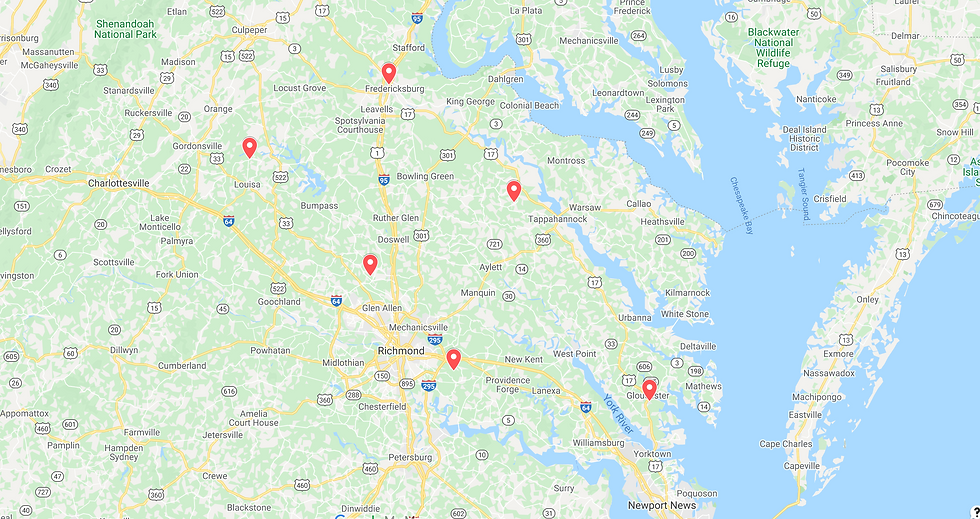
We can trace Grandma Sarah Terry's family back to early Virginia. Many land sales and patents were registered to our Terry ancestors in King and Queen, New Kent and King William Counties which were formed north of the James River. The red markers below show the approximate area of those three counties in 1701. That area lies between the James and Rappahanock Rivers. Our ancestors' properties were in the mid to westerly part of these counties.
Northern Virginia
The Terry's were one of the last of our families to arrive in Virginia and they were the only family to settle in the northern part of the colony. Kent County, the first of any size in the north wasn't formed until 1654. By then, steady growth up and down the James River and its tributaries created a need for more space. In Massachusetts that need led to western movement. In Virginia, newcomers headed north.
Prior to English settlement in that area, the land was occupied by several Powhatan-related tribes including the Tutelo, the Monacan and Manahoac. When these tribes were inevitably pushed out of their ancestral lands, they fled even further north to join an Iroquois tribe in New York. That left the entire area free for settlement and over the next fifty years King William, King and Queen and Louisa counties were formed in that region.
the earliest Terrys
The first two Terrys to arrive in Virginia that are most probably our ancestors came from England as indentured servants in 1653. Headright records show that William Terry was brought over by James Tooke to the Isle of Wight County. Sarah Terry, brought over by Richard Pinner, came on a different ship than William and the relationship between the two is unknown. We find records for four other Terry men living in the area at approximately the same time, Thomas, John, Stephen and James.
Note: All of these named carried down through our Terry generations.
Though the Terrys were not long in Isle of Wight County, it's possible that the Raifords and Terrys were first known to each other from their early Isle of Wight days. Two generations down the line, there began much intermarrying between the Raifords and Terrys.
While it's been impossible to determine the relationships between these six early Terrys in Virginia, we have been able to trace, through wills and land records, Grandma Sarah Terry (2GGM) definitively back to a Champness Terry (6GGF), born ca. 1700 in Virginia. Circumstantial evidence leads us to believe that James Terry was Champness' father. James Terry died in Spotsylvania County and Champness died in the neighboring county of Louisa. We also know that Champness had a brother named James (6U) because he was mentioned in Champness' will.

Our Raiford and Terry ancestors were not long in Virginia. Our grandfathers Matthew Raiford (6GGF) and William Terry (5GGF) (Champness' son) moved south into North Carolina. There William Terry married Matthew's daughter, Anne Nancy Raiford (5GGM). There, also, the Raifords and Terrys were allied with the Covington, Thomas and Wall families for generations to come.


Comments