
The Ballards ~ Your Typical Puritan New England Family
- westmohney

- Nov 11, 2021
- 9 min read
Updated: Nov 12, 2023
Joseph Ballard...his wife being sick...he...fetched two of the persons called the afflicted persons, from Salem village to Andover, which was the beginning of that dreadful calamity that befel us in Andover..." ~ from a signed confession of several accused

in Andover
In 1644, the Ballards, Grandpa William (9GGF) and Grandma Grace (9GGM) moved from Newbury to Andover. There was simply no way for them to have known that Andover, some fifty years later, would become a hotbed of witch accusation turmoil.
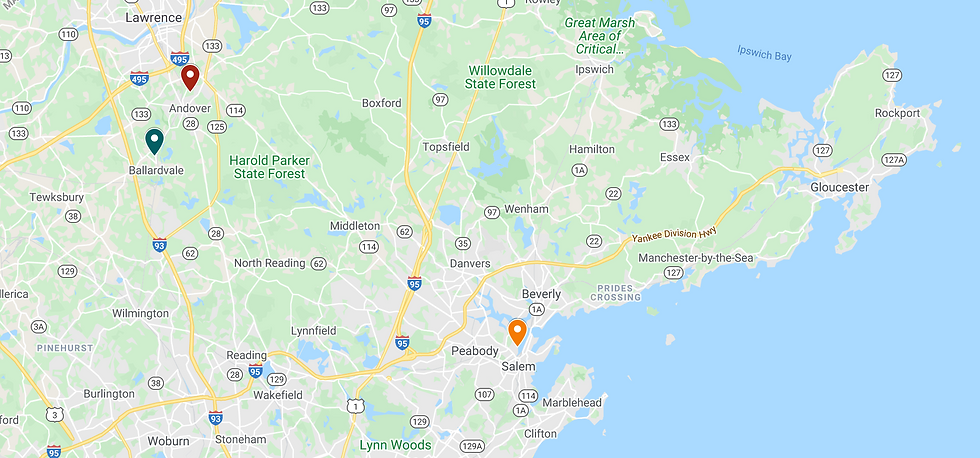
William and Grace had nine children, all born in Andover. Our grandfather Joseph Ballard (8GGF), the oldest child, was born in 1644. Joseph and his brother John (8U) operated a gristmill in the part of Andover which would later be called Ballardvale and still holds that name today.
life is good in Andover
Another of our grandfathers, Edward Phelps (9GGF), had also moved his family from Newbury to Andover at roughly the same time as the Ballards in the mid 1640's. In 1665, the families came together with the marriage of Joseph Ballard to Elizabeth Phelps (8GGM). Joseph and Elizabeth's lives, for the next twenty years, were filled with the raising of nine children, born between 1667 and 1688. Grandpa Joseph was an ensign in the militia and, in 1688, constable of Andover.
Then, in 1689, Grandpa Joseph gets a mill!
From Andover town records for 1689: “Voted, that twenty acres of Land granted to a mill on Shawshin River shall be enjoyed by Joseph and John Ballard and their heirs soe long as they shall keep up a grist and fulling-mill for the good and benefit of the Town, and in case by the providence of god, said mills or dam should come to such casualtie as to be wholly spoyled, and they repair it not within three years after such casualty, then said land to Revert to the Towne.”
Note: Cloth straight off the loom is loose and misshapen. Fulling mills were used to wash out all the dirt and lanolin, then beat the fabric with wooden mallets until it shrunk and tightened into a usable bolt of cloth.
death of the patriarch
William Ballard died, intestate, in 1689 at age 72. All three of his sons were still living in Andover when he died and it was left to them to try and divide his property fairly. So Joseph, William (8U) and John, agreed to divide the estate among themselves "as Equally as they could.” Equally amongst the sons, that is. All the property, naturally, went to the men. Joseph and William received the land where their houses already stood which amounted to about seventy-five acres each. John, the youngest son, married in 1681 and probably spent his early wedded life in the house of his parents. He inherited the housing, land, and meadow where his father and mother lived.
The sons agreed to give a small cash settlement to each of the sisters. They also provided for their mother, allowing her a room in the homestead house and John agreed to care for her as long as she remained a widow which turned out to be for the next five years. Grandma Grace died in 1694 at age 75.
William Chandler's taven
The Ballard and Chandler families were quite close, living side by side and intermarrying for many generations to come in Andover. The families were so close, in fact, that when William Chandler got into a wee bit of trouble with the town, the Ballards were at the forefront of the faction that supported him. William Chandler had opened a public house (tavern) in 1686. Four years later, many of the townpeople were up in arms. A petition was sent to the Court complaining about Chandler's "epidemicall evill"
"Wee your most humble petitioners in the name of many more, if not of most of the town do make our address to your honors to exert so much of your power and authority as may release us of the matter of our greivance wch is grown so much an epidemicall evill that overspreads and is like to corrupt the greater part of our towne if not speedily prevented by your help : viz to put a stopp to William Chandler's license of selling of drink...indeed at his first setting up he seemed to have some tendernesse upon his conscience not to admit of excess nor disorder in his house; but...the earnest desire of money hath proved an evil root to him...for through his over forwardness to promote his own gaine he hath been apt to animate and to entice persons to spend their money & time to ye great wrong of themselves and family they belong to; and to that end will encourage all sorts of persons both old and young to spend upon trust, if they have not money, & to some he will proffer to lend them money to spend rather than that they should be discouraged from such a notion... servants & children are allowed by him in his house at all times... sometimes till midnight and past & till break of day, till they know not their way to their habitations, and gaming is freely allowed... Many such pertiklers might be instanced and easily proved, but we be willing for brevity's sake to omitt much of what might be said of the like mater, but be sure if he be not restrained from the selling of drink our town will be for the greatest part of our young generation so corrupted thereby that wee can expect little else but a cours of drunkenness of them; and what comfort will that be to parents to see such a posterity coming on upon the stage after them? To this wee whose names are underwritten as your humble petitioners doe attest by our hands hereto."
This harsh petition was forthwith sent to the Court but the selectmen of the town, Grandpa Joseph Ballard among them, got a jump on the naysayers. To the damning petition, they attached a codicil attesting to the "good order" of William's tavern:
"William Chandler senr of Andover hath kept a house of publick entertainment for some considerable time past & hath kept good order in sd (said) house (soe far as wee are informed) & being an infirm man & not capable of hard Labour & deserving of approbation for his continuance in that employment we cannot but judge him a meet p'son for it & his house convenient for travelers. "
William Chandler kept his tavern. But some would later argue that the existence of this place of "epidemicall evil" did somehow contribute to the all pervasive evil of the witch trials which came to pass only two years later.
Note: Eighty-five years later, during the Revolutionary War, that same tavern was owned and operated in Andover by our uncle, Hezekiah Ballard (6U).
things fall apart
In 1687, our grandparents Joseph and Elizabeth Ballard welcomed their eighth child into the family, daughter Tabitha (7A). Sadly, little Tabitha died shortly after her first birthday. Only a year later, Joseph's father William, the patriarch of the family, died. The very next day, 11 July 1689, Joseph's sister Elizabeth (8A) died as well. Shortly before the deaths of father William and sister Elizabeth, Joseph and his wife Elizabeth had been blessed with another daughter, their second Tabitha. This little girl, like her namesake sister, was not strong and she, too, died a year after her birth.
The death records for Andover do not list the cause for any of these deaths. It's highly possible, however, that the spate of deaths was due to an outbreak of smallpox that hit New England in those years. Smallpox epidemics had plagued the colonists on and off since their arrival in the New World. While not as devastating for the settlers as it was for the Native Americans, the disease still took its toll.
Then, in July of 1692, Grandma Elizabeth Phelps Ballard fell ill. Joseph Ballard, at his wit's end, could conceive of only one explanation for his wife's illness. She had been stricken down by the accursed witchcraft.
fetching the afflicted ones
Elizabeth Ballard was not the first in Andover to fall into the scourge of witchcraft. The accusation of witchcraft had already, of course, reared it's ugly head with the arrest and trial of Martha Allen Carrier, sister-in-law of our Uncle Roger Toothaker (8U). Grandpa Joseph certainly knew of the terrible turmoil happening all around him, not just in Andover. He jumped immdiately into the fray, asking some of the "afflicted girls" from Salem to come visit his sick wife.
I can find no definitive names for the "afflicted" girls who came from Salem at Joseph's bidding but they were most likely two of the seven major players. The Salem Witch Museum says that "it is assumed they were Ann Putnam and Mary Walcott." However, the only two that testified in the procedings concerning Elizabeth's case were Mercy Lewis and Elizabeth Hubbard.
The "afflicted girls" comfirmed that Elizabeth had, indeed, fallen under the spell of witchcraft. And, as it turned out, Grandpa Joseph had set off a frenzy of accusations that rocketed Andover to the forefront of the hysteria. From a declaration signed by some of the accused of Andover caught up in the frenzy:
Joseph Ballard, of Andover, his wife being sick at the same time, he, either from himself or by the advice of others, fetched two of the persons, called the afflicted persons, from Salem village to Andover, which was the beginning of that dreadful calamity that befel us in Andover..."
Once the probable witches were identified by the afflicted ones, the real test began. In their declaration, the accused described what then happened to them:
"...we were blindfolded, and our hands were laid upon the afflicted persons, they being in their fits and falling into their fits at our coming into their presence, as they said; an some led us and laid our hands upon them, and then they said they were well, and that we were guilty of afflicting them. Whereupon, we were all seized, as prisoners, by a warrant from the Justice of the Peace and forthwith carried to Salem."
Among the signers of this Declaration was our aunt Deliverance Haseltine Dane (9A). Her story will be told in our next post.
Grandpa Joseph's complaint
On July 19th, Grandpa Joseph filed a complaint with the Magistrates: "Joseph Ballard of Andover husbandman Complaineth of Mary Lacy and Mary Lacy, Jr. of Andover as followeth that whereas this Complainers Wife Elizabeth Ballard hath been this Severall monthes Sorely aflicted & visited w'th Strange pains and pressures & remains so to this day which I verily beleive is Occasioned by Witchcraft and have cause to Suspect the above Mencioned Mary Lacy & her daughter Mary to be the Actors of it & accordingly Enter this my Complaint against them & acknowledge my Selfe Indebted to Our Soveraign Lord & Lady the King & Queen One hundred poundes Currant money of New England On Condition to prosecute this my Complaint to Effect as the law directs..."
Joseph Ballard had to have been quite a wealthy man to pay a whopping £100 to prosecute these women. With the prosecution money and money charged for keeping accused witches in prision, William and Mary, king and queen of England at the time, must have made out pretty well.
The complaint below is signed by Grandpa Joseph in the lower right corner.

afflicted unto death
Mary Lacey was the first person identified to have afflicted our grandmother Elizabeth Ballard. Her examination took place on July 21st. When asked if she was a witch, Mary answered that she was. She went on to name Richard Carrier, nephew of our uncle Roger Toothaker, as a witch also. In her examination Mary only admitted to being at Elizabeth Ballard's house, but basically threw Richard under the bus: "...it was a'bt afortnight Since we went upon poles in the night we got into the house & and this Rich'd afflicted Ballard by pinching & choaking her...and laying his hand on her Stomak..." Mary also said "further that this Rich'd told her he would Kill Goody ballard..."
Note: In the same examination Mary admitted to afflicting our cousin Timothy Swan (1C10X).
Six days after Mary Lacey's examination, on 27 July 1692, Grandma Elizabeth died of her illness. She was only forty-six years old. Three of her children were grown but she left Joseph with three underage children, thirteen, ten and eight.
The frenzy in Andover that began when Joseph Ballard "either from himself or by the advice of others, fetched two of the persons, called the afflicted persons, from Salem" did not, of course, end with the death of his wife. Three days later, when another accused witch, Mary Bridges was examined, she declared that "(Hannah) Broomage was in her society at Ballards house telling to her face she was there in her spirit...S'd Bridges said further that broomage hurt ballards wife by sitting on her breast."
the trials wind down
In Septemeber, Elizabeth Hubbard and Mercy Lewis both "affirmed to the grand Inquest" that they had seen "Mary lascy afflict: Joseph Ballards wife of Andover."
Below are Elizabeth Hubbard and Mercy Lewis' depositions:

In the end, however, no one was ever indicted for afflicting Grandma Elizabeth. All those accused of tormenting Elizabeth Ballard were indicted later for afflicting other people. The accused remained in jail for another six months until January of 1693 when the colony was finally sick of witches and inquiries and hysteria. The obligatory trials were held and all remaining incarcerated were released.
aftermath
Grandpa Joseph was only forty-seven years old when Grandma Elizabeth died. He didn't wait long to get on with his life. On 15 Nov 1692, while the furor he had begun was still raging, Joseph married twice widowed Rebecca Ray whose first husband died at the Battle of Bloody Brook in King Philip's War. Joseph and Rebecca had three children.
In 1717, when he was nearing seventy-five, Joseph began dividing his property amongst his sons. His oldest son, Joseph, Jr. (8U), had most probably taken over the running of the grist and fulling mills. Joseph, Sr. left property to all of his sons and a quarter share of his corn mill to four of his other sons. He died in 1722 at seventy-nine years.
Twenty-nine years after his death, a dam was built at the site of Joseph, Sr.'s mills, then owned by his grandson, Timothy Ballard (1C8X). The dam would usher in a grand manufacturing boom in Andover.


Comments