
War and Peace in Billerica

During all these years of danger, the inhabitants must have grown unpleasantly familiar with the trouble and annoyance, as well as the peril, of garrison life. ~ Henry Hazen, History of Billerica

before the war
Billerica, founded twenty-three years after the Great Migration began in 1630, was fairly late to the party. The prospect of large land grants, however, appealed to families living in overcrowded established towns and, in less than twenty years time, forty-eight families called Billerica home. Eight of those families were our relatives.
Relative peace reigned in Billerica in the twenty years before King Philip's War. From town records in the year 1661, we get a sense of day to day life in a colonial town. Evidently wolves were a problem and a bounty was set for their slaughter. In 1661, our uncle Ralph Hill, Jr. (8U) along with "John, Indian, received each one pound for wolves killed."
One thing in 1661 Massachusetts remains the same today: the wealthy carry clout. Our cousins, Francis (1C8X) and John Wyman (1C8C), already large landholders in Woburn were graced with a grant of another eighty acres in Billerica. Neither Francis nor John ever actually lived in Billerica. The new property was just another notch in their belts.
It seems that stray animals were an extremely common annoyance in the colonies and the cause for many a lawsuit. For enterprising men, however, wandering livestock offered a way to make a little extra income. Our grandfather John Kittredge (9GGF), looking to make a few shillings, "is desired to see to the fulfilling of the order about ringing and yoaking of swine." This practice, which had recently fallen out of use, was revived by Grandpa John and he got sixpence for "every swine he doth ringe." The only caveat was a three day warning he was required to give the swine owner.
Note: The owners of hogs were responsible for yoking (collaring) and placing rings in their noses. Grandpa John was paid by the swine owners who either couldn't or wouldn't ring their own hogs.
And, finally, 1661 was the year that our grandfather Ralph Hill, Sr. (9GGF) gave a half acre to the town for a burying ground provided the "Towne shall fence all against it Next to his own Land..." It is beleived that Grandpa Ralph was the first person buried in the ground that he donated.
Grandpa Ralph's will
Our grandfather Ralph Hill, Sr., a founder of the town of Billerica, was one of its most prominent citizens. In ten years time, he had been influential in town governance and had also amassed large tracts of land. Shortly before his death in 1663, he set about dividing his large estate in his will. As is often the case, children of a first marriage don't make out quite so well as those of a current wife. Ralph Hill, Jr., the only son of Ralph, Sr.'s first wife, received a mere £23. The two sons from Ralph, Sr.'s second marriage, Jonathan (8U) and Nathaniel (8GGF), received the bulk of his considerable properties. Jonathan Hill inherited his father's homestead and our grandfather Nathaniel Hill inherited two half lots on the Dudley Farm and a half-interest in his father's share of the Edward Oakes farm. Even step-son Roger Toothaker (8U) got his piece of the pie with thirty-three acres of meadowland.
Below is a portion of Grandpa Ralph's will signed by him at the bottom.

the war years
Billerica, like its near neighbor Chelmsford, was considered a frontier town in 1775. As with many other frontier towns in New England, the dread produced by constant fear of attack in the war years caused many to leave their homes and seek refuge in the garrison houses set up by the village militia. Billerca's former peaceful days were replaced with the "trouble and annoyance as well as the peril" of garrison life.
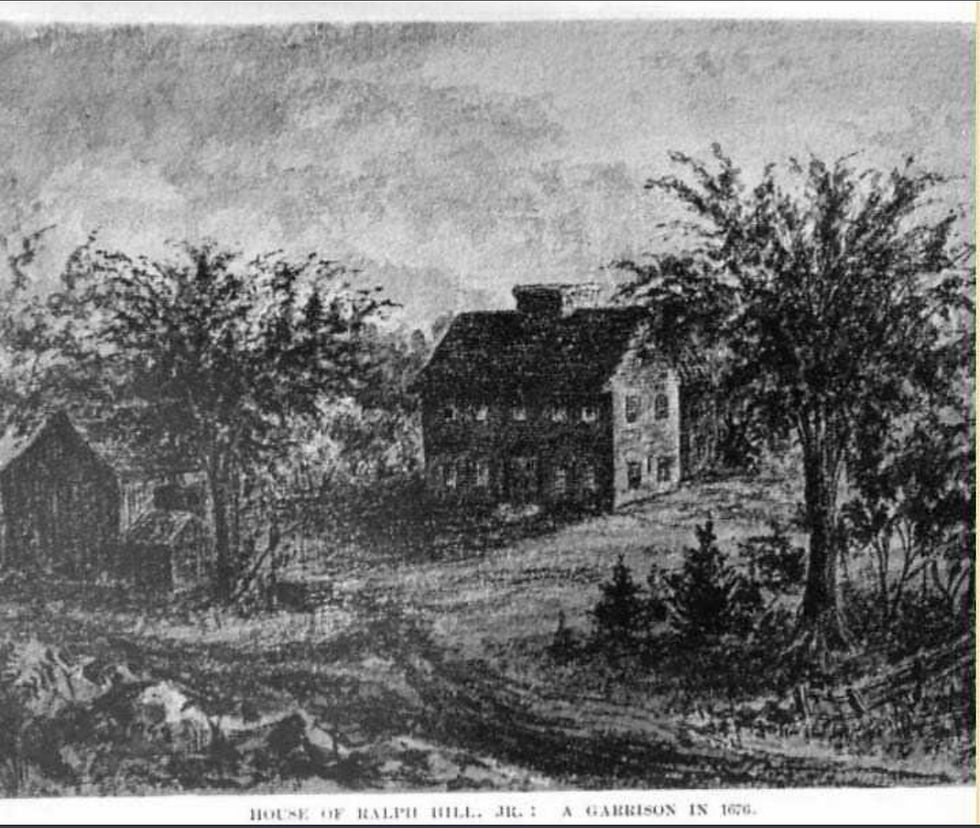
There were forty-seven houses in Billerica. Twelve were made garrison houses during the war. Our relatives who had their homes turned into garrisons were Uncle Ralph Hill, Jr., Cousin Simon Crosby (1C12X), Grandpa Thomas Patten (9GGF), Grandpa James Kidder (8GGF) and Cousin Jacob French (1C9X). Two of these houses are pictured in Henry Hazen's History of Billerica written in 1883. Below: Ralph Hill, Jr.'s house and what is believed to be Jacob French's house.

The majority of the men in Billerica, as in most towns, saw service defending garrisons in their own hometowns. In addition, some defended other town garrisons and participated in battles waged in various parts of the country. Our uncle Jonathan Hill who served as a corporal in the war, helped with the defense of the Groton garrison. Our cousin John French (1C9X) who married our grandmother Mary Littlefield Kittredge (9GGM), granddaughter of Ralph Hill, Sr., was wounded in the Great Swamp Fight.
Our grandfathers James Kidder and James Kittredge both died in 1676, the final year of the war. It seems likely that one or both may have died due to wounds sustained in the war. The Resgister of the Society of Wars has John Kittredge listed as a scout in 1676, a dangerous post. Most probably he was wounded or killed in that capacity.
While the war years were no doubt anxiety-ridden, Billerica came out of them relatively unscathed with only two minor attacks in the year-and-a-half conflict.
after the war
Even though Billerica had not sustained the kind of damage that many towns had endured, they, like all towns, were suffering from a shortage of supplies and general financial difficulties from higher taxes required to pay for the war. Billerica made the requisite appeal to the Council for relief on these taxes. This appeal was signed by Uncle Ralph Hill, Jr. and our cousin John French.
Our uncle Jonathan Hill, who had inherited Ralph Hill, Sr.'s homestead, did quite well for himself once the economy began to recover. He was able to acquire even more property in a Billerica land division of 1705. He received 91 acres in what is now Bedford, 162 acres in what is now Tewkesbury, and 70 acres in two pieces west of the Concord river.
Our grandfather Nathaniel Hill (8GGF) had married Elizabeth Holmes (8GGM) in 1667. Thanks to his father's bequest he, like his brother Jonathan, was quite a wealthy man. In 1688, his tax assessment in Billerica was the third largest in town. Nathaniel and Elizabeth moved to Chelmsford in 1689 at the outbreak of the French and Indian Wars. His story in Chelmsford continues in a future post.
Our grandfather, Enoch Kidder (7GGF) was twelve years old in 1676, the year his father James Kidder died, possibly from wounds sustained in the war. James Kidder was only fifty years old when he died unexpectedly and intestate, leaving twelve children, nine of them sons. Enoch was the ninth child born. Most probably when he married Mary Heywood (7GGM) of Concord in 1685 he had little inherited property to start his new life. He was not active in town affairs and few records remain of his life. Mary died in 1742 at 72 years. A year later, when Enoch was 79 yearls old, he married Rachel Crosby (2C11X), daughter of our cousin, Simon Crosby (1C12X). Rachel was no spring chicken herself at 70. Enoch died in 1752 at 88 years of age.
Our grandfather James Kittredge (8GGF) was only eight years old in 1676, the year his father, John Kittredge (9GGF), died. Very little is known about our Grandpa James. The only thing we know for sure about his wife, our grandmother, is that her name was Sarah (8GGM). I can find no record of any civic affairs or offices held by James. He and Sarah had four children. James died in 1739 at 71. I can find no record of Sarah Kittredge's death.
cousin Simon Crosby
Simon Crosby (1C12X) was only two years old when his father, also Simon Crosby (2C13X), died in Cambridge shortly after the family's arrival in the New World. In 1645, his mother, our aunt Anne Brigham Crosby, remarried and moved with her three sons to Braintree, MA.
Simon married Rachel Brackett in Braintree in 1657. In 1660, they were lucky enough to acquire a large plot of land in Billerica and the couple left Braintree for Billerica in 1662, thirteen years before the start of the war. Simon made seventeen land purchases over the next twenty years, ensuring that his six children would be well set up when he died. Shortly after his arrival in Billerica he was chosen a “surveyor of highways” and did his stint at constable twice.
Simon's log cabin was well built and therefore chosen as one of the garrison houses in Billerica during King Philip's War. Since the house was located on the main road, he often took on the role of hosting town meetings. Possibly finding himself good at hosting, Simon decided to go a step further. In 1672 he was approved by the Council to become a tavern keeper. His tavern, doubling as one of the garrison house, must have been a welcome respite during the war years.
When the war ended, Simon took advantage of a 1660 law requiring that every town to have lodging for visitors. He built a bigger house and expanded his tavern operation into an inn. Simon became one of the most prosperous men in the town of Billerica. He must have liked his chosen profession because he lived to the ripe old age of 87.
Note: Simon’s property was owned by his descendants for at least 250 years. The house he built in 1678 became known as “Crosby Place,” and remained in use until 1878 when fire destroyed it.

According to the article "The Lost History of Slaves and Slave Owners In Billerica," by Christopher M. Spraker, published in the Historical Journal of Massachusetts, much of Simon's prosperity was due to help from an unusual source. A small faction of Billerica's wealthier residents owned African slaves, freeing them to concentrate on "new professional activities." Simon owned at least one slave named Dick who would probably have done "myriad tasks in the field and in the home." Dick died in 1674. He was not the last slave the Crosby family would own. We'll have the full story of Billerica slave owners in a future post.
colonial tavern keepers
The first tavern in the Massacusetts Bay Colony was opened in Boston in 1634. Taverns, which served many purposes in colonial towns, quickly became centers of social and political activity. This is no surprise given the colonists love for all things alcohol which the tavern keepers happily supplied. In addition to alcohol, tavern keepers provided directions to travelers, entertainment and, often, a place to spend the night. Because many towns had taverns before they had a meeting house or church, taverns were also frequently used as courthouses and meeting places to conduct town business.
The Puritans, naturally, sought to regulate the taverns as well as people's behavior while imbibing. A license was required for operation and, for the most part, tavern keepers were men of high repute and respectibility in their towns (our incorrigible grandfather Daniel Clark (9GGF) of Topsfield a possible notable exception). Every innkeeper had to be recommended by selectmen and other town officials. Further regulations included a ban on serving alcohol to "Indians and Negroes." In addition, playing cards, billiards, dice or the dreaded shuffleboard was strictly forbidden. To make taverns even less fun, a 1664 law stated that "there shall be no rude singing in taverns and ale houses." Tavern keepers were also instructed to provide no service to “any rogues, vagabonds, thieves, sturdy beggars or masterless men or women..."
While taverns had been an integral part of colonial life shortly after the first ships in the Winthrop Fleet landed, inns became popular in the second half of the century. As horse and coach travel became more common, inns were a welcome resting spot for both the horses and weary travelers. By the 1660's every town was required to keep lodging for visitors. Innkeepers served meals as well as drinks and all inns had to provide at least two beds for travelers to sleep in. Many of the roads leading directly to Boston had taverns spaced about eight miles apart.
Taverns and inns were so important to colonial life that incentives such as land grants, pastures for cattle, or exemption from school and church taxes were offered to citizens who considered opening a tavern. Not only were taverns used as meeting places for assemblies and courts but also became important venues of debate and discussion. It would not be surprising to learn that the fires that fueled the American Revolution were fanned from tavern to tavern.
other Billerica relatives
Our grandfather William Patten (10GGF), of Cambridge, was granted lands in Billerica in 1654. He gave these lands to his son Thomas (9GGF) who moved to Billerica shortly afterwards. In 1662, Grandpa Thomas married Rebecca Paine (9GGM) whose father Thomas Paine (10GGF) had settled in Dedham in 1640. Theirs is another story of long distance romance as about twenty-five miles separate Dedham from Billerica.
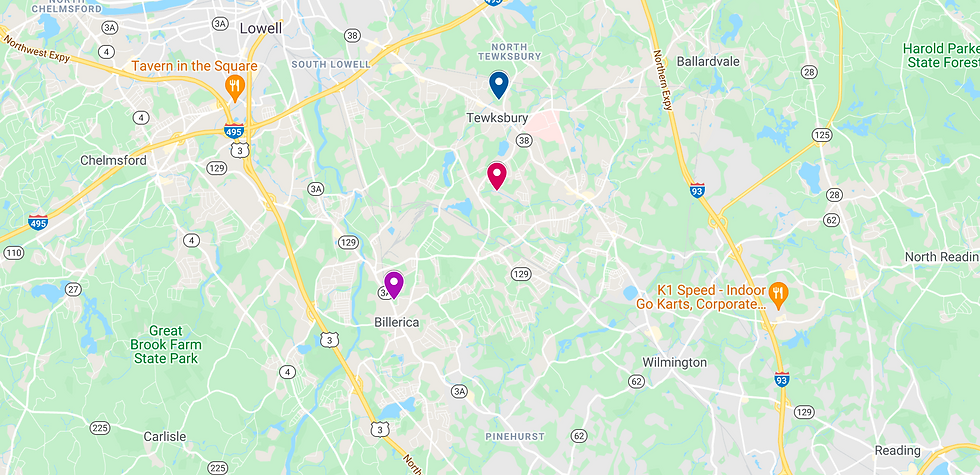
Thomas was able to acquire considerable property in Billerica and also a sawmill in an area of Billerica now called Pattenville. In the map below, Pattenville is the red marker between Tewksbury, the part of Billerica where the Kittredges lived, and Billerica proper.
Note: Notice Ballardvale to the right of Tewksbury. That town was named after our Ballard relatives from Andover (not shown, but to the north east of Ballardvale).
Thomas and Rebecca had seven children. Rebecca died at 38 in 1680 eleven days after giving birth to her seventh child. The child survived. Somehow Thomas managed for six years on his own with his seven children aged 16, 14, 12, 9, 5, 3 and two weeks. In 1686, he finally married widow Sarah Kendall Dutton. Together they had two children before Thomas died in 1690 at age 54. His underage children at the time of his death included 15, 13 and 10 year olds from his marriage to Grandma Rebecca and a two year old and a nine month old baby from his second marriage. Eleven months after Thomas' death, his widow married our uncle Thomas Richardson (8U).
In 1667, our uncle Thomas Richardson, Jr. moved to Billerica from Woburn where the powerful Richardson family held sway. Thomas had already received his inheritance from his father, our grandfather Thomas Richardson, Sr. (8GGF) who had been one of the founders of Woburn. Thomas, Jr. was able to acquire a whopping nine hundred acres in Billerica, making him one of the largest landholders there. When his first wife died, he married Sarah Kendall, second wife of our grandfather Thomas Patten (9GGF).
Note: I must apologize for the confusing array of Thomases in the two preceding paragraphs. Back in the day names like Mason, Carson and Devon were unknown and the colonists had to resort to Thomas, John and William in every blasted family.


Comments