
A Hodgepodge of Ancestors
- westmohney

- Aug 23, 2022
- 12 min read
To forget one's ancestors is to be in a brook without a source, a tree without a root ~ Chinesse proverb
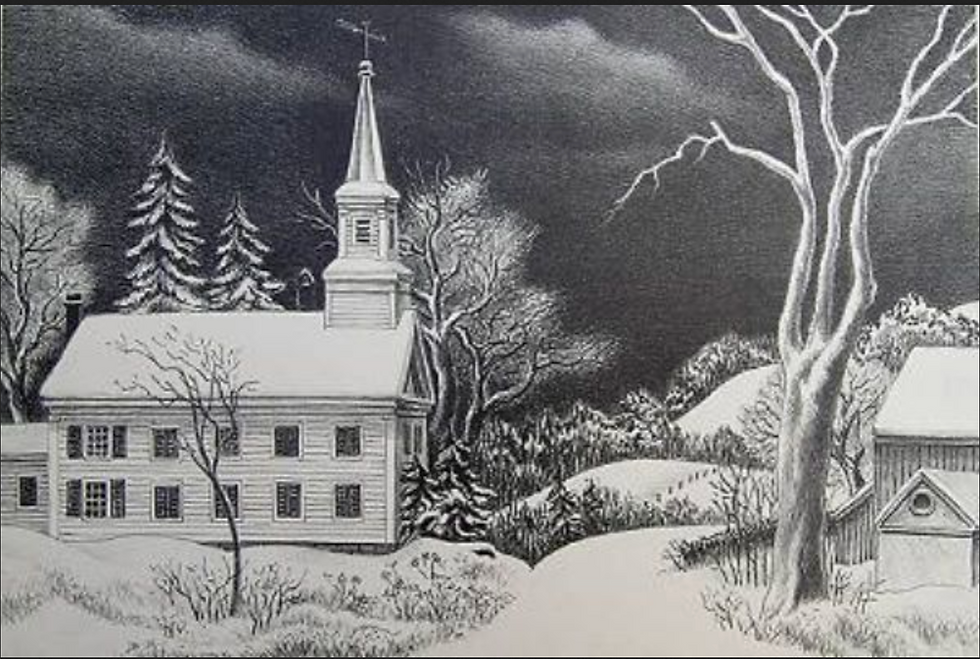
died on the battlefield
Our grandfather Samuel Dalton (9GGF) died in Hampton, New Hampshire in 1681 at the age of 52. After his death, Grandma Mehitable (10GGM) left Hampton and went back to her hometown of Haverhill, MA. Her grandson, our cousin Isaac Dalton (1C9X), was born there in 1699.

When another one of the seemingly endless French and Indian wars began in 1744, Cousin Isaac marched out to do his part. King George's War officially began in Europe in 1739 but didn't involve England and France until 1743. Word of the war declaration arrived in Louisbourg, New France in early May of 1744. As soon as word hit the colonies, the French lost no time beginning hostilities. From a nearby fort, they raided the English fishing port of Canso on May 23. A painful year ensued for the English.
Note: Canso, formerly French territory, lies on the eastern shore of Nova Scotia. The peninsula was awarded to the British at the end of Queen Anne's War in 1713. Conflict over the area, however, continued for another fifty years.
In May of 1645 conditions changed for the English. All was not well at the Fortress of Louisbourg, located on the present day island of Breton, only 120 miles from Canso. Fort Louisbourg protected the chief entrance to Canada as well as the Canadian fisheries.

Word reached Boston, 800 miles away, that the rank and file at Louisbourg were disgruntled. Promises of a share in the spoils from Canso hadn't materialized. In December of 1744, the French troops mutinied. By spring of 1745 conditions hadn't improved, making the fort a prime target for the English.
The attack by the British on the French fort began on 11 May 1745. The attack turned into into a six week siege. Ultimately, however, the English were successful in taking the fort. Louisbourg would be an important negotiating piece at the end of the war in 1748 when the fort was returned to the French in exchange for other concessions favorable to the English.
Our cousin Isaac Dalton was one of the English soldiers who participated in the siege of Louisbourg. He died on the battlefield. Possibly already wounded, Isaac wrote a letter to his family which is now is the possession of his great-great-grandson, Benjamin Dalton Dorr (5C5X). A copy of the letter was made by Benjamin's father, Edward Dorr, in 1839. Edward had married Ruth Dalton (4C6X), great-granddaughter of Isaac. I have not been able to find a copy of the the letter but, evidently, Isaac instructs his oldest son Samuel (2C8X), who was 17 at the time, to take charge of the family. On the back are the names and birth dates of all his children.
Prior to Cousin Isaac leaving for the Louisbourg, he and his wife Mary had ten children but, eight years before Isaac left for Louisbourg, tragedy hit the Dalton family. In December of 1637 and January of 1738, four of their children died in the Great Throat-Ail epidemic. We wrote about this disease, later identified as diptheria, in our Around Woburn post. Our cousin Aaron Richardson (3C8X) also had four of his children taken in the epidemic. When the disease hit the Dalton family, they had five children. Only their oldest son, ten years old at the time, survived. The other four, ages seven, five, three and one, died in a one month period. Isaac and Mary would subequently have five more children, the last one born a year before Isaac left the family to serve his country.
Mary, left with six children, five of them under eight, received just £40 for Isaac's wages at Cape Breton. Isaac's inventory revealed that he had only £218 to leave the family of seven members. Mary received a dower's right to live in the farmhouse but, by 1754, she was forced to petition the town several times for money to make ends meet. She died in 1758. It wasn't until 1761, sixteen years after his death, that Isaac's children finally settled his estate.
Note: Our cousin Benjamin Kidder (1C8X) was also killed at Louisbourg. He was forty-eight year of age.
the men's club
Our cousin Michael Dalton (1C9X) was a first cousin to Isaac Dalton who died on the Louisbourg battlefield. Born in Hampton, NH, Michael moved to Newburyport when he was a young man.

Following a life at sea, Michael made several voyages to the West Indies as a ordinary seaman. Finally placed in command of a ship, he soon became the owner of his own ship and an importer of West Indian goods. In 1646, with his import business proving quite lucrative, Michael bought three acres of land on what was then Fish Street in Newburyport at the mouth of the Merrimack River. Threre he built a beautiful home with "a spacious barn and a courtyard adjoining."
Twenty years later Michael purchased a wharf close to his home at the end of what is now Market St. There he established a distillery.

Cousin Michael's house, now on the Register of Historic Places, is one of the best preserved Georgian houses in the town of Newburyport. When Michael died, his son Tristram (2C8X) inherited the house. Tristram was one of the first U.S. senators elected after the Revolution and hosted a number of "luminaries" at his impressive home. One of his guests was none other than George Washington himself. He also knew our second president John Adams quite well as they had been at Harvard together.

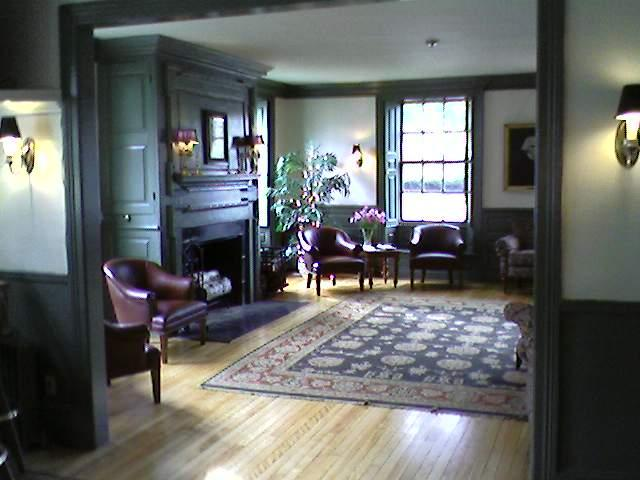
In 1898, Michael's former home was purchased by The Dalton Club. The Dalton Club describes itself as "a Social Club organized for the purpose of maintaining a historic home." For over 100 years, however, the Club has actually been a "male members-only private social institution" with extremely limited membership. Below is the parlor of the Club where members can "relax, mix with their friends, play parlor games, get a meal... and a convenient retreat for men who wish to get away from their female relations."
a protested marriage
On 10 August 1708, John Merrill filed his intention to marry our cousin Deborah Haseltine (2C10X). But wedding bells would have to wait for the unlucky couple. According to Essex County court records, "the marriage was 'forbidden' by Penuel Titcomb at the request of Sarah Sawyer, single woman." It seems that Sarah was with child and she claimed John Merrill was the father.
Sarah's child was born in sometime before December of 1708 but, sadly, lived only a few hours. John Merrill was ordered to pay her costs of 40s. Then, as most often happened, the wedding of John and Deborah went on as scheduled and they could both forget that the unfortunate episode ever happened.
the last laugh
Our branch of the Baldwin family, brothers, Henry and John Baldwin, settled in Woburn and Billerica, respectively. Their (and our) cousin Richard Baldwin (1C9X) settled in Milford, CT.

Cousin Richard became friends with Towtanimoe, the sagamore (leader) of the Paugussett tribe that lived near Milford. In 1659, "Towtanimoe, Sagamore of Pawgusutt...at the house of Richard Baldwin at Milford...The sayd sagamore did grant the meadow known and denominated by the name of Hogg Meadow unto Richard Baldwin." In 1661, Towtanimoe granted to Richard "all the upland adjacent to Hoggs Meadow." Then in 1665, "Ockenung, the sole and onely Sagamore of Pagasett" confirmed all the grants formerly made and gave Richard a deed, cementing his ownership.
Richard died in 1665, only months before the birth of his last son, Barnabas (2C8X). The event of Richard's death turned out to be extremely unlucky for poor Barbabas. Richard had made no provision for his unborn son in his will. It's possible that Richard died before knowing about his wife's pregnancy. As the law stood in Connecticut at that time, poor Barnabas was not entitled to any share of his father's large estate.
When he came of age, Barnabas eked out a living on his own somehow but evidently had some hard times. He didn't marry until he was forty years old. When he finally took the leap, he married a cousin of his and ours, Sarah Buckingham (3C9X), daughter of Thomas and Sarah Baldwin Buckingham (2C10X).
Finally, in 1711 when Barnabas was forty-six years old, his siblings must have taken a little pity on him. They conveyed to him half the rights to the piece of swamp land called "Hogg Meadow," which was a section of the property their father Richard had received as a gift from Towtanimoe. It's probable that Barnabas' brothers thought they were throwing him a bone. In an ironic twist, when the swamp was cleared out, Hogg Meadow would turn out to be "by far the best part of the township."
In another ironic twist, Barnabas' son Syvanus (3C7X) was also born posthumously and his brothers and sisters in turn coveyed Hogg Meadown to him. Sylvannus built a house on the newly valuable property he had inherited from his father. All's well that ends well.

Sylvanus must have done well for himself. He left a portion of his estate to "Ye College at New Haven." The college Syvanus left money to was Yale, founded in 1701.
Thomas Brigham's great sleep
After the death of his father, Simon Brigham (1C13X), our cousin Thomas Brigham (2C12X) moved to from Cambridge to Marlborough with his mother Marcy Hurd Brigham who had married Marlborough resident Edmund Rice.

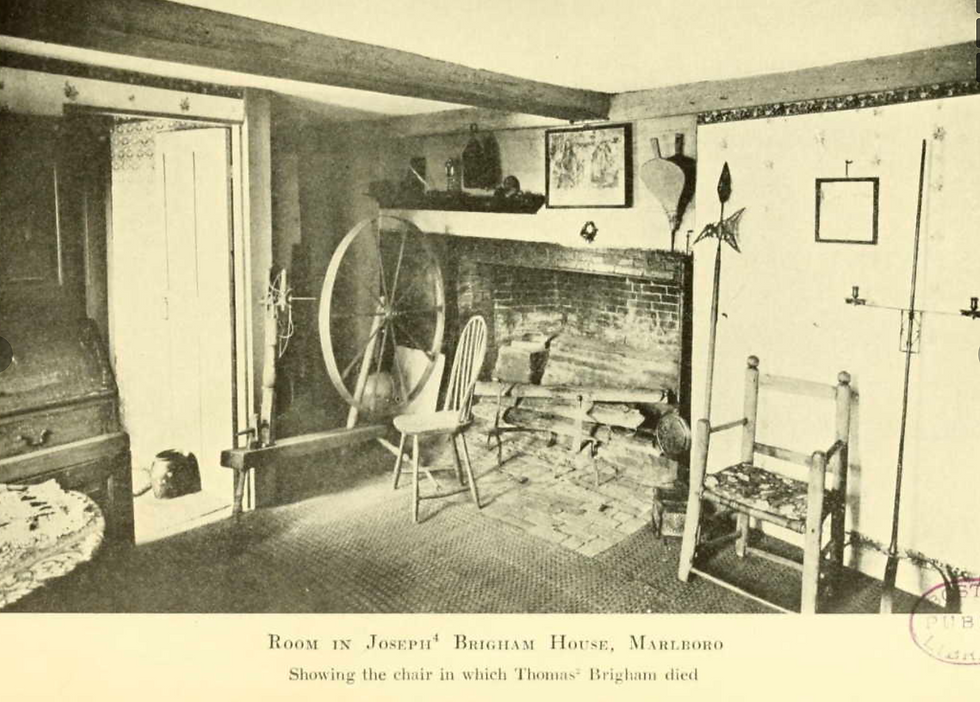
Thomas was fortunate enough to purchase property from his stepfather but, later, he acquired large tracts of land in his own right. Thomas built a house on the land purchased from his stepfather. According to family lore: "One day Thomas was found sleeping in his chair. He was 76 years old when this great sleep came upon him. They laid him away in 1716."
Below are pictures of the room where Thomas died and the chair in which he took his final rest. The chair is displayed in the Northborough town museum.

capture of the Rice boys
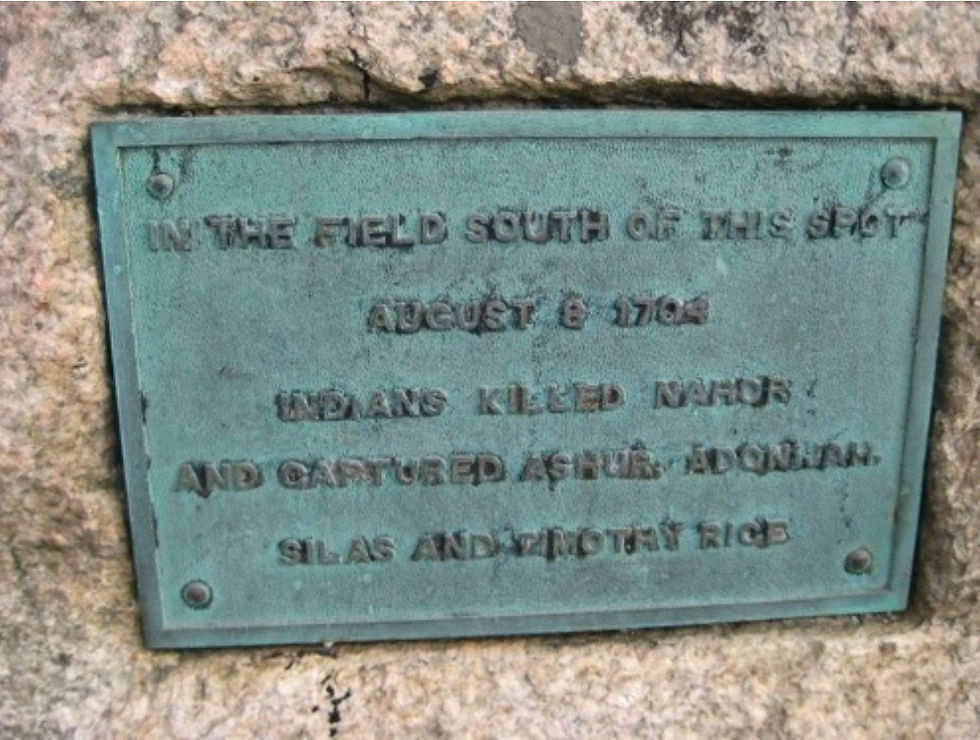
In 1704, two sons and three nephews of Thomas Rice, step-brother of our cousin Thomas Brigham, were captured by the Cagnawaga Indians from Canada. The boys were Asher, 10, Silas, 9, Adonijah, 8, Timothy, 7 and Nahor, 5. Little Nahor, obviously considered too young to make the trip, was killed immediately. The other four boys were marched up to Canada.
Note: The Rice's were obviously fond of obscure Bible names. Some other family names were Zephaniah, Zipporah, Cyprian, Pelatiah and Abishai.
Four years after the capture, Asher was redeemed by his father, Thomas, who sold his house to pay the ransom. Adonijah, Silas and Timothy were adopted into the Canawaga tribe. Adonijah later left the tribe and married a French woman. Silas and Timothy stayed with Canawaga for the rest of their lives. Timothy was adopted by a chief of the tribe and became "a respected chief of the Iroquois Nation himself."
Silas was given the name Jacques Tannahorens. He married an Indian girl named Marie Tsiakohawi and together they had five children.
Below is a memorial plaque placed near the field in what is now Westborough, MA, where the boys were taken.
eating up the estate
Our cousin James Hildreth (1C9X) moved from Chelmsford to Westford, Massachusetts in 1732. There he and his wife raised nine children. Then, in 1755 when James was 57 years of age, trouble visited the family. On 28 June of that year, a letter was written to the Probate Judge of Westford requesting that a guardian be put over "James Hildreth who is sometimes quarrelsome, mischievous and the neighbors will no longer suffer him at large. Someone is needed to take care that he will not eat out his estate and ruin the family who are at present in very good circumstances." It was requested that either his wife or eldest son Oliver (2C8X), then 32, be appointed his guardian.
It was a sad end of life for James who had, up until that time, provided very well for his family. He died six years later at the age of 63.
tragedy in the field
During the uncertain times of Queen Anne's War, our cousin Mary Brigham Fay (3C11X) was living with her husband and children in the frontier town of Marlborough. On the afternoon of August 18, 1707, Mary, six months pregnant at the time, was gathering herbs in a meadow with her two young children, Gersham Jr. (4C10X), 4, and Mary, Jr. (4C10X), 2. With them was a friend, Mary Goodnow. Mary Goodnow had the misfortune to have been "afflicted with a lameness of the leg which did not allow her to walk with much dexterity or run with any speed."
On this afternoon as they worked, the women "saw 20 or more stout Indian warriors stealthily approaching them. They immediately ran for the fort." Poor Mary Goodnow "being lame, could not escape from her merciless pursuers. She was overtaken, seized and dragged into the woods across Stirrup Brook and inhumanly murdered and scalped..." Her remains were found a few days later and buried.
Cousin Mary was more fortunate than her companion. She, with her children, managed to reach the safety of the garrison house.
disaster at the pond
For this story thanks go out to Wilkes Allen and the Reverand Wilson Waters, who both wrote histories of Chelmsford. Further thanks go to Chelmsford historian George A. Parkhurst who followed up with a more modern history of the pond.

In 1700, our cousin John Richardson (2C9X) of Chelmsford purchased, "one corn mill also one half of the third part of a Swamp Mill Standing on the aforesaid Stony Brook near to the said corn mill." Seven years later, in 1707, John, along with his brother Jonathan (2C9X), was "granted the Liberty of erecting Iron works upon Stony brook with Conveniency of flowing provided it Damnifie none of the Inhabitants..."
Then, in May of 1709, the Council made a fateful decision: "John Richardson shall have the Liberty of Drawing of the pond called Newfield Pond to suply his mill with Water: And shall have the benifit of sd pond to the high-water mark..."
Newfield Pond is shown below. The red marker near the pond shows the approximate location of Cousin John's mill on Stony Brook.

The "Liberty of Drawing of the pond" given to Cousin John caused a major disaster. According to Wilson Waters in his History of Chelmsford Massachusetts,
The attempt of Mr. Richardson to avail himself of the benefit of the waters of this pond caused a most remarkable catastrophe. As the workmen were digging a channel through the bank of the pond, the pressure of the water suddenly burst the weakened bank and the water rushing out carried with it a negro who was in the ditch at the time and buried him in a mound of sand washed by the water to the meadow below. Thus this pond, covering 100 acres, was all drawn off with the exception of about an acre in the lowest part...Thus it remained for more than a hundred years until Gen. Leech filled up the old breach in its banks and it was again filled with water.
The Negro who was carried away with the water was named Jack. His body was never recovered. The lake bed turned into a swamp that became covered with a heavy growth of wood and meadow grass that was used by the Chelmsford Glass Works as packing material.
Ca. 1824, General Shepard Leach purchased a large swath of property that happened to contain the depleted pond. Leach decided to restore water to the pond. The breach that had caused the drainage was filled in. Then, somehow, Leach finagled a canal built to bring water from Stony Brook to his new body of water which became known as Leach Pond. And so the pond remained until 1832 when the Boston Ice Company bought the property and once again changed the name of the pond, this time to Crystal Lake.
Below is a picture of ice cutting taking place on Crystal Lake:

By 1970, the Boston Ice Company was long defunct. When the lake again burst her boundaries that year, it only took a matter of minutes to expose "a veritable forest of tree stumps that had been sumberged for more than a century." No one came forward to claim the now desolate lake. Luckily no homes had been destroyed in the flood. Massachusetts Route 3 and a nearby railroad line were flooded but repairable.

After the new disaster, Representative Bruce Freeman of Chelmsford took charge of a committee to restore the newly devastated pond. It took seven years for inspectors to agree that the shores surrounding the lake were finally secure. In 1977 the lake was open once again to the public with yet another name. Freeman Lake is still blue today and as of 2022 still called Freeman Lake.

a fortunate escape
Our cousin, Captain Josiah Crosby (4C9X) was a native of Billerica. When he was only eighteen years old, Josiah saw action in the penultimate French and Indian War, King George's. The following anecdote about one of his experiences during the war was remembered by one of his descendants:
In 1748 he [Josiah} was a soldier on Connecticut River. He, with fifteen more, Commanded by a lieutenant was ordered from Fort Dummer to Fort Hinsdale, about four miles, and when they were within about one mile of Fort Hinsdale they fell into an ambush of one hundred and twenty Indians and French, who rose and fired. The commanding officer ordered each man to take care ofhimself. Two men escaped by secreting themselves; one reached Fort Hinsdale. Crosby ran up the river towards Foft Dummer, followed by an Indian, who coming up within a few rods of him, discharged his piece at him. The ball passed near his right ear; he then turned and fired at the Indian, who fell, and he saw no more of him. He pursued his way up the river until he came opposite Fort Dummer, where he attempted to swim the river, but before he could reach the opposite shore his strength failed him, and he sank to the
bottom and was taken out by some men from the fort. He and the others before named were all that escaped. The rest were either killed or taken prisoners.
Cousin Josiah lived to fight in the Revolutionary War. He commanded the first company raised in Amherst that marched to Cambridge the day after Lexington. He also saw action at Bunker Hill.


Comments