
A PATRIOT AND A LOYALIST Two Friends from Woburn
- westmohney

- Jun 8, 2023
- 10 min read
Updated: Dec 6, 2023
I remain your well-wisher, friend, and humble servant ~ from Loammi Baldwin to Benjamin Thompson

childhood friends
Two of our most famous cousins, Loammi Baldwin (3C7X) and Benjamin Thompson (3C7X), were both born in Woburn within a half mile of each other. Loammi was the great-grandson of our immigrant uncle, Henry Baldwin (8U), brother to our grandfather John Baldwin (8GGF) . Benjamin's mother was Ruth Symonds (2C7X), great-grandaughter of our immigrant grandfather, William Symonds (9GGF). Ben and Loammi were second cousins, with their common grandfather our cousin Joseph Richardson (2C9X).
Loammi became an army colonel during the Revolutionary War and later gained fame as an engineer and the driving force behind the Middlesex Canal. Benjamin's experiments on weapons, weather and heat earned him fame in his own lifetime have been noted by scientists even today. For his many contributions to the state of Bavaria, Ben was made a count. Ever after he was known as Count Rumford.
These two men, though born nine years apart, became fast friends as young men. As they grew older, they turned out to be very alike in their intellects and their contributions to society but very different in their personal relationships and loyalties to country. Though separated by a wide ocean due to differing allegiences when the war of revolution broke out, their friendhsip would survive.
Loammi was born to our cousins James Baldwin (2C8X) and Ruth Richardson (2C8X). It appears that he had a happy childhood growing up in Woburn with his two brothers. We wrote about Loammi's brother Cyrus (3C7X), the tea seller, in our "Cousin Cyrus' Tea Woes" post. Brother Reuel (3C7X) died in 1775 at only twenty eight.
Benjamin was born of more humble parents. A series of events when he was very young helped to shape his future life. When Benjamin's father died before he reached the age of two, he and his mother went to live with his paternal grandfather until his mother remarried. Shortly after Ruth's marriage, Benjamin's grandfather died. Many years later, Benjamin described his situation:
A tyrannical husband took me away from my grandfather's. . .I was then a child; my grandfather left me but a very slender subsistence. I was then launched at the right time upon a world which was almost strange to me, and I was obliged to form the habit of thinking and acting for myself, and of depending on myself for a livelihood.
Luckily for Benjamin, he still had men in his life able to give him guidance, his maternal grandfather, James Symonds (1C9X) and his uncle and guardian, Joshua Symonds (2C8X).
Below is a drawing called the "Birthplace of Benjamin Thompson, in North Woburn, Massachusetts" that I found in an article on Ben in the June 1876 edition of Popular Science Monthly.
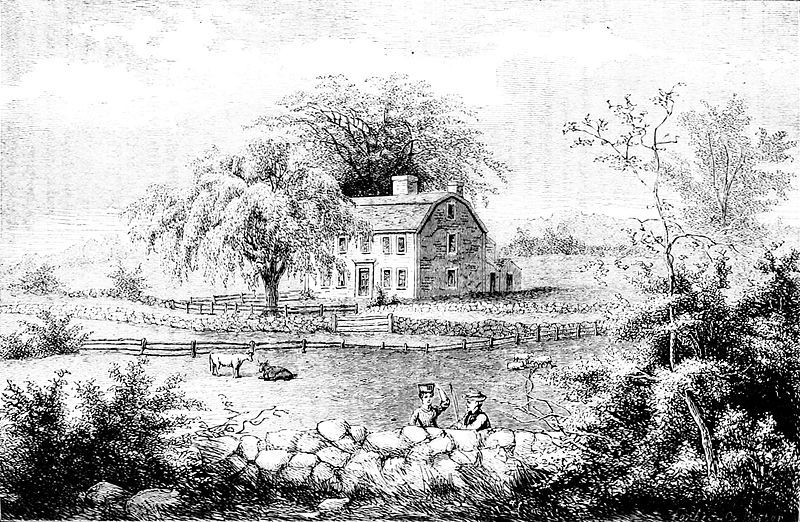
Today Ben's birthplace in Woburn, now a museum, still stands and is listed on the National Register of Historic Places:

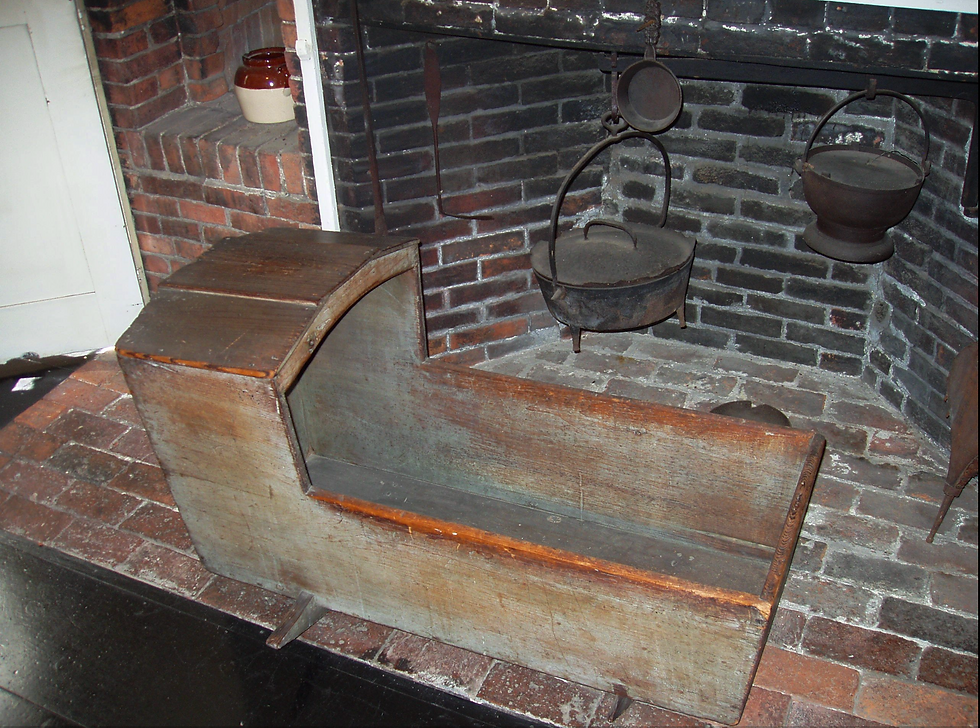
Exhibited inside the house is Ben's cradle:
Ben ventures out into the world
In 1776, when he was only thirteen, Benjamin's uncle Joshua apprenticed him to an importer of British goods in Salem. An extremely intelligent lad for his age, Benjamin "was able to calculate and trace rightly the elements of a solar eclipse. . .correct within four seconds and he also invented machinery for a perpetual motion machine."
In June of 1766, the colonies received word that that stamp act had been repealed. The town of Salem, like many others, celebrated the event with fireworks and young Benjamin was put in charge of the show. In a probably not so freak event, the firworks blew up on him.
Benjamin's injuries were serious enough for him to be sent home to Woburn. A year later, fully recovered, he was back in Salem working at the import store. At fourteen, Benjamin's entrepenurial side began to blossom as we can see from a letter written by his uncle Joshua:
To MR. JOHN APPLETON IN SALAM.
M E D F O R D , June ye 2 6 :1767.
Thompson has wrote to me divers times about his affairs, and he saith he is Contented, and hath privyledge of trade for himself, and that you. Sir, would let him have Sum fish to Ship, if I would send you an order for them. . .Pray Sir, if he Shipeth anything, See it insured in a proper manner. Sir, if Ben Sends to Sea and dont make Pay, let me have Notis of it. Pray, Sir,
tak Spechal Care about the Company he keeps, and I should be glad to know the General Run of his behavour, both as to trade and Company. . . Sir, I hear you live Shingel (single) as yet, but dont Exspect it will be so long. No more at this time. So I Remain yours to Serve,
JOSHUA SIMONDS
the beginning of a lifelong friendship
Even though Benjamin was only fifteen when Loammi was twenty-four, the two found themselves drawn to the same kind of intellectual pursuits. When Loammi "obtained the privilege" of attending lectures on physics at Harvard, he got the okay for Ben to sit in as well. Whenever Benjamin happened to be in Woburn, the two would walk together to Cambridge, a distance of about eight or nine miles.
It was during this time, that Loammi and Ben began a correspondence by mail that would last until Loammi's death in 1807. Below is an example of their correspondence in 1769. Benjamin, at sixteen, obvioulsy looked to the twenty-four year old Loammi for help with his studies.
WOBURN, Aug' 14, 1769
MR. LOAMMI BALDWIN,
S I R , — Please to give the Direction of the Rays of Light from a Luminous Body to an Opake, and the Reflection from the Opake Body to another equally Dense and Opake...Your, &c. Benj Thompson.
WOBURN, Augt. l 6 , 1769.
MR. BENJ. THOMPSON,
S I R , — Itis almost impossible to describe the directions the rays pass. Suppose one was at the Equinoctial Line, at twelve o'clock. At that place then I imagine that the rays of the Sun
would pass directly straight to the eye of the beholder. But suppose the Sun to be just arising, then I imagine that the rays would pass in a curveline, and so grow straighter as it rises higher in the horizon. Your Humble Servant, LOAMMI BALDWIN.
Sometimes Ben's questions were a little more than Loammi could handle as in the following exchange:
From Ben to Loammi: SIR , — Please to give the Nature, Essence, Beginning of Existence, and Rise of the Wind in General, with the whole Theory thereof, so as to be able to answer all Questions relative thereto. Yours, BENJ. THOMPSON .
From Loammi to Ben: " SIR, — There was but few beings (for Inhabitants of this world) created before the airy Element was: so it has not been transmitted down to us how the Great Creator formed the matter thereof. So I shall leave it till I am asked only the Natural cause, and why it blows so many ways in so short a time as it does.
more of Ben's talents
In addition to his other skills, Benjamin was kept busy engraving silver items, like knife handles, for his friends. Below is a silver bookplate he engraved for himself:

Ben stayed with Mr. Appleton until October 1769 when he took a position as an apprentice to a dry goods dealer. While there he began a memorandum book with varied entries. One entry shows that he he got "a Blue Huzza (Hussar) Cloak bought of Zebediah Wyman (4C7X), and paid for by fifteen and a half cords of wood." Ben's entry for the "disposal" of his time during each period of twenty-four hours shows he might have been just a wee bit obsessive:
From eleven to six, Sleep. Get up at Six o'clock and wash my hands and face. From Six to eight, exercise one half and study one half. From eight till ten. Breakfast, Attend Prayers, &c. From ten to twelve. Study all the time. From twelve to one. Dine, &c. From one to four, study constantly. From four to five. Relieve my mind by some Diversion or Exercise. From five till Bedtime, follow what my inclination leads me to; whether it be to go abroad, or stay at home and read either Anatomy, Physic, or Chemistry, or any other book I want to Peruse.
marriage and family
Extremely coincidentally, given the difference in their ages, Loammi and Benjamin both married in the same year, 1772. In July, Loammi married another cousin of ours, Mary Fowle (3C7X). Mary descended from our Wyman, Symonds and Richardson families. Loammi and Mary's first child, named Cyrus (4C6X) after Loammi's tea selling brother, was born in 1773. In November of 1772, Benjamin married wealthy widow Sarah Walker Rolfe. Ben and Sarah had only one child, a daughter Sarah Thompson (4C6X), born in 1774. While neither marriage would end in divorce, the unions took entirely different trajectories.
Loammi was twenty eight when he married. He and Mary had five children born to them before Mary's death in 1786 at age 39. Benjamin, though only nineteen when he married was mature for his age. Loammi described him as "of a fine manly make and figure, nearly six feet in height, of handsome features, bright blue eyes, and dark auburn hair."
Of his marriage, Benjamin wrote: "Perhaps I should have been poor and unhappy all my life, if a woman had not loved me , — if she had not given me a subsistence, a home, an independent fortune." It appears that Sarah Rolfe's love for Benjamin was not as fully returned. By the end of 1775, only three years after his marriage, Benjamin would be in Europe, never again to return to the country of his birth.
As both men were enjoying their early years of married life and child rearing, impending war began to loom large.
the beginning of military life
Benjamin and Sarah had spent part of their honeymoon in Portsmouth, NH where Ben's "striking figure" was noticed by Royal Governor John Wentworth. Richard Hale, in his article "Some Account of Benjamin Thompson," writes that Benjamin "had the power to charm, he ingratiated himself with others easily and excelled in social deftness." So taken with Ben was Wentworth that he offered him a major's commission which lifted Benjamin above other far more experienced men. This was the first of many positions Ben would be offered based mostly on his charm. The commission, however, turned out the be the beginning of a trajectory that would change Benjamin's life.
Meanwhile, Loammi was working his way legitimately up the military ladder. He had begun his military career in a company of horse guards and by the time the war started in 1775, he was a major in command of multiple companies of men.
Loyalist leanings
Benjamin's financial position due to his marriage allowed him to hobnob with British mucky mucks like Governor Wentworth and General Thomas Gage, who was also the governor of Massachusetts right before the war began. These associations must have certainly colored his feelings about the Revolution. Though he never said outright, Ben's British leanings seemed obvious to his neighbors in Concord, NH.
Ben's position of importance in the British army and his failure to embrace the Patriot cause made him a person of suspicion in Concord. The over zealous Sons of Liberty could be quite brutal to anyone thought to be a Loyalist. In the summer of 1774, as a person deemed "unfriendly to the cause of Liberty," Ben was summoned before a town Committee. When the committee failed to charge him with any wrong doing, the townspeople decided to take matters into their own hands. In November, an unruly mob gathered outside Benjamin's house demanding that he come out. Luckily, Ben wasn't home at the time but he quickly realized that he might be real in danger. He collected what money he could and skedaddled back to his hometown of Woburn and the warmth of his mother's house.
While in Woburn, Benjamin wrote a letter to his father-in-law, hoping to assuage his family's fears:
...but this you may rely and depend upon, that I never did, nor (let my treatment be what it will) ever will do, any action that may have the most distant tendency to injure the true interest of this my native country. I most humbly beg your kind care of my distressed family; and I hope you will take an opportunity to alleviate their trouble by assuring them that I am in a place of safety, and hope shortly to have the pleasure of seeing them.
Ben's dalliance
Benjamin's assurance to his family that he was in a place of safety turned out to be premature. The Woburnites had their own suspicions about Ben. In March of 1775, just one month before hositilities began, military companies were sent out twice to the Thompson house to arrest him. And, twice, Ben was again not at home.
But where exactly was Ben in March of 1775 when the authorities came looking for him? According to printer Isaiah Thomas of Boston, Benjamin Thompson was with Thomas' wife Mary Dill.
Note: Isaiah Thomas was the owner of the radical newspaper The Massachusetts Spy. Our Patriot cousin Joseph Greenleaf (4C7X) wrote extensively for the paper which led to a feud with then Massachusetts governor Thomas Hutchinson. We wrote about Cousin Joseph in our "Prelude to Revolution" post.
In a report to the authorities about his wife's indiscretion, Isaiah wrote that, on the 23rd of February, Mary and "Major Thompson set out on a Journey together to Newbury Port." He tried to "dissuade his Wife from journeying at so unreasonable a time of the Year & without any apparent Necessity; but she persisted in her Intentions & swore she would go 'if it was to her eternal Ruin' as she expressed it herself."
Isaiah then wrote a day by day account of the affair:
3rd (March) In the Course of said Journey at the House of Mr. Woart in Charlestown, the said Thompson was seen in the said Mary's bed Chamber, conversing with her while she was in bed.
4th. At the house of Mr. Newell in Lynn the said Thompson & the said Mary were discovered in bed together. And in their Conversation were constantly uttering such Expressions of Endearment & affection to each other as plainly indicated the wickedness of their Hearts.
5th. At the House of Mr. [Samuel] Greenleaf (4C7X) in Newbury Port they remained in a separate Room togethr while they continued there, & from thence they proceeded to Portsmouth in a Curricle (two wheeled carriage).
6th. At the House of Mr. Stivers in Portsmouth the said Thompson & the said Mary both insisted on lodging in the same room but being known they were forbid they however remained shut up in a room together.
7th. On their Return from Portsmouth they stop'd at the House of Mr. Williams an Innholder in Greenland; where they avowed themselves to be Man & Wife, had a Room to themselves and lodged together all Night.
Thus ends Isaiah's account of his wife's infidelity. The couple never again lived together and, in 1777, Isaiah filed for divorce. After his wild fling, Ben made his way back to Woburn.
Next up: Ben's arrest


Comments