
Another Four Grandfathers
- westmohney

- Dec 23, 2022
- 11 min read
Updated: Feb 1, 2023
Our ancestors dewll in the attics of our brains as they do in the spiraling chains of knowledge hidden in every cell of our bodies.
~ Shirley Abbott

only four remain
As the tumultuous last half of the eighteenth century began, our grandfathers in New England had been whittled down to from forty-one to just four. Grandfather number one, Abraham Stickney (6GGF), married Sarah Kittredge (6GGM). Their daughter, Sarah Stickney (5GGM), married grandfather number two, Isaac Kidder (5GGF). Grandfather number three, Daniel Proctor (6GGF) married Susannah Hill (6GGM). Finally, Susannah Proctor (5GGM), married grandfather number four, Daniel Ebenezer Sherwin (5GGF).
Grandpa Abraham 1733-1803
Grandpa Abraham Stickney was born in Billerica in 1733. The road to Billerica for the Stickneys began in Rowley, MA where Abraham's great-great grandfather, William Stickney (10GGF) settled in 1637. The Stickney's lived in the northern part of Billerica which became Tewksbury. In 1755, Abraham married Sarah Kittredge, also of Tewksbury.
During the Revolutionary War, Abraham did his part as a lieutenant in Colonel David Green's Tewksbury Regiment. Abraham's oldest son, Abraham, Jr. (5U), fought in the same regiment.
Abraham and Sarah had ten children over the course of twenty-seven years. Grandma Sarah was eighteen when her first child was born and forty-five when her last child was born in 1783. When the first U.S. census was taken in 1790, the Stickneys had five of their children still living with them. Listed in Grandpa Abraham's household in 1790 were one free white male over sixteen, two free white males under sixteen and four free white females for a total of seven household members.
Note: The 1790 census only differentiated ages for males, not for females.
Abraham was fifty-seven at the time of the census. The two males under sixteen were Abraham's youngest sons James (5U), 13 and Jeremiah (5U), 7. Sarah was fifty-two.
In the 1790 census, Tewksbury was listed as having two Stickney families, four French, eleven Kittredge and four Kidder. The population of Tewksbury in 1790 was 2,632. Not surprisingly, since slavery had been abolished in Massachusetts in 1783, there were no slaves recorded that year for the town of Tewksbury.
Grandpa Abraham died in 1803 at the age of 69. He left to Sarah his "dearly beloved wife, all of the indoor household furniture - and to have a comfortable support and maintainance Provided for her by my son James Stickney During the time that she shall remain my widow."
Son Joseph (5U)received £100, son Jeremiah received £40 and son James received the homestead and the rest of Abraham's estate. The other six children still living were all mentioned by name in the will as having already received their portion of the estate.
Below is Abraham's signature on his will:

Poor Grandma Sarah died in 1807 of consumption, another name for tuburculosis. Back in the day, that was not a pleasant way to die. She was 69 years of age.
Abraham and Sarah's first born child was our grandmother Sarah Stickney (5GGM) who married Isaac Kidder (5GGF).
Grandpa Isaac 1752-1825
Isaac Kidder was born in Billerica in 1752. His great-grandfather, James Kidder (8GGF), had settled in Billerica ca. 1656. Isaac's parents were William (6GGF) and Sarah Ballard Kidder (6GGM). Issac just happened to be the third son of that name born to the couple. The first Isaac (5U), born in 1744 didn't live even three months. The second Isaac (5U), born in 1746, died when he was only three. Another son, Enoch (5U), was born in 1749. Then four years later, William and Sarah welcomed their very last child. They decided to try the name Isaac one more time. The third Isaac, who thankfully survived to adulthood, was our grandfather.
Issac and Sarah Stickney were married in Tewksbury on June 1, 1775, only two months after Isaac had marched on the Lexington alarm that began the Revolutionary War. He must have married Sarah while he was serving in the militia because Isaac is credited with eight months service in Cambridge during the siege of Boston. He also fought in the Battle of Bunker Hill on June 17, less than three weeks after his marriage.
Note: We'll have much more on the Revolutionary War in future posts.
After Isaac's military service was completed, he and Sarah left Tewksbury and moved to Lyndeborough, New Hampshire, about 40 miles northwest of Billerica. Perhaps Isaac thought New Hampshire would be safer than Massachusetts with the ever escalating war.
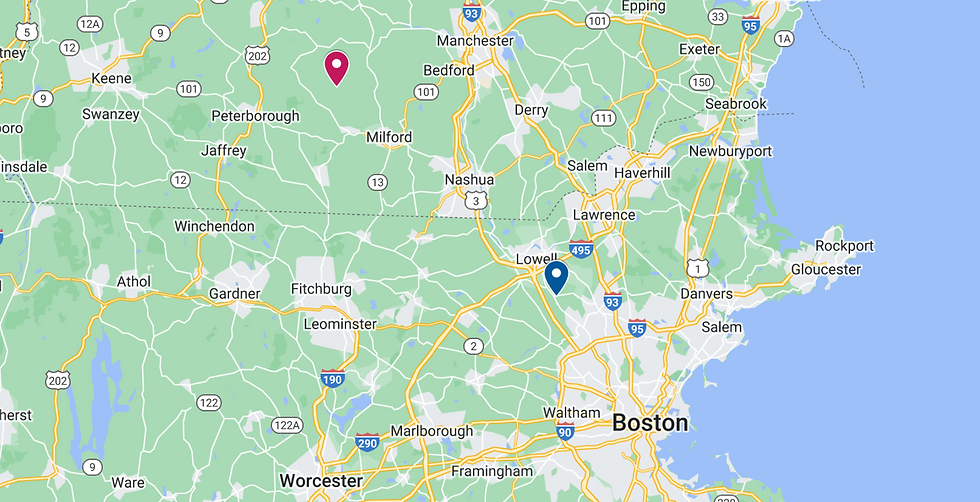
Isaac and Sarah's first child, another Sarah (4A), was born in Lyndeborough in June of 1776. Another child, Isaac, Jr. (4U) was born in New Hampshire in March of 1778. Lyndeborough, however, must not have proved to the Stickney's liking. By June of 1779, when their third child, Elizabeth (4A) was born, Isaac and Sarah were back in Billerica.
Four more children were born in Billerica before the couple decided to make a move to Townsend, MA where, in 1790, they were included in the first U.S. census. When the census was taken, the Stickneys had six children living with them and two other people counted who could not have been their children. Listed in Grandpa Isaac's household were two free white males over sixteen, three free white males under sixteen and six free white females.
Grandpa Isaac was thirty-eight at the time of the census and Grandma Sarah was thirty-four. They had three daughters and three sons living with them. Three more children would be born after the census. Grandma Sarah had ten children born to her over the course of twenty-five years. One child died in his first year.
Grandpa Isaac died in Billerica in 1825 at age 73. Grandma Sarah followed the next year at age 70.
Grandpa Daniel Proctor 1706-1775
Daniel Proctor (6GGF) was born in Chelmsford in 1706. Daniel's grandfather was Robert Proctor (8GGF) who settled first in Concord in 1643 and then moved on to the frontier town of Chelmsford in 1654. In 1727, Daniel married Susannah Hill (6GGM) of Billerica. Susannah was a great-granddaughter of our immigrant ancestor Ralph Hill (9GGF).
We know that Daniel was a selectman of Chelmsford by 1744 when he signed a testimonial about the safety of a dam on Grate Brook:
Chelmsford March ye 11th 1744 we whose names are here unto Subscribed are of oppinion that the Mill Dams a Cros Grate Brook so Called in Chelmsford is of no damedg to any person or to the pubbleck in perticular, so to the Coarce of Fishes passen Espetially Saman Shad Ealwaives...but is of Service to the Publect to have them kept up and Improved.
Two of the four signers of this document, all selectmen, are related to us: Daniel Proctor and Zachariah Richardson (3C8X).
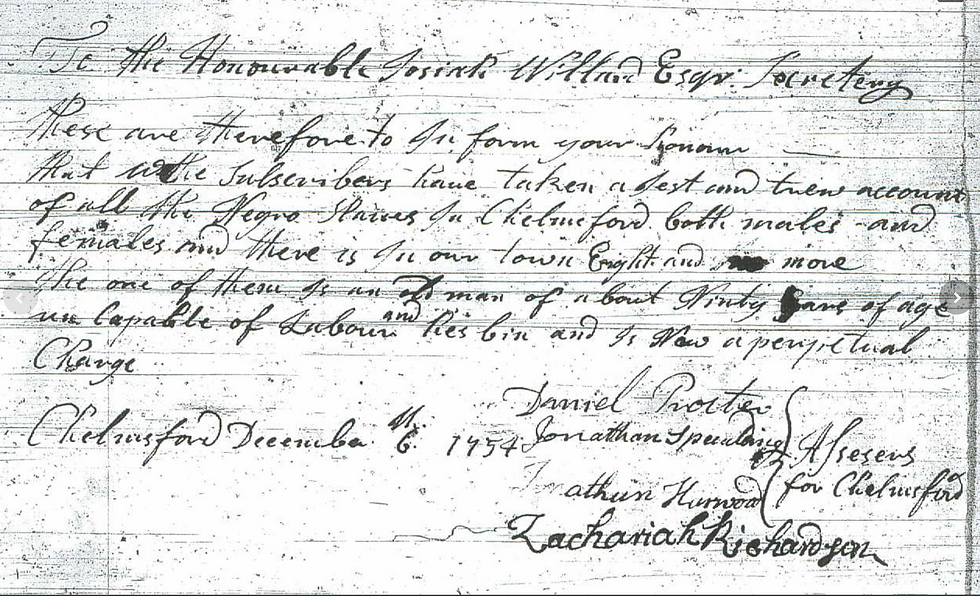
In addition to his selectman duties, Daniel was also chosen as one of the town assessors. Part of the assessors' duties was to make an accounting of all negro slaves over the age of 16. The account for 1754, which was signed by Grandpa Daniel and our cousin Zachariah Richardson states that:
...we the subscribers have taken a just and true account of all the Negro Slaves In Chelmsford both males and females and there is In our town eight and no more The one of them is an old man of about Ninty and of age uncapable of Labour and he's bin and is Now a perpetual charge.
During the final French and Indian War, Grandpa Daniel was a lieutenant in a Troop of Horse (calvary) that was commanded by our cousin Daniel Stickney (1C8X). In August of 1757, the troop was sent out in relief of the siege of Fort William Henry. The company, however, didn't arrive in time. In our post on the Seven Years War, we wrote about the surrender of the fort and the massacre of the men, women and children who left the fort after being promised safe conduct.
Daniel and Susannah had six children, all born in Chelmsford. After his service in the French and Indian war, it appears that Grandpa Daniel became an innholder. He died in January of 1775, only three months before the beginning of war. He was 69 years of age. Susannah lived through the war years. She died in 1785 at age 80. They are both buried in the Forefather's Burying Ground in Chelmsford. The ephitaph on Daniel's gravestone reads:
Behold and see as you pass by
As you are now so once was I
As I am now, so you must be,
Prepare for death & follow me

Le Grand Dérangement
Nova Scotia was first settled by the French in 1605. The island, strategically important to both France and England, had ping-ponged between the two countries for 150 years.

When the final French and Indian War began, most of the people living on Nova Scotia were of French descent. Since the island was controlled by Britain at the time, the British Crown demanded an "unqualified oath of allegience" from the people living there. The Acadians refused to sign such an oath.
Their refusal resulted in a travesty not unlike the relocation of the Natives to Deer Island during King Philip's War in 1675 or the relocation of the Japanese during World War II. On September 5, 1755, the Acadians were notified that "their homes and property were forfeit to the Crown and that they were to be removed from the colony." To add insult to injury, the Acadian's homes and farms were burned to the ground to discourage anyone who might escape from returning to the island.
The Acadians were transported in ships to Pennsylvania, Maryland, Virginia, South Carolina, Massachusetts, Connecticut, New York and Georgia. John Winslow, the man in charge of the relocation, wrote in his journal about the event:
October 8th – began to Embarke the Inhabitants who went verry solentarily and Unwillingly. the women in Great Distress Carrying Their Children In their arms. Other[s], Carrying their Decrept parents in their Cartes and all their Goods in Great Confusion & appeard a sceen of woe & Distres.
Reports of deplorable conditions on the ships led to an investigation by the Massachussets General Court. The Court allowed most of the passengers to disembark in Boston. Now the welfare of these people was firmly in the hands of the people of Massachusetts. The Acadians arrived destitute and were immediately dipersed out to various town. The selectmen were directed to provide for them "at the expense of the province."
The town of Chelmsford, where Grandpa Daniel Proctor lived, received seventeen Acadians. Daniel was still a selectman at the time. On October 24, 1757, the selectmen of Chelmsford made an accounting of the Acadians living in their town.
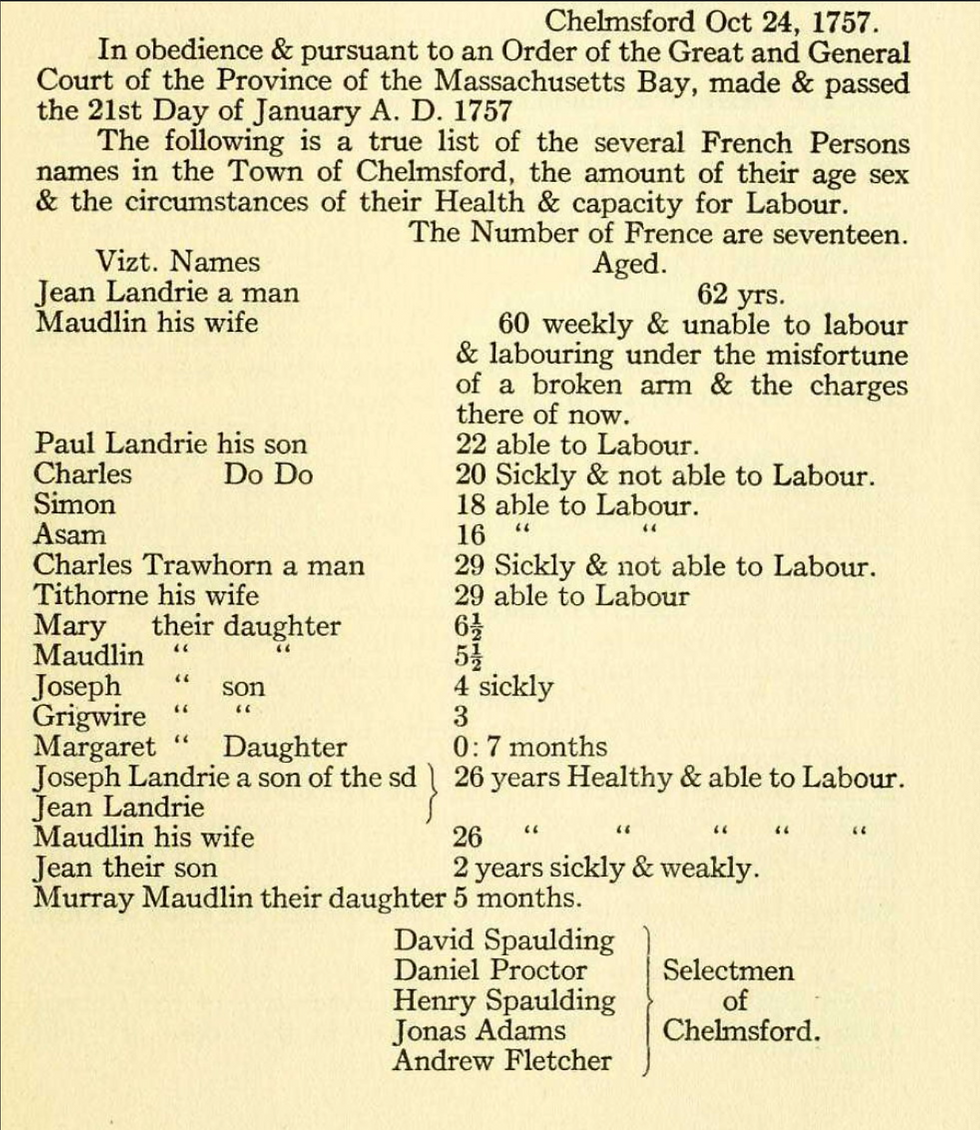
The government of Massachussetts did reimburse the towns for the care of the Acadians. Records show that in Jun of 1758 a little over £25 pounds was "Allowed to the seclectmen of Chelmsford for supporting French neutrals..." Another £42 was allowed in January of 1759. The Acadians had to be supported until the end of the war in 1763. Records show that Jean Landrie, the first name on the list above, had a large family. The total expenditure for his family alone was £200.
While the Council of Massachusetts certainly had its heart in the right place wanting to care for these people, not everyone was so charitible. Some towns, in order to defray costs, decided to indenture the Acadians children out to tradespeople. A letter to the Governor and Council of Massachusetts shows the Adadians' distress at having their children taken from them:
To his Excellency the Governor General of the Province of Massachusetts Bay of New England and to the hororable Gentlemen of the Council. We have taken the liberty of presenting you this request, as we are in sorrow on account of our children. The loss which we have suffered, of our houses, and brought here and our separations from one another is nothing compared with what we meet with at present, that of taking away our children by force before our eyes. Nature herself cannot endure that. If it were in our power to have our choice we should choose rather the taking away of our bodies and our souls than to be separated from them. We herfore pray in pity and to your honors that you would have the goodness to mitigate this cruelty.
The sympathetic council listened to the Acadians pleas and ordered that "there shuld be no more binding out, that the Acadians were to be provided with such things as they could work up for necessary clothing, and that they were to be treated with kindness and humanity."
The Acadians were not allowed to return to their homes until the war ended in 1763. Since their homes had been destroyed, many chose not return to Nova Scotia. Some remained in Massachusetts while others set out for France or Quebec.
A hundred years after this sad event, Henry Wadsworth Longfellow published a poem titled "Evangeline: A Tale of Acadie." The poem told the story of Evangeline and Gabriel, two lovers separated after the Acadian deportation.
Grandpa Daniel Sherwin 1729-1805
Daniel Ebenezer Sherwin (5GGF) was born in Boxford in 1729. His great-grandfather was John Sherwin (8GGF) who settled in Ipswich ca. 1665. When Daniel was quite young, only 20, he saw action in the French and Indian War. He served at Fort Dummer for one month in June of 1749. After his service at Dummer, Daniel joined a company headed by our cousin Captain John Catlin, Jr. (4C9X).
Note: We wrote of the Catlin family in our "Deerfield in the Thick of It" post. John Catlin Jr.'s father, John Catlin, Sr., was captured in the raid on Deerfield in 1704. John, Sr, who was seventeen at the time, was redeemed in 1706 and returned to Deerfield. John Catlin, Jr. was his oldest child.
No records show where Daniel went after his service during the war. He may have returned to his hometown of Boxford or it might have been then that he made the move to Townsend.
Grandma Susannah Proctor (5GGM), daughter of Daniel Proctor (6GGF), was born in Chelmsford in 1736. About twenty miles separate Chelmsford from Townsend but, somehow, Daniel and Susannah met and married. The wedding took place in June of 1756 in Chelmsford and the happy couple settled in Townsend where their first child was born in 1757. They would spend the rest of their lives in Townsend.
Daniel and Susannah had twelve more children born to them over the next twenty-three years. Three would be born during the revolution years. Three of their children did not live to adulthood.
The revolution years must have been hard on the Sherwin family. Daniel and his oldest son Daniel Jr. (4U), who was eighteen at the time, marched on the alarm of April 19th, 1775 and both continued their military service on and off during the war. Susannah, left at home with nine children between the ages of one and seventeen, would give birth three times during the course of the war, in 1776, 1778 and 1781.
When the Revolution began, Grandpa Daniel was a lieutenant in the Massachusetts militia. He commanded one of the companies from Townsend that took part in the first day of action in the war. He was in Cambridge during the siege of Boston, at the battle of Bennington in 1777 and at the surrender of Burgoyne, also in 1777. Sometime during the war, Daniel was promoted to captain.
Son Daniel, Jr. was in a different regiment than his father, but also marched on the alarm of April 19. He then did service at Bunker Hill and was part of the main guard at Cambridge under the command of our cousin Loammi Baldwin (3C7X). He served on the Burgoyne campaign in 1777 and in Rhode Island in 1778.
Note: We'll hear a lot more about Loammi Baldwin in posts to come.
After the war, life got back to normal for the Sherwin family. Daniel participated in the first census taken in the United States in 1790. Of their ten remaining children, five were still living with their parents in 1790. The census showed three males over the age of 16. That would probably have been Daniel and his two unmarried sons, Azariah (4U), 20 and Zimri (4U), 26. The two males under 16 would have been son Darius (4U), 12 and Levi (4U), 14. The two females were most likely Susannah and daughter Martha (4A) who didn't marry until 1791.
Grandpa Daniel died in 1805 at 76 years of age. In his will, he left a part of his estate to each of his ten children. The boys, Daniel, John, Zimri, Salome, Azariah, Levi and Darius all received a double portion. The girls, Susannah, Lucy and Martha had to be content with half shares.
Below is the bottom portion of Daniel's will where he appointed his son Levi, second to the youngest of his children, sole executor. Our cousin Josiah Richardson (4C7X) was one of the witnesses.

The epitaph on Daniel's grave reads:
SACRED to the memory of Cap. Daniel Sherwin
Friends, nor physicians could not save My mortal body from the grave Nor can the grave confine me here, When Christ doth call me to appear.

Susannah Proctor Sherwin, mother of thirteen children, died in 1813, eight years after her husband. She was 77 years of age.
Daniel and Susannah Sherwin's son Azariah (4GGF) would go on to marry Isaac and Sarah Kidder's daughter Sarah (4GGM). Azariah and Sarah's daughter Susannah (3GGM), named after her grandmother, would marry Ezra Parrish (3GGF). The two of them would leave their native state of New York in the year 1835. Little did they know that their travels would eventually take them coast to coast, almost three thousand miles, to the town of San Bernardino in the newly created state of California.


Comments