
AROUND WOBURN
- westmohney

- Mar 16, 2022
- 11 min read
Updated: Mar 7, 2024
Many a cherished and beautiful home, rich in annals of family prosperity and private hospitality, ended its days as a tavern
~ Alice Morse Earle

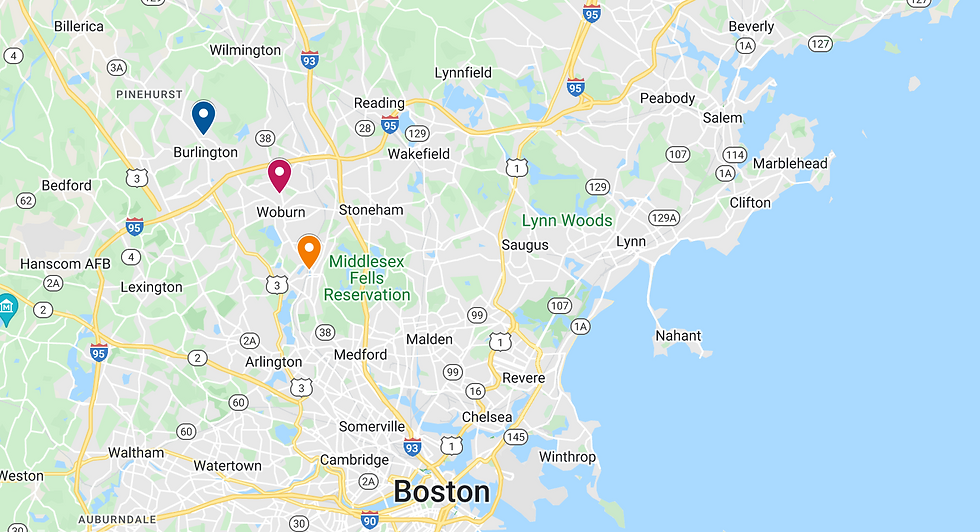
Many of our Richardson ancestors settled in the southern part of Woburn (now known as Winchester (orange). Our Wyman ancestors settled in the northern part of Woburn that butted up against Billerica, now known as Burlington (blue). The red marker is present day Woburn.
The Black Horse Tavern
Our cousin Nathaniel A. Richardson (7C4X) was born in 1820. He had a full life and career as a colonel in the U.S. Army, as an advocate for African Americans after the Civil War and as an historian who dug extensively into the roots of his (and our) family. The information we have about the Black Horse Tavern comes mostly from a thirty-two page booklet Nathaniel wrote called "Black Horse Tavern: Two Centuries of History."
The Black Horse Tavern was built on a piece of property puchased in 1724 by our cousin William Richardson (3C8X). Nathaniel Richardson wrote that the tavern "was a landmark in the area for about a century and a half, a stopping place for stagecoach travelers." From the 1740s to 1835, the Black Horse Tavern fed and housed not only residents of Woburn but also many weary travelers.
William Richardson built a "mansion house" on his property. There are no records to indicate that the home was turned into a tavern while William was living there. Nine years later, he moved on to the greener pastures of Lancaster, MA where he spent the rest of his life. It's very likely, however, that William held onto his Woburn property until 1743 when ownership passed to his (and our) cousin David Wyman (1C9X). David Wyman's mother was Phebe Richardson Wyman (2C9X), William Richardson's aunt.
Note: As these posts are confusing enough, I won't even get into how many Richardson/Wyman marriages took place to produce these two men.
The tavern was definitely up and running during David Wyman's ownership. In his will of 1751, he is described as an "innholder" and "Black Horse Tavern" appears on the deed to David's property. He left this property, including the tavern, to his brother James Wyman (1C9X) who sold it shortly afterwards. Over the next ten years the tavern passed through a few different hands before coming back into the Wyman family in 1771 when our cousin Noah Wyman (3C7X) purchased the property.
Note: Noah Wyman was a third cousin to David and James Wyman.
Since the tavern license on the property had expired, Noah immediately petitioned the General Court for an inn-holder's license. He ran The Black Horse Tavern throughout the revolutionary years when many a cup must have been raised in support of the rebellion.
The tavern was also a meeting place for troops marching out to quell Shay's Rebellion, a minor rebellion uprising by disgruntled citizens in 1786.
After Noah's death in 1789, the inn again passed from hand to hand until 1806 when it was purchased by yet another Wyman relative. Wyman Weston (5C5X) was related to the Wyman family through his grandmother, Lucy Wyman Damon (3C7X), another product of a Richardson/Wyman marriage.
Weston ran the inn for twenty-one years. Then, according to Nathaniel Richardson, in 1827 Weston evidently "experienced religion and stopped selling liquor, kind of a death knell for a tavern." The next innkeeper, Joshua Davis, “was a high liver and a frequent patron of his own bar,” Davis died in 1835. “With his death the light and life of the Black Horse Tavern went out,” His wife didn't have the means to keep the tavern afloat and "since that day the house was closed to the public.”
The ownership of the tavern came full circle after Davis' death when our cousin Samuel Steele Richardson (4C5X) bought not only the tavern property but much of the surrounding area. The entire region became known as the Black Horse Tavern District of Winchester, a thriving commercial center there for many years. The tavern building was often used for community events and dances, many of which were held by our Wyman ancestors. The structure was finally demolished in 1892.

The Massachusetts Historical Commission has this to say about the tavern:
"...A famous tavern known as the "Black Horse Tavern" stood at the north corner of Main Street and Black Horse Terrace from about 1728 until 1892. It was the only meeting place for the farmers of southern Woburn and northern Medford during Colonial times and it served as the mustering place for those who fought at Lexington, and soldiers in the Revolution....
The barn is the only remaining part of the Black Horse Tavern, an era with great significance in much of Winchester's past. For a time the town was even called Black Horse Village after the well-known tavern which provided a center for community life in the 18th and early 19th centuries...."
Less than half a mile from the site of the original Black Horse Tavern, a modern Black Horse Tavern opened its doors in 2010. The tavern features "a blend of casual tavern food, drink and specialty dishes" and is "sure to provide an authentic pub dining experience." If you ever make it out to Winchester, MA, it might be worth a visit.
Below, green marks the section of Washington St. that was originally called Richardson's Row, where the three immigrant Richardson brothers owned their land. Blue marks the site of the original Black Horse Tavern and red marks the present day tavern.


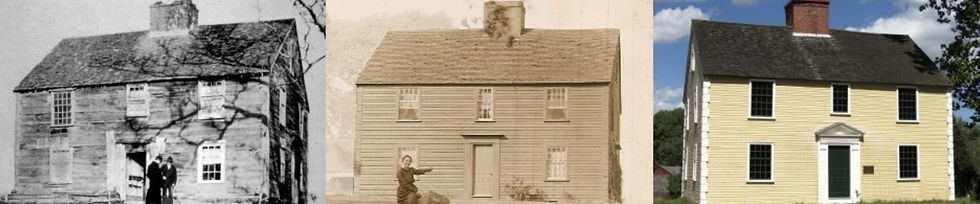
the Francis Wyman homestead
The Wyman Homestead (56 Francis Wyman Rd.) is worth a mention. The home was built by our cousin (and possible grandfather) Francis Wyman in 1666. It is now listed on the National Register of Historic Places. According to the Register:
It is one of the most historically-significant landmarks in eastern Massachusetts, and is notable for a wide range of associations and connections. Potential site interpretations include farming, tanning, Colonial settlement, and a wide range of early American historical skills and themes. Historically, the house is important as an early Colonial landmark which sheds light upon English settlement patterns and domestic lifestyles. Architecturally, the homestead is significant as an 18th century structure, and as the home of one of Burlington and Woburn’s earliest settlers.
The Francis Wyman Association, formed in 1699, was incorporated in 1902 “for the purpose of acquiring and preserving relics and records of the family of Francis Wyman, and the ancient Wyman homestead in the town of Burlington and also for encouraging friendly intercourse among his descendants.”
Below are pictures of the house in various stages of disrepair and repair.

Aaron Richardson and the Great Throat-ail
Our cousin Aaron Richardson (3C8X) lived in Woburn. He might have faded into obscurity except for the fact that all of his children born before the fateful year of 1738 died in that year's horrific "throat-ail" epidemic. Better known as the Great Throat Distemper, the disease was also commonly called “the strangling angel of children.”
New Englanders had certainly lived though their share epidemics including the recurring scourge of smallpox. Still, the Great Throat Distemper, which lasted from 1735 to 1740, was "one of the greatest epidemics ever to terrify New England."
In his History of Haverhill, George Wingate Chase perpetuated a myth about the origin of the disease:
The disease originated in the manner now to be described. In May, 1735, a Mr. Clough, of Kingston, N. H., having examined the throat of a swine which had died of a throat disease, was himself suddenly attacked with a swelling of the throat, and lived but a few days. Three weeks after, three children in his neighborhood were attacked in a similar manner, and died in thirty-six hours. From this, the disease spread rapidly and proved fearfully fatal, particularly to children.
The disease did, in fact, have its beginning in Kingston, N.H. and it was particulary fatal to children but physicians today recognize the disease as diptheria. From the first identified case of the child who died in Kingston, the infection spread like wildfire. The symptoms, which began like nothing more than a cold, quickly turned into a very sore throat, loss of appetite and fever. The bacteria then attacked the throat, nose and lungs, killing tissue as it spread. The coating of dead tissue would eventually interfere with breathing and kill the sufferer.
The throat distemper disproportionately affected children who would often be dead within three days of contraction. Rowley, Mass., would lose one-eighth of its entire population to the disease. Chase writes that "...in Haverhill, Mass., it appeared in October, 1736, and swept off more than one-half of all the children under fifteen years of age. Almost every house became a habitation of mourning." And In Ipswich, all eight children in the household of Mark and Hephzibah Howe died during the month of November 1735. Some who could remembered back forty years might have seen this as only fitting. Mark Howe was the grandson of accused witch Elizabeth Howe who was executed on 19 Jul 1692.
Some New Englanders, still living in the "worlds of wonder" of the witch trials, tried to find some sense in the affliction. In Newbury, the disease became connected to an explosion in the population of caterpillars in the summer of 1735. The destructive caterpillars covered roads and houses and destroyed crops. Another culprit was, of course, the ever present sin. Some ministers counseled that there be no mourning for the dead as the disease was surely God's will. In Haverhill, MA, a pamphlet explained that children’s wailing and coughing showed that God or supernatural beings spoke through them.
The Great Throat Epidemic tore through New England for five years. By 1741, the disease had loosened its grip on the populace. But it wasn't soon enough for Aaron Richardson.
In May of 1738, Cousin Aaron and his wife Bethia had four children ranging in age from ten to two years. Within a month's period, beginning May 31, all four of their children had succumbed to the "throat-ail." Aaron and his wife would have two more children born to them. Bethia (4C7X), born in January of 1639, was their only child to live to adulthood. Little Phebe (4C7X), born in 1741, lived for only one month.
Note: Five years later another scourge would hit New England: the dysentery epidemic. More on that in our next post.
Cousin John Richardson
John Richardson (1C9X), born in Woburn, became a successful merchant, first in Medford then in Boston. Cousin John seemed to be something of a "house flipper." In 1730, while in Boston, he bought a brick house for £1000. The thousand pounds he paid for the home was in "Province Bills" which were then greatly depreciated. Only a year later, John sold the house for £1300 . In 1732, he bought another house in Boston for £487. Then, in 1733, he moved to the Roxbury section of Boston. There John bought six acres of land for £506 using Bills of Credit this time. He had also amassed other property in Boston because in 1734, he sold a warehouse he owned for £600.
In addition to house flipping, John was a distiller of spirits who brought his sons into the business when they were grown. His sons, however, didn't get a free ride. In 1737, "John Richardson, Esquire, distiller of Boston...for £1550, conveyed to his son, Joshua Richardson (2C8X) of Boston, a still-house, land etc." In 1738, John sold a house and land in Roxbury where his son Caleb (2C8X) had been living. Cousin John received £1,000 "current money" for that property.
Finally, in 1747, John bought land in Boston for £3100 using "old tender." This property had a wharf and distilling house already built. Two years later, he sold this property to one of his sons for £3000.
You would think that after all this buying and selling of property, John would have died a rich man. That was not the case. When he died in 1752, his inventory amounted to only £1,200 and his estate "was heavily encumbered with debt."
I've mention the types of currency John used for his transactons because, most probably, his money woes at the end of his life were tied the the vast fluctuations in currency throughout the colonies at that time.
money matters in colonial America
The age-old barter system had worked well in the colonies for the duration of the seventeenth century. By the turn of the century, however, the lack of actual currency became a problem as foreign trade, mercantile businesses and surplus farming became more prevalent. Gold and silver, the standard used world wide, was in short supply in New England. The mother country, wanting to maintain a "stranglehold" on trade in her colonies, didn't make these currencies available to them.
The endless wars, however, had led to a dire situation in America. In the late seventeenth century, the colonies turned to fiat paper money which is "a government-issued currency not backed by a physical commodity, such as silver or gold but rather by the government that issued it." Paper money eventually made up an estimated 50 to 75 percent of the total currency used in New England for the first half of the eighteenth century.
Money in America at that time was pretty much haphazard. Each colony had its own laws regarding currency, its own coin ratings and each issued its own paper money. Massachusets, to fund King William's War, decided to issue "bills on credit." These bill were, in essence, short term bonds meant to be redeemed by the government as payment for taxes owed. Instead, businesses began accepting these bills in place of money and the notes were widely circulated throughout the commonwealth.
In 1686, Massachusetts had established the first American land bank. These institutions were not true banks as they did not accept deposits. Their purpose was to issue “notes on loan,” to property owner who were able to put their land up as collateral. To gain confidence in the system, the government promised to issue only a certain amount of notes for a set term. In addition the loans were secured with collateral equal to twice the amount of the loan. These notes also eventually became legal tender for all private and public debts.
Money matters became even more complicated when new note issuances didn't replace the currently circulating note, but simply added another layer. This led to an oversupply of paper currency which led to a significant devaluation all notes. This devauation became particularly grim in the late 1730s and early 1740s which just happened to be the time frame of Cousin John Richardson's many real estate dealings. Business owners saw their share of financial woes with these money matters as well. When new bills were issued, borrowers stood to gain because they could repay their debts with older, depreciated bills.
To deal with these escalating problems, Massacusetts closed the Land Bank Offices toward the end of the 1740s. Then, in 1749, the mother country came through to save at least one of her struggling provinces. That year, England sent a large payment to Massachusetts in hard cold coin, payment for contributions to the 1745 Siege of Louisbourg. Massachusetts was finally able to retire all her notes and, in 1750, abolished the use of paper money within her borders. This action came about a little too late to help our Cousin John but it was a firm step forward in creating financial solvency for the province.
Finally, the Currency Reform Act, passed by the English Parliament in 1751, put New England on the Lawful Money Standard of 6 shillings to the Spanish dollar which severely limited any future currency emissions in New England.
Cousin Matthew Wyman
Finally, mention should be made of our cousin Matthew Wyman (2C8X). He was born in Woburn in 1707. He was one of the men in Captain Josiah Willard's company of six men which marched to the defense of Fort Dummer. On 16 Jun 1748, while making camp for the night, the men were "surprised, stripped of their arms and most of their clothing." All six men were taken to Canada. Matthew was released in October of 1748 and sent on the Schooner Brittanicus from Louisburg to Boston. Even though their stay in Canada was reltively short, only four months, the men returned "feeble, emaciated and unfit for labour."
It may have taken Matthew a while to recuperate from his ordeal but at least he made it home to his wife, Abigail, who just happened to be Captain Willard's daughter.


Comments