
BACON'S REBELLION
- westmohney

- Jan 24, 2022
- 10 min read
Updated: Mar 9, 2022
If the redskins meddle with me, damn my blood! ~ Nathaniel Bacon
the setting
As the number of colonists in Virginia grew, so did the demand for land. In southern Virginia, two devastating wars with the Powhatan had effectively created a reservation system in which Native Americans were allowed to live only on lands designated by the General Assembly. Heightened land contraints then pushed new settlers ever northward into areas populated by the the Patawomeck tribes. In 1666, the Patawomeck pushed back, refusing the colonial government's demand that they sell their land. The Colony of Virginia did what came naturally to them. They declared war to force the tribe into submission. In the bloodshed that followed, most tribes of the Northern Neck of Virginia were wiped out. By 1669, a good portion of the land west of the Potomac and as far north as what is now Washington, DC, was in the hands of the colonists.
The red and blue markers on the map below show the wide swathe of land between the James River and northen Virginia which was taken over by the colonists. The orange marker shows the Eastern Shore of Maryland where many of our relatives lived.

Various tribes like the Pamunkeys, Occaneechis, and Susquehannocks, then living on the fringes of the colony, had survived the massive assault. William Berkeley, governor of Virginia at the time, found these tribes useful and wanted to retain good relations with them. For the governor and his cronies, trade with the Natives had proved quite lucrative. The general populace, left out of these trade agreements, stewed.
Berkeley's relationship with Native tribes led to a rebellion that proved devastating to the colony. To quote from Howard Zinn in A People's History of the United States: "[It was] a rebellion so threatening that the governor had to flee the burning capital of Jamestown, and England decided to send a thousand soldiers across the Atlantic, hoping to maintain order among forty thousand colonists."
the grievances
First and foremost, the populace in Virginia was unhappy with "the disturbance given by the Indians" and the government's failure to protect its people. The main complaint of Bacon and his followers was Berkeley's friendly relations with the Native population. When the people sent a petition to the governor asking for a commander whose sole job would be to protect them from Native assault, Berkeley responded by forbidding petitions. Virginians were further outraged that, while the common people were prohibited from trading with the Natives, Berkeley "privately gave comission to some of his Friendes to truck with them..." To make matters worse, these "Friendes" traded guns, powder and ammuntion "soe that they (the Natives) were better provided than his Majestye's Subjects."
Plummeting tobacco prices were another cause for concern. The root of poverty for many small farmers living in Virginia at the time was the devaluation of their sole means of making a living. Even wealthy planters felt they were being taken advantage of by English merchants who forced a monopoly on trade in order to dictate tobacco prices. Governor Berkeley, somewhat hypocritically, declared "...we cannot but resent, that forty thousand people should be impoverish'd to enrich little more than forty merchant..."
But Berkeley himself faced the wrath of his citizens with his decision to split the colony into proprietaries. Again, only the governor's inner circle profited from his practice of granting consficated Native land to his "Friendes." The land given away in this manner brought in no revenue to the colony so taxes on the general population were once again raised. The lower classes complained that they were "in the hardest condition - who having nothing but their labor to maintain themselves, wives and children, pay as deeply to the public as he that hath 20,000 acres."
These grievances were felt across so many class divisions that the thought of revolution swelled in many a breast. Add to these grievances the fact that a fundamental shift was taking place in Virginia's labor force as the more "easily controlled" African slaves began to take the place of white indentured servants. All these forces had coalesced into a powderkeg waiting to go off.
Nathaniel Bacon
Enter onto the scene Nathaniel Bacon. Only twenty-nine years old and something of a rogue, he had been sent to Virginia from England by his father in the hopes that he would mature. Bacon, not one of the lower class, was well known to Governor Berkeley. They were related by marriage as one of Bacon's cousins had married the governor. In the beginning, Berkeley treated Bacon with respect, giving him a substantial land grant and even a seat in the Assembly. Perfectly poised to join Berkeley's inner circle, Bacon instead chose another path altogether. Hearing the cries of discontent all around him and, with a little help from his friends, Bacon was enflamed into action.
Bacon had become friends with others of his ilk, young ambitious planters looking to do better than their fathers. Our second generation Eppes, Hardyman, Cocke and Poythress families fell into this category, men dissatisfied with the direction the colony was taking. Henry Isham, whose daughter had married our uncle Francis Eppes (7U), was a particular friend. One night, as Bacon, Isham and others sat crying in their beer, the men quickly recongnized a leadership quality in Bacon. They convinced him to go see the soldiers on the other side of the James river and "to take a quantity of Rum with him." Their plan was to get the soldiers to do what Berkeley would not: to take revenge on the Natives and "to ruin and extirpate all Indians in General."
on the warpath
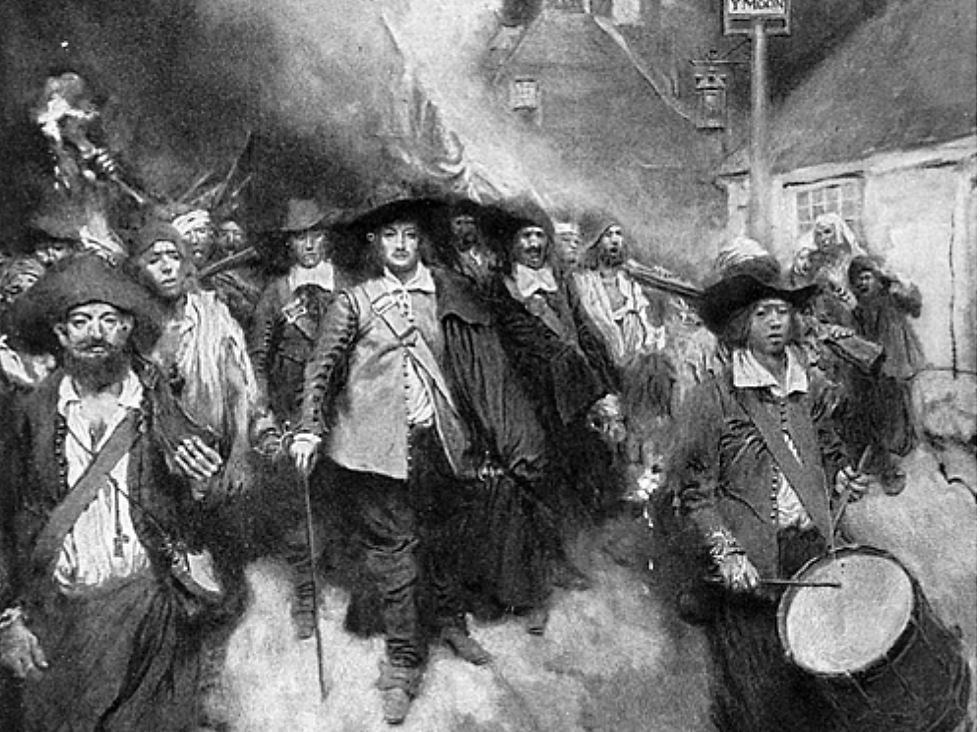
So began a killing spree that began in March of 1676. Bacon, managed to get up an army of three hundred men who set out to eliminate as many Native tribes as they could. When Bacon's troop met a group of Occaneechi, they enlisted the tribe in a fight with the Susquehannock. The Occaneechi, glad to help against their natural enemies, in the end met with a cruel reward. After the battle, Bacon and his men turned on the tribe that had just offered them aid, slaughtering most of them and burning their village. Bacon rallied his troops with the cry, "If the redskins meddle with me, damn my blood!"
As support for Bacon's rebellion grew, Berkeley seemed powerless to quell the momentum. The best he could do was to proclaim "Bacon and his Followers Rebells and Mutineers for going forth against the Indians without a Commission" with the faint hope that Bacon would be apprehended.
Note: A commission refers to someone in the militia with a leadership role. Bacon had no ranking in the militia.
Bacon's fiery reply to Governor Berkeley portrayed his makeshift army's actions as purely defensive:
"... those loud and several bulls would aifright innocents and render the defence of our brethren and the inquiry into our sad and heavy oppressions treason. But if there be...a just God to appeal to...if to plead the cause of the oppressed...if to stand in the gap after so much blood of our dear brethren bought and sold, if after the loss of a great part of his Majesty's colony, deserted and dispeopled...to endeavor to save the remainders, be treason, Lord Almighty judge and let the guilty die."
the rebellion heats up
Undeterred by Berkeley's benign threats, Bacon promised freedom to African slaves and all English indentures who would take up arms with him against both the Native Americans and the government of Virginia. At the time of the rebellion, white indentured labor still predominated over African labor. Bacon also sought the support of Englishmen who had served out their indentures and now wanted land, especially land reserved by treaty for the Natives. Bacon's promise would turn out to have far-reaching consequences for future African Americans.
While Bacon's militia mainly consisted of white and black indentured servants and enslaved black people who believed they were joining the cause in exchange for freedom, it's entirely possible that our Eppes, Poythress and Hardiman relatives joined Bacon at the beginning of the rebellion. With large plantations being split up between sons, ambitious up and comers were always looking for more land. These young men believed that Bacon's goal was to frighten Berkeley into granting more Native land to young planters such as they. As the rebellion gained steam among the lower classes, however, the wealthier young men quickly jumped ship.
Berkeley, after declaring Bacon a rebel, scheduled elections for a new assembly hoping a new set of men could solve the problem. Lo and behold, Bacon's numerous followers, with their votes, ensured him another session as Assemblyman. A cat and mouse game followed. Berkeley allowed Bacon to take his seat in the assembly but, after a heated and unresolved discussion, Bacon abruptly left the assembly room. A few weeks later he marched to Jamestown with his supporters demanding a commission and carte blanche to go after the Natives. His demand must have included threats because the governor stood up to Bacon and yelled, "Here shoot me before God, fair mark, shoot."

Tense moments followed. Bacon did not shoot his cousin's husband. Berekley finally caved and gave in to Bacon's demand for a campaign against the Natives without government interference. From July to Septemeber, Bacon and his supporters were finally in control and mayhem in Jamestown ensued. Berekely fled to the Eastern Shore of Virginia.
the burning of Jamestown
What followed was all out war. Berkeley was down but not out. His spies infiltrated Bacon's camp and, with knowledge gained, found his militia strong enough to retake Jamestown. This time it was Bacon who fled, but it didn't take him long to regroup. On September 19, 1676, Bacon took his troops to Jamestown for a final showdown. This time his rally cry was "Come on my hearts of gold! He that dies in the field, lies in the bed of honor!" The rebels put up a good fight, but found it impossible to take the town. In sheer retribution, Bacon and his supporters burned Jamestown to the ground.
In the words of Mary Newton Standard in her account the Rebellion, "...and soon all that remained of Jamestown was a memory, a heap of ashes, and a smoke-stained church tower, which still reaches heavenward and tells the wayfarer how the most enduring pile the builders of that first little capital of Virginia had heaped up was a Christian temple."

death of Bacon
It seems Bacon had gone too far with the destruction of the Capitol. He found himself a wanted man, had lost much of his popular support and was forced to hide in the damp swamps surrounding Jamestown. England, realizing the situation was too dire for Berkeley, sent a naval squadron of a thousand men to restore order. But, a month after the destruction of Jamestown and before the English fleet could arrive, Nathaniel Bacon died. He died not in battle, but of dysentery while sheltering in the marshes.
And thus Bacon's Rebellion fizzled to a close. A feeble attempt was made by Bacon's followers to continue but, without their leader, the people of Virginia had lost their inspiration. Bacon's body was said to have been buried by his faithful followers in a secret place where it could not be meddled with. According to Mary Newton Standard, "tradition has it that stones were placed in his coffin and he was put to bed beneath the deep waters of the majestic York River, whose waves chant him a perpetual "requiescant in pace."
aftermath
While historians endlessly argue the myriad significances of Bacon's rebellion, from the perspective of the Pamunkeys, Occaneechis, and Susquehannocks, the issue was decidedly about acquiring Native American lands. And in this, though his rebellion was officially squelched, Bacon actually achieved his goal. Subsequent governors heeded the call for harsher Native policies. Forty years later, Lieutenant Governor Alexander Spotswood summarized the situation, “a Governour of Virginia has to steer between Scylla and Charibdis, either an Indian or a Civil War...” The fortunes of the Virginia's Natives rapidly declined in the generation following the rebellion.
the final reckoning
Putting the Native issues aside, the uniting of black and white servants and slaves shook Virginia’s wealthy planters to the core. Legal scholar Michelle Alexander writes:
"The events in Jamestown were alarming to the planter elite, who were deeply fearful of the multiracial alliance of [indentured servants] and slaves...In an effort to protect their superior status and economic position, the planters shifted their strategy for maintaining dominance. They abandoned their heavy reliance on indentured servants in favor of the importation of more black slaves."
Bacon's Rebellion, in effect, lowered the status of blacks while it raised the status of whites. Virginia’s lawmakers began to make legal distinctions between “white” and “black” inhabitants. The permanent enslavement of people of African descent gave poor, white servants and farmers new rights and heightened status. The ultimate objective was to create a permanent separation between the two groups, making it far less likely that they would ever unite again in rebellion.
Marie Tyler McGraw in her historical study "Slavery and the Underground Railroad at the Eppes' Plantations" writes:
"Bacon’s Rebellion was important in the efforts of seventeenth century English settlers to define racial differences between Africans and Europeans. Bacon had to unite the grievances of both the aspiring gentry, such as the Eppeses, and the landless ex-indentured whites. He united them on the basis of their rights as Englishmen, visible as white masculinity... while Africans were outside this covenant of convenience."
Soon after Bacon's Rebellion ended, laws were enacted making people of African descent "hereditary slaves." More power was then allotted to independent white farmers and land holders in every social class. Historian Ira Berlin posits that "what we see here in Virginia in the late 17th century, around Bacon's Rebellion, is that freedom and slavery are created at the same moment."
According to the Oxford English Dictionary, the first appearance in print of the adjective white in reference to “a white man, a person of a race distinguished by a light complexion” was in 1671, only five years before Bacon's Rebellion. As the status of people of African descent plummeted, the word white was increasingly used in public documents and private papers to describe European colonists. Historian Robin D. G. Kelley explains: "Many of the European-descended poor whites began to identify themselves, if not directly with the rich whites, certainly with being white. And here you get the emergence of this idea of a white race as a way to distinguish themselves from those dark-skinned people who they associate with perpetual slavery."
And so it has continued even until today. The division in American society created between black and white that began after Bacon's Rebellion has had devastating consequences for African Americans for three hundred and fifty years. Both during the years that slavery existed in the United State and after it was abolished, the supposed differences between the black and white races has been used to justify brutal and inhuman treatment of African Americans. Those differences certainly came into play when the cries for liberty and equality for all men that rang out in 1775 paid little heed to the institution of slavery.


Comments