
BENNINGTON PART II
- westmohney

- Oct 31, 2023
- 8 min read
Updated: Nov 29, 2024
without delay, . . . have the Plunder of every kind collected and given in the Quar. Master Gen’l. that the men may receive the value of it.
~George Washington
plunder at Bennington
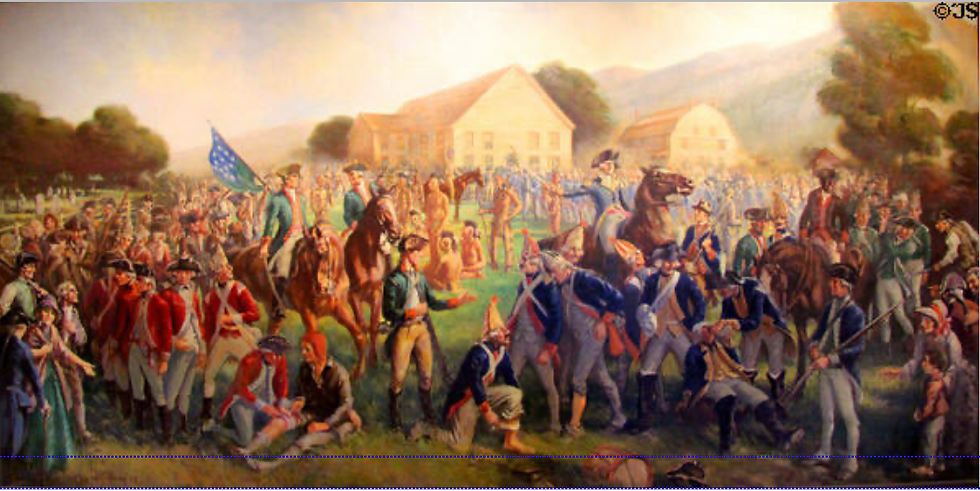
As he prepared his troops for battle, Stark promised “that the soldiers should have all the plunder, taken in the enemy’s Camp.” But Stark's men weren't the only ones to benefit from the bounty of British arms and personal items that littered the field after the battle. Civilians in the area also arrived to scour the field, competing with soldiers for the choicest items. The frenzy for plunder got so hot that Stark finally organized a committee to search the men who were taking more than their fair share and to oversee the division of goods.
The plunder was then divided into four categories. It was decided that private possessions must be returned to their owners. Trophies, like swords and helmets were sent to the three states, New Hampshire, Vermont and Massachusetts, that had participated in the battle. Some arms and cannon went to the Continental Army. The rest, the largest portion, was to be sold and divided among the men.
An example of some of the items sold at auction came from a "highly detailed" list of lost items that Hessian soldier Lt. Col. Heinrich Breymann compiled after the battle. The list, translated by historian Thomas M. Barker contained fifty-four categories of equipment. The items included "278 muskets with bayonets; 32 single bayonets; 13 drums; 2 musical pipes and carrying cases; 8 carpenters’ axes; 43 rifle slings; 523 knapsacks; 564 bread bags; 129 camp kettles; 129 camp kettle sacks. . ."
Records indicate that at least four auctions took place in Bennington. Anyone in the area, including soldiers, had a chance to purchase plunder items. Our cousin Peter Kimball's (3C7X) diary mentions, among other things, his visits to the auction which he refers to as "vandue."
Saturday 16 we formed the Brigade & had a battle with the enemy in which I Received a slite wound
Sundy 17 I went & viewed the ground where the Battle was & returned to camp and Laid in camp all Day
Mondy 18 we Lay in the camp sent out scouts Berried some Dead
tuesday 19 I want to town to see the sick & wounded. Rote a Letter to send home.
monday 25th I went to town to the Vandue of the plunder
tuesday 26 sarch was made for plunder in the company
Wensday Aug 27 I went to Vandue.
fridey 29 I went to Vandue
thursday (September) 4th I went to Vandue and bot a hatian (Hessian) gun for 49 shillings.
frydey 5 ordered to be ready to march to Ranzelers mills, and I went to town and saw the Baymen (Hessian Lt. Col. Breyman's prisoners) march for manchester
fridey 19 I went to town & gut the plunder money for the cmpany 13-7-0 which was in the Benningtown fight of my company
no date the plunder money at Bennington Divided to 2250 men.
Four auctions were held and it appears that Cousin Peter went to all of them. The sales netted 13 pounds 7 shillings and 0 pence for his company which amounted to only about 7 pence per man. Certainly many of the men felt that they deserved a larger slice of the pie. A good example is the case of Charles Cavenough and John McAllister who were arrested for “Concealing and Conveying away two Horses & a Quantity of other Plunder. . . taken from the Enemy on the 16th August and under pretence of being ordered there by Col. [Thomas] Stickney.”
According to stories handed down in the Kimball family, the Hessian musket Peter bought at auction was later used by his grandson, Solon Kimball (6C5X) for hunting.
The taking of plunder certainly wasn't confined to the Battle at Bennington. After the battle at Trenton, George Washington ordered his commanders to “without delay, . . . have the Plunder of every kind collected and given in the Quar. Master Gen’l. that the men may receive the value of it.”
On occasion, however, plunder could definitely cause problems. American Brigadier General Richard Montgomery took umbrage with soldiers taking personal items. When some of his men wanted to exchange their old garments with those of British prisoners, Montgomery knew that British soldiers paid for their own clothing. He wrote that “there was no driving into their Noddles that the clothing was really the property of the soldiers.”
our relatives at Bennington
the Sherwins
Our uncle Daniel Ebenezer Sherwin (4U) was 20 years old when he served at both Bennington and Saratoga along with his (and our) cousin Ebenezer Sherwin (1C6X).
the Fays
We wrote about our cousin Stephen Fay (4C10X) and his Catamount Tavern in the town of Bennington in our "Final Days Before Revolution" post. Not surprisingly, six of Stephen's seven sons participated in the Battle of Bennington. Sadly, John Fay (5C9X) was killed in the melee. From the Fay Family Book by Orlin P. Fay we have this romanticized account of Stephen reaction to his son's death:
. . .when his father was informed that he had been unfortunate in respect to one of his sons he exclaimed, "What! Has he misbehaved?" "No, sir," said the informant, "worse than that, he is among the slain, he fell contending mightily in the cause." "Then I am satisfied," replied the venerable sire, and in his deep grief, bowing his head, he exclaimed, "I thank God that I had a son who was willing to give his life for his country, bring him in and lay him before me, that at my leisure, I may behold and survey the darling of my soul." Upon which the corpse was brought in and laid before him, all besmeared with dirt and gore. He then called for a vessel of water and washed the gore from his son's corpse and wiped his gaping wounds with a complacency, as he expressed it, which before he had never felt or experienced. This account is from papers published 1777, soon after the battle.
Besides John, there were Elijah (5C9X), Benjamin (5C9X), Col. Joseph (5C9X), and David (5C9X) who fought in the battle. Jonas, a physician, was the surgeon for Ethan Allen's Green Mountain Boys.
Abraham Kimball
Our cousin Abraham Kimball (3C8X) was the great-grandson of our aunt Mercy Haseltine Kimball (9A). He was born in Hopkinton, NH in 1742 and had the distinction of being the first white child born there. He served at Bennington under the command of our cousin Colonel Thomas Stickney (2C8X). During the battle, Abraham was wounded in the knee at Bennington and gave an account of his medical expenses to government officials:
Abraham Kimball's account, Bennington, Aug. 28, 1777.
Hired a horse to come to Hopkinton, 130 Miles £9. 0.0
To expenses on my way home 1.14.6
To a horse 2 journes from Hopkinton to Andover 5.10.0
To nursing while at Andover 1.16.0
Expenses going to and coming from Andover 4. 5.6
Paid Dr. John Clement 12.6
Dr. Thomas Kitteridge 4.16.0
£27.14.6
Note: Abraham traveled all the way from his hometown in Hopkinton, NH to Andover, MA, a journey of 50 miles, in order to be treated by our cousin, the famed Dr. Thomas Kittredge (3C8X).
Loss of time about six months occasioned by said wound.
A true account errors excepted
Abraham Kimball.
Cousin Thomas Stickney wrote to the Council to verify Abraham's wound:
To the Honorable Council and house of representatives.
These may certify that Abraham Kimball of Hopkinton in the County of Hillsborough was a soldier in Capt. Balles Company, in Col. Stickney's Regt. in the late expedition to Bennington. Being wounded at said Bennington in the Battle there
Nov. 13, 1778.
Attest Thomas Stickney Col.
The Council alloted him half pay for two years and £10 for his medical expenses:
State of New Hampshire Nov. 14, 1778.
To John T. Gilman Officer Appointed to register wounded soldiers &c.
Persuant to a vote of Council and Assembly you are to register Abraham Kimball a soldier in Capt. Bailey's Co. Col. Stickney's Rgt who was wounded in the battle of Bennington and allow him half pay (Agreeable to the .Resolves of Congress) two years commencing the 18, of Sept. A. D. 1777.
M. Weare Prest.
0170 .A.ARON KIMBALL OF HOP.KINTON, N. H.
His bill for Doctor's bill nursing &c. £27.14s.6d. was allowed. Nov. 18, 1779 he received £10.
Benjamin Cummings
Our cousin Lt. Benjamin Cummings (4C6X) also took part in the Battle of Bennington. His other claim to fame is that he was the brother of Prudence Cummings Wright (4C6X), heroine of the Pepperell Bridge affair that we wrote about in our "Revolutionary Stories" post. Below is a picture of Cousin Benjamin:

Nehemiah Richardson
Our cousin Nehemiah Richardson (4C7X) served at Bennington. His father, Jonathan was a great-grandfather of our distant cousin Susan B. Anthony (6C5X).
the Brighams
Three Brigham brothers served together at Bennington: Artemas (6C8X), Lt. John (6C8X) and Col. Timothy Brigham (6C8X)
James Ballard (3C7X), reported deserted
Ebenezer Ballard (3C7X)
David Brigham (5C9X)
Isaac Brigham (6C8X)
Stephen Brigham (5C9X)
Benjamin Chamberlain (3C6X)
Peter Coffin (4C7X)
Elisha Crosby (4C9X)
Captain Josiah Crosby (4C9X) was paid £25 for camp utensils for Stark's regiment
William Crosby (5C8X) was Josiah Crosby's son
Samuel Crosby (4C9X) was a doctor who returned to Boston with Bennington prisoners
William Greenleaf (5C6X) was the son of Sheriff William Greenleaf (4C7X) of Boston
Richard Haseltine (2C8X)
Oliver Hildreth (3C7X)
Abel Richardson (4C6X)
Luke (4C7X) and Tilly Richardson (4C7X) were brothers
Jonah Richardson (4C7X)
John Stickney (3C8X)
Israel Wyman (4C6X)
Joseph Wyman (5C5X)
Josiah Wyman (3C6X)
Oliver Wyman (5C6X)
Ross Wyman, Jr. (5C6X) was the son of Blacksmith Ross Wyman (4C7X) of Shrewsbury.
Jonas Wyman (4C7X)
Probable family members at Bennington that I can't place in any family:
James Baldwin
John Baldwin
Jonathan Ballard in our cousin Benjamin Symonds (2C8X) regiment
Jonathan Richardson also in Ben Symond's regiment
Jonathan Brigham
Stephen Crosby
Simeon Haseltine Hardwick
John Haseltine
Jeremiah Proctor
John Richardson
Paul, Jonathan, Joseph, Asa and David Richardson were all from Barre, MA
Abijah Richardson
James Richardson, fifer
Nathaniel Richardson
Nehemiah Richardson
Robert Richardson
Seth Richardson
Joseph Richardson
Richard Stickney, possibly a nephew of Col. Thomas Stickney
And, of course, there was our cousin Colonel Benjamin Symonds (2C8X) who, like Cousin Thomas Stickney (2C8X), played a major role at Bennington. Benjamin will be the subject of our next post.
back on the western front with Jeduthan
Cousin Jeduthan Baldwin (3C7X), along with the rest of new commander Horatio Gates' army, was camped at Bemis Heights on the banks of the Hudson. On the 16th of August, still unaware of the major battle raging 30 miles away to the east, Jeduthan was having an interesting day himself. His journal entry for that day:
this morning I was ordered up to Stillwater with 280 Men to burn the Bords left cut & burn the Bridges & break up the Roads...about 1 o clock we discovered 3 men with packs crossing the river from the uper to loer island, a Serjt & 6 men went over to discover who they were. . .
It tuned out that a harmless family of Tories, 4 men, 7 women and 17 children, had been hiding out on an island in the Hudson near Stillwater, about two and a half miles south of Bemis Heights. Jeduthan wrote that "those tories are persons of welth Inhabitants of Stillwater who had secreted there Houselstough, Cloathing & movables in the woods & then went on to this desolate Island that was thick wooded where they design'd to Remain till our Army was movd down & then they would return home under the protection of Burgoin. Jeduthan never wrote about the ultimate fate of those poor Tories.
Three days after the battle, Jeduthan finally got word of Bennington. On August 19 he wrote: "Had the acct of the Victory gaind by Genl. Starks near Benington 936 Killd & taken. Genl Gates came to Camp this evening"
Jeduthan spent the next ten days either at Van Schaick's Island or in Albany. On August 30, he hobnobbed with a bunch of generals. His journal entry for that day: "Rode with Genls. Gates, Arnold & Paterson to Dine with Genl. Poor."
Albany is about 16 miles from General Gates' camp at Bemis Heights:

On September 1, Jeduthan reported that a flag of truce had come from Burgoyne's camp across the river asking the Americans to care for British soldiers who had been wounded at Bennington.
Jeduthan then spent the next three and a half weeks in camp at Bemis Heights working on fortifications for impending battle.


Comments