
Cousin Cyrus' Tea Woes
- westmohney

- Mar 12, 2023
- 11 min read
Updated: Aug 20, 2023
This destruction of the tea is so bold, so daring, so firm, intrepid and inflexible, and it must have so important consequences...that I cannot but consider it as an epocha in history. ~ John Adams

The Tea Act of 1773
Our cousin Cyrus Baldwin (3C7X) was born in Woburn in 1740. Both his parents just happened to be cousins of ours, James Baldwin (2C8X) and Ruth Richardson (2C8X). Cyrus' brother was Loammi Baldwin (3C7X) who would become, according to Wikipedia, "a noted American engineer, politician and a soldier in the American Revolutionary War." Cousin Cyrus, however, was a dealer in tea at perhaps the worst time in history to be such a dealer.
In our post "Sheriff Stephen Greenleaf" (4C7X), we included Cyrus' letter to his brother Loammi reporting on the hanging in effigy of Stamp Master Andrew Oliver. That incident happened in 1765 and, by 1766, the Stamp Act was gone, replaced by the Townshend Acts of 1767. The Townshend Acts were every bit as unpopular as the Stamp Act had been. To placate the colonies, Britain had repealed most of the Acts by 1770. This partial repeal turned out to be a case of too little too late.
The Boston Independent Company of Cadets
In 1741, a team of cadets was charted by the Province of Massachusetts to serve as bodyguard for the governor. As time wore on, the role of the corps shifted to that of a local militia. Cyrus was part of this group which was first called the Company of Gentlemen Cadets. The corps was suspended from 1774-1776, probably because its original allegiance was to the crown. In 1776, the group was reformed as the Boston Independent Company under the command of John Hancock. It's doubtful whether Cyrus was part of the corps when they marched out for the battles at West Point and Yorktown in 1780.
Below is a photograph of Cyrus' uniform which is now housed in the Fort Ticonderoga Museum:

Note: We've already written of Cyrus' (and our) cousin Jeduthan Baldwin in our "Cousin Jeduthan Baldwin" post. We will see much of Jeduthan in future posts.
the Patriots react
After the death of Christopher Seider and the Boston Massacre, the city remained on high alert, waiting for another shoe to drop. The shoe that finally dropped was the Tea Act, passed by Parliament in 1773. The Act granted the British East India Company a monopoly on tea trade in the colonies, effectively cutting American merchants out of the highly profitable tea business. To add insult to injury, there would, naturally, be a tax on all tea coming into Boston Harbor.
The first ship carrying the dreaded taxable tea arrived in Boston on 28 Nov 1773. The import fees had to be paid within twenty days so the Patriots wasted no time. On the 29th, they called a meeting at Faneuil Hall to talk about a course of action. The response of the Bostonites was far greater than the Sons of Liberty could have hoped. 4,000 people gathered outside the Hall. The meeting had to be moved to the Old South Meeting House in order to accomodate everyone.
Samuel Adams described the meeting on November 29 in a letter to a friend:
…the people met in Faneuil hall, without observing the rules prescribed by law for calling them together. . .they were soon obliged for the want of room to adjourn to the Old South Meeting House; where were assembled upon this important occasion 5000, some say 6000 men, consisting of the respectable inhabitants of this and the adjacent towns. The business of the meeting was conducted with decency, unanimity, and spirit.
Our intrepid cousin Sheriff Stephen Greenleaf interrupted the gathering with a message from Governor Hutchinson ordering the assembly “to disperse and to surcease all further unlawful proceedings at your utmost peril.” As J.L. Bell put it, "[t]he meeting resoundingly refused to comply." Then, the citizens went one step further. The people of Boston "solemnly voted. . .that the said tea never should be landed in this province. . . "
Note: While Cousin Stephen had his hands full dealing with the increasingly tense atmosphere in Boston, he was going through personal problems as well. Shortly before the Boston Tea Party, his youngest daughter Hannah and her husband died at sea on a voyage to Charleston, SC. Stephen was chosen guardian for his three young grandchildren children, 12, 6 and 3.
The dumping of the tea into Boston Harbor on 16 Dec 1773 is a well known story to the vast majority of Americans. While none of our relatives that I know of dressed as a Native that night and stole out to the wharf to make that bold statement of rebellion, for one of our relatives at least, the tea affair was something of a disaster.

Note: Our cousin Moses Richardson's (4C7X) son-in-law William Russell was one of the tea-partyers that night. We'll hear more about both Moses and William Russell in future posts.
woe for poor cousin Cyrus
The importance of tea in Britain and Colonial America cannot be overstated. The colonists simply loved their tea and the dumping of that product into the harbor showed the lengths they were willing to go for their freedom. But, with the passage of the Tea Act, Cousin Cyrus found himself in something of a pickle. He still had loads of tea to sell and wanted to provide his customers with the best.

Cyrus worried, however, that people might think his imported Chinese tea came from the dreaded East India Company. On December 1st, he took out an ad in the Boston Gazette affirming that not only was his tea “Choice Souchong and Hyson Tea” but that he, himself, was "neither Addresser, Protester, nor Roman Catholick." After the tea-dumping party on the 16th, Cyrus added a discalimer to his ad stating that “[t]he above Teas were imported before any of the East India Company’s tea arrived.”
Unluckily for Cyrus, the prevailing view in Boston at the time deemed all tea as repugnant. Most tea dealers agreed not to sell any tea at all. It appears that poor Cousin Cyrus decided to follow suit. By January, his ads in the Massachusetts Spy no longer included tea. Still, Cyrus had quite a conundrum on his hands. He still had a huge stock of tea and some of the more rabid Patriots would be happy to burn any tea they could get their hands on. Where could Cyrus possibly store his tea until the crisis was over?
Brother Loammi to the rescue! Loammi was a big man in the colonies and "beyond reproach," according to J.L. Bell. He also happened to own a farm in Woburn, only ten miles from Boston. On a day in early January, 1774, a cart loaded with tea made its way north from Boston toward the town of Woburn. From the January 13 issue of the Massachusetts Spy:
Last week a barrel of Bohea tea which was attempted to be smuggled into some of the country towns, was detected and stopped at Charlestown, soon after it crossed the ferry, and the whole contents emptied into the river. An update showed that some were sympathetic to the plight of the tea dealers: it being Part of some that had been imported here before the East India Company’s Tea arrived, and publickly advertised for Sale: The Tea it is said belonged to Persons who are esteemed Friends to Liberty, But the Inhabitants of Charlestown having resolved against the Use of that Article. and burnt their own, some of them tho’t it an Insult to be sent through their Town, and destroyed it as reported.
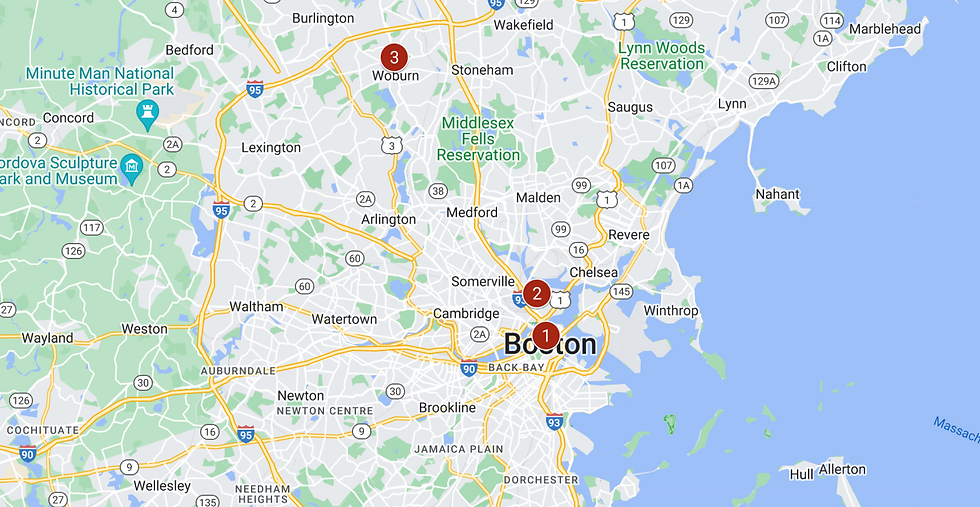
The tea that was dumped into the river in Charlestown belonged, of course, to poor Cousin Cyrus. There was no recourse for him but appeal to the town of Charlestown for restitution:
Boston Jany 25 1774 Gentn. On the 4th Instant I was sending a quantity of Goods to my brother Mr Loammi Baldwin at Woburn & pack’d a bag containing 26 lb. Bohea Tea into a Barrel not for secrecy but for safety of conveyance. In the evening the Team was stoped just on this side Winter hill and the driver interogated by three or four men who called themselves a Commitee of Suspiscion for Charlestown: what goods he had & whether any Tea? To which he answered generally that he knew nothing what goods were in the Cart. Upon which they insisted upon probing, & abused and drove off the Teamster, broke open the cask that contained the Tea, carry'd off the bag with the Tea—& some other articles are missing.
I cannot harbour the least suspicion that any Gentlemen of Charlestown, much less any of the respectable Committe of Correspondance were knowing to or any way incouraging such high handed Villany, yet as they assumed the character of a Committee from the Town of Charlestown I think it my incumbant duty to the Inhabitants of Charlestown to inform you of the above particulars, not doubting but you will properly resent such Wickedness perpetuated in the name of the Town, & if it is in your power, promise me satisfaction for my loss.
I think it not proper or advisable to make a public stir about it just at present, least the Enemies to the good cause which we have imbarked in should triumph in our Divisions. But unless a speedy & intire stop be put to such attacks upon private property we shall fall into a greater Evil than we are endeavouring to avoid.
All which is submitted to your wisdom and confidence. Your most respectfull and obediant Humble Serv't, Cyrus Baldwin. I shall inteem it a favour you'd return an answer as soon as convenience will permitt.
the town of Woburn gets involved
Fortunately for Cousin Cyrus, he had a brother who sat on on Woburn's Committee of Correspondence. Four of the five members of Woburn’s Committee wrote to their peers in Charlestown in defense of Cyrus. Loammi wisely stayed out of it.
Note: The Washington Library defines Committees of Correspondence as "longstanding institutions that became a key communications system during the early years of the American Revolution. The network created by these committees organized and mobilized hundreds of communities across the British North American colonies"
From the letter sent to the Charltown Committee which never mentions Cyrus' name or Loammi's relationship to him:
Som violent measures we know have been rendered necessary, in order to make a proper Stand against those incroachments that have been made upon our Liberties—But the measures that we would now draw your attention to, we look upon as violent, unjust, & cruel.
A Team was stopped on the King’s highway, in sd Town; his Teamster abused—his Cart robed of several articles, belonging to him, And at the same time about 26 lbs of Tea, not belonging to him, nor any man in this Town—but only to be conveyed for a Gentleman, by his favour, to some distant place. . . We Trust you will use your influence to detect & punish the aggressors—and will indeavour that proper compensation be made to the Sufferers.
Unfortunately for Cousin Cyrus, Charlestown was having none of it. They replied first to Cyrus:
We conceive, when the Town appointed us to this honorable Trust, they expected that we should attend to such Grievances of a publick Nature only as there was no legal Remedy for . . .We can no Means suppose ourselves authorized to interfere in private Matters, where the legal Remedy is plainly pointed out. As to the Fact refer’d to in your letter, this is the first authentick Intelligence we have had of it, a Rumour has prevailed, that something of that kind had taken Place.
The reply to the Woburn Committee: But this we dare affirm, that either the Teamster Who relates the Matter, or the Persons who are said to have attacked him, were guilty of an infamous Falsehood, in declaring that they were employed in this Business by Charlestown. . . . We are extremly sorry, that Mr. Baldwin at this trying Time after the Body of the People at Boston had resolved “that the Use of Tea was improper & pernicious” should become a Carrier of that detested Article. We can take no Notice of this Matter.
That was the end of it. The tea was gone and Cousin Cyrus had to suffer the loss.
Cyrus soldiers on
Cyrus continued in his trade business minus the tea but it wasn't easy. By March of 1775 he was advertising his English goods at "50 per cent from the Sterling Cost." Then, in May of 1776 when the British soldiers were leaving Boston after a year long siege, a newpaper article indicated that his shop had been looted. In the article Cyrus, probably in severe financial difficulties at the time, requested that "all those who are indebted to him on note, book or otherwise to make speedy payment to him at Woburn..." He may have gone to stay with his brother Loammi in his time of troubles. His new inventory of wares now included sugar, rum, coffee and "sundry other articles.”
Things might have improved financially for Cousin Cyrus after the war. It appears he had gone back to his home in Boston. On one trek from Boston to Woburn, he suffered a mishap at Winter Hill in Charlestown. From Boston’s Continental Journal of 29 July 1784: "Mr. Cyrus Baldwin of Woburn, crossing Winter Hill, was attacked by three foot pads who robbed him of his watch and money and, after abusing him very much, made off."
Note: According to Wikipedia "a footpad is a robber or thief specializing in pedestrian victims."
It seems that poor Cyrus was beaten badly, repeatedly hit with a club on the left side of his head. He survived the assault and later the thieves were caught after a subsequent attack on another man. Cyrus' "watch, purse, pocket-book, &tc." were all recovered. Both robbers were duly executed in Cambridge.
After a somewhat brief life of triumphs and tribulations, Cyrus Baldwin drowned in Dunstable on his fiftieth birthday.
The event was recorded by diarist Samuel Thompson of Woburn: "Nov. 5 1790 Fair. Cyrus Baldwin, Esquire, drowned at Dunstable." The largest body of water in Dunstable is the Massapoag Pond. That may have been where poor Cousin Cyrus met his end.
And, from the Herald of Freedom newspaper:
Died—at Dunstable, the 4th inst. CYRUS BALDWIN, Esq. formerly of Boston.—His funeral will be this afternoon, at two o’clock, from the house of his brother Loammi Baldwin, Esq. at Woburn—where the friends and acquantence of the deceased are desired to attend.
in other tea party news...
One of the stories told by prolific blogster J.L. Bell on his Boston 1775 site is about our cousin Daniel Greenleaf (5C6X). Daniel was the son of Sheriff William Greenleaf (4C7X) who ironically took over the sheriff position from his brother, the beleaguered Sheriff Stephen Greenleaf after revolution broke out.
The story concerns a speech given in the Old South Meeting House on 16 Dec 1773 by Josiah Quincy just hours before the Boston Tea Party. According to Josiah's daughter Eliza Quincy, her father closed his speech with these words:
I see the clouds which now rise thick and fast upon our horizon, the thunders roll, and the lightnings play, and to that God who rides on the whirlwind and directs the storm I commit my country.
Eliza named two eyewitnesses who had heard her father's speech. One of them was Cousin Daniel Greenleaf. Eliza wrote that "on the 18th of June, 1852, the venerable Daniel Greenleaf, of Quincy, Massachusetts, at the age of ninety years, gave the same account, and repeated the closing sentences."
When he was young, Daniel attended Latin School in the Old South Meeting House which was used as a meeting place whenever Fanueil Hall got too full. When the Old South was used for gatherings, Latin school was quickly adjourned and the boys were told to wait in the upper gallery. Daniel happened to be in that upper gallery the day that Josiah gave his speech and he remembered those words for all of his ninety-one years. Bell posits that "[i]n 1852, Mr. Greenleaf was probably the only person living who distinctly remembered the 16th of December, 1773."
Daniel evidently loved reminiscing in his old age. According to a family history: “His memory was very retentive; he could relate almost every transaction of his long life; was full of anecdotes of revolutionary events; being then a young and active lad in immediate contact with some of the prominent actors of those times.”
Ex-president John Adams also lived in the town of Quincy. When he died there In 1826, Cousin Daniel was one of the appraisers for Adams' estate. Daniel died in 1853 at the age of 91.


Comments