
COUSIN REUBEN KIDDER
- westmohney

- Jan 11, 2023
- 9 min read
Updated: Feb 28, 2023
Col. Kidder may be said to have been, for the first 20 years of his residence here, the father of the town.
~ Charles Chandler in his History of New Ipwich, NH

settling in New Ipswich
Our cousin Reuben Kidder (2C7X) was born in that part of Chelmsford that became Westford in 1723. He lost his father, Thomas (1C8X), when he was only six. As an adult, however, Reuben had the good fortune of becoming a surveyor which was a money-making proposition given the number of new towns being settled in the 1740s. He was then doubly fortunate to become acquainted with new locations and privy to good deals on land sales.
Much of the area around the Massachusetts/New Hampshire border had been abandoned during King George's War which was fought from 1744-1748. Reuben was quick to see the possibilities. He moved to New Ipswich, New Hampshire and immediately began buying up land not only there but also in more remote regions. His next trick was to go back to Chelmsford and convince his former neighbors of the opportunities to be found in New Hampshire.
Charles Chandler in his History of New Ipswich New Hampshire says of Reuben:
It was by his influence and exertions that a large number of young men, natives of Chelmsford, including Westford, were induced to buy lands and become settlers here. . . Many of them purchased farms of Col. Kidder, who was a large land seller, both of his own and of the Masonian proprietors. Col. Kidder may be said to have been, for the first 20 years of his residence here, the father of the town.

other relatives in New Ipswich
Some of our relatives who were convinced to make the move to New Ipswich:
Joseph Kidder (2C7X) was Reuben's brother. He came to New Ipswich early, in 1750. It appears that Joseph got no favors for being the brother of the so-called "father of New Ipswich." Reuben's grandson, historian Frederic Kidder (4C5X), compiled his own history of New Ipswich, the town where he was born. In that book, Frederick wrote that Joseph's land "lay in alder swamp, so dense that Judge Farrar said he had seen the time when he could walk across, on the bushes, without touching the ground; and it was regarded as so worthless, that 'poor as Joe Kidder's lot' became a proverb in town."
Note: We relied heavily on Cousin Frederic's account of the Battle of Lovewell's Pond for our post "Lovewell's Fight."
Joseph may have had the last laugh. He left his swampy property in New Ipswich and settled seven miles away in Temple, NH and lived to the ripe old age of 93.
Aaron Kidder (2C7X) was another of Reuben's brothers. He died in New Ipswich in 1769 at 50 years.
John Chandler (2C8X) of Westford was in New Ipswich by 1750 when he built the first saw and corn mills in town. His grandmother was our aunt Elizabeth Phelps Chandler (8A). John left New Ipswich in 1767 when he purchased land in Maine. This land in Maine was owned by, among others, John Hancock. The last signature on the purchase agreement is Hancock's and it looks strikingly similar to his signature on the Declaration of Independence, flourish and all:

When John Chandler left New Ipswich, he sold his mills to our cousin Eleazor Cummings (3C7X).
Simeon Hildreth (2C8X) of Westford was a fifer in the Revolutionary War. He fought at the Battles of Bennington and Saratoga. He became ill in the army and died shortly after his return in 1777.
Simeon's third (and our) cousin Stephen Hildreth (3C7X) also made the move to New Ipswich. He fought at Ticonderoga and Saratoga in the Revolutionary War.
We wrote about our cousin Joel Crosby (4C9X) of Townsend in our "Defeat and Final Victory post." In 1758, during the final French and Indian War, Joel was captured and taken to Canada. Sometime after his return, he settled briefly in New Ipswich before setting off to his final resting place in Winslow, Maine.
Joel's brother Robert Crosby (4C9X) also settled briefly in New Ipswich. Robert married our aunt, Susannah Sherwin (5A) of Townsend. Robert and Susannah would, like Joel, eventually make their home in Winslow, Maine.
Note: Susannah Sherwin's brother was our grandfather Daniel Ebenezer Sherwin (5GGF). One of Daniel's granddaughters was Susannah Sherwin Parrish (3GGM) who married Grandpa Ezra Parrish (3GGF). Susannah and Ezra made the long trek across the United States from New York to California.
Josiah Crosby (4C9X) of Billerica was a cousin of Joel and Robert Crosby. He settled only briefly in New Ipswich before moving on to Milford, NH. The Milford branch of the Daughters of the American Revolution is named after Josiah. Milford has a marker honoring his service in the Revolution:

Perhaps the town of Milford didn't remember one important detail about Josiah Crosby when they erected the marker. David Palance of the Milford Historical Society did some digging into the history of slavery in Souhegan Valley in New Hampshire. This is what he found about Josiah:
One of Milford’s early setters was the Captain Josiah Crosby. His son William (5C8X), was known as the “father of Milford” since he gave the town its Oval. When Josiah came to the area in 1753 he brought with him two children, “one white and the other colored.” The girl dies young but the “colored” boy, Jeffrey, was obtained in Boston when the young Josiah was on a shopping trip in the city. The shop owner was complaining that her help was not available because she was at home tending to a number of infants that had been orphaned when their parents were sold into slavery. The two children were simply given away as if they were excess from a litter of kittens.
The cousins Leonard (1C7X) and Oliver Proctor (2C7X) of Chelmsford both settled in New Ipswich.
Reuben's home life
The placement of Reuben's house in New Ipswich is described in Chandler's History of New Hampshire:
For his house he chose a location gently sloping to the south, while in front and on the left extended noble meadows for half a mile in extent, which those industrious animals, the beavers, as advanced pioneers, had already cleared of the forests and constructed dams, the remains of which a century have not obliterated, and so extensive, that this was then the broadest surface which was opened to the rays of the sun in the township. On the north was a conical hill, then covered with a thick grove of beech. . . while to the west, at the distance of only half a mile, was a range of mountains, the most prominent of which, for a century, has borne the name of the ‘Kidder Mountain’ and will serve to perpetuate the name to generations yet to come.
Below is a painting of Kidder Mountain, as it is still named, painted ca. 1900 by William Jurian Kaula:

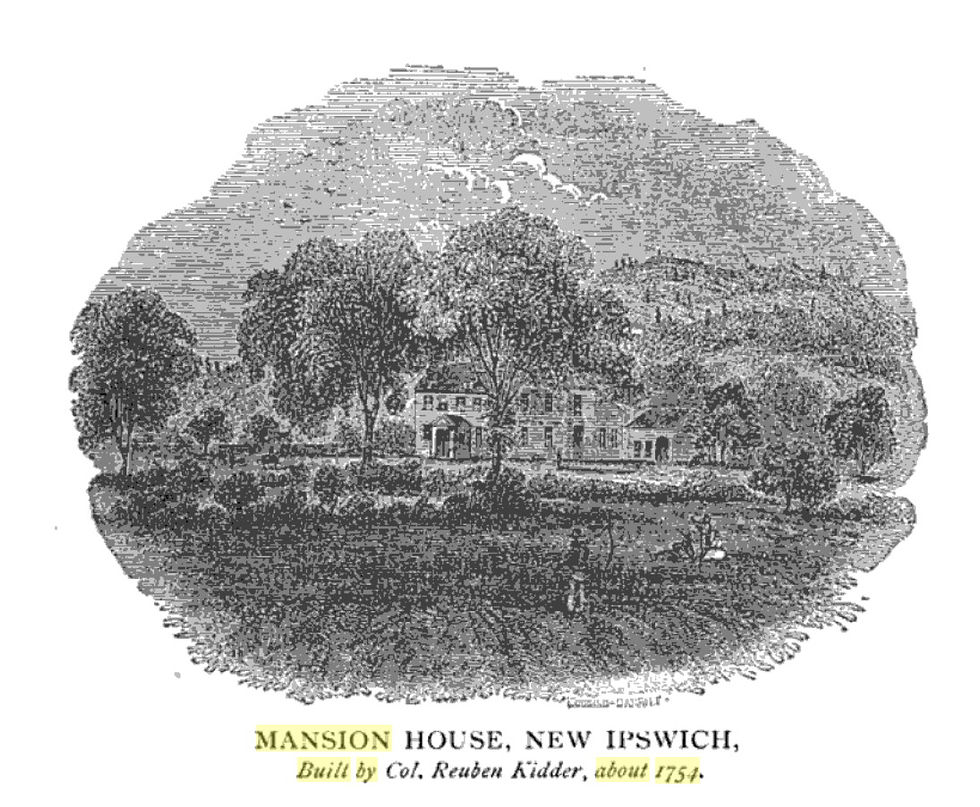
Reuben's home, considered a mansion, was completed ca. 1754. As befit a man of his stature, he owned the only carriage in the area. Charles Chandler relates a story told to him by a man who knew Reuben:
A gentleman, now living (1852), says he well remembers when the Colonel used to come out of church, had his wife into the curricle, and, when seated, his colored man Caesar would rein up his span of black horses and drive to his residence, much to the admiration of a large portion of the congregation, all of whom either came on horseback or on foot.
So it appears that our Cousin Josiah Crosby wasn't our only relative in the area to own slaves. That these two men would own slaves is not so surprising if we remember our "Slaves in Billerica" post. Both the Crosby and Kidders were known slave owners in Billerica.
Reuben purchased young Caesar in Chelmsford, paying £10 for the seven year old boy. Historian David Palance wrote that "Caesar was later known by the kids in Milford as the good-natured “Old Caesar.” He eventually earned his freedom and settled on the Mount Vernon town line where he married a woman named Phyllis."
Reuben was interested in the culture of fruit and, according to Charles Chandler:
. . .previous to the Revolution [he] had one of the largest and most valuable orchards in New England, containing the rarest varieties of apples and pears. . .He erected the first mill in this region, and made annually three to four hundred barrels of cider, a beverage then universal and indispensable in every family. On this farm, then said to be a mile in length, he commenced in the summer of 1750 the process of cultivation, and having several men in his employ, he was enabled to pursue it with energy, and the virgin soil yielded abundant crops of grain, while the beaver meadows brought, will little labor, large crops of hay--an article of which is not soon obtained in a new settlement.
Below is a drawing of Reuben's "Mansion House."
Washington, New Hampshire
The first survey of this area was made in 1749. By 1751, a charter was granted for 60 proprietors for a town called New Concord. These land owners never acted on their grant which was then summarily revoked. Cousin Reuben, seeing distinct possibilities for the area, purchased the grant. He named his new town Camden. The first settlers moved there in 1768. In 1776, the town was incorporated with the new name of Washington after the man who was leading their country to ultimate victory in the war being fought for independence. It's believed that Washington, New Hampshire is only the second town in the United States to bear that name.
In 1775, possibly just before the war began, three sibling cousins of ours from Chelmsford set their sights on Washington. Hannah (2C7X), William (2C7X) and Nathan Proctor (2C7X) were in their late twenties and early thirties when they moved with their families to the wilderness of New Hampshire. William Lawrence Proctor (6C3X) in his genealogy of the Proctor family describes the conditions:
This removal is said to have taken place in 1775. If dates are given correctly, the little company which he (William) led out into a distant and almost unbroken wilderness must have comprised, with six adults, at least four young children. Their journey may be described in the language which the historian of Washington uses. . .'no traces of white men or Indians were to be seen. The roads were untraveled, poorly made, and a part of the way there was no road at all, they being obliged to find their way by means of marked trees. . .They came on foot and horseback, with children and household goods bound on together, and the journey was attended with many hardships."
Both William and Nathan served in the militia for a short time in the war. They set out from Washington to aid in the assault on Fort Ticonderoga in 1777. Their company arrived too late. The American army was in full retreat from the fort. The New Hampshire company immediately turned tail back to their homes.
The Proctors lived for some generations in Washington. We'll have more about William's daughter Mary Proctor Brockway (3C6X) in a future post.
the war years
A few years before the start of the Revolutionary War, Reuben was granted additional lands to settle a township about forty miles from New Ipswich. The town, first called Camden, later became Washington, NH. The grant was given to Reuben on the condition that he develop the land for families to live. Unfortunately, the war interrupted his new enterprise and Reuben lost a considerable amount of money in the endeavor.
In 1770, Governor Wentworth of New Hampshire, a noted Tory, had "conferred on Reuben the title of Colonel" in the British army. When war broke out, Reuben was holding two offices under the king and he remained loyal to England. Chandler wrote that it was only natural that "he should have viewed the measures of the patriots as injudicious, and calculated to prove disastrous to all engaged in them."
Reuben, who refused "to submit to the authority of the New Ipswich Committee of Safety," had all military titles stripped from him. Still, the his fellow townspeople held a certain amount of respect for him. Even though, "he always expressed his opinions freely as averse to the war, and therefore must have been extremely unpopular," his previous reputation in the town allowed him to live free "from any of the annoyances which many of the loyalists of that day had to encounter."
The town of Ipswich itself was decidedly Patriot. On 6 Dec 1774 they voted "[t]hat it is the opinion of this Town that Representation is absolutely necessary to legal taxation or Legislation..." Though opposed to the war, Reuben continued to pay his share of American taxes, and paid more than any one in town to boot.
When the Alarm of April 19, 1775 was sounded "three guns in quick succession, the signal that had been agreed upon in case of a sudden alarm, the people rapidly assembled, and in less than two hours a great proportion of the male population met on the little common in front of the meeting-house. After a short consultation with the oldest and most experienced, it was decided to prepare as many as possible and March for Concord."
Death
Reuben and his wife Susannah had twelve children. When the war ended in 1783, they continued to live quietly in New Ipswich, the town Rueben had helped to found thirty long years prior.
When Rueben died in 1793 at age 70, all his children were grown except for Lydia, 14 and Jeremiah, 12.
His gravestone has the Kidder family crest at the top followed by these words:
Erected to the Memory of Col. Reuben Kidder
who died September 20, A.D. 1793
Aged 70 years and 3 months.
As thou looketh on this Monument Others shortly will look on thine For know O reader tho’ thy cheek now reddens with the glow of health thy sparkling eye shall soon languish in death and thy body now active shall ere long, like the deceased be consigned to the narrow confines of a grave, where a few feet of kindred earth shall forever hide thee from the busy world.



Comments