
Defeat and Final Victory
- westmohney

- Dec 7, 2022
- 8 min read
The paths to glory lead but to the grave ~ Thomas Gray

another British disaster
A year after the woeful surrender of Fort William Henry, the British were still fuming about the failure of the French to adequately protect the British soldiers and their families. In retaliation, they planned yet another attack on the French Fort Carillon at Crown Point. In particular they were hoping to give General Montcalm, still commander at the fort, his comeuppance. The British would set off from Fort Edward, 50 miles south of Carillon.

To ensure victory, the British sent a force of 15,000 men who would easily be able to contend with the 3,600 Frenchmen inside the fort. But the ambitious expedition was jinxed from the start. En route to their destination, the extremely capable General George Howe was killed in a minor skirmish. That left the extremely incompetent General James Abercrobie in charge. What followed on July 8th, 1758, was another British disaster of epic proportions. Despite the fact that the British forces outnumbered the French almost four to one, Abercrobie's army lost 2,000 men in the battle to the French 350. What was left of the British force made a harried retreat south.
Our grandfather, Abraham Stickney (6GGF), twenty-five at the time, was part of this failed expedition. He would go on to fight again in the Revolutionary War.
Other relatives involved in the debacle:
Benjamin Baldwin (1C8X)
Thomas Baldwin (2C7X)
Aaron Chamberlain (2C7X)
Benjamin Chamberlain (3C6X)
John Chamberlain (2C7X)
Samuel Crosby (4C7X)
Simon Crosby (3C10X)
Jesse French (3C7X)
Samuel Fletcher (4C7X)
Jonathan French (2C8X)
James Heywood (2C7X)
John Hildreth (1C9X)
Amaziah Hildreth (3C7X)
Ebenezer Kittredge (6U)
Thomas Kittredge (1C8X)
Peter Proctor (1C8X)
Andrew Richardson (3C7X)
John Richardson (3C8X)
Moses Richardson (4C7X)
the capture of Cousin Joel Crosby
Our Cousin Joel Crosby (3C7X) was one who took part in the disastrous expedition to Crown Point. A resident of Westford, he had signed up in nearby Groton to be part of Captain Thomas Lawrence's company. Before they marched, Captain Lawrence asked for an appraisal of his mens' arms:
Whereas Capt Thomas Lawrance Informs me...that a Number of men belonging to his Company...have been Preswaded to Carry their own arms in the Present Expedition Disigned against Canada Disire that Some Suitable Persons may be appointed to apprize the Said arms...
Most proably the reason for the appraisal was that the colonies had a policy of reimbursing their soldiers for items lost in the course of the war. The downside was that the Council then found themselves swamped with petitions asking compensation for lost coats, shoes and guns. According to the report, Joel's arms were worth £1 12s.
After the retreat from Fort Carillon, Joel's company reached the stockade at Half-Way Brook, so named because it lay halfway between Fort William Henry and Fort Edward. On July 19th ten men were sent from Half-Way Brook "to escorte a Post to the Lake (George)." On their return, the men were within a mile and a half of the stockade "where lay in Ambush near 50 of the Enemy." In an instant, the Natives attacked the soldiers and "[a]ll these unhappy Men fell into the Hands of the Enemy, except one..." The captain of the stockade, upon hearing the gunfire, sent "a Party consisting of near 100" to assist the men under attack.
The Natives were driven off but not before 20 soldiers were killed and more wounded in the melee. I was unable to determine if Joel was one of the inititial ten man escort or the hundred men sent to aid them. In any case, twelve men were taken captive and one of them was our Cousin Joel. All were taken to Canada.
In 1743, when Joel was only four years old, his father Robert Crosby (2C8X) had died. Shortly afterward, his mother Mehitable had married another cousin of ours, Andrew Spaulding (2C8X). Andrew was the great-grandson of our aunt Mary Hildreth (8A) of Chelmsford. Andrew applied to the General Court of Massachusetts for their help in redeeming Joel from prison in Canada. Andrew's appeal was probably similar to the one sent to the Court by Oliver Lakin's relatives:
Petition of Oliver Laken: Captivated by the Indian Enemy, suffered many & great Hardships, and was obliged to borrow a Sum of Money to purchase his Freedom from Captivity... Got 8 lbs.
An inventory was taken by the militia of the items belonging to the men who had been killed or were missing after the Half-Way Brook attack. Below is a list of Cousin Joel's effects:

Note: a tumpline was a strap that went around a man's forehead to help him carry "a burden" on his back.
By August of 1759, Joel still remained in Canada. That year, his brother, Robert Crosby (3C7X), was reimbursed for Joel's effects:
Groton Apriel ye 18: 1759 Recived of Ephm Wesson one Doler in part of an invantory taken at half way brook of my brother Joel Crosbys affects I say Recived by me Robert Crosby
Groton Autust ye 6: 1759 Recived of Ephraim Wesson thirteen pounds twelve Shilings old tenor in part of an Invantary taken at the halfway brook of my brother Joel Crosbeys Cloaths I say recived by me Robert Crosby
There appears to be no record of when Joel was finally released and returned home. We know that he did return because, in a history of Kennebec County, Maine, he is listed as a trader in Winslow. The history maintains that Joel brought slaves from Massachusetts to build his house there. That is believable since the Crosby's were known slave owners. The history also says that he freed his slaves after the house was completed.
The Crosby house, now known as the Eames farm, a dairy in Winslow, is still standing. Below is a photo of the house taken ca. 1900.

Below is a photo from Google maps showing the farm as it looks today:

An article in the Benton Falls newpaper ca. 1970 told Joel's story and made mention of his gravesite.

Across the street from the Eames farm is the Barton-Hinds Cemetery, AKA the Crosby Cemetary, where Joel is buried. He died in 1775 at only 36 years of age. His experiences in the war must have taken their toll. His military record says that he died of "Complications from war." The epitaph on his gravestone reads:
Weep not my friends but silent be, I hope that Christ has called for me. When my Saviour doth appear, Then I shall rise from sleeping here, Behold the place where I now lie As you are now, so once was I. As I am now you all must be, Prepare for death and follow me.

the tides finally turn
After Abercrombie's defeat, the British knew they needed to get serious if they were going to win this war. Three stunning victories over the course of five months completely changed the trajectory of the war. The first bright spot came in July of 1758, only weeks after the defeat at Fort Carillon. British General Jeffrey Amherst was finally able to take the much fought over fortress at Louisbourg, opening a path to Canada from Nova Scotia. A month later, the French were forced to surrender Fort Frontenac on Lake Ontario, cutting off their access to Fort Duquesne in the Ohio Valley.

The rest of 1758 was sunny as well for the British. In October, they were able to make peace with three Native tribes, the Iroqouis, Shawnee and Delaware. Then in November, George Washington, at long last, captured Fort Duquesne where he had suffered his humiliating defeat four years earlier.

In the summer of 1759, the British decided that the time was ripe to make yet another assault on Fort Carillon. Putting General Jeffrey Amherst in charge was a no brainer. Amherst assembled his army at the recently built Fort George, near the ruins of old Fort William Henry. He sent Rogers' Rangers to break through the log boom on Lake Champlain which protected Fort Carillon. This "the Rangers did with stunning success." The French quickly evacuated the fort but managed to destroy sections with explosives before they left. Renamed Ticonderoga by the British, the fort on Lake Champlain would again come into play in the Revolutionary War.
Note: Our cousin Samuel Kidder (1C7X) was one of the Rangers.
With a hard fought for foothhold in French territory, the British capitalized on their growing advantage. In July, the French fort at Niagra was taken. Carillon and Niagra set the stage for for the most important battle of the entire war: the Battle of Quebec.
the Battle of Quebec
The Battle of Quebec involved less than 10,000 troops on both sides and lasted less than an hour. Still, effects of the outcome still resonate amongst the British and French Canadians living in Canada today. For the conflict that would effectivly end French rule in Canada, the British chose General James Wolfe. Wolfe would go into battle against the British nemesis, French General Joseph de Montcalm.
Wolfe's plan involved a landing on the St. Lawrence River at a cove called L'Anse-au-Foulon. A small party of men would then scale the steep slope of the promentory which protected the city. Counting on the element of surprise, the men would easily be able to overpower the small garrison at the top. Below is an aerial view of the slope the men climbed.

Everything went according to plan. Wolfe followed his men an hour later with the rest of the troops. As the British army made its way up the slope, Montcalm felt he had no other choice than to fight. The two armies met on the Plains of Abraham, named for the man who owned the field.

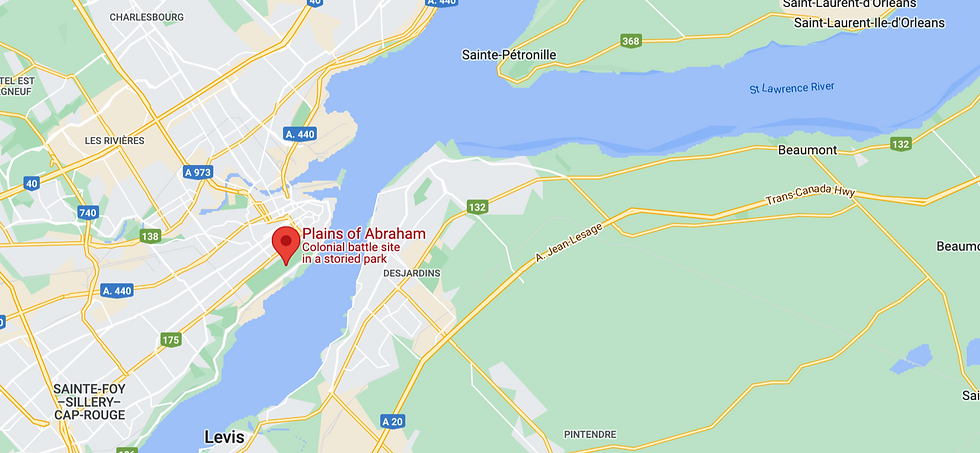
Wolfe had ordered his soldiers to charge their muskets with two balls each in preparation for the battle. Captain John Knox wrote in his journal that as the French came within range, the regiments "gave them, with great calmness, as remarkable a close and heavy discharge as I ever saw." After only two volleys of shots fired, the French soldiers devolved into full retreat. Then, in a shocking turn of events, during the chaos of the French retreat both General Wolfe and General Montcalm were killed.

Governor de Vaudreuil fled the city and, after a short siege of five days, the British took possession of Quebec. In the spring of 1759, the French made an unsuccessful attempt to take back their city. Montreal was finally taken in September of 1760, effectively ending the war.
Relatives in the Quebec Expedition:
Our Grandfather Abraham Stickney (6GGF) and his brother, Benjamin Stickney (6U)
Our uncle Jonathan Hill (6U)
Our cousin Moses Parker (2C8X) who would later be killed in the battle of Bunker Hill
Our cousin Thomas Stickney (2C8X) served as a scout and would go on to fight in the Revolution.
Other Relatives in the French and Indian War:
David Baldwin (1C8X)
Hezekiah Crosby (4C9X)
Josiah Crosby (4C9X)
Simon Crosby (2C7X)
Thomas Crosby (3C10X)
Josiah Crosby (4C9X)
Ebenezer French (3C7X)
Nathaniel Haseltine (3C9X)
James Heywood (2c7X)
Samuel Heywood (2C7X)
William Hildreth (2C8X)
Benjamin Kidder (1C7X)
Joseph Kidder (2C7X)
Samuel Kidder (2C7X)
Luke Richardson (3C7X)
Eliphaz Wyman (4C7X)
aftermath
The final French and Indian War which had begun so disastrously for the British turned out to be extremely profitable. In the treaty of Paris, signed in 1763, Britain gained possession of not only Canada but the eastern half of French Louisiana. They would lose their Louisiana lands in the Revolution but managed to hold on to Canada.
Life in Canada has not been all roses since the British took over. In 1837 and 1838 French Candadian militants, unhappy with British rule, staged an uprising. Not surprisingly, the rebels had a little help from American sympathizers. Though the uprising was supressed, the struggle continues to this day with ongoing efforts by Francophiles in the provice of Quebec to separate from Canada. A sovereignty referendum, put on the ballot in 1995, was only narrowly rejected but the Francophiles soldier on still.
At the 1763 peace conference, the British received the territories of Canada from France and Florida from Spain, opening the Mississippi Valley to westward expansion.


Comments