
Diary of Joseph Ballard Part III
- westmohney

- Mar 25
- 10 min read
London is one continual scene of uproar and joy in consequence of the total defeat of Bonaparte at Waterloo by Lord Wellington. ~ From Joseph's diary

London again
June 15 ~ In company with three of my fellow-countrymen. . .I departed for London. . .At Uttoxeter we changed horses. The Inn was directly opposite an ancient church whose graveyard was filled by a rabble of boys, pedlars' stalls, etc. and seemed to be a common thoroughfare. It is shocking to behold the ashes of the dead outraged in this manner, but in this country I have remarked too often that the dead are trodden upon whenever it suits the convenience of the living.
On going through the Royal Exchange I was peculiarly struck with the variety of dress in the crowd of merchants assembled there. Here were Christian, Turk and Jew. In walking the city a person meets such a variety of fashion in dress that it is impossible to tell the prevailing one. A man must possess considerable talent to make himself notorious for dress or equipage in this great city. Even Romeo Coates, the amateur actor, when he first made his appearance in a dashing curricle ornamented with a cock as his crest, had to employ some boys to cry " Cock-a-doodle-doo " to bring it into notice.

Being near Eastcheap today I tried to discover the Boar's Head, but was unsuccessful. This is where Sir John Falstaff and Prince Henry had their "cup of sack."
At a window in a print shop my eye was attracted by a print in glaring colors purporting to be the Capture of Washington. It represented a strongly fortified place, compared which Quebec and Gibraltar were nothing. The British troops were marching over a breastwork of dead Americans in the face of a battery of cannon blazing at them. In the background was the " President's Palace " (as the explanation informed me) and eight or ten seventy-fours in flames. This is the mere idea of the print seller, but the British Government tried all in their power to make this circumstance popular. They were unsuccessful. Many Englishmen have acknowledged to me that it was a stain on their national character which cannot be obliterated.
Having a desire to see Royalty I attended the Chapel Royal, St. James' Palace, to see the Princess Charlotte, probably the future Queen of England. . .

The Princess came in attended by several lords and ladies, and took her seat in the gallery opposite to where I stood. She has a pretty face and eyes, with the buxomness of a country lass. Her dress was a purple pelisse edged with white, with a French fashioned bonnet and a wreath around it. She had not the least gentility of appearance and her manners were shockingly vulgar, particularly when she stood up. She had then a kind of rolling about, and kept her arms akimbo. She took very little notice of the service and seemed, from her uneasiness, to wish that it were ended.
Note Princess Charlotte died in childbirth at age 21. The child died also leaving no heir to the throne. Four unmarried sons of George III scrambled for spouses and heirs. The winner was George's son Edward whose only legitimate child was Victoria who became queen in 1837.
June 20 ~ Last night went to Covent Garden Theatre. . .The after piece was " The Forty Thieves," and I feel proud for the theatrical fame of America to be able to say that the representation, both as to acting and scenery, was quite inferior to that which we had on the Boston boards, when Mrs. Darley and Mr. Bernard took a part in the performance.

Carlton House is a gloomy pile of buildings faced by a colonnade; but the interior, it is said, surpasses most palaces in magnificence;

behind it is Warwick House, an ill-shapen building, the residence of the Princess Charlotte. All communication with her is through her father's palace, as all other entrances are closed up. This is caused by her running away from her keepers some time ago and jumping into a hackney coach, which carried her to her mother!

Note: Princess Charlotte's parents didn't get along and lived separately.
June 22 ~ London is one continual scene of uproar and joy in consequence of the total defeat of Bonaparte at Waterloo by Lord Wellington. This is announced by the Park; and Tower guns and by placards upon the gates of the Mansion House. It is also publicly declared that upon Friday and Saturday nights the public buildings are to be illuminated on the occasion.
. . .On Friday and Saturday night all the public buildings and many private ones were illuminated. Many fanciful and beautiful devices were exhibited. Among those which were prominently beautiful were the excise office, the Bank, Post-office, Somerset House, Admiralty, Horse Guards, Carlton House, Foreign and Home Department (here the eagles taken from the French were displayed). . .
June 27 ~ Went to Vauxhall Garden, which to attempt an adequate description of would be impossible! The entrance is through a gloomy passage at the end of which you pass through a small door and are immediately transported into one of the fairy scenes of the Arabian Tales, as it all appears enchantment. . .At eleven o'clock the nobility and fashionables began to enter, when there was a grand display of dress, for most all who are here appear in full dress. I should imagine there were from four to five thousand persons promenading the walks this night. At twelve the fireworks commenced. These were exhibited at the end of dark walks, They surpassed anything of the kind I ever beheld ! At two o'clock the party to which I belonged left the garden, as the dances had begun, this being the signal for the departure of respectable ladies. Fifteen thousand lamps are lighted in these gardens each night they are opened.

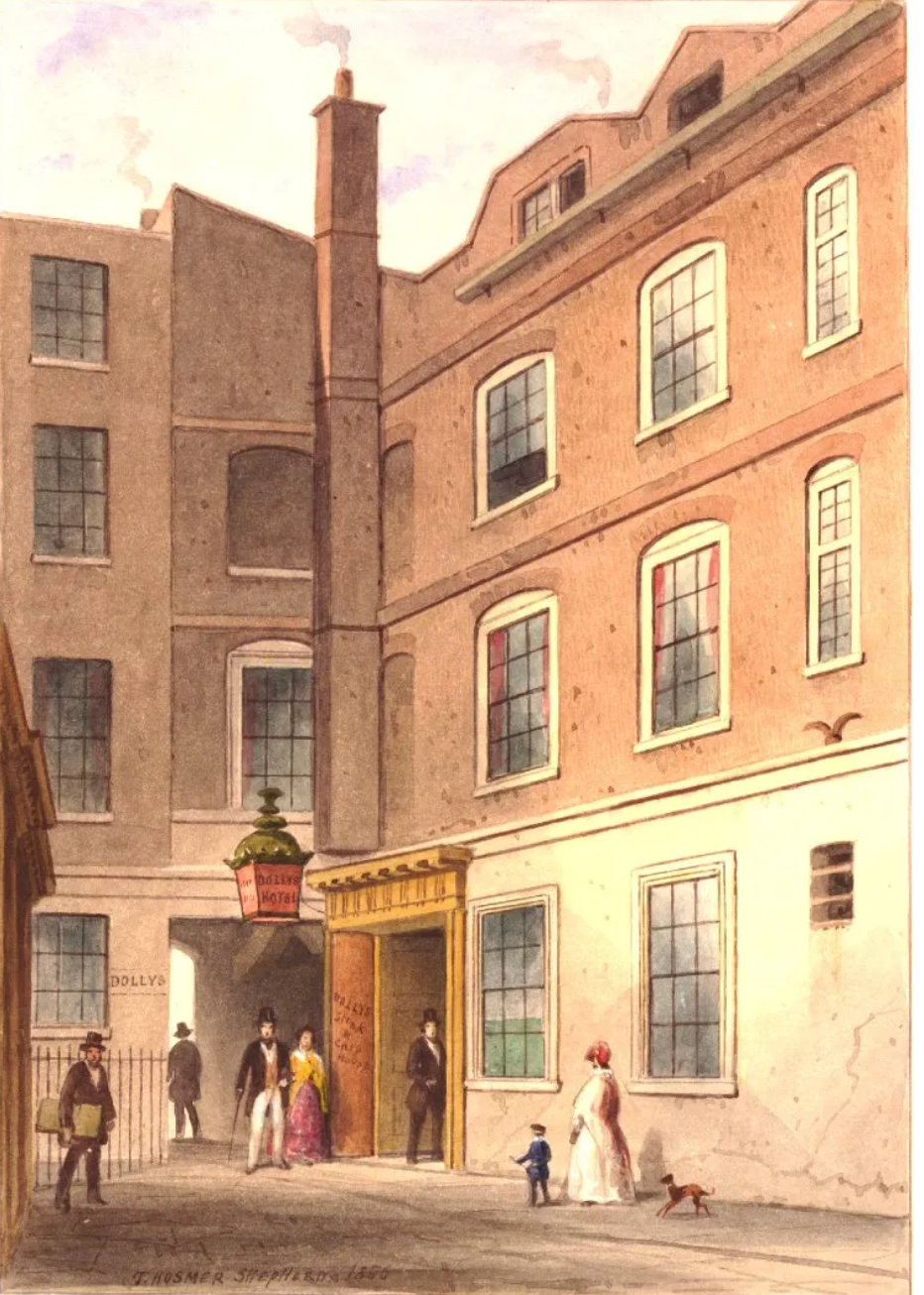
Fourth of July ~ Dined with a friend at Dolly's chop-house. This house was formerly kept by a woman whose name was Dolly, and to perpetuate her name, a female servant attends upon customers (which is not the case in other chop-houses) who, let her name be what it will, is still called Dolly. This place is much frequented by the booksellers, as it is adjoining Paternoster Row, where the principal booksellers prosecute their business.
I was not a little amused at meeting near London with a party of sailors having the American flag displayed in honor of Independence Day. They were headed by a Jew playing upon a handorgan. Each one had his girl with him, and the procession was closed by two large negroes each with a white girl under his arm.
July 7 ~ Last night during my walks I discovered a fire and after following the direction of the light for some time found that it was near the Tower, the turrets of which were beautifully illuminated by the flames. The crowd around the fire was immense ; the bustle of the firemen and people moving their effects made the scene " confusion worse confounded." The place consumed was a gun-maker's shop, from whence some powder exploded and wounded several people.
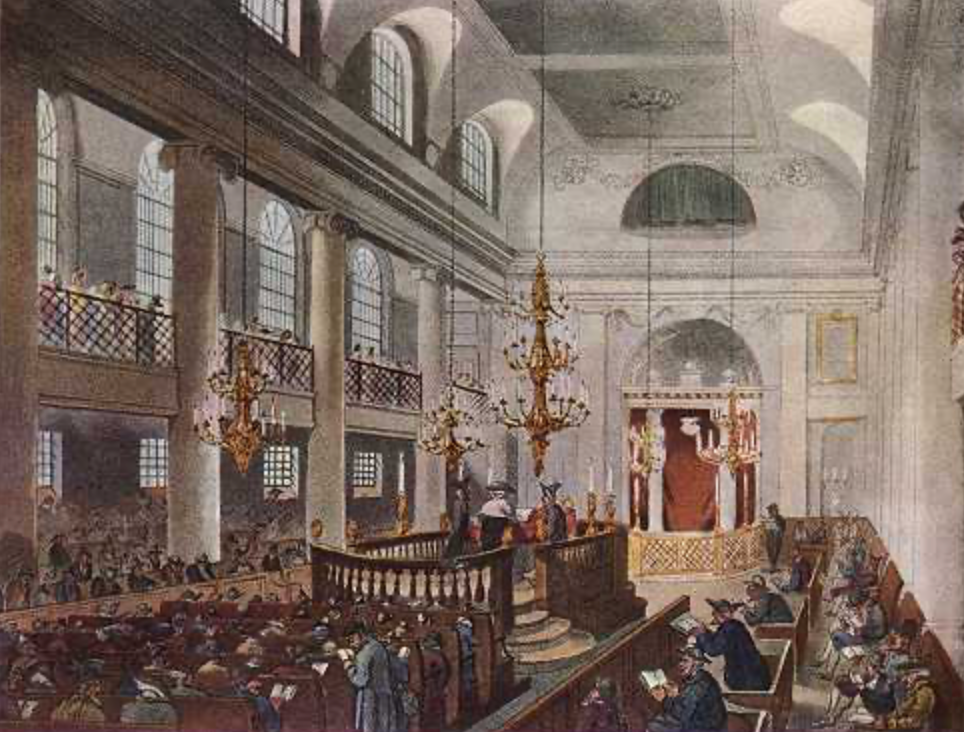
July 8 ~ It being the Jewish Sabbath I was induced to visit the Synagogue near Duke Street, the residence exclusively of these Shylocks. The church is a neat edifice. It is lighted with seven chandeliers, the pulpit, or desk, where the priests stand being in the centre: at the end is the altar or holy of holies, toward which they turn their faces and bow while repeating their prayers. The men sit with their hats on. The women are in a screened gallery, apart from the men! The service was chanted in Hebrew, the congregation joining in at times in "din most horrible." I came away disgusted with the little reverence they seemed to pay to that Being who pronounced them His chosen people!
Note: The Synagogue was destroyed in World War II during the blitz of London.
July 12 ~ Today the Prince Regent prorogue both Houses of Parliament. I went to see the splendid procession usual upon these occasions, and was fortunate enough to procure a situation opposite the door of the House of Lords and close by the state-coach which was in waiting for the Prince. I was enabled thereby to have a fair view of his person: his form is perfectly elegant, but his countenance exhibits the marks of intemperate habits. He was dressed in uniform. When he made his appearance there was but little acclamation among the people. " Now and then a voice cryd God save King Richard " and that was all!
On Monday. . .took an excursion to Richmond. . .I was quite enchanted with the scene before me ! the winding of the " silvery Thames," the beautiful lawns gradually sloping from the houses upon its banks, and its charming walks overshadowed with trees, conspired altogether to render it a charming place. . .When our carriage was ready I sincerely regretted to leave this sweet spot, and I think that one must be utterly insensible to the beauties of nature not to admire such a scene as Richmond Hill. The view from Milton Hill near Boston bears a faint resemblance to that of Richmond, and has I think the preference in one particular, — the view of the sea! while that of Richmond is "one boundless landscape" only terminated by the horizon.

. . .Lounging in the park today I turned into the street which leads to Westminster Abbey, and went in once more to view that venerable building. I was not less interested than on my former visit there. I could not walk through this receptacle of the ashes of kings, warriors, statesmen, poets and other great men without instructive lessons on the vanity and shortness of life. Many of the monuments are so crumbled by the hand of Time that their inscriptions are scarcely legible ; many are entirely effaced ! Yet with this knowledge of the folly of outstanding the lapse of ages, vanity still raises yearly new monuments, which three or four hundred years hence will puzzle the antiquarian in discovering for whom they were erected.

. . .Being in want of a passport to enable me to leave the country, I was obliged to wait upon Mr. Adams (John Quincy) the United States Minister to the British Court, to obtain a paper to enable me to obtain one. I went accompanied by Dr. W. After walking about four miles, we found him at the west part of the town, in lodgings at a house in Harley Street. Over the front door was a signboard in large characters denoting that warm and vapor baths were to be had here. We were not at all pleased that the representative of the American nation should be so meanly lodged. This we thought was carrying his Republican simplicity a little too far! Mr. Adams treated us politely and furnished me with the necessary passport. . .
Note: John Quincy Adams came to England to head the commission that negotiated the Treaty of Ghent that ended the war of 1812. He held the position of U.S. Minister to the British Court from 1815-1817. In 1817, he returned to Us to serve as Secretary of State under James Monroe. He served as president from 1825-29.
. . .There is never a dearth of novelty to a stranger in the streets of London. Numerous ways are resorted to by the beggars to attract attention and gain a halfpenny. One poor fellow who had lost both his legs, has a board before him upon which he chalks in so elegant a manner that it would not disgrace a copperplate engraver, any word that the spectator desires, beginning at the end and writing them bottom upward. . .
July 31 ~ . . .I went to the East India House for the purpose of viewing its museum of curiosities. The opulence of the company and the power they have acquired by their conquests in India have thrown into their possession the greatest and richest collection of eastern curiosities in the world. We were first conducted into the Library, containing a splendid collection of Eastern literature, among which is a book of dreams in Tippoo Sahib's own hand-writing, the Poems of Hafiz, and innumerable other Indian, Chinese and Persian manuscripts. Here is also a collection of minerals, shells, &c. In the next room are some Hindu idols, bricks from Babylon, a marble covered with characters from the same place and which is supposed to contain some matter relative to the history of that magnificent city.

. . .In company with Dr. W. took a ride to Kensington Gardens, situated at the extremity of Hyde Park. It is by far the most beautiful promenade that London or its immediate vicinity affords. The grandeur and wildness of the woods more strongly reminded me of the American forest scenery than any other place I have seen, in England.


Being obliged to take Mr. Adams's passport to the Alien Office for the purpose of obtaining Lord Sidmouth's license to leave the country, I chanced to meet a friend on the way thither who informed me that a small douce would be a great facility in enabling me to get it, although the Alien Act expressly provides that they shall be given gratis. When I came to the office I received the pass from a man of gentlemanly appearance, who with many profound bows excused himself for making me wait, &c., &c. at the same time looking me in the face as if he were saying "you must be a stupid fellow if you don't understand me!" I put four shillings into his hand and received many polite assurances as to the pleasure it would afford him to be of service to me in renewing the passports, and that if I wrote from Liverpool I might depend upon a speedy answer to my letter. It is true the law did not compel me to give the man anything, but if I had not, and it should have happened that I wished for a renewal of the paper, it might have been delayed and I had cause to regret not having paid the accustomed tribute.
Since my residence in England some of the most important events in modern history have occurred, the most prominent of which is the downfall and captivity of Buonaparte. London has been agitated many times in consequence of reports that apartments had been fitted up in the Tower for his reception, and so much were these believed that some thousands of the populace waited a long time upon London Bridge in order to see him pass. It is now, however, understood that he is to be sent to St. Helena, there to remain a prisoner for life. Thousands have gone from all parts of England to Plymouth to catch a glimpse of the disturber of the world. He is now confined on board of the Bellerophon Frigate, on board of which no one is allowed to go. The boats which daily sail around this vessel for the purpose of carrying persons to see him are estimated at two thousand.
The final chapter of Joseph's diary concludes in our next post.


Comments