
ENTER THE COVINGTONS!
- westmohney

- Oct 14, 2022
- 10 min read
Updated: Jun 8, 2024
Henry Covington, in 1712, was living on his plantation ‘Providence'...
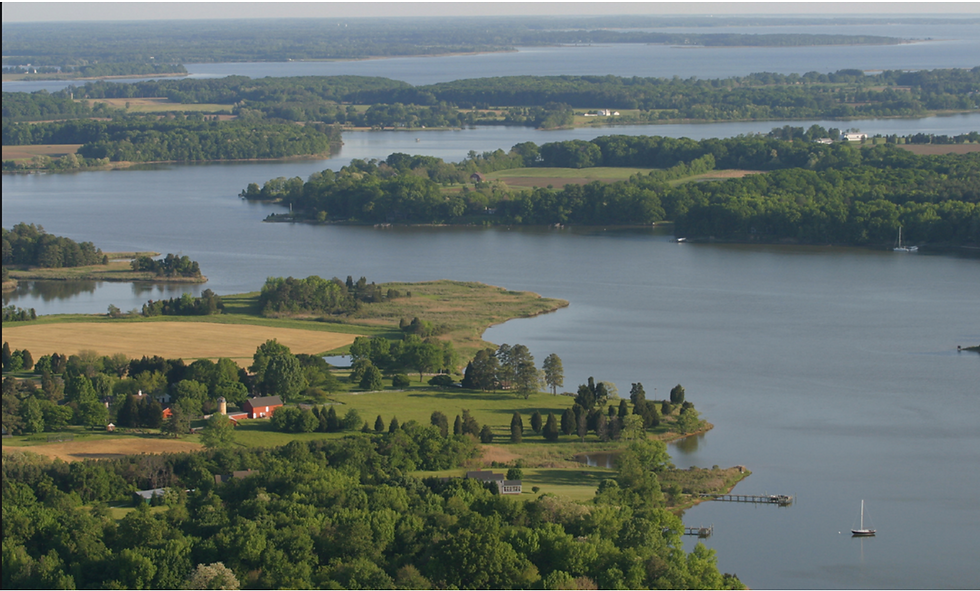
Queen Anne's County
The first settlement in Maryland was on Kent Island which today lies in Queen Anne's County. The "island people" on Kent had a bit to do with the creation of Queen Anne's in 1704. Kent orignially belonged to St. Mary's County. In 1642, a county division put Kent Island into Kent County. Then, In 1660, the island became part of Talbot County and there it remained until the turn of the eighteenth century.
As the oldest community in Maryland, the Kent Islanders resented their place in "lowly" Talbot County. They felt the island should be a county unto itself. Perhaps the powers that be tired of the islanders' incessant complaints and petitions. The new county of Queen Anne's was created in 1704 and the island was included in the package, whether they liked it or not.
In the map below, we can see that Kent lsand in the Eastern Bay represents only a small part of Queen Anne's County.

Queen Anne's County was named in honor of "good Queen Anne" of England. Anne was the sister of Mary, of William and Mary fame. When Mary died, William reigned alone until his death and Anne took over the throne.
Anne suffered from ill health her entire life but that was far from her greatest heartbreak. Between 1684 and 1700, Queen Anne had been pregnant seventeen times and had miscarried or given birth to stillborn children for twelve of those pregnancies. Of her five live born children, four died before reaching the age of two. Her son William, born in 1689, lived to the age of eleven. He died in 1700 of a "malignant fever."
the first Covingtons in Maryland
Our inveterate genealogist cousin Lou Poole (5C) has sifted through research done by DaCosta Euclid Covington who wrote Covington Cousins, Eleanor Pratt Covington McSwain who wrote My Folk, E. Stuart Gregg who wrote A Crane's Foot and Elbert E. Covington who wrote Covington and Kin. From careful reading of these texts, coupled with his own research, Lou has concluded that "...What we can be sure of, then, is that we are descended from Henry Covington (died 1744), but whether he was an original emigrant, or descended from an earlier emigrant Covington on the Maryland eastern shore, we cannot be sure."
In 1712, our grandfather Henry Covington (6GGF) was among 1,011 taxable men in Queen Anne's County. That year, there were also 843 white women, 1,446 children and 550 negroes living in the county. Few records remain to piece together Henry's life. Lou says that "...According to McSwain he (Henry Covington) was listed in the First Settlers List as coming from Kent County, England to Maryland the '20th of Feb. 1670, with William Pettus, London Merchant.'" Since I have only been able to find a list of early Maryland settlers beginning in 1679, I haven't been able to verify McSwain's information.
From tax records and Henry's will we know that, in 1712, he was living on a plantation called Providence. And he appeared in court records in 1729 when he was listed, among others, as having been paid a “bounty for squirrel heads." Looks like those pesky critters have been a nuisance for at least 300 years. Lastly, right before his death in 1744, Henry purchased 156 acres of additional land from John and James Tully.
St. Lukes Church
Henry's plantation probably lay near the church his family attended. St. Luke's (red marker) was one of a few "chapels of ease" created for parishioners living a great distance away from their home parish of of St. Paul's (blue marker) in Kent County.
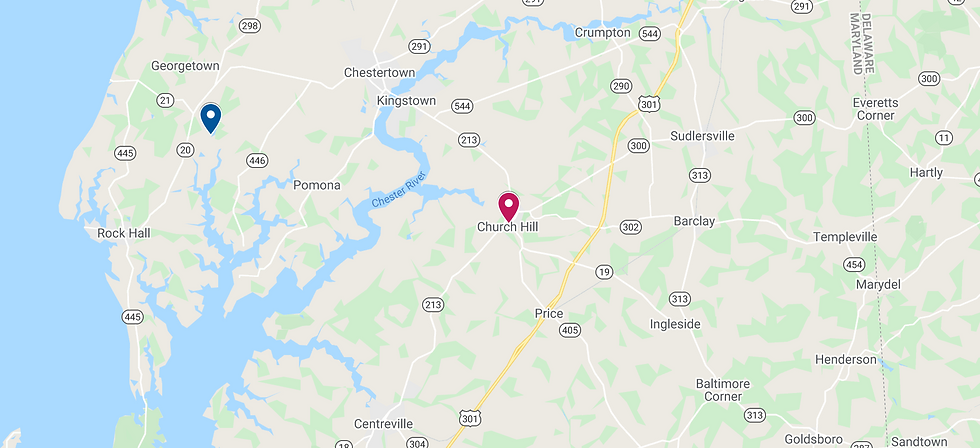
Dating from the late 17th century, a simple log building called the Up River Chapel sat on the site where St. Luke's stands today. A parish priest from St. Paul's would make once a month visits to the small chapel. As the population in Queen's County grew, satisfaction with their religious services diminished. In 1728, 250 of the Up River Chapel faithful petitioned the Maryland Assembly for a new church. The petition was approved in 1729. Area residents raised 140,000 pounds of tobacco to pay for the building of the new church. Today, St. Luke's Church (below) is one of the oldest Episcopal Churches still in use and is the same building in the same location that Henry Covington and his family attended.
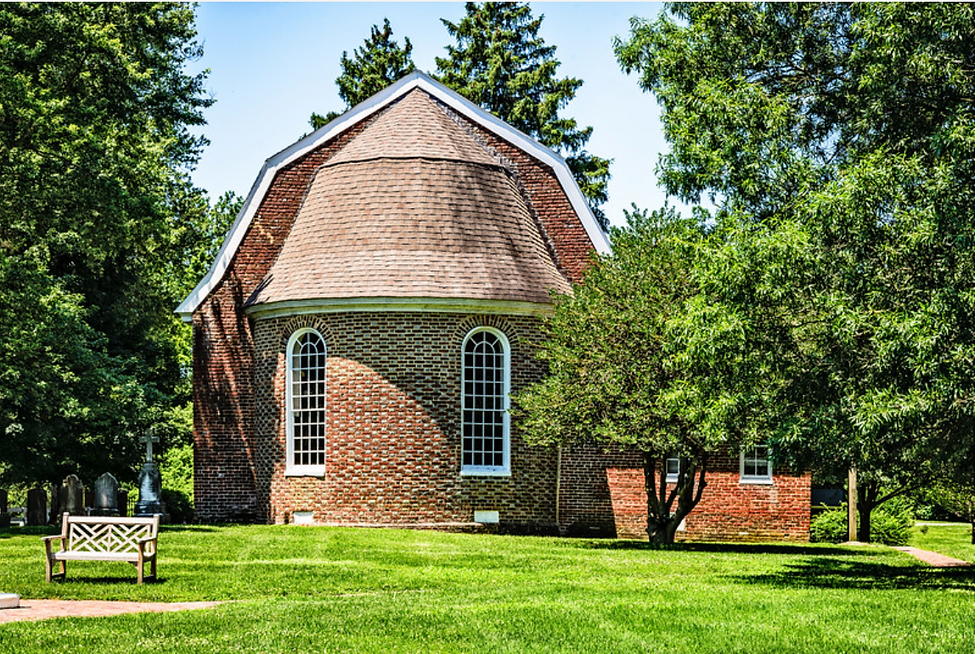
In 1727, Henry was elected Church Warden of St. Luke’s Church. In 1728, he signed a petition to establish the boundaries for St. Paul’s Parish. Many of Henry's children were married and baptized at St. Luke's.
Note: St. Luke's is the same church attended by a Sarah Covington Lloyd. She was the daughter of Nehemiah Covington who came to Virgina ca. 1640 and subsequenly moved to Maryland. While there is no proof, there is a good chance we are related to this branch of the Covington family.
Henry's will
No records remain that name Henry's wife, our grandmother. While there have been many conjectures, I choose to align myself with Lou Poole and leave that part of our tree blank. Henry Covington's will was drawn up only a few days before he died in 1744 at age 63. The will was probated about two weeks later. Our unknown grandmother must have preceded Henry in death because he mentions no wife in his will. Four sons are mentioned by name, John (5GGF), James (5U), Henry, Jr. (5U) and William (5U). Since Henry's personal estate (personality) was "equally divided amongst the rest of my children," we know he had other offspring, probably daughters.
Three of Henry's sons received property in his will. Our grandfather John, probably the eldest, received the home plantation: "all that Tract or parcell of Land and plantation whereon I now Dwell, containing one hundred acres of Land, part of a tract of land called ‘Providence,’ to him and his heirs Forever..." John and James each received seventy eight acres of the parcel which Henry "bought lately of John and James Tully..."
Other information gleaned from Henry's will also leaves more questions than answers. Henry names William and Nathaniel Covington as "nearest of kin." Then he names under "separate debts" Peter and Benjamin Covington. These might be sons but, since there were other Covington families living in Maryland at the time, Lou Poole theorizes that these Covingtons were possibly cousins or uncles from the Nehemiah Covington branch of the family.
Our grandfather John and his brother Henry, Jr. were chosen as executors of their father's will. Henry, Sr. was a fairly wealthy man for his day. Among the items listed in the inventory of his property were a bed with drapes, lots of pewter and brass items, a linen and wool wheel, a long list of household items and furniture, seven cows, eleven sheep, twenty-one hogs, 2,400 lbs of tobacco, eleven barrels of corn and 8 barrels of wheat. Also included in the inventory was "one servant man named James Kingowre." This man was probably an indentured servant. Although the Covington family would go on to own hundreds of slaves after their migration to North Carolina, it doesn't appear that practice began with Henry.
The two executors of Henry's will, John and Henry, Jr., certified the inventory. "John Covington made Oath on the holy Evangels of Almighty God" and "Henry Covington (being one of the People called Quakers) did sincerely solemnly and truly affirm and declare that the foregoing is a just and perfect Inventory..." So we learn that some of our Covington relatives, like the Thomas family who also attended St. Luke's, embraced the Quaker faith.
Finally, Edward Roe (6GGF) and Jonathan Arey (6U) are listed as "Creditors." Edward Roe is our 6th great-grandfather and Jonathan Arey is our uncle, brother to our grandmother Mary Arey (5GGM) who married our grandfather, John Covington.
The Roes and Richardsons
The Roe, Arey, Thomas and Covington families all lived within fairly close proximity of each other in Queen Anne's County and were well known to one another. The number of marriages between these four families is proof enough of that.
Our grandfather Edward Roe certainly knew Henry Covington outside of the fact that he owed him money. Edward's daughter, our aunt Rachel Roe (5A), married Henry's son, Henry Covington, Jr. (5U) We know little about our grandfather Edward Roe except for property that he owned in Queen Anne's County. Most probably he began accumulating property shortly after he left his father's home as a young man.
Edward married Sarah Richardson (6GGM) ca. 1716. Sarah's family had known tragedy before she was born. In 1669, her grandfather (and ours), John Richardson (8GGF) was indicted for the murder of his wife, our grandmother Mary (8GGM). From court records:
...for that he the said John Richardson the fourth day of October...upon Mary Richardson his then wife by force and armes an assault did make...with a certain tobacco stick to the value of one penny Sterling which he the said John Richardson did then and there hold in his hand upon the aforesaid Mary Richardson...then and there in the Peace of God... ...voluntarily and of his malice forethough, did make an assault and the same Mary...and there with the stick feloniously did Strike. So that by the said Stroake the said Mary Richardson...received a mortall blow whereupon the body of the said Mary Richardson...did immediatley fall to the earth and...instantly there of the blow aforesaid died and So the said John richardson...of his malice before thought the said Mary Richardson...did voluntarily feloniously and wickedly kill and murther Contrary to the Peace of the Lord proprietary...
John Richardson was a man. The jury was composed of all men. Poor Grandma Mary was a woman of small consequence. In spite of the fact that there were three witnesses for the prosecution, the jury found John guilty of "misadventure." Basically he "accidentally" struck his wife with the "one penny Sterling" tobacco stick, obviously worth more than her life. Then, in a notice to "all Sheriffs, Bailiffs and others" it was declared that the powers that be "moved with Piety have...pardoned unto the Said John Richardson the Said manslaughter and Granted unto him our firm peace thereupon So...that he Stand Right in our Court if anyone will him therupon Implead." John Richardson got off scot free.
Edward Roe and Sarah Richardson had six children, five sons and one daughter. By the time Edward died in 1748 at age 53, he had amassed a considerable amount of property. In 1748, just before his death, Edward patented 843 acres of land which he named Sarah's Fancy after his wife. That property was still in the hands of the Roe family in 2008. A family cemetery lies across the road and down the street little way. Below you can see the placement of the farm (1) and the cemetery (2) in the sparsely populated lands of what is now Price, MD:
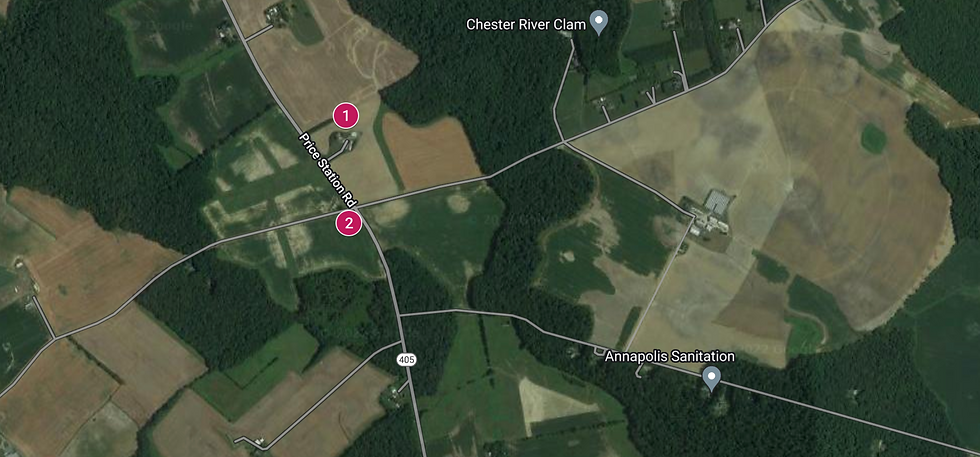
Below is the farm as it looks today:

From his will and other land records, it appears that Edward owned at least 2,500 acres. Before his death, he gave to his oldest son John (5GGF), our grandfather, 150 acres of land called "Narborough." But poor John, while named an executor of his father's will, was left no additional property at all. He also gave 164 acres to his son Samuel (5U) before his death.
In his will, Edward left the home plantation and other property to his two other sons, Joseph (5U) and Thomas (5U). Daughter Rachel Roe Covington (5A) received "Rachel's Desire" and Edward made an additional bequest of property to son-in-law Henry Covington, Jr. (5U).
Note: American Southerners were fond of naming their property. Some names of Edward's properties were "Tully's Addition," "Ned's Beginning," "Sarah's Fancy" (for wife Sarah, no doubt), "Oakenthorpe" and "Rachel's Desire," for daughter Rachel.
Note: Edward's daughter Rachel Roe Covington wasn't the only Rachel Roe in our family. Two generations later, the Thomas and Roe families would come together with the marriage of our grandparents William Thomas (4GGF) and Edward's granddaughter, Rachel Roe (4GGM).
John and Mary Arey Covington
You may remember the three Quaker brothers who left their home in England's beautful Lake District to start anew in Maryland. We wrote of them in our Areys of Tuckahoe post. With letters of recommendation in hand, Jonathan (6U), David (6U) and Joseph Arey (6GGF) were welcomed into the Third Haven Quaker Community. Our grandfather, Joseph married Mary Barnard (6GGM) and together they had three children, Mary (5GGM), Jonathan (5U) and David (5U).
The Areys, like the Roes, were well known to the Covington clan. Jonathan Arey owed money to Henry Covington and Mary Arey married Henry's son John.
Our grandfather John Covington, born ca. 1710, was a stone mason and a surveyor. In 1744, he inherited the home plantation, Providence, from his father. In 1753, he purchased 257 acres of property called Rowland's Hazard that had formerly been part of Providence. We know from a sworn statement by his grandson, Matthew Poythress Covington (3U), that John Covington kept the parish records. Matthew's testimony upon being asked his age: "I have arrived at my age from my Grandfather who was Clerk in the congregation where I was born..."
John and Mary had ten children. John's will, probated in 1767, mentions wife Sarah, so we know that Mary had died sometime before her husband. John left all of his property to two of his sons. The rest received "the equivalent of $100 sterling silver" as well as personal property.
John Covington died in Maryland and would be one of the last Covingtons to do so. All of John's children, his brother William (5U) and all of his brothers' children would make the migration to the green pastures of North Carolina. Below is our family tree showing the progression from Henry Covington in Maryland to Stephen Wall Covington and Esther Parrish who lived and died in California.


the Thomas Family
Our grandfather Stephen Thomas (5GGF), son of Tristram (6GGF) and Sarah Stevens Thomas (6GGM), was born in Queen Anne's County in 1705. The granddaddy of all genealogical rarities involved Stephen, his father and his wife. Stephen married Mary Jane Clothier (5GGM) , the daughter of his father's third wife, Jane Kemp (6GGM). We wrote of Jane in our post The Three Husbands of Jane Kemp. Below is a chart of the genealogical rarity. Everyone on the chart is a grandparent of ours.

All of the families mentioned in this post, the Covingtons, the Roes, the Areys, and the Thomases had close ties to the Quaker communities in Maryland. Mary Jane Clothier was a staunch Quaker. Marrying outside of the church was considered "running out on the truth" and would result in being "denied" by the Quaker community. To avoid that horrific stigma, Stephen adopted Mary Jane's faith and the couple followed all necessary Church protocol. At the Third Haven Monthly meeting at Tred Avon on 19 Aug 1730, "Stephen Thomas and Mary Clother declared their Intention of marrige the first time." Then on 31 Oct 1730:
Stephen Thomas and Mary Clother appeard in this meeting and Declared their Intention of marriage This being the second time thay having Consent of Parrants and appearing Clear of all others are left to their liberty in the Truth to Effect their marrage thay appointing time and place and making the same Publick. John tilliston is appointed to see the sd marriage Decently accomplished.
The couple finally married in January of 1731. Their first child, a daughter, was born at the end of that year. In all, Stephen and Mary Jane would have thirteen children over the course of twenty-eight years. In 1746, Stephen inherited 200 acres of land from his father, Tristram. That land would be sold in 1767 when the Thomases, like their neighbors the Covingtons, pulled up stakes in Maryland and moved on to North Carolina.
The Thomas and Covington families would settle near the Pee Dee River in an area that would become the town of Rockingham, NC and intermarriage between the two clans over the years was common. The most important of those for us would be the marriage of William "Billy Ram" Thomas (3GGF) and Jane Mehitable Thomas (3GGM), parents of James Wall Covington (2GGF) who was born in Rockingham in 1817 and died 79 years later in Redlands, CA.


Comments