
ENTER THE GERMANS!
- westmohney

- Nov 2, 2022
- 8 min read
Updated: Jan 15, 2023
It was fully a century after the first settlement of Maryland that the settlements got away from the tidewater. ~ T.J.C. Williams, author of History of Frederick County

German stock
On 27 Oct 1890, Isaac Clifton Mohney (GGF) married Cora Blanche Wyman (GGM) at the home of the bride in Sligo, Pennsylvania. Both families had roots in Germanic stock. We had nine German families who came to America between the years of 1724 and 1771. Eight of these are on the Mohney side. The Wyman side can lay claim to only one German family, the Finefrocks.
Most of our German relatives came from two just two regions in Europe, the Palitinate in Germany and Alsace in France. These regions near the Germany/France border have ping-ponged between French and German control many times since 1681. It was these continual wars in the area that led many Germans to emigrate to America in the eighteenth century. All of our German families came on ships that docked in Philadelphia and all settled in either Pennsylvania or Maryland.
Note: The nine families in order of arrival are the Swineharts (ca. 1724 MD),
Hutzels (1730 MD), Borns (1738 MD), Millers (ca. 1740 MD), Mohneys (1741 PA),
Hilgerts (1751 PA), Finefrocks (1770 PA), Armagosts (1771 MD) and Schucks (? MD).
I have only been able to trace with reasonable certainty where five of our German families came from, shown on the map below. Even though the the Armagosts (2) came from Alsace in France, they were a decidedly German family, settling amongst and marrying into other German families in America. The four families not on the map most probably hailed from the same general area.
Note: Our Born grandmother and grandfather met aboard the ship bringing them to America. Anna Maria Zentz was from Alsace, France and Michael Born (5) was from Jungholzhausen, Germany.

The Maryland four
Four families, all forebears of our Armagost clan, came to America in the early 1700s and all settled finally in Maryland. These families were the Hutzels, Schweinhardts, Millers and Borns. The tree below shows the intermarriages among the Maryland families leading to the marriage of Christopher Armagost (3GGF) to Mary Nancy Schuck (3GGM). The Born family, not shown, also married into the Armagost family.
Note: Grandpa Isaac Mohney's mother was an Armagost.

journies across the ocean
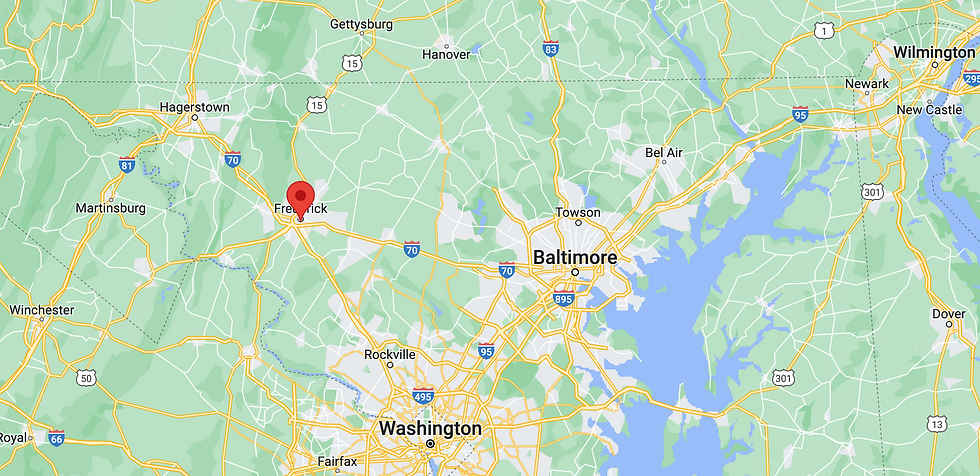
One of the earliest German settlements in Maryland began near the present day city of Frederick in 1712. Twelve German families of about fifty people settled on the Rappahannock River that year. They were shortly followed by twenty more families with another eighty people. These people were amongst the first of a massive wave of German immigrants who flocked to Maryland and Pennsylvania in the eighteenth century.
In order to finance the expensive trans-Atlantic journey to America, thousands of Germans signed indentures that bound them to work for the first five to seven years of their lives in a new land. The journey over was harsh for those without much money. Families were sardined onto ships, provided with inadequate food and generally suffered from cold and illness along the way. Thousands died en route to their new life.
"Redemptioners" were those who came without an indenture contract but hoped to find relatives or friends already settled in America who would pay for their passage. Those who couldn't find a sponser, were sold by the ship's captain at auction, much like slaves in the South or the English in Canada. "Sad and miserable" was the description of the journey used by Gottlieb Mittelberger in his book Journey to Pennsylvania.
Our first German families to arrive in America may have suffered the abysmal conditions shared by all aboard ship, but none of them began their new lives indentured. Like seventy percent of German-speaking immigrants to the American colonies, all four of our families docked in Philadelphia.
The overwhelming influx of German speaking colonists alarmed provincial officials. In 1727, Governor Patrick Gordon warned the legislature that the "large numbers of Strangers" that were entering every day could endanger Pennsylvania's "peace and security." The governor and his council decided that all foreign males age sixteen and over should be required to take an oath of allegiance to the King of Great Britain. This requirement remained in force until the end of the colonial period in 1776. Below is a portion of the oath:
I ___ do solemnly & sincerely promise & declare that I will be true & faithful to King George the Second and do solemnly sincerely and truly Profess Testifie & Declare that I do from my Heart abhor, detest & renounce as impious & heretical that wicked Doctrine & Position that Princes Excommunicated or deprived by the Pope or any Authority of the See of Rome may be deposed or murthered by their Subjects or any other whatsoever. And I do declare that no Forreign Prince Person Prelate State or Potentate hath or ought to have any Power Jurisdiction Superiority Preeminence or Authority Ecclesiastical or Spiritual within the Realm of Great Britain or the Dominions thereunto belonging.
Germans in Maryland
Though all four of our first German families arrived at the bustling port in the City of Brotherly Love, none of them chose to stay there. They all set their sights for the rapidly forming German settlements in Maryland. It's easy to see why. In the 1730s and 40s, Maryland encouraged Rhineland Germans to settle in the rich farmlands of western Maryland which would become Frederick County. As it turned out, these Rhinelanders turned out to be the largest non-British group of people to settle in America during that period.
The Monocacy Trail was an old Indian path that went northeast from Philadelphia to Taneytown, MD. It then followed the Monocacy River down to what became the German settlement of Fredericksburg. Immigrants who were traveling from Pennsylvania to Maryland used this trail. Early surviving historical records indicate that Monocacy was the oldest settlement in Western Maryland. The actual town has never been precisely located since it was completely abandoned in the early 1800s.

Our four German families arrived in Philadelphia between 1725 and 1740. Three of these families would soon find their way to the new settlements in Monocacy and Fredericksburg in Maryland.
our grandfather Johann George Swinehart (formerly Sweinhardt)
The information I found on George Swinehart (7GGF) comes from an extremely well researched book called the Pioneers of Old Monacacy by Grace L. Tracey and John P. Dern. The authors maintain that:
The first official record found to date which shows the beginning of the German settlement in today's Frederick County (Maryland) is an interesting document in Prince George's County Court records. It concerns one John George Swinehart and notes that on November 16, 1731 "at Prince George's County aforesaid John George Swinehard...by his certain writing obligatory acknowledged his debt to John Pawling...
Evidently Grandpa George had racked up his "twelve pounds six shillens and fore pence" debt to Pawling in Pennsylvania where he first settled before moving to Maryland. The wheels of justice must have ground exceedingly slow back then. It appears that George wasn't prosecuted on the charge until fifteen years later in 1746 when he "appeared by his attorney in Court...and had the writing obligatory read to him." George's son Gabriel (6U), twenty-five at the time, "stood pledge and manucaptor for Swinehard, should he be convicted." Luckily for Grandpa George, Pawling indicated that "he would no further prosecute." The Court awarded George his costs.
Arrival lists for Germans landing in Philadelphia didn't begin until 1727, so we have no way of knowing the exact year George came to America with his wife Margaretha (7GGM) and their four children. We do know that it was sometime before January of 1725 when their daughter, our grandmother Magdalena (6GGM) , was born in Pennsylvania. George and Margaretha would have four more children born in America for a total of nine.
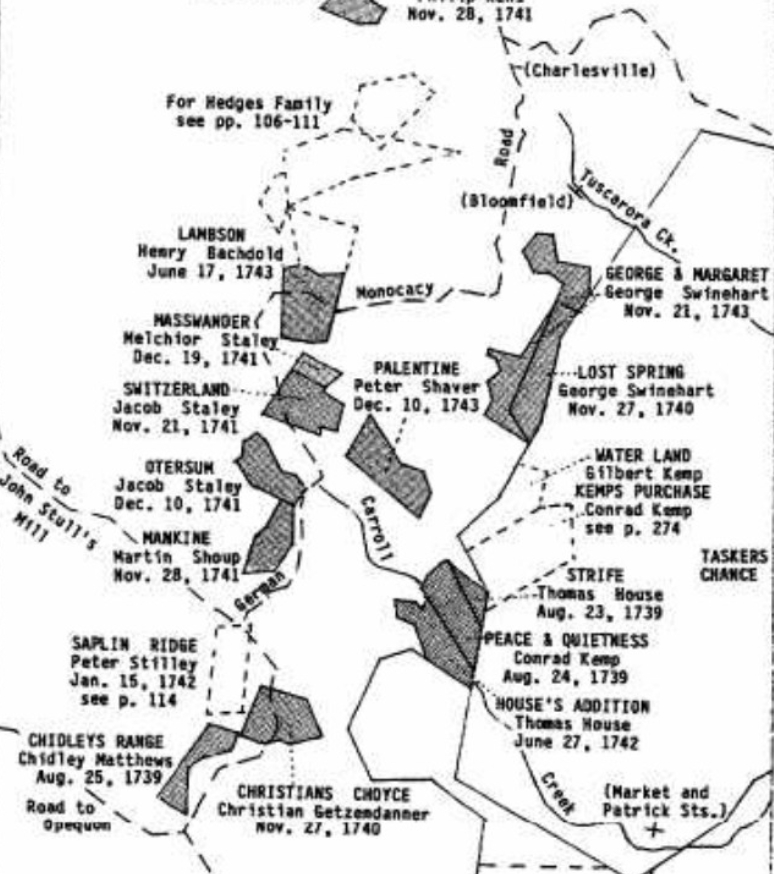
The Swineharts settled first in the New Hanover Township in Pennsylvania. The timeline for moving to Maryland is unclear but Tracy and Dern place it at about 1731. It doesn't appear that George took advantage of the 5th Lord Baltimore of Maryland's offer of 200 acres per family for new settlers. Instead, he chose to buy a 100 acre piece of property known as "Lost Spring." George's acreage, which lay in Prince George County "between the bounds of Fort Detrick and Tucarora Creek," was surveyed on November 27, 1740.

In 1742 George was one of the residents of Prince George County that signed a petition to divide the county. In 1747, the new boundaries were made and George henceforth lived in Frederick County.
In 1743, George acquired another 225 acres. He had his land resurveyed and changed the name of his property to "George and Margaret." On the map below, Grandpa George's property is in the upper far right between Tuscarora and Carroll Creeks.
naturalization
In another big event of 1743, George was naturalized in the Provincial Court of Maryland on October 19 after having been in America for about twenty years. Private naturalization by the English government "afforded the highest legal status." It was, however, very expensive, about £50 or more. And the British were reluctant to naturalize non-Protestants. They particularly excluded Catholics.
Because Americans were looking for immigrants to fill population and labor shortages, each colony, except New Hampshire, developed their own, less restrictve, naturalization policies. Most colonies gave their naturalized citizens the right town own land which was a requirement to vote. Since George was already a landowner when he was naturalized, his citizenship in Maryland probably also gave him voting rights.
religion
The Swineharts, like most German immigrants, belonged to the Lutheran Church. In 1647, there was no permanent Lutheran church in Frederick County. The parishoners depended on traveling ministers. Since the German Lutherans who mainly lived in Pennsylvania and Maryland were without a religious leader for much of the time, Moravian ministers who had settled in Georgia traveled to those colonies. Moravians' beliefs centered on a "feminized Holy Spirit, the right of women to preach, sacralizing the sex act, and metaphorically re-gendering Jesus Christ." Because the Moravians claimed theirs was not a separate religion from Lutheran, they were extremely successful in winning converts. An urgent request was sent to Germany for a Lutheran pastor who could minister to the at risk German immigrants in the colonies.
Pastor Henry Melchior Muhlenberg arrived in Pennsylvania in 1742. Today, Muhlenberg is considered the patriarch of the Lutheran Church in the United States. He provided much needed leadership for Lutherans from Maryland to New York. Through his work, new congregations were developed and pastors were trained to serve the faithful. Muhlenberg made repeated attemps to pull the Morovian converts back into the fold but most decided to stay put.
In 1747, Pastor Muhlenberg made a visit to Frederick, MD. George Swinehart and his son Gabriel were both on hand to sign the Lutheran Church articles that had been prepared by Muhlenberg. Also signing the articles that day was George's son-in-law, our grandfather George Hutzel (6GGF). The Swineharts and Hutzels remained faithful to the Lutheran Church for the rest of their lives.
In 1752, work was begun on the new Evangelical Lutheran Church. The final French and Indian war slowed construction but the church was finally completed in 1762. A history of the church is shown on the plaque below:

final years
By 1747, George may have felt that he was getting too old to manage his property. That year, when he turned sixty-six, George deeded fifty acres of his land to his new son-in-law, Georg Philipp Klemm, who had married his daughter Margaretha (6A). The rest of his property was mortgaged to son-in-law Joseph Mayhew who married his daughter Elizabetha (6A). It appears that there must have been some agreement between George and Joseph. In 1760, Joseph Mayhew released all of the property back to George's son Gabriel who was about forty at the time.
The same year that he relinquished his property, George petitioned the Court to be made "levy-free" because of his age. To support his claim for this tax exemption, he testified that "it is set down in his Bible that he was born the fourth day of March in the year 1681." George died nine years later in 1756 at age 75.
Grandma Margaretha was 64 when her husband died. Three years after his death she married Adam Miller. Adam died in 1767 and, four years later, Margaretha married Adam Grindler. Five years after her third marriage, Grandma Margaretha died at age 84.
Next up: The Hutzels, Millers and Borns


Comments