
FAMILY STORIES
- westmohney

- Jan 1, 2023
- 12 min read
Updated: Apr 22, 2024
Every day of your life is a page of your history ~ Arabian proverb

Cousin Joseph's island
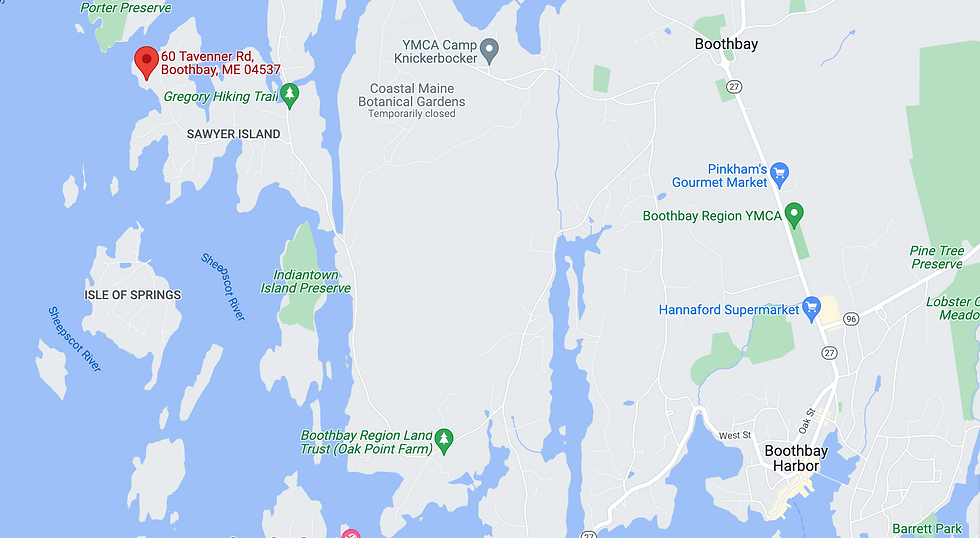
Our cousin Joseph Patten (1C9X) was born in Billerica in 1710. He made his living as a tailor. In 1735, Joseph married another cousin of ours, Susannah Hill (2C8X). Susannah was the great-granddaughter of our immigrant grandfather, Ralph Hill (9GGF) of Billerica. Joseph is of interest because, in 1746, he bought an entire island in Maine. Joseph's property, known then as Ship Island and today as Sawyer Island, was about 160 miles northeast of Billerica. The map below shows (1) Billerica, (2) Sawyer Island and (3) Nova Scotia where Joseph ultimately ended up.

The island itself is approximately a mile in width either way.

life in the north
Susannah Hill had inherited property from her father, Samuel Hill (1C9X), which became Joseph's when they married. The couple didn't remain long in Billerica, however. Eight years after their marriage, in 1743, Joseph's name disappeared from the tax list of that town. We know that he and Susannah moved to the town of Newbury because the deed for Ship Island listed that town as their residence. Newbury, about thirty miles northeast of Billerica, lies on the coast of Massachusetts. Joseph purchased the island in 1747, but remained in Newbury for a time. The eventual move to Maine happened by 1753 when Joseph's name showed up on a petition to divide a portion of York County into a new county. At that time, Joseph listed his occupation as "trader."
The petition Joseph signed brought about the formation of a new county in Maine. Some of the first records for the new county of Lincoln refer to the opening of a new courthouse in Pownalborough, about twenty-five miles north of Sawyer Island. Cousin Joseph's name appears on the list of justices. Courthouse records list marriages performed by "joseph patten J.P." The Pownalborough courthouse, where Joseph plied his trade, "is the only surviving courthouse in the state of Maine that was built during the colonial period." Now it serves as a museum owned and operated by the Lincoln County Historical Society.

The same that year he signed the petition, Joseph bought another small island called Indiantown, just below Sawyer, shown on the map above. His property holdings in the area also included two hundred acres of land with two ponds in Boothbay on the mainland. Boothbay is almost directly east of Sawyer Island.
In addition to his justice duties, Joseph made a good living as a trader and innkeeper on Sawyer Island. Barbara Rumsey of the Boothbay Region Historical Society wrote a nice account of him:
Sawyers/Ship Island was an attractive site for a trader and innkeeper, catching traffic going up and down the Sheepscot. If you plunked yourself down on the most visible northwest part of the island, you were likely to become a destination. Patten did it all on the island: he ran a tavern and inn, functioned as a trader, decided minor disagreements, performed marriages, and drew up legal papers as a justice of the peace, and perhaps built a sawmill.
Patten had a variety of rum items for thirsty neighbors and voyagers who arrived at his wharf: flip, milk punch, toddy, egg toddy. . .Patten often sold a night's lodging, dinners and breakfasts, usually to Massachusetts men who were here in their vessels to get all those staves, shingles, clapboards and firewood. In terms of food staples sold, Patten focused mainly on bulk goods, such as molasses, corn, sugar, coffee, salt, potatoes and beans.
Joseph's account book
In her history of Sawyer Island, Rumsey mentions Joseph's account book. She says that it is the earliest surviving Boothbay account book. He kept it from 1753 until 1762. Rumsey maintains that Joseph's account book "provides invaluable insight into who was here and what they were doing, often drinking a lot of rum. Though the account book spans the final French and Indian War, at no time is there a gap, leading me to believe that Patten stayed on through it all. Most of the local population stayed on as well; the previous 1740s war was much more daunting."
Below is a portion of Joseph's account book.

Cousin Joseph's tavern and store
Rumsey says that the "oldest documentary evidence of the property is a 1746 deed for the entire island, and by 1753 there was a house on the site, which served as a tavern, inn, and store, under the proprietorship of Joseph Patten." Joseph's life in the north was an obvious success and, for him, there was no going back. In 1762, he deeded all of his Billerica property to his daughter Alice (2C8X) and his sister Mehitable (1C9X).
In 1761, Joseph recorded 63 patrons who made a total of 373 visits. Many were local, others from parts unknown, and a few from his old hometown of Newbury. From Joseph's account book we can see that payment for his goods in hard cold cash was rare. Some of the items he accepted in payment were calfskins, gunpowder, butter, codfish and even knitting needles. Labor was accepted as well. Samuel Barter bought his rum and tobacco by cutting staves and shingles for Joseph. Joseph also accepted shoes and the use of another man's oxen. Payment, however, wasn't always perfect. Rumsey says that, according to the account book, "[s]ometimes Patten had to demand adjustments for defective goods taken in payment, such as 'damnified hay' or 'very bad shingles.'"
Cousin Joseph ran his store and tavern on Ship Island for about fifteen years. In 1761, he and Susannah packed up and moved across the Bay of Fundy to Annapolis Nova Scotia. He may have given up his trading business because records there show him as a justice of the peace also involved in town politics. Joseph died in Annapolis in 1687 at age 77 and Susanna followed him the very next near at age 73. We'll end Joseph's story with Barbara Rumsy's words: "We are fortunate he passed through here and that his account book somehow survived for 250 years."
Below, the red marker shows the location of Joseph's store and tavern on then called Ship Island.
the tax collector
Our cousin Joseph Hildreth (1C9X), grandson of our immigrant ancestor Richard Hildreth (9GGF), was born in Chelmsford in 1695. He married another cousin of ours, Phoebe Fletcher (3C8X) who was the daughter of William and Sarah Richardson Fletcher (2C7X). Phoebe's grandfather was Josiah Richardson (1C10X) who, along with his brother James (1C10X), were special friends of the Wamsit tribe who lived in the Chelmsford area. Sometime between 1738 and 1731, Joseph and Phoebe moved to the neaby town of Westford, less than five mile away.

In 1731, Joseph was serving as constable for the town of Westford. One of the duties that fell on constables was that of collecting taxes. Below is paper authorizing Cousin Joseph to collect said taxes. The authorization came from Jeremiah Allen, "Treasurer and Receiver General of His Majesties said Province."


The authorization says, in part:
These are in his Majesties Name to Will & Require you to Collect all and every the Sums of Money mentioned in the List or Lists of the Said Taxes or Assessment of your town, Made by the Assessors or Select-men of the Said Town, and Committed to you to Collect; Amounting in the whole to the Sum of nine pounds seven shillings sixpence.
The townspeople were given four days to pay up. Payment not forthcoming after four days would result in a distress sale: “the said Distress or Distresses to be forthwith Openly Sold at an Out-cry by you, for payment of said Money, (Notice of such Sale being Posted in some Public Place in the same Town Twenty-four Hours before hand…)” If any money were left over from the sale, the “Over-plus” should be “immediately restored to the owners."
Woe to anyone who hadn’t paid their taxes after twelve days: “If any Person or Persons…shall refuse or neglect to pay…by the space of Twelve days after demand thereof…in every such case you are to apply your self unto Two or more Assessors within your Town, for Warrant to conjoint such Person or Persons to the Common Goal (gaol, which is the jail)…” If anyone should decide to skip town with their taxes unpaid, the constable was authorized to hunt them down and throw them into the pokey. These imprisoned people were “there to remain until payment be made…with all Charges arising by reason of such Commitment."
The authorization ended with a warning to all Constables and tax collectors: “And here you are not to fail upon the Pains and Penalties as may in such Case by Law be inflicted on you.”
Let's hope cousin Joseph didn't fail in his duty.
When Cousin Joseph was constable, the colonists dutifully paid their fair share of taxes. A time would come, however, when the taxes levied by Jolly Old England would prove too much to bear.
Josiah Richardson and the Half-Way Covenant
Our cousin Josiah Richardson III (3C8X) was another grandson of Josiah Richardson (1C10X) of Chelmsford. Josiah is of interest because he and his wife Lydia were Puritan church members who "owned the covenant." This meant that their children could benefit from a "religious-political solution" that had been adopted by the church in 1657.
Most first generation settlers to New England were church members in full communion. That meant that, not only had they been baptized, they also had given evidence of a religious "conversion experience." As time wore on, that "conversion experience" became less and less common among second and third generation Puritans. Although unconverted parishioners were still considered church members because they had been baptized, they could not be admitted to the Lord’s Supper. Even worse, they were not allowed to vote or hold any public office. And,worst of all, the sins of the father carried over to his children. The Church decreed that offspring of parents who had not gone through the conversion process would not be eligible even for baptism.
By the middle of the eighteenth century, the plight of these unbaptized children raised a major hue and cry by many parishioners. The solution turned out to be a practice called the Half-Way Covenant. Parents who "owned the covenant" could have their children baptized in the Church. The caveat? These children could not be members of the Church in full communion, only half-way members. Heaven may await them, but they could not partake in the Lord's Supper, could not vote and could not hold a public office.
While most of the congregation was happy with this compromise, there were others who felt the Church was lowering its standards by allowing children of "heathens" to be baptized. The Half-Way Covenant was one of the last dying gasps of the Congregational Church to appease their parisoners. The result, however, created just one more rift in the already fractured Puritan Church system that was slowing being eroded by newly formed churches during the years of the Great Awakening starting midway in the century.
It's unknown how many of Josiah and Lydia's children benefited from the practice. By the time these children were grown, however, they would have a great number of churches to choose from to suit almost any religious belief.
unsound mind
Our cousin Abraham Adams III (2C9X) was born in 1715 in Newbury. He moved to Rowley where he made his living as a tanner. According to Andrew N. Adams who wrote A Genealogical History of Robert Adams of Newbury, poor Abraham's mind "became unsound" and he hung himself in the entry of his house in 1771 at age 56.
life in the further frontier
Our cousin Paul Hildreth (3C7X) was born in Dracut, MA. He was a descendent of our Chelmsford Hildreths. In 1770, Paul and his his wife Hannah Merrill moved to Lewiston, Maine. They had the distinction of being the first white settlers there.

The following sketch of Paul's life was written by Georgia Drew Merrill in 1891 for the publication Geneology Trails:
Paul Hildreth. . . built his log cabin on the bank of the river, just below the Continental Mill. Mr. Hildreth. . .possessed a roving, as well as a resolute, spirit. In the autumn of 1770 his cabin was burned, and the family spent the winter in new Gloucester (11 miles south of Lewiston), but returned to Lewiston in the following spring. . .Tradition relates many adventures experienced during the early settlment of the place, of marvelous contests with venomous wild beasts which invaded the sanctity of the settlement; of women frightened; of children pursued by bears; of the destruction of cattle by huge and ferocious catamounts; of the dread experienced as the dusky forms of the aborigines were seen gliding through the forests in pursuit of game. With the pioneers life was a sad and checkered reality. A trackless forest, fifteen miles in extent, lay between them and the nearest white settlement. Provisions were frequently short, and once for four days they were without food or fire. During those days of fasting and anxiety, Mrs. Hildreth and an infant were the only persons in the settlment. Tradition also informs us that the first grant of land. . . was a present of fifty acres to Mrs. Hildreth, as a testimonial of their respect for the first female settler of Lewiston. This tradition may be true, but so far no documents substatiate the claim. Mr. Hildreth occupied this lot until 1795, when he sold and took up a new lot. Hildreth established the first ferry in town, about a half a mile below the falls. . .
Cousin Paul lived in Lewiston until 1802 when he moved to the town of Gardner, 30 miles northeast. He died in Gardner in 1830 at age 74.
The founding of New Salem, MA
In 1729, a tract of land was granted to the inhabitants of Salem, MA. When they failed to meet the requirements for founding a new town, the general court granted the property to our cousin Daniel Epes (3C8X), among others. Daniel's grandfather, also Daniel (1C10X), was a nephew of our grandfather Francis Eppes (9GGF) who settled in Virginia.
While cousin Daniel, who lived in Salem, helped to get the town going, he never actually lived there. One of our other relatives, however, did decide to make New Salem his home. Uncle Jeremiah Ballard (7U) was the son of our grandfather Joseph Ballard (8GGF) and his second wife, Rebecca Rea. Grandpa Joseph was the man who began the whole witch brouhaha in Andover in 1692.
Jeremiah was in New Salem by 1750 when he and another man were licensed to erect a sawmill. In 1753, Jeremiah's name was on a petition presented to the General Court asking that the town be incorporated. Uncle Jeremiah spent the rest of his life in New Salem, evidently a pillar of the community. According to a history of town written by Florence Cogswell Cox, "Captain Jeremiah Ballard seems to have been the leader in town affairs for several years, and some of his descendants still live in New Salem."
Isaac Wyman's tavern
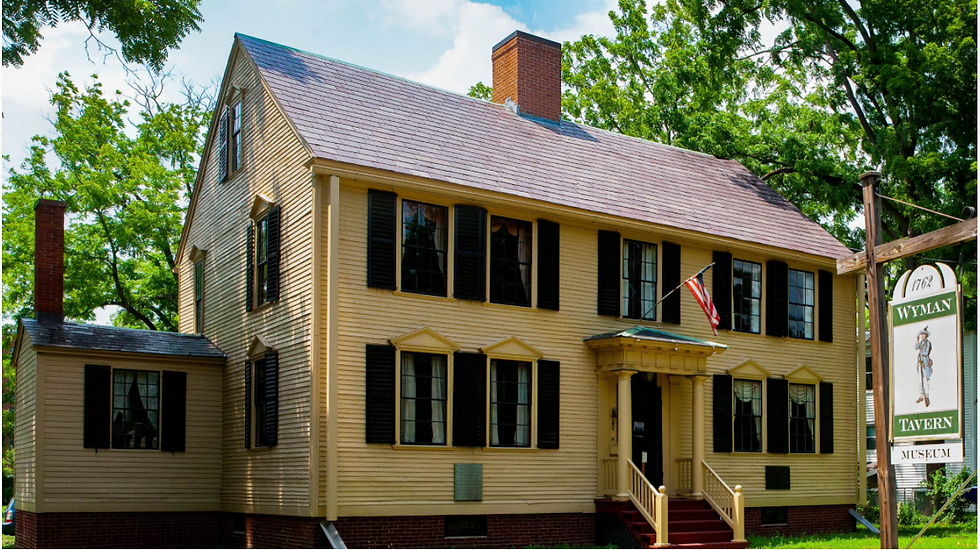
Our cousin Isaac Wyman (4C7X) was born in 1724 in Woburn. In the final French and Indian War, he rose to the rank of captain and, for a time, was in command of Fort Massachusetts, located in the far northwestern corner of Massachusetts. After the war, in 1762, Isaac settled in Keene, NH where he built and ran a tavern.

Isaac ran his tavern for thirty years. In 1770, the first meeting of the trustees of Dartmouth College was held there presided by college president Eleazor Wheelock. According to Eleazor, the Wyman Tavern was known "far and wide as an excellent inn." A plaque on the house commemorates the event and a subsequent owner:

Note: Reverend Eleazor Wheelock had extensive dealings with some of our relatives. We'll see him in future posts. One of Eleazor's great-grandsons, Cyrus Hubbard Wheelock, a Mormon extraordinaire, married our Aunt Olive Parrish.
The building that housed Isaac's tavern is now listed On the U.S Register of Historic Places as the Wyman Tavern Museum. Guided tours are held from May to November.
We'll have more on Cousin Isaac, who also fought in the Revolutionary War, in future posts.
Ben Franklin's nephew by marriage
Our cousin Anthony Stickney (3C8X) was born in Newbury in 1724. In 1747, he had the good fortune to marry Dorcas Davenport. Dorcas' mother, Sarah Franklin Davenport, was sister of Benjamin Franklin who was already fairly famous in the colonies. Anthony was a humble chairmaker who evidently had the reputation amongst his wife’s relatives of being “a lazy fellow.” Benjamin Franklin had visited Anthony and his family on a journey from Boston to Portsmouth N.H. in the summer of 1763. The next summer Franklin wrote the following letter to his nephew by marriage:
Philada. June 16. 1764
Loving Kinsman
I received yours of the 16th May, and am glad to hear that you and your Family are well, and that your Wife is safely delivered of another Daughter (1), which I hope will prove a Blessing to you both. I got home without any farther Accident (2), but have not yet recovered fully the former Strength of my Arm. Your Brother Josiah Davenport (3) is still at Pitsburg, near 400 Miles west of this Place, where he has the Care of the Provincial Store, that was establish’d there during the Peace, for the Indian Trade; and since the War (4) broke out again, there has been no good Opportunity of bringing off the Goods, so he is oblig’d to remain with them. His Wife and Children are here; and she seems to be in a bad State of Health, but the Children are well. My Wife and Daughter thank you for your good Wishes, and return theirs for you and yours. Present my best Respects to Mr. and Mrs. Lowell, and my Love to your Wife and Children. Remember me too, to your Brother Davenport and his Family. I am, Your affectionate Uncle
B Franklin
(1) Anthony and Dorcas' sixth and last child, daughter Dorcas (4C7X), had been born in September.
(2) Franklin had fallen and dislocated his shoulder on the Boston to Portsmouth trip.
(3) Anthony's brother-in-law.
(4) The final French and Indian War which would end in September of 1763.
Anthony died in 1774, just a year before the Revolutionary War began. He was only 50 years old. Franklin lived on another sixteen years. He died in 1790 at 84 years.


Comments