
Final Days Before Revolution
- westmohney

- Mar 21, 2023
- 10 min read
Updated: Jul 6, 2024
Here William French his Body lies, For Murder his Blood for Vengeance cries ~ From William French's memorial marker
revolution in the air
Boston in late 1774 meant heady days for the Patriots. As they inched ever closer to the revolution that would create a new independent nation, the Powder Alarm in September of that year pushed the agenda into high gear.
When British General Thomas Gage decided to remove some gunpowder from its storage place in Boston, rumors began to fly. It was falsely reported that blood had been shed. The Patriots sprang into action. Thousands of militiamen marched toward Boston, even from as far away as Connecticut. Once again, British officials and Loyalists were forced to flee to safety.
Even though the moving of the gunpowder turned out to be benign, the exercise proved to be a "dress rehearsal" for the Battles of Lexington and Concord to come only seven months later. Both the British and the Patriots spent those months striving to acquire and gain control over military stores available in the colonies. As time wore on, the struggle to obtain weaponry, gunpowder, and other military supplies became more and more contentious.
Blacksmiths unite !!
Our cousin Ross Wyman (4C7X) was the son of Seth Wyman (3C8X). We wrote of Seth in our "Lovewell's Fight" post. He was just one of our two cousins who were later endowed with the dubious fame of killing Chief Paugus in the battle at Lovewell's Pond. Ross was born in 1717 in Woburn. His father, Seth, died of dysentery when Ross was only eight years old. His mother died two years later. He was probably raised in Woburn by family members.
Shortly after his marriage in 1743, Ross moved to Tewksbury and from there he moved on to Shrewsbury where he lived until his death.
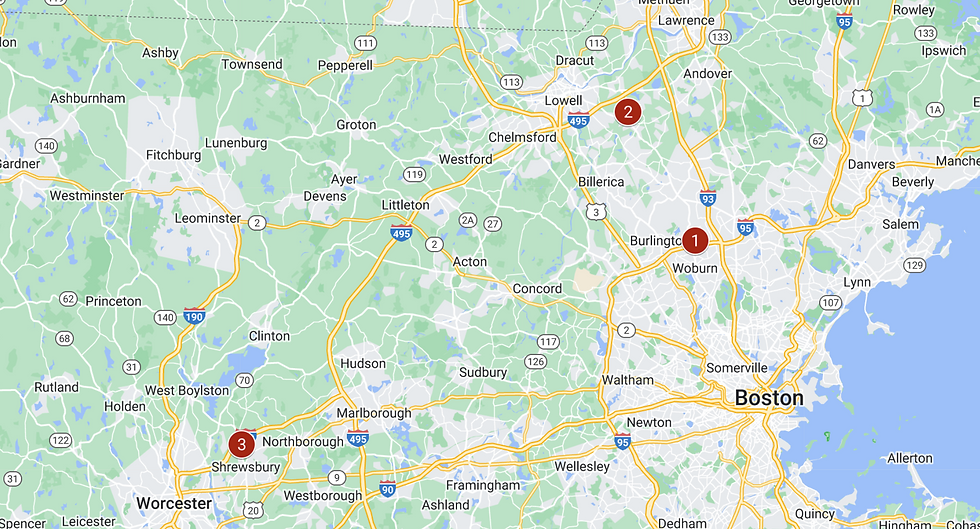
In 1746, Ross built a house in Shrewsbury that later became known as the Bonnie Dell Farm. Below is a picture of the house as it looks today:

Cousin Ross was a blacksmith. Our cousin Andrew H. Ward (6C8X) gives a possibly exaggerated description of him in his History of the Town of Shrewsbury:
He was a stout, athletic man, and, previous to the Revolution, while in Boston, and in his wagon, came near being seized and carried off by a press-gang from a British man-of-war. He resolutely defended himself, and, at length, snatching up a cod fish with both hands in the gills, beat them off by slapping them in the face with its slimy tail!
Note: Genealogist Andrew H. Ward (6C8X) was a grandson of our cousin General Artemas Ward (4C10X), first commander in chief of the newly formed Revolutionary Army. Artemas' story will be told in a future post.
Frederick L. Rushton, feature writer for the Worcester Sunday Telegram in the 1940s had this to say about Ross:
A blacksmith and gunmaker, [Ross Wyman] was a man of character, of influence in his community and, above all, a patriot. Although relatively prosperous and secure economically he did not hesitate to incur the disfavor of the authorities by taking a conspicuous part in the events which eventually led to the rebellion.
About three weeks after the Powder Alarm, Cousin Ross took part in a very important convention of blacksmiths held in the town of Worcester. This convention took place seven months before the start of the Revolutionary War and illustrates the climate in the colonies at the time. Our cousin Andrew Ward tells the story:
On the 21st of September, 1774, a Convention of the Blacksmiths of the County was held at Worcester, and their patriotic proceedings, signed by forty three members, were printed, and distributed through the County. Ross Wyman of Shrewsbury, Chairman. They resolved, that they would not, not either of them do any blacksmith work for the tories, nor for any one in their employ, nor for any one, who had not signed the non-consumption (importation) agreement agreed upon, and signed by the Congress at Philadelphia; and requested all denominations of artificers to call meetings of their craftsmen, and adopt like measures. The proceedings of the several conventions were communicated to, and read in the Provincial Congress, which gave free utterance to the combined will of the people, so consonant to their own. Their recommendations and resolves were received as laws duly enacted, and were enforced with a promptitude and zeal, that nothing could withstand.
Ross Wyman and General Artemas Ward, both living in Shrewsbury, were well known to one another. According to Andrew Ward, "[a]t the commencement of the Revolution, Gen. Ward requested him (Ross) to make him a gun and bayonet of sufficient strength for him to pitch a man over his head. He made it to order, and, of horse nail stubs; it was a real king’s arm, as a certain kind of musket was called at that day; and did the country some service."
Cousin Ross did his time in the military during the war, serving at Bennington and Stillwater in 1777. In the early 1800's he built a mill on the banks of Hop Brook. The area surrounding the mill today is an upscale neighborhood known as Wyman Farms. Below is a picture of what's left of Wyman's Mill.

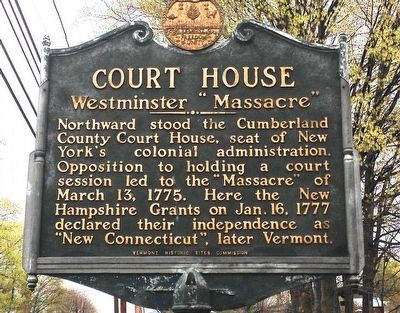
Westminster Massacre
The colonists in America appeared to be fond of the word "massacre." An incident that happened at the courthouse in the town of Westminster in Vermont became known as the Westminster massacre even though only two men were killed. One of the men that died in that fracas was our cousin William French (2C8X).
The backstory to the incident involves a longstanding struggle between New York and New Hampshire for lands that eventually became the state of Vermont.
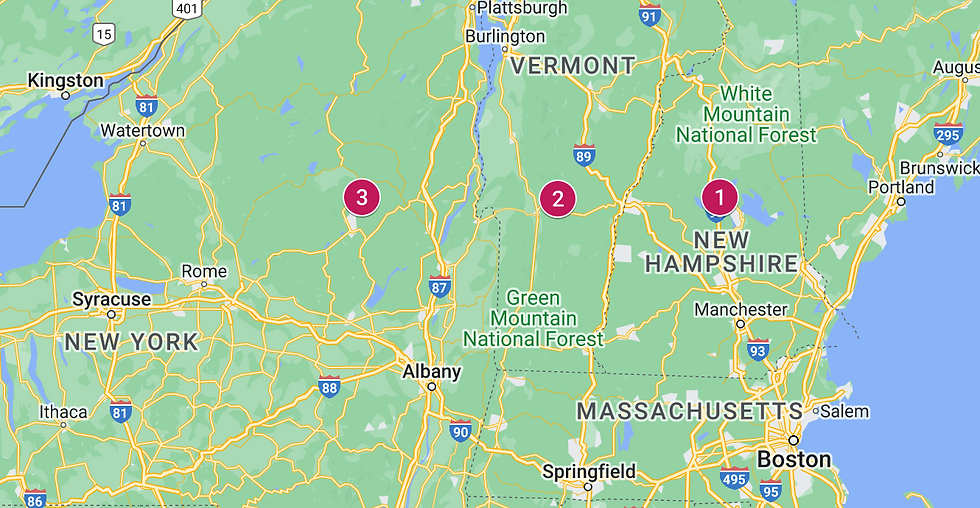
The majority of New Hampshire residents were lower class farmers. These farmers were pitted against the "Yorkers," wealthy landowners from England and New York. Ethan Allen and his Green Mountain Boys were heavily involved in the struggle. Allen's men patrolled the area, attacking and beating surveyors employed by the Yorkers. The Green Mountain Boys also began destroying homes of Yorkers who settled in the contested areas.
In response to the attacks on Yorkers, officials from New York began arresting and evicting poor settlers all across the New Hampshire Grants. The heated climate of impending revolution certainly didn't help matters between the Loyalist Yorkers and the Patriot New Hampshire farmers. The animosity between these two groups reached a peak in the early months of 1775.
the Catamount Tavern
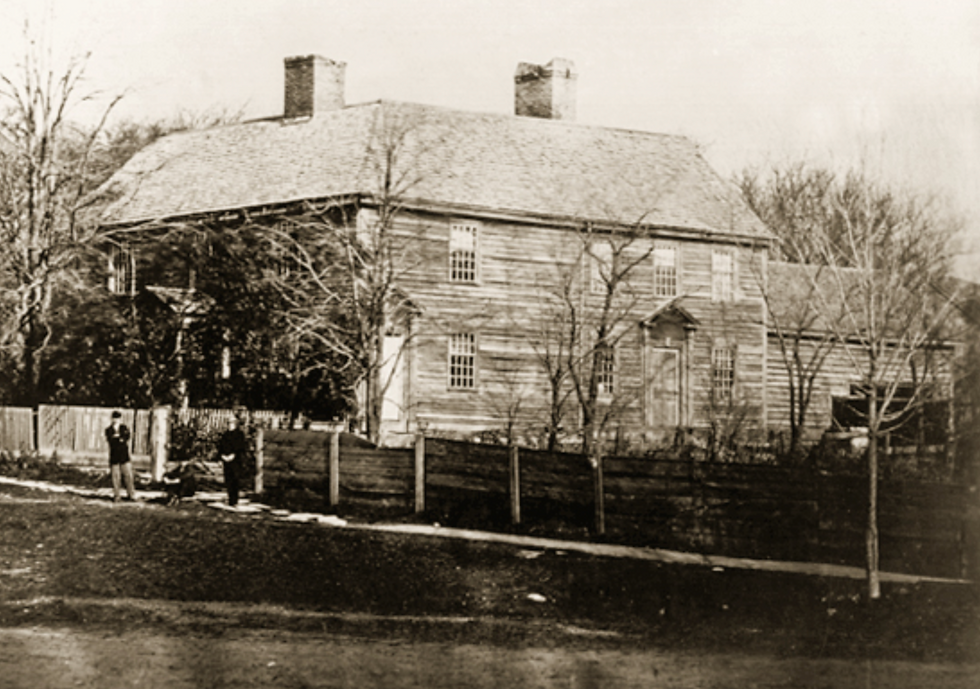
In 1770, when the New Hampshire/New York clashes were beginning to heat up, Ethan Allen's gang frequently gathered at the Green Mountain Tavern in Bennington. The tavern, locally known as Fay's House, was owned by none other than our cousin Stephen Fay (4C10X). Stephen's grandmother was Mary Brigham Fay (2C12). The tavern, now in the state of Vermont, then lay in a bottom corner of New Hampshire just inside the New York Border.

Allen's gang of men took their name, as Cousin Stephen's tavern originally did, from the surrounding green mountains of New Hampshire. The Catamount name came about when Stephen took a stuffed catamount (cougar) and put it on the signpost outside the tavern. The catamount, with teeth bared, was said to have been mounted facing New York.
The Catamount tavern was a perfect meeting place for the Green Mountain Boys. Not only was it situated in the thick of the action, but Stephen Fay wholeheartedly supported the cause and one of Stephen's sons, Jonas (5C9X), became an active member of the "Boys." Five of Stephen's sons, including Jonas, would go on to fight in the Battle of Bennington and one was killed there.
Cousin Stephen's tavern continued to be an important meeting place throughout the war. Loyalist David Redding, accused of stealing muskets, was imprisoned and tried there. He was subesquently hanged. The tavern also served as a planning room for General John Stark before the Battle of Bennington in 1777.
By the 1860s the building was old and worn and, in 1871, the former tavern burned to the ground. Below is a picture taken shortly before the fire:
The only reminder of the Catamount Tavern today is a sculpture of a catamount which was erected on the site in 1896:

tensions mount
New Hampshire grant owners first tried to settle their disputes peacefully in the New York courts. They repeatedly lost. Most were not willing to give up the lands they had worked so hard for and many were unwilling to compromise with Yorkers. Feeling abandoned and betrayed by their government, New Hampshirites were quick to join the Patriot cause. Cousin Jonas Fay was a frequent participant, along with Ethan Allen and his Boys at the Catamount, plotting the course of their resistance.
Note: The New Hampshire State motto "Live free or die," though not adopted until 1945, stems from this period in its history. General John Stark, hero of the Bennington battle which helped change the course of the war, was a proud New Hampshirite. When ill health forced him to miss a reunion dinner commemorating the famous battle, he sent this message instead, "Live free or die: Death is not the worst of evils."
On 13 March 1775, tensions heated to the boiling point. A New York judge had arrived in Westminster, about 40 miles northeast of Brattleboro, to hear cases pertaining to debt owed by some New Hampshire land owners. Afraid of losing their property, a group of "riotous and disorderly persons. . .[numbering] between eighty and ninety" assembled outside of the Westminster Courthouse to protest. Among the group was our cousin William French.
the massacre
The courthouse was soon filled with hundreds of men, some "armed with clubs and firearms." When Sheriff Patterson of Westminster ordered the men to leave, they refused. The sheriff promptly rode out to Brattleboro and recruited “25 residents for the purpose of ‘keeping the peace’”.
Patterson returned to Westminster at 9:00 that night and found the rioters in control of both the courthouse and the local jail. After once again ordering the mob to disperse, Patterson ordered his men to fire warning shots. Predictably, the rioters returned fire, wounding a magistrate. That was all the sheriff and his posse needed. They stormed the courthouse shooting into the crowd. Our cousin William French was shot in the head. Another man, Daniel Houghton, was shot and beaten. The fracas devolved into "hand-to-hand combat, in which many of the rioters were injured." An eyewitness to the melee described what he saw:
They rushed in with their guns, swords, and clubs, and did most cruelly maim several more, and took some that were not wounded, and those that were, and crowded them all into close prison together, and then told them they should be in hell before the next night, and that they did wish that there were forty more in the same case with that dying man (Cousin William). When they put him [French] into prison, they took and dragged him as one would a dog, and would mock him as he lay gasping, and make sport for themselves.
Cousin William, twenty-two at the time, had been shot five times. He had been hit behind his ear as well as his calf, thigh, mouth and forehead. Ten of the rioters were wounded. Daniel Houghton died of his injuries nine days later. Seven men were imprisoned. Two of the sheriff's posse were slightly injured.
aftermath
News of the "massacre" spread quickly throughout the colony. The "Live free or die" New Hampshirites were not about to take this insult lying down. The next day a seriously angry mob, "upwards of 500," descended on Westminster from neighboring towns all over New Hampshire. The throng of men seized the "judges, the sheriffs, the clerk and local loyalists" and "paraded" them to the local jail. There, they freed the seven imprisoned rioters before scouring the town for more Loyalists to lock up. Now firmly in control, the mob quickly created a committee which charged five of their prisoners with the murder of William French.
The coroner's report decreed only one of the wounds to William's head as the fatal shot. From the report:
William Paterson Esqr, Mark Langdon, Christopher Orsgood, Benjamin Gorton, Samuel Night, and others unknown to them assisting with force and arms made an assault on the Body of the Said Wm French and Shot him Through the Head with a Bullet of which wound he Died and Not Otherways…
Below is a copy of the coroner's report. The red splotches are sealing wax used by the witnesses of the report:

The sheriff and his posse were later taken to Albany where a New York Court set them free.
a martyr
Cousin William was buried with honors the day after the shooting. His gravestone is inscribed with these words:
Here William French his Body lies,
For Murder his Blood for Vengeance cries.
King George the third his Tory crew
Tha with a bawl his head Shot threw.
For liberty and his Country’s Good,
he Lost his Life his Dearest Blood.

In his article,". . .Confrontation in Westminster was a Prelude to the Revolution," historian Mark Bushnell contends that William French "was no longer a young man misfortunate enough to be killed during a protest that was violently suppressed. He was now a martyr -- the "proto-martyr" of the Revolution, in one writer's estimation -- whose name was invoked to rally people to the cause of liberty."
medical supplies for the military
After the riot at the Westminster Courthouse, revolution was deemed inevitable and the Provincial Congress of Massachusetts decided to prepare for that likelihood. They created a commitee to determine what medical supplies would be necessary for their troops. Money was allocated and put under the direction of doctors Joseph Warren and Benjamin Church. The Greenleaf Apothecary was still going strong in the early months of 1775 and, in a major coup for our cousin John Greenleaf, his shop was chosen as one of the government's apothecaries of choice.
Note: We wrote the sad story of Cousin John Greenleaf's poisoned son in our "The Greenleaf's" post.
Dr. Warren, it appears, had a slight money problem and, for some reason, did not want to be in Cousin John's debt. Below is a letter to Warren's brother asking for a loan.
February 18, 1775
Dear Jack,
I would not lead you (although I stand much in need of cash) into any situation from which you could not easily bring yourself, honorably and conveniently. Mr. Greenleaf is not in want of money, but a circumstance is soon likely to take place which makes it proper I should not be personally in his debt; but I cannot otherwise discharge it than by paying him in notes.
Most probably the "circumstance...likely to take place" had to do with a young woman Warren was enamored of who had ties to John Greenleaf.
The medical supplies for the government, regardless of Dr. Warren's personal problems, were eventually purchased. This turned out to be a very fortuitous happenstance. Cousin John's records show that, on April 4, 1775, his pharmacy supplied at least five of the fifteen chests of medicines ordered by the government. The transaction took place only fifteen days before the fateful confrontations at Lexington and Concord.


Comments