
Final French and Indian War
- westmohney

- Nov 19, 2022
- 10 min read
Updated: Jun 27, 2024
That men do not learn very much from the lessons of history is the most important of all the lessons of history ~ Aldous Huxley
the Seven Years' War
The final French and Indian War, waged from 1754 to 1763, was also known as the Seven Years’ War. It might have appeared to be an uneven fight. The French colonies had a population of only about 60,000 settlers compared with two million in the British colonies. The fact that the French had spent years nurturing their relationship with Native tribes who particularly loathed the English evened the playing field somewhat.
The colonists, in both New England and New France, had only enjoyed a six year respite since King George's War ended in 1748. Trouble ignited when the French began settling in territory north of the St. Lawrence River into what would become western Pennsylvania and eastern Ohio. At the time these lands were claimed by Virginia and the British intended to defend their claim.
The map below shows the vast lands claimed by Virginia which included West Virginia, Ohio and Pennsylvania. At the time of the French and Indian War, these lands were mostly empty frontier settled only by fur trappers and Indian traders. The red marker indicates the French held Fort Duquesne and the blue indicates the short-lived English Fort Necessity.

For the war, both sides amassed what Native allies they could. The British colonists were supported by the ever fickle Iroquois, the Catawba and Cherokee tribes while the French allies were various Wabanaki Confederacy tribes as well as Algonquin, Lenape, Ojibwa, Ottawa, Shawnee, and Wyandot tribes.
Fort Necessity
A precursor to war, the battle of Fort Necessity took place in early 1754. It would prove to be just one of many defeats in the long military career of then Lt. Col. George Washington. When the French began construction of a fort near present day Pittsburgh, PA, the British took immediate action. Lt. Col. Washington arrived on the scene and, after an intitial skirmish with the French, decided a British fortification was in order. The, as yet, inexperienced commander placed the fort, called Necessity, in the vulnerable depression of a meadow.
Perhaps the mistake at Fort Necessity was a valuable lesson for Washington. By the Revolution years he had learned to always seek the higher ground. When the French attacked the English fort only five days into the building of their still weak fortificaton, it turned into a rout.

Washington was forced to surrender his "fort" and the French burned it to the ground.
The French completed Fort Duquesne in the Ohio River Valley and there it remained, firmly ensconsed, until the British finally got the upper hand in 1758.
the battle of Lake George
The first four years of war were difficult for the British with a long string of defeats. Another expedition against Fort Duquesne in July of 1755 was even more disaterous than the first. The commander of that expedition, Major General Edward Braddock, was killed and his army decimated when they were ambushed approaching the fort. The British suffered 456 men killed and 422 wounded. The French casualties, a mere 30 men.
The British, sorely needing a victory, then turned their sights towards Crown Point in present day New York. This area had already seen its share of battles during all previous French and Indian Wars. Fort St. Frederick at Crown Point had been built by the French in 1734, giving them control over the Champlain Valley. During the Seven Years War, the British made five attempts on that fort.
The first attempt resulted in the Battle of Lake George on September 8, 1755. Lake George was about sixty-five miles from Fort St. Frederick.

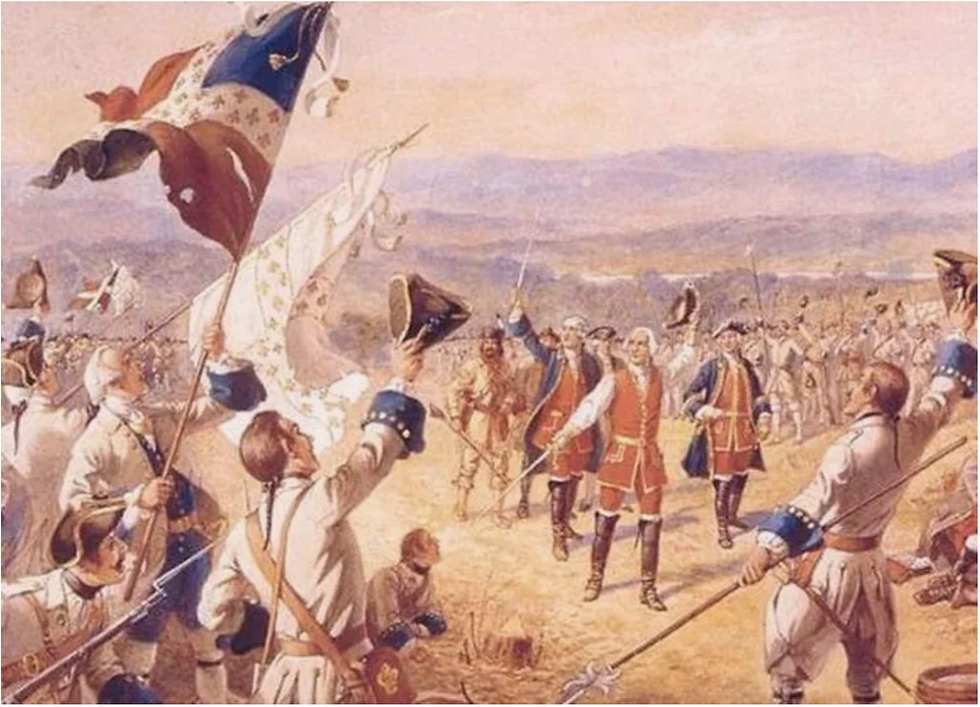
General William Johnson assembled a force of 3,500 men, mostly colonial militia from New England and New York. The September day of the battle became known as "The Bloody Morning Scout." All three "desperate and bloody" battles, fought in one day and within the space of only a few miles, ended with a British victory. After Braddock’s calamitous defeat at Fort Duquesne, the English triumph at Lake George was a morale boost for both the soldiers and the general public alike.
Below is a picture from a 19th century postcard depicting the battle of Lake George.

Though Johnson won all three of those "desperate" battles at Lake George, he gave up his plans to attack Fort St. Frederick at Crown Point. Insead, he concentrated on establishing a British fort at Lake George. Fort William Henry would soon see its share of action in many battles to come. For his efforts, Johnson was made a baron by King George II and Sole superintendant of Indian Affairs in the area.
Our cousin Isaac Proctor (2C7X) was killed in one of the three Battles at Lake George.
Our cousins Abel Richardson (4C7X), Gideon Fletcher (4C7X), Ebenezer French (3C7X) and Samuel Fletcher (4C7X) all fought in the Battles of Lake George. Cousin Josiah Richardson (4C7X) was a muster master from Chelmsford.
Note: A muster master was a person who took an account of the troops and their equipment.
Cousin Samuel Blodgett at Lake George
Our cousin Samuel Blodgett (2C7X) was born in Woburn in 1724. His mother was our first cousin, Sarah Wyman (1C8X). Samuel had done his duty for his country in the third French and Indian War, King George's. In 1745, he took part in the battle of Louisbourg.
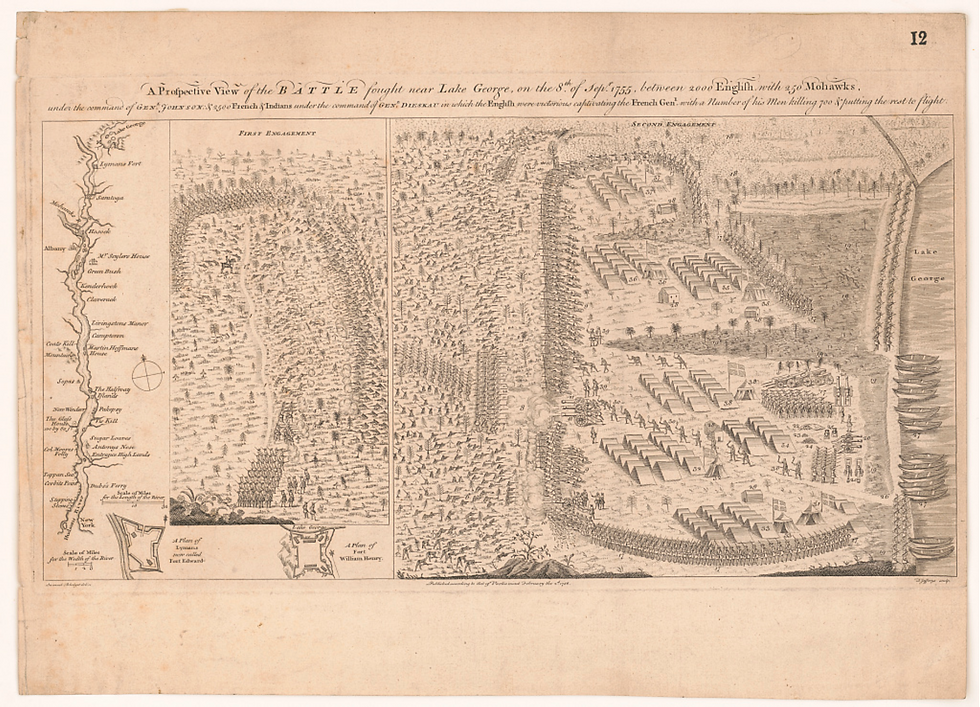
During the final French and Indian War, Samuel was at Lake George on September 8, the day those three important battles were fought. Samuel was not, however, part of the regular army. He was a sutler in William Johnson's regiment. His job was to follow the army and sell provisions to the soldiers. Since Samuel didn't take part in the battle, he was able to position himself on a hill with the men firing the cannon. There he had a perfect view of the action on the battlefield. Afterwards, he "learned the particulars" of the all three battles from survivors at the end of that bloody day.
The resulting map that Samuel sketched of the action was engraved and printed early in 1756. Along with the map, Samuel included an explanation of his work. The explanation reads, in part:
I Herewith offer to the Public a visable Representation of two of the Eangagements the English had with the French on the 8th of last September...The Representation I have given, whether as appearing to the Eye in this Plan, or to the Mind in the descriptive Notes, contains the real Truth. I was my self present at the Camp...yet being an independent person, not belonging to the army, I had, it may be, as good an Opportunity, as any Person whatever, to observe the whole Management on both Sides...I have not...contented myself with my own Observations, but made it my Business to converse with those, at the Camp, who were most capable of enabling me to give a fair and full Account of the Transactions of this memorable Day. I am sure, I have no sinister End to serve, nor do I know of any Thing that should biass me to vary in the least from the Truth of Fact. As the Action near Lake George is the greatest, in it's Kind, that ever happened in North-America, it is hoped, the Prospect, and Account, here given of it, will not be unaccaeptable, unless to those who don't wish well to his Britannick Majesty's Interest in these Parts of the World.
Below are the title page to his "Prospective-Plan" and his explanation of his work.


Though there were actually three battles that day, Samuel's map include only the First and Second Engagements and, on the left, a map of the Hudson River from New York to Albany.
We'll hear more about cousin Samuel and his canal work in Massachusetts in a later post.
Cousin Rachel Parker's petition
Our cousin Rachel Parker's (2C8X) grandmother was our aunt Abigail Hildreth Parker (8A). I can't find a date for Rachel's marriage to her cousin Jacob Parker but, since they had no children, I imagine it was shortly before 1755 when Jacob left Chelmsford to fight in the first Crown Point Expedition. Jacob was killed in that battle. Two years later, Rachel submitted the following petition to the Council asking for compensation:
The Petition of Rachel Parker of Chelmsford in the County of Middlesex widow, humbly Sheweth. That her late Husband Jacob Parker. . .in the Month of April A.D. 1755 enlisted into his Majesty's Service in the Expedtion then carrying on against Crown Point. . .& proceeded to Lake George, & on the Eighth Day of September last in the forenoon was in the Engagement with the French & Indians. . .& then Killed in the same Engagement before he returned to the Army at their encampment at Lake George, and in the same Engagement lost the Gun he had with him, being his own Property of the Value of one Pound Six Shillings, & eight pence Lawful money and also the Blanket which he received as Part of his Bounty (besides all the Clothing he had with him.)
June 14, 1757 Rachel Parker Executrix
£1.6.8 and a blanket asked. Nothing granted.
In Wilson Water's History of Chelmsford, fourteen petitions for this war are listed. Poor Cousin Rachel's is the only one that received "nothing granted" for compensation.
the death of Benjamin Adams
A year later after the victory at Lake George, the British decided another attempt at Crown Point was in order. Plans were made for an expedition to set off from the newly built British Fort William Henry, about fifty miles from the French Fort St. Frederick. One of the men answering the call to arms was our cousin Benjamin Adams (4C7X). From a petition written by his brother Oliver (4C7X), we learn of his sad fate.
Thursday, July 1, 1756
The Petition of Oliver Adams of Chelmsford...Executor of the last Will and Testiment of Benjamin Adams, junr. late of Chelmsford...Housewright, deceased...humbly sheweth that the said Benjamin Adams, on the twnety seventh Day of September last...was impressed into his Majestys service for the Crown Point Expedition...And accordingly he...set out for Worcester...not having any Opportunity to settle any of his Afairs or even so much as to make any Charges for his Labour against those People whom he had then lately laboured for; to the great injury of the Heirs at Law of the sd. Benjamin...Benjamin arrived at Worcester...the thirtieth Day of September...and there Tarryed nine Days and Billetted himself at his own Costs from the time that he marched from Chelmsford...eleven Days, at one shilling & six pensce per Day...Benjamin...proceeded to Albany, & was employed from thence to Lake George as a Guard to the Waggoners Carrying Provision for the Army untill the twenty fourth Day of November last, when through the great fatigues of his marches & the Duty he was ordered to perform & the very bad and unholesome Provisions he did receive & was obliged to eat (or else to starve) he was reduced to a low & bad stae of health, and thereby rendered unable to do any further Duty; he on the twenty fourth Day of November...Obtained dismission from the Service under the Hand of Colo John Haseltine (3C9X) to return Home to chelmsford; that in his journey & return his illness & weakness increased so upon him that he was unable to travel on foot the greater Part of the way & necessarily put the charged Eight shillings Lawful money for the hire of Horses from Town to Town and assistance therein, as also the expence of one shilling & six pence per Day for his subsistance for eleven Days...on the fourth Day of December last got to Chelmsford...to the house of one Peter Proctor (1C8X) (our cousin and Oliver's future father-in-law) within about three miles of his own Lodging, and then was taken so very sick of a Fever that he could not hold out to be moved to his own Lodging, & continued so at the sd Peter Proctor's until the eighteenth Day of December...when he died.
Note: Peter Proctor's son Issac (2C7X) had been killed a year earlier at the Battle of Lake George.
Benjamin's ordeal wasn't so unusual in that more men died of illness than wounds during the course of the war. His journey home, however, seems particularly agonizing. Oliver's petition asked for compensation from the government for Benjamin's out of pocket expenses during his travels and for Peter Proctor's expenses in taking care of Benjamin at his home. The court allowed £2 9 shillings. The court proceedings, however, certainly didn't speak to the anguish of families losing their loved ones.
The year after his brothe's death, 1756, Oliver Adams married Peter Proctor's daughter, Rachel (2C7X).
casualties of war
Far more soldiers in the French and Indian War died of exposure and illness than of actual battle wounds. Of the 11,000 men who died in this war, only about 3,000 deaths were due to actual combat. In addition to Benjamin Adams, we had at least three other relatives who died serving at Fort William Henry in 1756. According to the Massachusetts Archives, our cousin Isaac Proctor (2C7X) mustered into Captain Robert Butterfield's company on Oct. 11, 1756. Before the end of the year, a report listed six of Butterfield's thirteen men sick and four listed dead, including Butterfield's son. Only three men in the company were healthy. Cousin Isaac was sick enough to have been sent by boat to Albany, sixty miles away. The exact date of his death isn't recorded but it was before the new year. Small pox, the scourge of the army, may have been responsible for the high number of casualties in Butterfield's company.
Two other relatives that died at William Henry in 1756 were our muster master cousin Josiah Richardson (4C7X), who had been at the battle of Lake George in 1755 and our cousin Lt. Ephraim Kidder (2C7X). Ephraim died "from effects of hardship and exposure..."
Note: In 1735, Ephraim had married another cousin of ours, Elizabeth French. Elizabeth (1C9X) was a great-granddaughter of our immigrant grandfather, Ralph Hill (9GGF).
The other side of the coin were those men who were injured in battle, but survived. Physicians and surgeons were kept busy, both on the battlefield and at home, treating men who had suffered minor to grievous wounds. Sick and wounded men were cared for either in military camps, their own homes or "tarrying at the houses of the surgeons." Our cousin John Kittredge (2C8X) was a surgeon who was constantly on call during the war. The suffering of Simon Wade, one who survived his wounds, serves as an example of the plight of hundreds of men:
These may certify whom it may concern that I, John Kittredge of Andover aforesaid, some time in the month of August last I saw Lieut. Simon Wade of Medford at the House of my
father in Tewksbury which I found in dangerous circumstances by reason of a wound (as he enformed he Received at Fort William Henry in the Late Expedition to Crown Point). My
father enformed me that he was doubtful whether he would recover of his wound & to all appearance his wounds looked Incurable. About the term of three weeks (as my Father enformed me) he continued with him, during which time my father enformed me that the canker had taken his sore & it eat to a Great Degree & caused his sore to Bleed half a pint in one night & that he Despaired of his recovery: sometime in the month of Sept'r last Mr. Wade put himself under my care (by reason that my father was labouring under bodily Indisposition) & from s'd month of Sept. to the Day of the Date hereof s'd Wade hath been under my care & for the greatest part of the Time his wound was very Bad. I was obliged to take several pieces of Bone out of his Leg & even now judge him to be quite Incapable of military Duty.
John Kittredge Essex, Andover, June 19, 1757
Next up: The War Grinds On


Comments