
FIRST ALARM
- westmohney

- Mar 30, 2023
- 12 min read
Updated: Oct 26, 2024
Don't fire unless fired upon, but if they mean to have a war, let it begin here. ~ Captain John Parker at Lexington, 1775.

Paul Revere's ride and our cousin Amos Wyman
On April 18, 1775, British General Thomas Gage had two orders for his troops. They were to first march to Lexington and capture the Patriot leaders, Samuel Adams and John Hancock. They were then were to continue on to Concord and take control of the large colonial arsenal stored there. Luckily for the Patriot cause, spies had caught wind of Gage's plan. It wasn't luck, however, that the colonists had already devised a warning system for just that event. While Paul Revere wasn't the only man riding that night to sound the alarm, he certainly became the most famous.
Revere's first task that night was to warn Adams and Hancock of their imminent danger and get them safely out of Lexington. Since time was of the essence, he chose to take a shorter but more dangerous route from Boston. His journey that night took him across the Charles River where British ships stood guard. In a letter to Jeremy Belnap, secretary of the Massachussetts Historical Society, Revere described how, before crossing the river, he sent instructions to have signal lanterns hanging in the steeple of the Old North Church lit to alert the Patriots that the British traveled by sea. Revere was rowed across the river by two friends. Then he borrowed a horse and began his ride.

Revere recounted that when he arrived in Lexington just past midnight, James Monroe cautioned him to be quiet as everyone was sleeping. Revere cried "Noise! You’ll have noise enough before long! The regulars are coming out!"
Hancock was reluctant to run but Samuel Adams finally convinced him to go. It was decided that Revere would take them to Woburn, five miles northeast of Lexington. They first stopped at the house of "Madame Jones" and were just sitting down to eat when a farmer rushed in to warn them that the British were on their way. According to The History of Woburn by Samuel Sewall:
Mr. Marrett next conducted Mrs. Jones' illustrious visitors to the house of (our cousin) Mr. Amos Wyman (3C7X), situate in an obscure corner of Bedford, where were collected the women and children of several of the neighboring families, who had fled thither for safety. And now, as soon as Messrs. Hancock and Adams had had time to become calm after their flight, they besought Mrs. Wyman to give them a little food; Their good natured hostess, in ready compliance with their request, took down from a shelf a wooden tray, containing some cold boiled salt pork. . .and brown bread; and upon this plain, course fare, they made a hearty meal. . .Not many years since, it was a current report in Lexington, that Hancock, in gratitude to Mrs. Wyman for her kindness to him and Adams at her house, in their flight for fear of the British, made a present to her of a cow.
The Amos Wyman home stood on the current Francis Wyman Road, just down the street from the historic Francis Wyman House. Amos was a direct descendant of Francis Wyman (10U) who lived in the original home, the oldest house in Burlington (then part of Woburn) which was built in 1666. The Amos Wyman cellar hole is in Billerica, marked by a plaque on a nearby stone.

Note: In 2012, the bronze marker (shown above) commemorating Hancock and Adams' stay at Amos Wyman's house was stolen. The Billerica Historical Society decided to install a replacement plaque made of granite instead of bronze which can be melted down and sold for scrap.
the Prescott brothers
Paul Revere had crossed the Charles River at about 10:00 p.m. on April 18. Only an hour later, 700 British soldiers began crossing the same river. At 2:00 a.m., they began their march toward Lexington. At about the same time, our cousin Samuel Prescott (5C9X), son of Abigail Brigham Prescott (4C10X), was on his way home from Lexington to his home in Concord after visiting his fiancee. On the road he met the midnight riders, Paul Revere and William Dawes, on their way to Concord. Revere later wrote about the incident that "[w]e were overtaken by a young Doctor Prescot, whom we found to be a high Son of Liberty."
According to J.L. Bell's account in his Boston 1776 blog:
Revere warned his companions that there were British army officers on the road that night, so they should be prepared and "I likewise mentioned, that we had better allarm all the inhabitents till we got to Concord; the yound Doctor much approved of it, and said, he would stop with either of us, for the people between that & Concord knew him, & would give the more credit to what we said.
The three were speedily continuing on toward Concord when they were stopped by British soldiers. Revere was captured but Dawes and Cousin Samuel managed to escape. Dawes took a cicuitous route to evade his pursuers but Samuel knew the terrain and, as it turned out, he was the only one of the three that made it back to Concord to warn the town.
Once in Concord, Samuel alerted his brother Abel (5C9X). The two rode out to alert other towns, Samuel to Acton and Abel to Sudbury and Framingham. On his way home from Sudbury, Abel encounted British soldiers near the bridge and was shot in his side. He managed to make it to "the house of a Mrs. Heywood." Mrs. Heywood happened to be the wife of our cousin Jonathan Heywood (2C7X). She and her son Abiel (3C7X) offered what help they could and Abel survived his wounds.
It seems fair to say that it was in large part due to the Prescotts' efforts that night, that the town of Concord was well prepared when the British invaded.
Sadly, Abel died of dysentery in Concord only five months after the events of April 19th. He, like his brother, was a doctor and may have contracted it from one of his patients. Samuel's fate is less clear. The accepted account is that he had been serving as a surgeon for the American army when he was captured by the British. It's believed that he died in a Nova Scotia prison sometime in 1777.
Concord has never forgotten its famous son, Samuel Prescott. Every year at midnight on April 19, his arrival in Concord is reenacted and a memorial placque was placed by the DAR at the Prescott home.


an encounter with the British
In the dark early hours of April 19, 1775 our cousin Josiah Richardson (3C7X) was on the road from Woburn to Boston to sell wares with his brother-in-law, Ashael Porter. Asahel was married to our cousin Abigail Brooks (3C7X) who descended from our Wyman and Symonds families. Josiah was married to Abigail's sister, Ruth Brooks (3C7X).
In the village of Menotomy, now called Arlington, Josiah and Ashael ran smack into the British army.

William Sutherland, a scout riding ahead of the British column, saw the two men on the road. In a later report of the incident, Sutherland wrote of hearing another British soldier call out "here are 2 fellows galloping express to Alarm the Country, on which I immediately rode up to them, Seized one of them & our guide the other..."
Were Porter and Cousin Josiah really out to sound an alarm or just two farmers trying to sell thier wares? According to J. L Bell, a specialist on the Revolutionary War, the jury is out on that one with "experts" on both sides weighing in. Either way, the two men's horses and farm goods were taken and they were placed "in the middle of the British ranks" and forced to march "as prisoners surrounded by soldiers" on the road to Lexington. Another prisoner was picked up along the way. And so came our cousin Josiah to Lexington, marching amidst a bevy of Redcoats.
first shots fired
Thanks to Paul Revere and his fellow alarm sounders, the Americans had been warned that the British were coming. By 4:30 a.m. the Lexington Minutemen, about 80 men strong and headed by Captain John Parker, had gathered on the Lexington Green. Included in Captain Parker's company were some of our cousins: Ensign Joseph Symonds (2C8X), Joshua Symonds, (2C8X), John Chandler (2C8X), John Chandler, Jr. (3C7X), James Wyman (3C7X) and Nathaniel Wyman (3C7X). Parker's company stood on the Lexington Green, face to face with Major John Pitcairn's troop of British regulars.
Note: Minutemen were "small hand-picked elite forces which were required to be highly mobile and able to assemble quickly." British regulars were the "footsoldiers" of the British Army.
It's not known who fired the first shot. It is believed that neither Captain Parker nor Major Pitcairn had intended to fight that day. One speculation is that a shot came from somewhere off the green which spooked the British soldiers. Captain Parker's statement, given six days later, is one interpretation of the events:
I. . .ordered our Militia to meet on the common in said Lexington, to consult what to do, and concluded not to be discovered, nor meddle or make with said Regular Troops (if they should approach) unless they should insult us; and upon their sudden approach, I immediately ordered our Militia to disperse and not to fire. Immediately said Troops made their appearance, and rushed furiously, fired upon and killed eight of our party, without receiving any provocation therefore from us.

Outnumbered, the minutemen quickly dispersed, leaving eight dead and ten wounded on the village green. The British had suffered two casualties, both wounded. One of the eight left dead near the green was the British prisoner Asahel Porter, Cousin Josiah's brother-in-law from Woburn.
Asahel's death, Cousin Josiah's release
According to J.L. Bell, after the shooting on the Lexington Green, the British realized there was no sense in keeping their three prisoners as the Americans had already been warned. A possibly romantic account of what happened to Cousin Josiah and Asahel Porter was written in Silas Dean's Brief History of the Town of Stoneham written in 1870.
Richardson requested permission to return [i.e., go home], and was told by the individual to go to another person, who would no doubt give him a release; but in case the second person he went to told him to run he was by the first ordered not to run; being informed that if he did run he would be shot.
Richardson did as he was told to do; and though he was told to run, he walked away, and was not injured. The reason why he was ordered to run was this: that the guard might think him a deserter, and thereby, in the discharge of their duty, shoot him.
Mr. Porter not being apprised of their artifice in telling him to run, got permission, in the same way of Richardson. Having liberty to go, he sat out upon the run. On getting over a wall a short distance off, he was fired upon and received his death wound.
However it happened, Cousin Josiah was able to get away from the British without injury. He returned to Woburn where he died in 1826 at 77 years of age. Brother-in-law Ashael was not so lucky.
Note: Ashael's gravestone (below) was placed in 1975 by The Baldwin Historical Society, named after our cousin Loammi Baldwin (3C7X). The society "was established in 1972 and was a prominent historical group until 1983. Their mission was 'to cultivate, collect, preserve, and publish data concerning the economic growth and history of Baldwin Mansion and related areas in Woburn…"

supplies for the soldiers
On the morning that the alarm rang throughout the country, getting ammunition and powder to the men fighting in Lexington and Concord became a priority. Our cousin John Richardson (5C6X) provided a needed service for his town. The morning of the alarm, he was working in Waltham, only five miles from Lexington, as a baker's apprentice. Only seventeen at the time, John was asked by the selectmen of his town to ride to Lexington with a load of gunpowder. He was only too happy to serve his country. And his service didn't end there. John later joined the regular militia and did his stint in the war. John's older brothers, twins Edward (5C6X) and Moses (5C6X), were already doing their part. They marched on the alarm to Lexington and, later, both participated in the Battle of Bunker Hill.
We'll hear more about John and his hotel in Concord in a future post.
on to Concord
Possibly unnerved by the bloodshed in Lexington, the British quickly left that town and began their march toward Concord and the sought after hidden stash of weapons and ammunition. The alarm, however, had been spreading from town to town for many hours. As the British marched from Lexington toward Concord, minutemen and militia companies from dozens of towns began their own marches. The two militia companies from Concord were soon joined by men from nearby towns.
At the time of the Lexington and Concord battles, our cousin Loammi Baldwin (3C7X) was a major in command of the Woburn militia. He kept a diary and his entry for April 19, 1775 is a good example of the skirmishes happening between the British and the Massachusetts militias on the road to Concord.
1775, April 19, Wednesday. This morning a little before break of day, we were alarmed by Mr. Stedman's Express from Cambridge. Informed us that the Regulars were upon the move for Concord. We mustered as fast as possible. The Town turned out extraordinary, and proceeded toward Lexington. I rode along a little before the main body, and, when I was nigh Jacob Reed's, I heard a great firing; proceeded on, — soon heard that the Regulars had fired upon Lexington people and killed a large number of them. We proceeded on as fast as possible and came to Lexington and saw about 5 or 10 dead. . . proceeded on. . .with a prisoner before me, when the cannon began to play, the balls blew near me, I judged not more than 2 yards, off. I immediately retreated back behind the meeting-house, and had not been there ten seconds before a ball came through. . .near us and numbers wounded. . .We proceeded to Concord. . .ascended the hill and pitched, refreshed ourselves a little. . .
Note: Cousin Loammi, one of our more famous relatives, will feature in many of our upcoming posts.
At about 7:00 a.m., the British soldiers, 700 strong, entered Concord. Thaddeus Blood a Private in one of the Concord companies wrote an evocative description of the sight:
...we were then formed, the minute (men) on the right, & Capt. Barrett's (militia company) on the left, & marched in order to the end of Meriam's hill then so called & saw the British troops a coming down Brooks Hill. The sun was arising & shined on their arms & they made a noble appearance in their red coats & glistening arms...
battle on the North Bridge
The first order of business for the British was to secure the North Bridge crossing the Concord River. About 100 Redcoats were sent to that bridge while the rest continued on to secure the South Bridge and to the Barrett Farm where the arms were believed to be stored. By this time, however, several companies of minutemen and militia, possibly 400 men, had also reached the bridge.
Seeing that they were outnumbered, the British commander ordered a hasty retreat. The retreat turned chaotic when some of the Redcoats tried pulling planks off the bridge to impede the Americans. A shot rang out. That shot later became known as "the shot heard round the world." Reverend Joseph Thaxter of Westford described what he saw that day:
I was an eyewitness to the following facts. The people of Westford and Acton, some few of Concord, were the first who faced the British at Concord bridge. The British had placed about ninety men as a guard at the North Bridge. . .we saw the British making destruction in the town of Concord; it was proposed to advance to the bridge. . .strict orders were given not to fire, unless the British fired first; when they advanced about halfway on the causeway the British fired one gun, a second, a third, and then the whole body; they killed Colonel Davis, of Acton, and a Mr. Hosmer. Our people then fired over one another's heads, being in a long column, two and two; they killed two and wounded eleven. On this, the British fled, and assembled on the hill, the north side of Concord, and dressed their wounded, and then began their retreat. As they descended the hill near the road that comes out from Bedford they were pursued; Colonel Bridge, with a few men from Bedford and Chelmsford, came up, and killed several men.

In just a few seconds of gunfire, eighteen men were killed or wounded. Two Americans were killed and four wounded. On the British side, three were killed and nine wounded. The British regrouped and began the seventeen mile retreat back to Boston. But the fight was far from over. When formulating the plan to destroy weapons in Concord, the British believed that their suprise attack would meet with little resistance. What they actually encountered was much different. The road to Boston was soon filled with wave upon wave of Colonial minutemen and milita in a throng that eventually grew to 4,000 strong.
Note: The British march to Concord in search of an arsenal was mostly for naught. Forewarned, the Americans had moved a large portion their weapons to other safer locations including the farm of our cousin James Chandler (2C8X). We'll see his story in a future post.
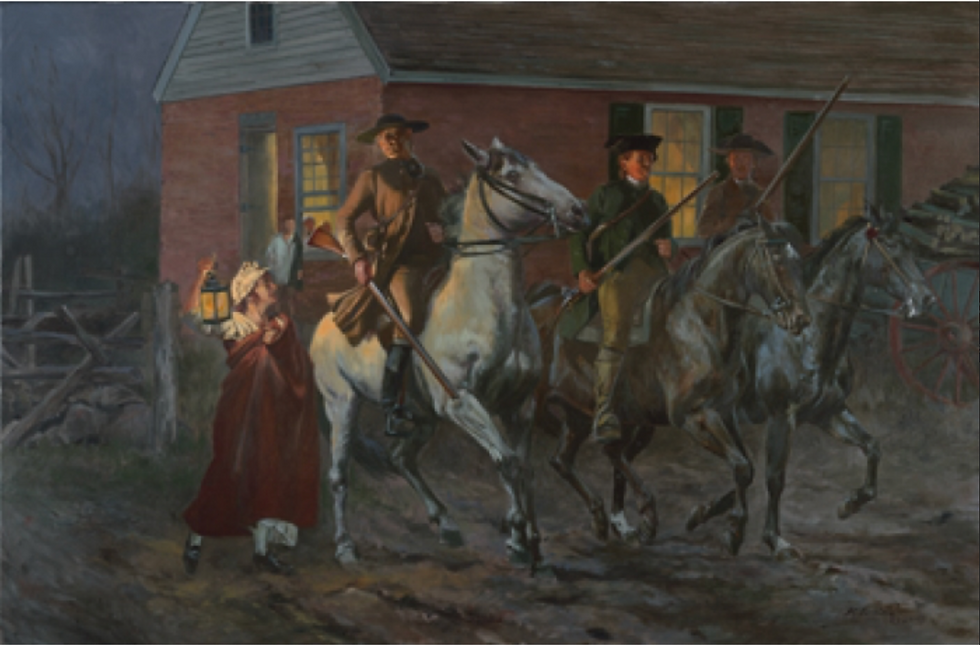
Don Troiani painting
Troiani included a description for his for his painting titled Departure of the Minutemen, Westford Responds that includes one of our cousins. His description reads:
In the pre-dawn hours of April 19th, 1775 an alarm was spreading through the Massachusetts countryside that British regulars were on the march towards Concord.
As the word reached Westford and the other surrounding towns, men grasped their muskets and swords, said goodbye to their loved ones, and rushed to the call to arms. In advance of the rest of the Town of Westford's Minutemen and Militia companies, three men left that morning on horseback for the ten mile trek to Concord. Sgt. Joshua Parker (3C7X) said goodbye to his wife Hannah, while his three children Joshua Jr., Mary, and Patty, awoken by the commotion looked on, probably not understanding the gravity of what was to come. All three men said goodbye and rode off, not knowing if or when they would return, or that they would be witness to great events soon to come that day in Concord, and along the road back to Boston.
Don Troiani is a contemporary artist who specializes in U.S. military history. His Departure of the Minutemen was painted in 2010. He no doubt got his information on Joshua Parker from the History of the Town of Westford by Edwin Hodgman in 1883.
Next up: The British retreat back to Boston


Comments