
COUNTY YORKSHIRE

It's a small world after all ~ The Sherman Brothers

a slight detour back to jolly old England
So far, we haven't delved very far into our English roots. An exception should be made for this county called Yorkshire from which so many of our relatives hailed.
Unlike most counties in Great Britain, which were divided into hundreds, Yorkshire was divided into three large ridings and then into numerous wapentakes within each riding. Our ancestors lived in East Riding in a collection of villages, all within a 15 mile radius of the town of Rowley. These vilages were Gilberdyke (Swan), Howden (Haseltine), Cottingham (Stickney) and Holme Upon Spalding Moor where we can trace our family back to the 1400's.

Holme Upon Spalding Moor
Holme-Upon-Spalding-Moor is a village named for its location on the Spalding Moor. Holme is a Danish word meaning island. At one time, Spalding Moor was a boggy marsh with a single hill where a church was built in the 13th century. The town was built on the "island" surrounding the church. Though the Moor has been largely tamed, All Saints Church stands today pretty much alone on its beautiful pedestal.

Our earliest ancestor from Holme, William Sotheron (16GGF), was born there ca. 1438. Most probably he and his descendants for many generations worshiped at All Saints. It wasn't until the Puritan movement in the early 1600's that Reverend Ezekiel Roger's Church in Rowley must have become more attractive to them.
Through the 17th and 18th centuries, the main occupation for people in Holme was growing and dressing hemp. This was the industry carried over to the New World that made Rowley, MA renowned for cloth manufacturing.
our Holme families
Most of the information about our relatives from Holme-Upon-Spalding Moor have been gleaned from wills. From the information in these wills, five families emerge as the major players with three minor families tagging along:
The Sotherons with William (16GGF) the patriarch born ca. 1438.
The Brighams with Thomas (16GGF) born ca. 1475.
The Millingtons with Thomas (16GGF) born ca. 1460.
The Crosbys with Thomas (14GGF) born ca 1505.
The Watsons with John (15GGF) born ca. 1672
For generations, these five families intermarried amongst each other with a few Lamberts, Elithorpes and Barkers thrown in for good measure. Later, factions of the Brighams, Crosbys, Lamberts, Elithorpes and Barkers would make the journey across the ocean in the 1630's to settle in Rowley, MA.
Note: All of the following took place during Grandpa William Sotheron’s lifetime:
In 1461 Henry VI was overthrown by Edward IV
In 1470 Edward IV was overthrown by Henry VI
In 1471 Henry VI was put in the Tower of London and probably killed by Edward IV
In 1483 Edward IV died of natural causes
In 1483 Edward V (13 years old)) succeeded his father to the throne
In 1483 Edward V and his brother were put in the Tower of London and probably killed
by their uncle who became Richard III
In 1485 Richard III was killed on the battlefield by Henry VII who took the throne
The year William Sotheron died, 1509, Henry VIII succeeded his father to the throne.
The conflict between 1461 and 1485 was known as The War of the Roses

the Brighams from Holme
The earliest Brigham record found in Holme Upon Spalding Moor is for Thomas Brigham (16GGF), born about 1475. If you've seen Downton Abbey, you may understand something of the manor system that existed in Britain for many generations. If not, a small explanation: Manors were large land partitions where the legal and economic power rested in the lord of the manor. The manor house and church were the heart of the community. Lesser beings lived in wooden huts or stone houses. They worked the land and paid rent and other subsidies to the lord.
One such lesser being was our grandfather Thomas Brigham (16GGF). According to the 1528 rental rolls for the Manor of Holme, Thomas held "one toft, an orchard, a barn, a close called Leyre Pytts, and half a bovat of land called Salvan Lands, etc..." He paid the manor lord 14s. 8d. yearly for rental of the property.
For the same year 1528, Thomas' son, also named Thomas (15GGF) born about 1500, is shown on the rental rolls as Thomas Brigham, Jr. For that year, Thomas, Jr. held "a cottage formerly in the tenure of William Armytts, three butts of arable land in Tathom, a flatt of arable land of five acres above Rowley, etc." His yearly rental was 5s. 8d.
By the mid-1600's, the rental system had changed in Holme Upon Spalding Moor. The wills of the Brigham men from that time show them finally as landowners!
a genealogical rarity
It was truly a small world in old Holme Upon Spalding Moor. We have a perfect example of this in our grandmother, Constance Brigham (11GGM), whose mother and father both had ancestry lines leading back to the same great-grandfather, William Sotheron (16GGF). That meant that William Sotheron was Constance's 4th great-grandfather AND her third great-grandfather. And that makes William's daughter Agnes both our grandmother (16GGM) and our aunt (16A). Similarly, William’s son Robert is both our grandfather (15GGF) and our uncle (16U).
On the chart below, the lineage descending from Agnes (below William on the right) leads to Thomas Brigham (12GGF), Constance's father. The lineage descending from Robert (bottom, left of William) leads to Isabel Watson (12GGM) Constance's mother. Note that Agnes' line takes four generations to reach Constance while Robert's take only three.

Gilberdyke, Howden and Cottingham
Only six miles separate Gilberdyke from Howden. The Swans from Gilberdyke and the Haseltines from Howden were definitely known to one another. Robert Haseltine (11GGF), father to the emigrant brothers, Robert (10GGF) and John (11U), married Joanna Swan (11GGM) 6 Jul 1606. They were married at St. Michaels in Eastrington, the church that served both Howden and Gilberdyke. We know that the original St. Michaels was standing in the 11th century because it was mentioned in the Domesday Book, a survey of England ordered by William the Conquerer in 1086. Most of the existing building today, however, is from the 14th century.

the genealogical rarity strikes again
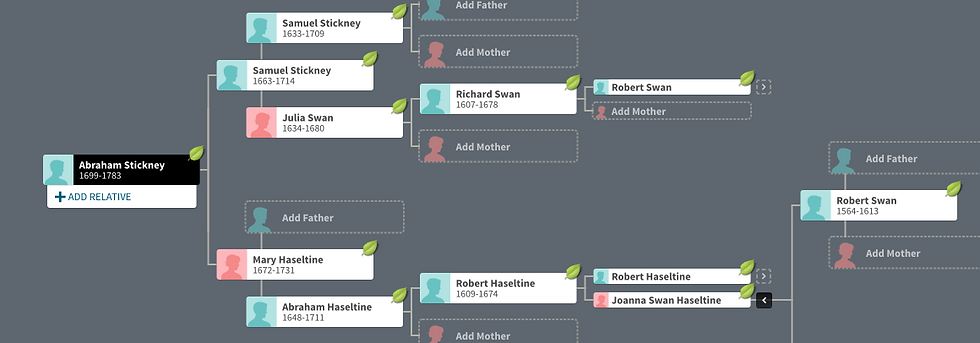
As it happens, I've found three instances of this genealogical rarity in our family. The third will have to wait for another post. This one begins in Yorkshire with Robert Swan (11GGF), father of Joanna Swan Haseltine (10GGM) and ends in America with Abraham Stickney (7GGF), descendent of the Cottingham Stickneys. Robert is Abraham's 2nd and 3rd grandfather.
In the tree below Robert Swan, born 1564, is shown twice on the tree as head of the two branches. Richard Swan and Joanna Swan Haseltine are brother and sister, both our grandparents and aunt and uncle. The bottom lineage takes four generations to reach Abraham Stickney while the top lineage takes only three.
beautiful Yorkshire
Many people believe that Yorkshire is the most beautiful county in England. I would find it hard to disagree. We began this journey back to lovely Yorkshire with a photograph of the wolds and we'll leave it with a painting of the wolds by artist David Hockney.
Note: The wolds are an upland area of open country


Comments