
IN MAINE
- westmohney

- Jun 12, 2022
- 9 min read
Updated: Jan 1, 2023
Tuesday morning the eastern Indians...did yet join with the French, and in a very perfidious and barbarous manner committed many grievous outrages & massacres upon ye poor people...
~ From the journal of John Pike
a dangerous place to live
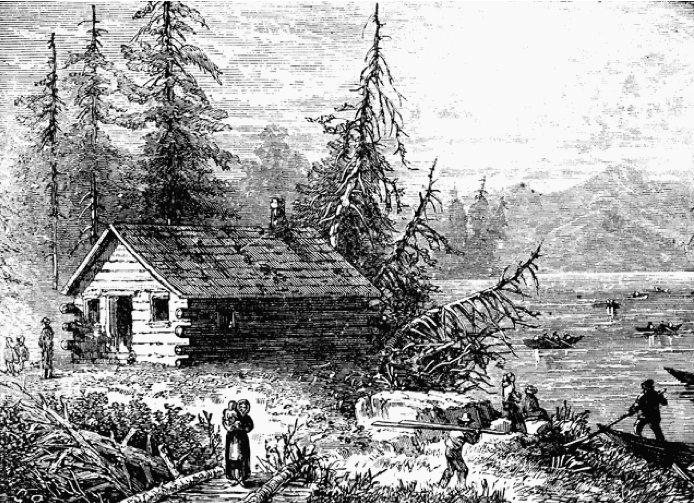
Maine, positioned so far northerly as it was, had a tough road to hoe in all of the wars the English waged with French and their Native allies. Our Littlefield family suffered during those years, as did most of their neighbors and friends. King William's War, begun in 1692, took place, for the most part, in Maine.
In 1694, two years into the war, the town of York, ME was attacked. Our cousin Mary Littlefield Austin (1C11X) was living in York with her husband, another cousin of ours, Matthew Austin (2C11X). In the attack on the town, the Austin's daughter, Mary Austin (2C10X), was taken captive. In our last post, we wrote extensively about the fate of English captives taken to Canada. Nine year old Mary, like so many others, never returned to her home in New England.
In 1708, our cousin Josiah Littlefield (1C11X), an uncle of Mary Austin, was captured. When he arrived in Canada, he was able to visit with his niece. Josiah sent word back to the family that "Mary Austin of York is well."
In January of 1711, Captain John Livingstone made yet another expedition to Canada in an attempt to redeem the English subjects still being held there. A list of captives made at that time has Mary's name on it. By this time, she was firmly entrenched in Canada. A year ealier, she had married Etienne Gibau and the couple had an infant daughter. That Mary was in close contact with other English captives is proved by the fact that our cousin Freedom French (2C9X) of Deerfield was one of the witnesses at Mary's wedding.
Mary and her husband Etienne went on to have eight more children. 1722 was a rough year for the Gibaus. Three of their children died that year at ages ten, six and two. Mary died in 1755 at 69 years of age.
Another of our Littlefield cousins captured and taken to Canada was Barsheba Webber (2C10X). Barsheba was the daughter of Samuel and Deborah Littlefield Webber (1C11X). The only information we have about Barsheba comes from the research done by Alice Baker and Emma Coleman. In Emma Coleman's extensive book, there is a only a question mark for the date Barsheba was captured. Most probably she was taken during the French and Abenaki Northeast Coast Campaign of 1703, also known in Maine as the "Six Terrible Days." Barsheba was baptized into the Catholic religion in 1714 and given the name Marie. In 1720, she married Joseph Saleur. Like Mary Austin, Barsheba had some sadness in her home life She and Joseph had six children born to them. Four of these children died in the same year as their birth.
the attack on Wells
The story of our cousin Moses Littlefield (1C11X) is a tragic one. Moses was the grandson of our immigrant grandfather Edmund Littlefield (11GGF), who has become known known as the "father of Wells, ME." In 1687, Moses and his paramour, Martha Lord, were "presented" by the Court for fornication. The couple wed shortly afterwards and their first child, Moses, Jr. (2C10X) was born the same year. Three more children were born to them over the next eleven years, Aaron (2C10X) in 1694, Tabitha (2C10X) in 1696 and Ruth (2C10X) in 1698.
The Littlefields were living quietly on their plot of land when the tragedy known as the "Six Terrible Days" struck in 1703, one year after the beginning of Queen Anne's War. From the journal of John Pike of Dover, NH, about 20 miles south east of wells:
"1703, Aug 10 About 9 or 10 oclock Tuesday morning the eastern Indians (notwithstanding ye many solemn and newly Repeated protestations of Continuing peace wth the English) did yet join with the French, and in a very perfidious and barbarous manner falling upon the eastern parts from Casco to ye East end of Wells committed many grievous outrages & massacres upon ye poor peo: Killed to the number of 73. Captivated to the number of 95."
Note: Pike mentions the protestations of peace by the Natives with the English. He fails, however, to mention the numerous Treaty of Ryswick violations that had been committed by the English in the six years following King William's War.
Thirty nine of those captured were from Wells: "The enemy sallied forth from their ambuscades, and killed or carried away thirty-nine of the inhabitants. The horrors of that day cannot be depicted. Families were broken up. Husbands, wives, or children were taken from the home circle."
the captives
Moses' wife Martha and three of their children were taken captive by the Abenaki in the attack on Wells. Only the oldest son, Moses, 15, was spared along with his father. At the time of their capture, Aaron was nine years old, Tabitha, seven and Ruth five. All four were forced into a 300 mile trek to Montreal. If there was any luck at all to this sad event, it was that it happend in August. The long march to Canada would not have included freezing weather.
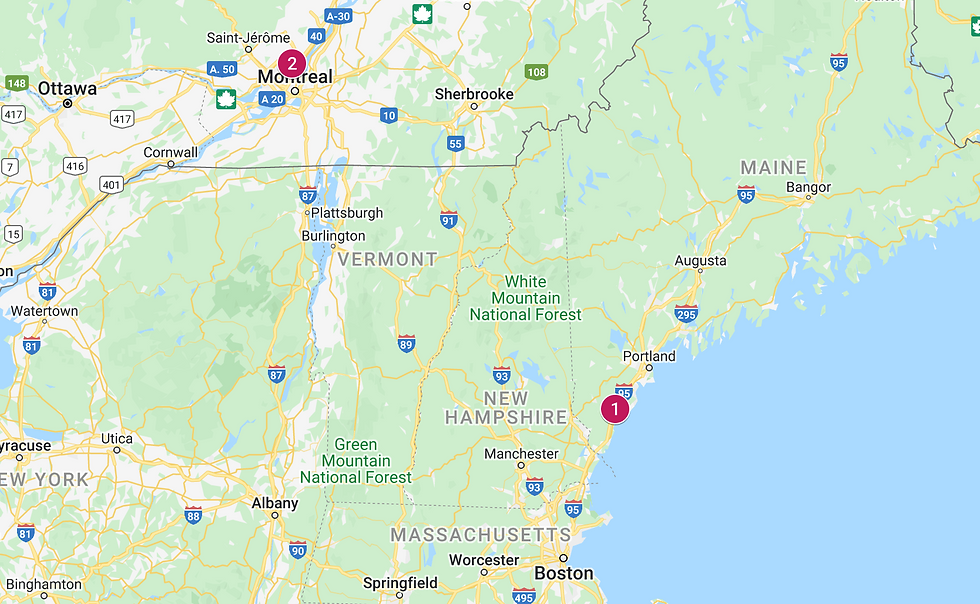
Four diffrent fates awaited the Littlefield captives. The only one who was redeemed and returned to Wells was Martha. We know that she was back in Wells by 1708. The children all fell into that desireable "golden age range" and never returned to New England.
Because of the detailed records kept by the French, we know the fates of Aaron and Ruth. Aaron was sold by the Abenaki to a French priest of Boucherville, a village near Montreal. Ruth was raised by nuns in Montreal, eventually serving at the Hotel-Dieu hospital. Tabitha is believed to have been kept with an Abenaki tribe.
Aaron's story
Cousin Aaron was "converted" and baptized into the Catholic Church only months after his arrival in Canada. His patron was Rudolphe Guybert de la Saudraye, curé de Bourcherville. With his baptism, Aaron recieved the new name of Pierre Augustin. From parish records:
Jan 27th 1704 Monsieur Meriel Priest of the Seminary of Ville Marie in presence of me, the undersigned Priest, curé of Bourcherville, baptized in the Parish church of the Holy Family of Bourchervill Pierre Augistin Littlefield aged about 9 years, born at Wels in New England 20 Oct 1694 of the marriage of Moyse Littlefield and of Marthe Lord his wife, inhabitants of the said new England...His godfather was Pierre Boucher, ecuyer, Seigneur of Boucherville. His godmothr was Madlle Charlotte Denys wife of mer Bourcherville. They all signed with me R. de La Saudraye
Five years after Aaron's arrival in Canada, Joseph Bartlett, who was captured at Haverhill in 1708, saw Aaron at Fort Chambly, near Montreal. Fort Chambly was where all new captives were "processed." Bartlett was able to spend a few hours with Aaron but no details remain of their conversation.
In 1710, at age 16, "Pierre Augustin Littlefiere" was naturalized as a Canadian citizen. His parents, however, had never given up hope that he would be returned. In 1714, when a prisoner exchange was being arranged between delegates from Massachusetts and Governor de Vaudreuil of New France, Aaron's name was mentioned as a possible exchange candidate. The governor sent for him. Aaron evidently told the governor that he wanted to go back to Wells. Captain Thomas Baker began making arrangements for his return, supplying him with English clothing. But the curé was not willing to let his ward get away so easily. According to Baker's report, "before his (Aaron's) departure came the priest of Bushervil (with home he dwells) while Captain Baker was absent, he took off the boy's clothes and prevailed with him to stay..." Governor de Vaudreuil, in an attempt to convince the boy to go back to New England, had Aaron come to his own home for a time but "it was then too late; the same priest (who then took the pains to come to Quebec with him) had made too thorough work with his proselyte."
So Aaron stayed in Montreal and, on 3 Feb 1717, "Pierre Augustin Lidfril married at Boucherville Marie Brunel of Varrennes..." He was twenty-three years old at the time of his marriage. Pierre and Marie settled in the village of Saint Mathias, thirty miles east of Montreal. The couple had seven children. Sadly, the first three did not live long. Pierre Lidfil, Jr. (3C9X) lived only three days, Marie-Joseph (3C9X) died at five months and Marie Anne (3C9X) died at twelve years. The other four children married, had large families and much of their progeny live in Canada to this day.
Ruth's story
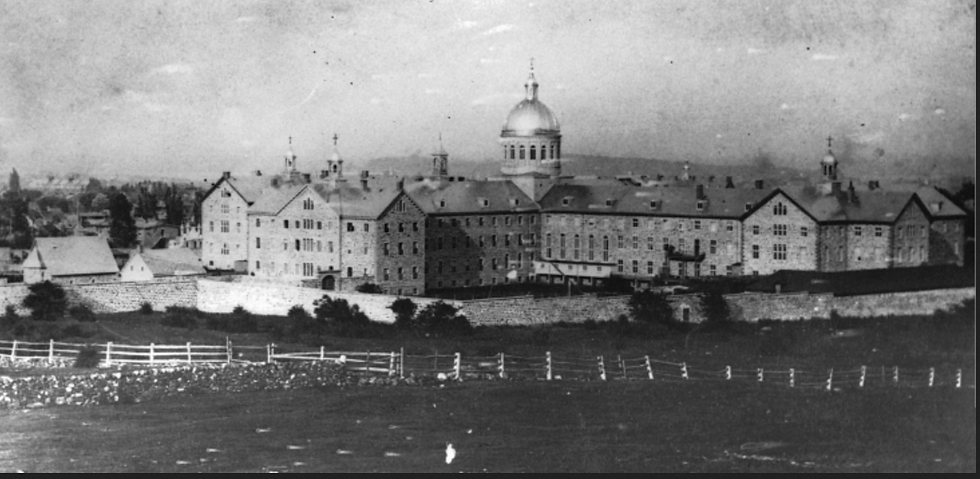
Little is known of Ruth's early life in Montreal. Most probably she was taken in by nuns and converted to the Catholic Religion. While many young female captives later married and had families in Canada, some either chose or were forced into a life of service to God. A life serving God turned out to be Ruth's fate. She became Sister Angélique, a nursing sister at the Hôtel-Dieu hospital in Montréal. Ruth contracted smallpox at the hospital while caring for patients who had the disease. She was only thirty-three years of age when she died.
Tabitha’s story
According to Emma Coleman, it was initially believed that Tabitha had been killed shortly after the attack on Wells. One day, however, a cousin of Tabitha’s (and ours), Abigail Littlefield Harding (1C10X), was trading with some Natives. Abigail related that "a young squaw who was standing near asked if she did not remember Tabitha Littlefield and immediatley darted from the house…” Though the family tried to find her and even tried bribing the Natives for her safe return, Tabitha was never seen again. Emma Coleman wrote that she “probably preferred the wild life.“
coming home to claim what’s his
Moses Littlefield, who never saw any of his three children again after their capture, died
in 1714. His wife, Martha, who had been redeemed from her captivity in 1708, married twice more after Moses’ death. She died intestate in 1726.
Twelve years after his mother's death, Aaron, returned to Wells to claim his part of her estate. In 1738, he filed suit in the county of york "to recover Possession of one Seventh Part of a Certain Tract or Parcel of Land with ye Edifices & appurtenances in Berwick."
New England had strict laws concerning those of the Catholic religion. When the case finally went to a jury, their verdict was that "a Papist Cannot by Law maintain an action for ye Recovery of a real Estate.” To add insult to injury, Aaron was ordered to pay all court costs. Undaunted by the verdict, Aaron appealed. He must have chosen a very good attorney. His attorney argued that there was no proof that Aaron was a papist and maintained that he was "now a Protestant." It seems unlikely that Aaron would have been allowed by the French to revert back to his former religion, but his attorney must have been quite convincing. Aaron won his suit and claimed his property.
Aaron died in 1761 and is buried with his wife in St-Mathias.
Littlefield Tavern
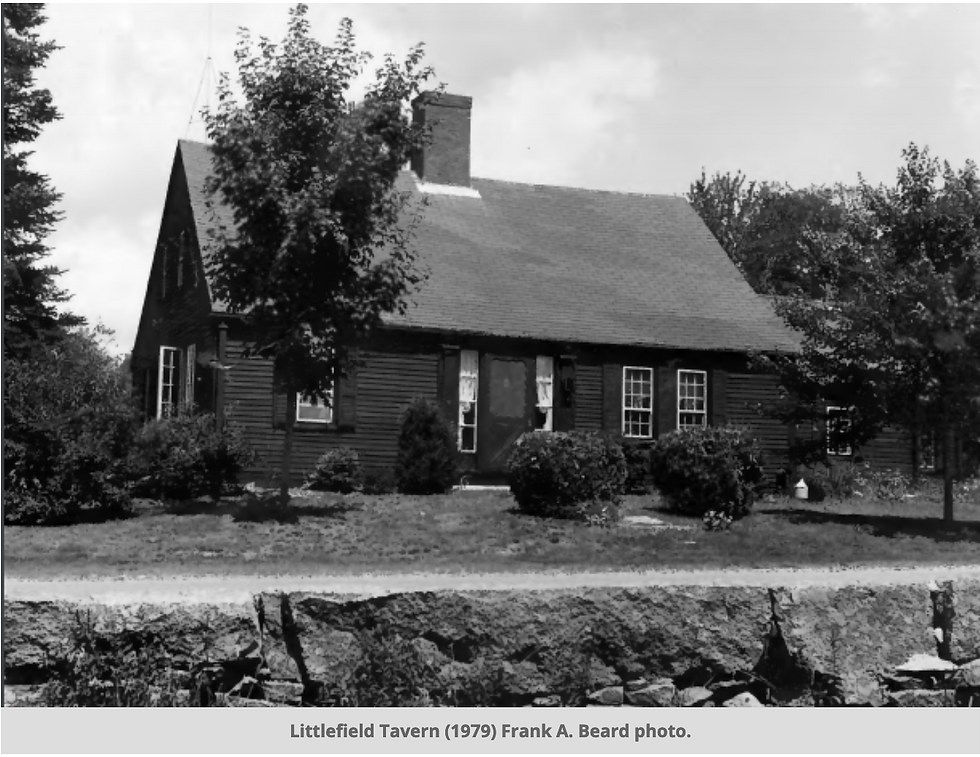
Our grandfather, Francis Littlefield, Sr. (10GGF), operated a tavern in Wells. Like grandfather, like grandson. Francis' grandson, Captain James Littlefield (1C10X) built a house in 1735 which he turned into a tavern. And like another of our tavern owner cousins, Simon Crosby (1C12X) of Billerica, James owned slaves to help him run his tavern and farm. Below is a picture of the home taken in 1979 and another of the restored house as it looks today.

a tragic accident
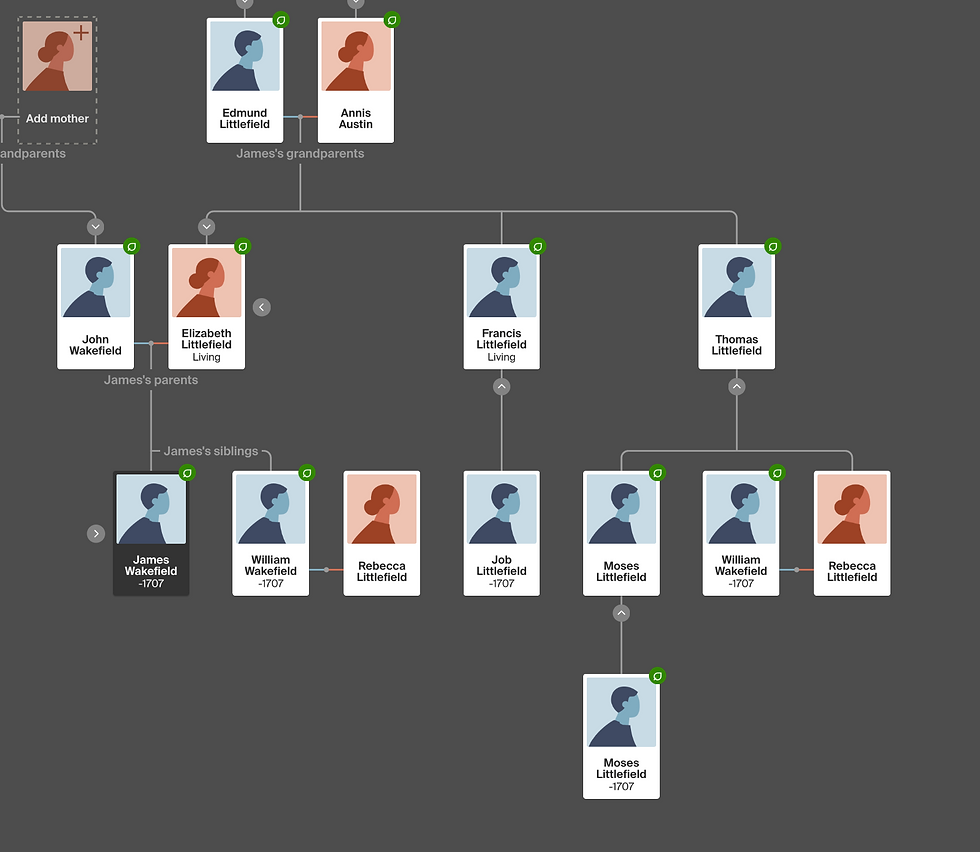
In 1707, two of our Wakefield cousins, James (1C11X) and William (1C11X) were drowned in a tragic boating accident. Also drowned in that accident were two of our Littlefield cousins, Job (1C11X) and Moses (2C10X). The easiest way to show the relationships of these four men is with the tree chart below. The Wakefield boys were sons of our aunt Elizabeth Littlefield Wakefield (10A). Job, the son of Elizabeth's brother Francis, Jr. (10U), was a first cousin of James and William. Elizabeth's brother Thomas (10U) had a daughter, Rebecca (1C11X), who was married to the unfortunate William Wakefield who drowned. Rebecca's brother Moses (1C11X) had a son, Moses, Jr., who was with his cousins that day and also drowned. At the time of their deaths, James was 40, William, 33, Job, 33 and young Moses only 20.
An account of the accident in the History of Wells, Maine by... says that the four cousins and a friend "went out in a small sloop to fish, there was a heavy sea at the bar, and as they attempted to drive the sloop over it, she was upset and all were drowned, bodies of four were recovered. These men were all valuable citizens and their aid was greatly needed."
Coincidentally, James, William and Job had all lost their fathers at an early age. At the time of the accidently all parents of the men, except for Moses, had died before he accident. Our cousin Rebecca lost her husband, her nephew and two of her cousins that day.
The Wildes Brothers
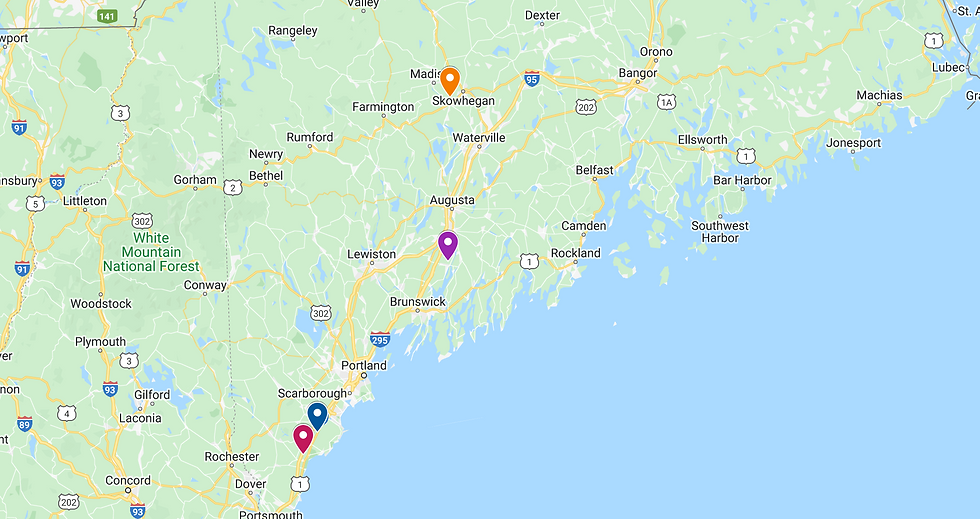
In 1722, Massachusetts mounted an attack on the Native village of Norridgewock in Maine. The attack was a second attempt to kill Father Râle, a Jesuit priest believed to be inciting the Natives to violence. Included in the Norredgewock expedition were our cousins Samuel (1C8X), Ephraim (1C8X), Jonathan (1C8X) and Jacob Wildes (1C8X) of Topsfield, MA. The Wildes brothers were sons of our aunt Mary Howlett (7A) and her husband Ephraim Wildes of Topsfield. You may remember Ephraim's sad task of arresting his mother Sarah Averill Wildes who was later hanged for the crime of witchcraft.
The brothers gathered with the rest of the English force at Fort Richmond and made their way up the Kennebeck River to take part in the battle. There were about 160 Abenaki Natives at the village when the English attacked. Father Râle was killled almost immediatly. About thirty Abenaki warriors engaged in the battle to allow the women and children to escape. Most of the defenders were killed and the English even fired on families attempting to escape in canoes. The surviors moved north, abandoning the village of Norridgewock.
After the battle, the four Wildes brothers were released from the militia. On their way home to Topsfield they stopped to visit their sister, Mary Wildes Perkins, (1C8X) who had moved to Arundel, Maine with her husband some years before. The brothers "were so besotten" with the area that all four purchased property there and Maine is where they spent the rest of their lives. Arundel is only nine miles from Wells, ME, so the Wildes and Littlefields most probably came together in various ways over the years.


Comments