
IN NEWBURY
- westmohney

- Apr 6, 2022
- 11 min read
It takes an endless amount of history to make even a little tradition. ~ Henry James
Cousin Abraham Adams and the Great Snow of 1717
Our cousin Abraham Adams (2C9X), great-grandson of the immigrant Robert Adams (10GGF) , was born in Newbury in 1697. He may have faded into obscurity except for a romantic story written by Joshua Coffin in his History of Newbury:
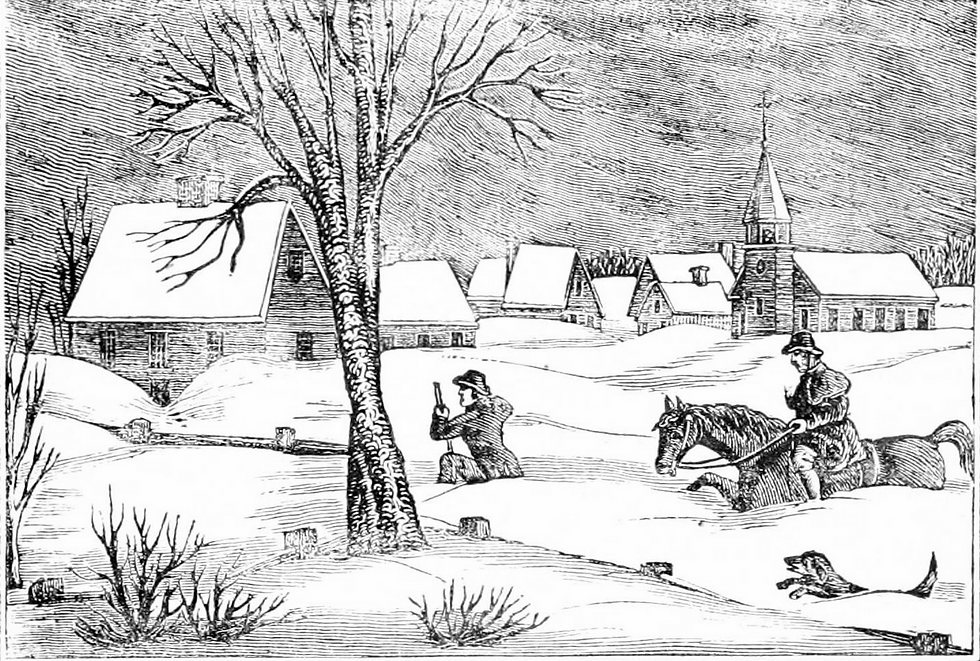
1717: This year is rendered memorable, by the unusual quantity of snow, which fell on the twentieth and twenty-fourth of February. In these two storms, the earth was covered with snow, from ten to fifteen feet, and, in some places, to twenty feet, deep. Many one-story houses were covered, and, in many places, paths were dug, from house to house, under the snow. Many visits were made, from place to place, by means of snow shoes, the wearers having first stepped out of their chamber windows, on these excursions.
Love, we know, 'laughs at locksmiths,' and, of course, will disregard a snow-drift. Tradition informs us, that a Mr. Abraham Adams, wishing to visit his “lady love,” Miss Abigail Pierce, mounted his snow shoes, took a three-mile walk, for that purpose, and entered her residence as he left his own, namely, by the chamber window. He was the first person the family had seen from abroad, for more than a week.
The story seems unlikely as the "lady love" mentioned was actually Abraham's wife. The couple wed in December of 1716, two months before the occasion of the giant storm. Below is a copy of their marriage intention recorded in September of 1716:

The story of Cousin Abraham might be mere fabrication, but the storm was certainly not.
The snowfall of February 1717 was legendary. Cotton Mather declared it to be “as mighty a snow as perhaps has been known in memory of man.” The storms began in January of that year and by early February the drifts were as high as anyone had ever seen in those parts. But the worst of it hit on February 27th and continued until March 7th.
Life in New England was impacted in many ways from the heavy snowfall. Livestock as well as wildlife suffered. Farmers spent weeks digging out dead cows, sheep, chickens and pigs. Some livestock miraculously survived and, after being unearthed, were nursed back to health. The deer population drastically declined. Some estimated as much as ninety percent of the deer succumbed to the cold.
Everything slowed to a crawl during those frigid months and some roads, like the Post Road from Newbury to Boston, remained impassible until the middle of March. Mail carriers, however remained true to their creed: "Neither snow nor rain nor heat nor gloom of night stays these couriers from the swift completion of their appointed rounds." The great snow may have delayed the mails but, with the help of snow shoes, the mail carriers persevered.
Cotton Mather, a prolific chronicler of his times, wrote an eloquent account of what he witnessed:
That vast icicle, glittering so cheerlessly in the sunshire, must be the spire of the meeting-house, incrusted with frozen sleet. Those great heaps, too, which we mistook for drifts, are houses, buried up to their eaves, and with their peaked roofs rounded by the depth of snow upon them. There, now, comes a gush of smoke from what I judge to be the chimney of the Ship Tavern; and another—another—and another—from the chimneys of the other dwellings, where fireside comfort, domestic peace, the sports of children, and the quietude of age are living yet, in spite of the frozen crust above them.
It's no wonder that for generations afterwards, it became common in New England to refer to events as having occurred either before or after the great snow.
Uncle Abraham's estate
Another Abraham Adams (9U), our Uncle Abraham, was the son of the immigrant Robert Adams. While Abraham did not inherit his father's homestead, he did inherit some property from his father and, over the years, was able to amass extensive land holdings.
Abraham probably died intestate as, after his death, his ten children did something rather unusual. They made an agreement amongst themselves for an equitable division of their father's estate. The agreement began: "We, the subscribers, children of our honored father, Abraham Adams...do mutually agree upon and make the following division of said estate to and among ourselves, in full settlment therof." The document was signed by all ten children.
From the division of land in the agreement we find that Abraham owned property in Newbury (1), Haverhill (2), Kent's Island (3), Plum Island (4) and along the Merrmack River (5).
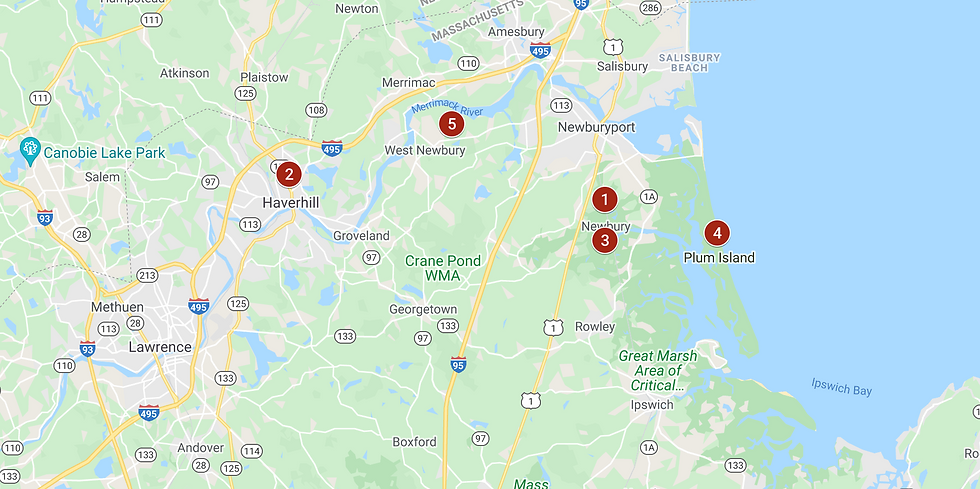
Abraham had seven sons, all still living at his death. The property named above was divided among six of his sons and considerable amounts of cash went to the three daughters. Abraham's second son, Abraham Jr. (1C10X), however, was the recipient of a special piece of land that his father had purchased in 1705 in that part of Newbury that would become known as Byfield.
Cousin Abraham Adams, Jr.'s house
Uncle Abraham's son, Abraham, Jr., chose the adventurous life of a sailor, eventually becoming captain of his own ship. According to John Lewis Ewell in The Story of Byfield, "He was an enterprising sea captain, who launched coasters from the river in front of his house." That river would have been the Merrimack (shown in the map above) which emptied into the ocean at Newburyport. Abraham made voyages to both the West Indies and England.
In 1703, when he was twenty-six, Abraham gave up his sea-faring life and married Ann Longfellow whose father was an ancestor of the poet Henry Wadsworth Longfellow. Ann came from a wealthy, renowned family. Her uncle on her mother's side was Judge Samuel Sewell. Judge Sewell had become well-known in Massachusetts not only for his role in the Salem witch trials, but also for a written confession apologizing for his part in that entire debacle. The minister of the Boston Church read Samuel's apology in front of the entire congreation stating that Sewell "Desires to take the Blame and shame of it, Asking pardon of men, And especially desiring prayers that God, who has an Unlimited Authority, would pardon that sin and all other his sins."
Samuel Sewell was also one of the earliest colonial abolitionists. In 1700 he wrote a treatise called The Selling of Joseph, which is believed to be the earliest anti-slavery tract published in what would become the United States. Sewell believed that "Liberty is in real value next unto Life: None ought to part with it themselves, or deprive others of it...man-stealing as an atrocious crime which would introduce among the English settlers people who would remain forever restive and alien..."
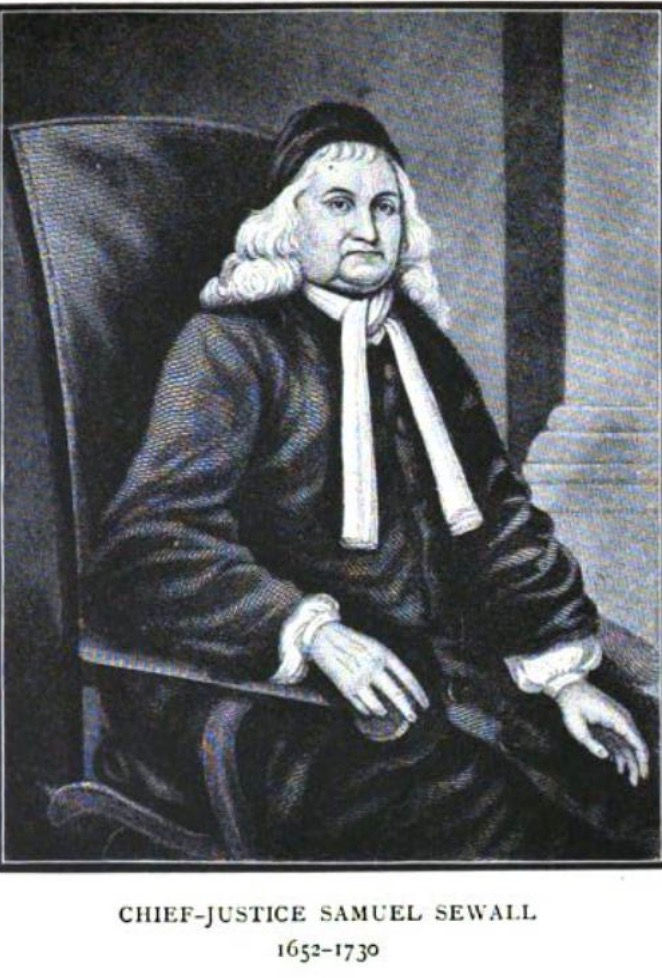
Judge Sewell owned property in the Byfield section of Newbury which he sold to our uncle Abraham Adams, Sr. in 1705 for £500. Sewell's stipulation in selling the property was that it be given to Abraham, Sr.'s son, our cousin Abraham, Jr. who had married the judge's niece, Ann Longfellow. Abraham Sr., true to his word, deeded the property to his son who built a home there sometime between 1705 and 1707. That property is now known as the Highfield Estate in Byfield.

Today, the house that Abraham, Jr. built is listed on the National Register of Historic Places. It holds the original deeds of the estate and two chairs which belonged to Ann Longfellow. Additionally, visitors to the house will find spinning wheels, warming pans, china, a sword used at the battle of Bunker Hill and the diary of Josiah Adams (3C8X) whose papers on the Revolutionary War are held in the Peabody Essex Museum in Newburyport. Cousin Abraham died in the home he had built at the ripe old age of 86.

Note: Abraham, Jr's. son, Abraham III, was a tanner in the town of Rowley, MA. Sadly, when he was fifty-six, "his mind became unsound and he hung himself in the entry of his house..." Luckily, his father did not live to witness that tragic event.
the First Presbyterian Society of Newbury
Our cousin Abraham Adams, Jr. had another son, Joseph (2C9X), who attended Harvard College in 1742. Joseph was ordained to the ministry that same year and immediately became embroiled in a church revival in his hometown of Newbury that "ranked among the most powerful, acrimonious, and best-documented ecclesiastical tumults in early American history."
This tumult was related to what became called "The Great Awakening," a movement begun in the 1740s by revival style clergy who were fighting for the "free expression of religion." These "boisterous and often fractious religious revivals" were sweeping through the colonies. Our cousin Joseph, not your average Puritan preacher, joined this movement.
In A Historical Disiscourse commemorative of the Organization of the First Presbyterian Church in Newburyport, Jonathan F. Stearns writes about our cousin Joseph and his role in furor:
Meanwhile, a young man from the neighboring parish of Byfield, Joseph Adams, a graduate of Harvard University, and a very recent convert, began to exhort and hold meetings in the vicinity. He was a man of great fervor and zeal, and having entered upon the work he had undertaken with all the earnestness of sincerity, and the freshness of youthful devotion, he charmed and melted by his preaching the hearts of multitudes, who regarded him, in the language of one of his adversaries, as 'some great one, the mighty power of God.
Stearns went on to say that the "imprudent zeal of the young preacher led him to commit some indescretions." Evidently Joseph "scandalized" the town when he decided that the minister of the Newbury Church at the time, Thomas Barnard, was "peculiarly deficient in ministerial qualifications..." Joseph wrote a letter to Barnard "calling him an opposer of this blessed reformation..." and ended by telling the minister that he could either convert or be "frowned into Hell" by God. The letter, meant to be private, was immediately published in the newspaper with a rebuttal of "no less severity" by the offended minister. So began the ruckus.
In spite of Barnard's rebuttal to Joseph's letter "the confidence of the friends of the young preacher (Cousin Joseph) appears to have remained unabated..." But the argument between the two ministers began a "powerful, acrimonius" division in the congregation of the Newbury faithful. Joseph's father Abraham, Jr. supported his son wholeheartely, complaining that " the Brethren of the Chh (church) are against opening the Meeting House Doors to Such men as he thinks are faithful Preachers of the Gospel..." Joseph's brother Samuel chimed in with his claim that "I generally find the Lord graciusly visits me under the Means of Grace used in the new Congregation of Christians."
Note: Samuel would later repent of his words and seek readmittance to the Byfield Church.
The family of Joseph's mother, Ann Longfellow Adams, were not so supportive. Ann's brother and cousin believed that the "doors to the pulpit" should be closed to men like Joseph whose "conduct served to distub the Peace and Edification of the Chhs in alientating the minds of the People from their setled Pastors." The Longfellows and others worried that these "new light men," as they were called, were actually doing the “secret work of Corruption & Temptation by the Wicked one.” In their minds, the "new light men" were nothing more than “busy men of unstable & unsound minds & disorderly practices”
The two churches in Newbury now found themsleves in complete upheaval. The powerful schism resulted in large numbers of both congregations leaving their former places of worship to follow their "fiery young leader," Joseph Adams, to a new meeting house built especially for his ministry. But fickle Cousin Joseph, after creating so much mahem, only remained in Newbury, preaching to his "separatists," for two more years. In 1746, he left for the greener pastures of Stratham, New Hampshire, where he begin a new ministry.
Joseph's work in Newbury, however, had not been in vain. When Reverend Jonathan Parsons came to take Joseph's place, Parsons was instrumental in getting a new church built in Newburyport. An assesment of parisioners in 1748 show that the schism caused by Joseph led at least forty percent of the old congreations to embrace his "new light church."
By the days of the American Revolution, the Old South Presbyterian Church, as it became known, had blossomed into one of the largest and wealthiest religious congregations in New England. The story of the founding of the First Presbyterian Society of Newbury is just one of many that were unfolding in New England during the eighteenth century as the populace began slowly but surely shedding the Puritan yoke.
The bell in the clock tower of the Old South church was cast by Paul Revere.

Cousin Joseph died in Shratham at age 66 with the reputation of being "a remarkably good man."
Joseph Greenleaf, slaveowner
As we learned in our Slaves in Billerica post, slave owners in New England belonged mostly to the wealthy class. Our cousin Joseph Greenleaf (4C7X) fit right into this category. Joseph, who lived in Newbury, had a lot in common with our cousin Simon Crosby (1C12X). Both were innholders and both owned African slaves.
We learn from Joseph's will that, at the time of his death in 1735, he owned four slaves, Nancy, Robin, Dinah and Cate. They were included in the inventory of his property. Robin was worth £100, Nancy, £60 and Dinah, £40. Cate was probably a child as she was valued at only £5.
Joseph's total estate was valued at over £3,000. Robin, Nancy, Dinah and Cate were all bequeathed to his wife, Thomasin.
Cousin George Granger
Our aunt Joanna Adams (9A), daughter of the immigrant Robert, married Launcelot Granger in 1654. Some years after their marriage, Launcelot and Joanna moved their family from Newbury to to Suffield, just across the Connecticut border.

The Granger's third son, George (1C10X), was granted a house lot in Suffield which lay next to his father's. He was additionally granted fifty acres of farmland. George waited until he was 35 to marry but, even before the marriage, he had shown himself to be a "shiftless fellow." The only office he appears to have held in town is that of fence viewer.
It turns out that Cousin George's main claim to fame was the number of court battles he was involved in. His troubles started in 1691 when the town found "George Granger of Suffield as being presented to this court for neglecting public worship of God, and petitioning this court pleading his sickness, weakness, and want of clothes this cold winter. This court ordered that the worshipful Colonel Pynchon admonish him."
Perhaps the admonishment worked for a time as nothing more was heard of George for twenty-four years. In that interim, George and his wife Lydia had nine children born to them. In 1716, one year after her last child was born, things hit rock bottom for poor Lydia Granger. That year, the town voted to "see what may be done with respect to the maintenance of the wife of George Granger..." and further voted "To allow Goodman Banes seven shilling for his trouble about keeping the wife of George Granger."
The very next year, hoping to recoup what they had lost, the town voted "To sue George Granger for the money which the town had necessarily expended on his wife or may expend for her relief before process be made in the law thereabout..."
At the time, the Grangers still had six children under 18, the youngest only two. Since no mention is made about the keeping of Lydia's children, we have to assume that either George or other family members were caring for them. The only conclusion we can draw is that Lydia had mental problems of some sort.
By the end of 1717, the town was tired of caring for destitute Lydia Granger and equally tired of trying to get George to pay what he owed. They told twenty-three-year old John (2C9X), oldest son of George and Lydia, that if he would agree to take care of his mother, "the Town will defray all charge that has been passed w/respect to the said Liddia Granger... but if the said John do not speedily do as aforesaid, then to proceed to sue George according to a former vote of the Town."
These attempts to force the husband or son to support the wife and mother might have worked for a while but certainly not long term. Seven years later the Town was again dealing with the "Lydia problem." The Suffield selectmen voted "To allow three shillings a week for the keeping of Liddia," and still later voted "To bare the charge of caring (carrying) Liddia the wife of George to the House of Correction" (poor-house).
Poor Lydia's last appearance as a town charge was in December of 1724. She was forty-nine years old. We can find no date of death for her but imagine that she died in the poorhouse sometime afterwards, sorely neglected by husband and children.
From town records we find that, in November of 1729, "The Town granted William Huxley half a crown for digging George Granger's child's grave." This unnamed child was the son of George Granger's son, George, Jr. (2C9X), proving that the apple doesn't fall far from the tree.
Shortly after the death of this child, the entire Granger clan skedaddled out of Suffield to start over in the nearby town of Simsbury, CT.


Comments