
John Chapman ~ aka Johnny Appleseed
- westmohney

- Jun 5
- 12 min read
So long as his memory lives will a grateful people say: "He went about doing good." ~ Rosella Rice

John's early life
Our cousin John Chapman (4C6X) was born in 1774 in Leominster, MA. He was the third child born to Nathaniel Chapman and our cousin Elizabeth Symonds (3C7X). Elizabeth descended from our immigrant grandfather William Symonds (9GGF) who settled in Woburn. Seven months after John was born, his father marched on the alarm of April 19, 1775 to Lexington and Concord. Beginning in August of 1775, Nathaniel also served three months in Cambridge during the siege of Boston.
In July of 1776, when little John was two months shy of his second birthday, his mother died giving birth to her fourth child. Two days later the newly born child died as well. In 1780, Nathaniel decided to make a move 70 miles southwest to Longmeadow, MA, near the Connecticut border.

In Longmeadow, Nathaniel married for a second time and had ten more children. John lived there with his father until he was 18. Then, with his half-brother Nathaniel, Jr., who was only 11 years old at the time, he set out on a journey west. The newly acquired Northwest Territory had recently opened up for settlement so the brothers traveled to the area that would become the state of Ohio. When John's father brought his family west in 1805, Nathaniel decided to stay with the family and John made his way alone.
becoming Johnny Appleseed
While most stories of the man who came to be known as Johnny Appleseed paint him as an altruistic hippy-type throwing seeds out into the wilderness for people to enjoy, it appears that there was actually method to his madness. We found a somewhat more realistic version of our Cousin Johnny in an article by Nathasha Geiling for Smithsonian Magazine:
On a family farm in Nova, Ohio, grows a very special apple tree; by some claims, the 175 year old tree is the last physical evidence of John Chapman, a prolific nurseryman who, throughout the early 1800s, planted acres upon acres of apple orchards along America's western frontier, which at the time was anything on the other side of Pennsylvania. Today, Chapman is known by another name—Johnny Appleseed—and his story has been imbued with the saccharine tint of a fairytale. If we think of Johnny Appleseed as a barefoot wanderer whose apples were uniform, crimson orbs, it's thanks in large part to the popularity a segment of the 1948 Disney feature, Melody Time, which depicts Johnny Appleseed in Cinderella fashion, surrounded by blue songbirds and a jolly guardian angel.

But this contemporary notion is flawed, tainted by our modern perception of the apple as a sweet, edible fruit. The apples that Chapman brought to the frontier were completely distinct from the apples available at any modern grocery store or farmers' market, and they weren't primarily used for eating—they were used to make America's beverage-of-choice at the time, hard apple cider.
Note: According to Henry David Thoreau, an apple grown from seed tastes "sour enough to set a squirrel's teeth on edge and make a jay scream."
It wasn't that Chapman—or the frontier settlers—didn't have the knowledge necessary for grafting, but like New Englanders, they found that their effort was better spent planting apples for drinking, not for eating. Apple cider provided those on the frontier with a safe, stable source of drink, and in a time and place where water could be full of dangerous bacteria, cider could be imbibed without worry. Cider was a huge part of frontier life, which Howard Means, author of Johnny Appleseed: The Man, the Myth, the American Story, describes as being lived "through an alcoholic haze." Transplanted New Englanders on the frontier drank a reported 10.52 ounces of hard cider per day (for comparison, the average American today drinks 20 ounces of water a day). "Hard cider," Means writes, "was as much a part of the dining table as meat or bread."
There was another reason besides bitter apples for cider that led Johnny to plant his apple trees by seed. It turns out that Johnny was a card carrying member of the Swedenborgian Church whose "belief system explicitly forbade grafting (which they believed caused plants to suffer). Author Michael Pollan had this to say about Johnny's methods:
Really, what Johnny Appleseed was doing and the reason he was welcome in every cabin in Ohio and Indiana was he was bringing the gift of alcohol to the frontier. He was our American Dionysus.
As a loyal Swedenborgian, Johnny did double duty as he traveled around the country spreading not only seeds but also "good news, fresh from heaven." The Church believed in "the oneness of God, the afterlife, a deeper meaning to the Bible, and the importance of living a good life." Notable members incuded William Blake, Ralph Waldo Emerson, Helen Keller and Eliza Tibbets.
Note: Eliza Tibbets was one of the founders of Riverside, California. She was also an activist for progressive social causes such as abolitionism and universal suffrage. She was a spiritualist and often led seances in Riverside. She is probably best know for successfully growing the first two hybrid Washington navel orange trees. The parent tree is still lovingly cared for in Riverside.
From the Washington Apple website:
Johnny Appleseed is described as a man of medium height, blue eyes, light-brown hair, slender, wiry and alert. Folksore has also described him as "funny looking" because of the way he dressed. It is said that he traded apple trees for settler's cast-off clothing. . .He rearely wore shoes, even during the cold of winter. . .another legend says he wore a mush pot on his head as a hat. . .it is more likely he wore someone else's castoff hat or made his own out of cardboard. He rarely sought shelter in a house, since he preferred to sleep on bare ground in the open forest with his feet to a small fire.
Over the years, his requent visits to the settlements wre looked forward to and no cabin door was ever closed to him. To the men and women he was a news carrier; to the children he was a friend.

method to his madness
At the turn of the 19th century, the newly acquired Northwest Territory was the hottest spot in the nation,. Speculators and private companies were buying up huge swathes of land and simply waiting for settlers to arrive. Cheap land grants were being offered by the Ohio Company to anyone who would develop their property. A specific requirment was to plant fruit trees.
This offer was right up Johnny's alley. Contrary to the popular belief that he just spread seeds willy nilly, Johnny actually bought land and created orchards. His first orchard was in Warren County, Pennsylvania. He then traveled west into Ohio territory, buying land and planting apple nurseries that were actually fenced with fallen trees and logs. Johnny's land holdings would evenutally run to more than 1,200 acres in Pennsylvania, Ohio, Indiana and Illinois.
From the Smithsonian Magazine website:
Ever the savvy businessman, Chapman realized that if he could do the difficult work of planting these orchards, he could turn them around for profit to incoming frontiersmen. Wandering from Pennsylvania to Illinois, Chapman would advance just ahead of settlers, cultivating orchards that he would sell them when they arrived, and then head to more undeveloped land. Like the caricature that has survived to modern day, Chapman really did tote a bag full of apple seeds.
the man and the legend
An article about Johnny that appeared in Harpers New Monthly Magazine told the story of him in the audience of a traveling preacher. The preacher was admonishing the people for their extravagance.
"Where now is there a man who, like the primitive Christians, is traveling to heaven barefooted and clad in coarse raiment?" the preacher repeatedly asked, until Johnny Appleseed walked up to him, put his bare foot on the stump that had served as a pulpit, and said, "Here's your primitive Christian!"
More believable stories about Johnny came from author Rosella Rice, who had actually met him.
His personal appearance was as singular as his character. He was a small, "chunked" man, quick and restless in his motions and conversation; his beard, though not long, was unshaven, and his hair was long and dark, and his eye black and sparkling. He lived the roughest life, and often slept in the woods. His clothing was mostly old, being generally given to him in exchange for apple-trees. He went bare-footed, and often traveled miles through the snow in that way.... [He] wore on his head a tin utensil which answered both as a cap and a mush pot.
We can hear him read now, just as he did that summer day, when we were busy quilting upstairs, and he lay near the door, his voice rising denunciatory and thrilling—strong and loud as the roar of wind and waves, then soft and soothing as the balmy airs that quivered the morning-glory leaves about his gray beard. His was a strange eloquence at times, and he was undoubtedly a man of genius.
Author and historian Henry Howe wrote this story about Johnny:
One cool autumnal night, while lying by his camp-fire in the woods, he observed that the mosquitoes flew in the blaze and were burned. Johnny, who wore on his head a tin utensil which answered both as a cap and a mush pot, filled it with water and quenched the fire, and afterwards remarked, "God forbid that I should build a fire for my comfort, that should be the means of destroying any of His creatures." Another time, he allegedly made a camp-fire in a snowstorm at the end of a hollow log in which he intended to pass the night, but he found it occupied by a bear and cubs, so he removed his fire to the other end and slept on the snow in the open air, rather than disturb the bear.
In his later life Johnny became a vegetarian. He also chose not to marry "as he believed that he would find his soulmate in Heaven if she did not appear to him on Earth."
The many stories about Johnny include the rather far-fetched one that was said to have happened in 1819. One morning, the story goes, he was picking apples while high in a tree. He lost his footing and, as he fell, his neck was caught in the fork of the branches. Luckily, eight year old John White happened by while Johnny was struggling. Young John "cut the tree down, saving Chapman's life."
Johnny's death
Whatever close calls Johnny may have had in his life, it wasn't until 1845 that illness finally got the best of him. After 50 years of wandering throughout the Northwest Territory, Johnny was making his way back to Ohio to live with his half brother Nathaniel, the very one who he had begun his travels with. On his way to Ohio He died, however, in Fort Wayne Indiana, in March of 1842. One story says that he decided to visit his friend William Worth in Fort Wayne contracted pneumonia while there. The other, more dramatic story is that he got word that one of his fences near Fort Worth was down and walked through a snowstorm to fix it. He then stopped at William Worth's and woke the next morning with pneumonia.
Whatever the true story, Johnny died in March of 1845 at age 71. The Fort Wayne Sentinel had a report of his death in the March 22, 1845:
. . .The deceased was well known through this region by his eccentricity, and the strange garb he usually wore. He followed the occupation of a nurseryman, and has been a regular visitor here upwards of 10 years. He is supposed to have considerable property, yet denied himself almost the common necessities of life—not so much perhaps for avarice as from his peculiar notions on religious subjects. He was a follower of Swedenborg and devoutly believed that the more he endured in this world the less he would have to suffer and the greater would be his happiness hereafter—he submitted to every privation with cheerfulness and content, believing that in so doing he was securing snug quarters hereafter. . .He always carried with him some work on the doctrines of Swedenborg with which he was perfectly familiar, and would readily converse and argue on his tenets, using much shrewdness and penetration.His death was quite sudden. He was seen on our streets a day or two previous.
His friend Rosella Rice had this to say about him after his death:
He died near Fort Wayne, Indiana, in 1846 or 1848, a stranger among strangers, who kindly cared for him. He died the death of the righteous, calmly and peacefully, and with little suffering or pain. So long as his memory lives will a grateful people say: "He went about doing good."

gravesite and obituaries
Though there has been "much speculation and controversy" about the site of Johnny's grave, it is widely accepted that he was buried in the Archer family cemetery in Fort Worth.
According to an 1858 interview with Richard Worth Jr., Chapman was buried "respectably" in the Archer cemetery, and Fortriede believes that use of the term "respectably" indicates that Chapman was buried in the hallowed ground of Archer cemetery instead of near the cabin where he died.
And, in 1934, a committee of the Johnny Appleseed Commission Council of the City of Fort Wayne reported:
As a part of the celebration of Indiana's 100th birthday in 1916 an iron fence was placed in the Archer graveyard by the Horticulture Society of Indiana setting off the grave of Johnny Appleseed. At that time, there were men living who had attended the funeral of Johnny Appleseed. Direct and accurate evidence was available then. There was little or no reason for them to make a mistake about the location of this grave. They located the grave in the Archer burying ground.
legacy
After his death, Johnny left his estate of over 1,200 acres to his sister. Most of the orchards went by the wayside over the years. During prohibition, much of the rest was cut down by FBI agents. His influence, however, has not been forgotten. From the Smithsonian:
But not all of the apples that came from Chapman's orchards were destined to be forgotten. Wandering the modern supermarket, we have Chapman to thank for varieties like the delicious, the golden delicious, and more. His penchant toward propagation by seed, Pollan argues, lent itself to creating the great—and perhaps more importantly—hardy American apple. Had Chapman and the settlers opted for grafting, the uniformity of the apple product would have lent to a staid and relatively boring harvest. "It was the seeds, and the cider, that give the apple the opportunity to discover by trial and error the precise combination of traits required to prosper in the New World," he writes. "From Chapman's vast planting of nameless cider apple seeds came some of the great American cultivars of the 19th century."
In 1880, abolitionist author Lydia Maria Child mythologized Johnny in a poem:
In cities, some said the old man was crazy
While others said he was only lazy;
But he took no notice of gibes and jeers,
He knew he was working for future years...
And if they inquire whence came such trees
Where not a bough once swayed in the breeze,
The answer still comes, as they travel on,
"These trees were planted by Apple-Seed John."
Poet Vachel Lindsay, considered a founder of modern singing poetry, published four poems about Johnny. One became the "source text for Eunice Lea Kettering's prize-winning choral-orchestral composition Johnny Appleseed." Composer Gail Kubic composed a work called In Praise of Johnny Appleseed which was also based on Lindsay's poems.
In 1933, poets Rosemary Carr Benét and Stephen Vincent Benét featured Johnny in their children's poetry book A Book of Americans.
In Disney's 1948 film Melody Time, Johnny appears in an animated musical segment titled "The Legend of Johnny Appleseed"
In 1984, Jill and Michael Gallina published a biographical musical, Johnny Appleseed.
In 2016, John Chapman appeared in Tracy Chevalier's historical fiction novel At the Edge of the Orchard.
In 1966, the U.S. Postal Service issued a five-cent stamp commemorating Johnny Appleseed.

Warren County, Pennsylvania "lays claim" to Johnny Appleseed's first tree nursery.
Mansfield, Ohio honors Johnny with a monument in South Park.
Fort Wayne has designated their city park Johnny Appleseed Park
Johnny's hometown of Springfield, Massachusetts has a park named after him.
The first recorded Johnny Appleseed Festival was held in 1968 in Lisbon, Ohio. The festival takes place the third weekend of September in downtown with food and entertainment taking up just over 2 square blocks.
Since 1975 in Fort Wayne, Indiana, the Johnny Appleseed Festival has been held the third full weekend in September in Johnny Appleseed Park and in Archer Park. Similar festivals are held in Sheffield, PA; Apple Creek, OH; Crystal Lake, IL; Lisbon, OH; and Paradise, CA.
In 2008, the Fort Wayne Wizards, a minor-league baseball club, changed their name to the Fort Wayne TinCaps, referring to the tin hat (or pot) which Johnny allegedly wore. The team mascot is named "Johnny".
Urbana University in Urbana, Ohio, maintains one of two Johnny Appleseed museums in the world.
Below is a memorial to Johnny in the Spring Grove Cemetery in Cincinnati, Ohio

A bronze statue of Johnny "sits on a bench on Jefferson Boulevard in Fort Wayne, Indiana, offering a red apple to visitors who sit beside him."
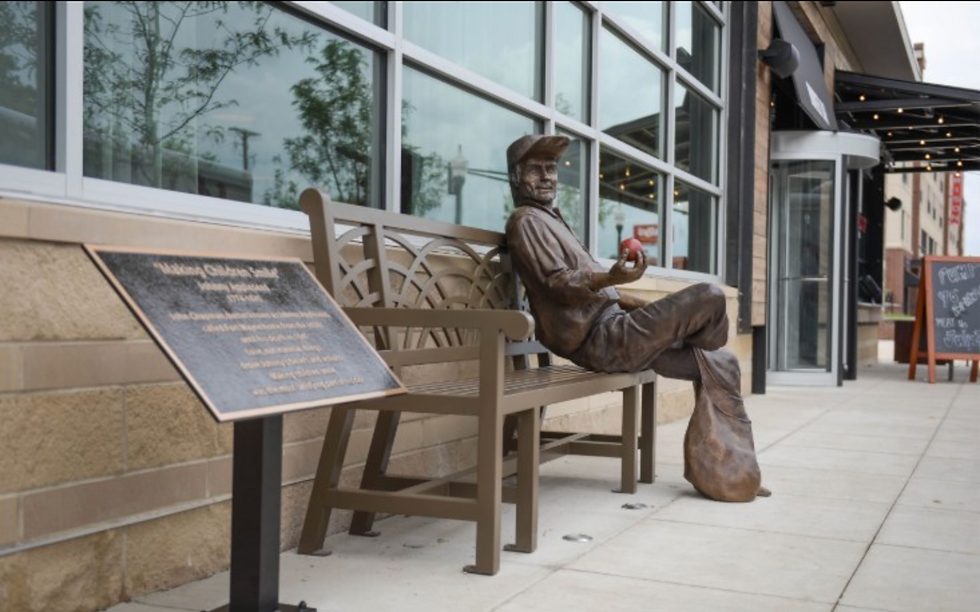
March 11 and September 26 are sometimes celebrated as Johnny Appleseed Day in America. The September date is Appleseed's acknowledged birthdate, but the March date is sometimes preferred because it falls during planting season.
An elementary school in Johnny's birthtown of Leominter, MA is named after him.
A large terracotta sculpture of Johnny Appleseed, created by artist Viktor Schreckengost, welcomes students at the front of the Lakewood High School Civic Auditorium in Lakewood, Ohio. According to Wikipedia:
Although the local board of education deemed Appleseed too "eccentric" a figure to grace the front of the building (renaming the sculpture simply "Early Settler"), students, teachers, and parents alike still call the sculpture by its intended name: "Johnny Appleseed".



Comments