
LOVEWELL'S FIGHT
- westmohney

- Jul 15, 2022
- 10 min read
Updated: Jul 4, 2024
Canada paid her Indians for English scalps and prisoners, while New England...offered money for Indian scalps only...such reward...caused a great increase of cruelty in the savage wars...
~ Emma Lewis Coleman

Much of the information used for this post was taken from a history of Lovewell's expeditions written in 1865 by our cousin, historian Frederick Kidder (4C5X).

Lovewell's Rangers
In our last post, Aunt Sarah Kids, we wrote about the attack on Dunstable in September of 1724. Two men were taken captive and, in the chase to recover them, an entire party of nine men were killed except for one, our cousin Josiah Farwell (3C8X). Killed in the ambush were our cousins Ebenezer French (2C8X), Ebenezer Cummings (2C8X) and Daniel Baldwin (2C8X). This event sparked three excursions into Maine led by Captain John Lovewell, a resident of Dunstable, whose legend made him one of the the most famous rangers (also known as scalp hunters) of the 18th century.
The attack on Dunstable was only one of a series of skirmishes in what would become an undeclared war, known as Dummer's War, between the English and the Abenaki Nation. The root cause of this war had been the failure of the English to include the Abenaki in certain treaty negotiations and the further encroachment of the English into Abenaki territory.
Dummer's War, begun in 1722, had taken it's toll on the citizens Dunstable who were ever in the line of fire. After the attack on the town, Lovewell took it upon himself to gather "a company of amateur scalp-hunters" for a proposed strike against the Natives. Lovewell, Cousin Josiah Farwell and Jonathan Robbins put together a petition asking Massachusetts for approval of the expedition and for money to cover five shillings a day per man. The petition reads:
The humble memorial of John Lovewell, Josiah Farwell, and Jonathan Robbins, all of Dunstable, sheweth:
That your petitioners, with near forty or fifty others, are inclined to range and keep out in the woods for several months together, in order to kill and destroy their enemy Indians, provided they can meet incouragement suitable. And your petitioners are Imployed and desired by many others Humbly to propose and submit to your Honors consideration, that if such soldiers may be allowed five shillings per day, in case they kill any enemy Indian, and possess his scalp, they will Imploy themselves in Indian hunting one whole year; and if within that time they do not kill any, they are content to be allowed nothing for their wages, time, and trouble.
The petition was signed by Lovewell, Farwell and Robbins:

The Massachusetts Assembly approved Lovewell's petition but, instead of paying the men daily, they offered a bounty of £100 for "every male Indian scalp" brought in by the expedition.
During the course of all the French and Indian Wars, both New England and New France would offer money for scalps. While New England offered money for Indian scalps only, the French, as we've learned in earlier posts, would pay Natives not only for English scalps but also for prisoners. According to historian Emma Lewis Coleman, the practice of taking scalps, which began ca. 1690, "caused a great increase of cruelty in the savage wars."
the first expedition
Captain Lovewell gathered his troops in Dunstable. Our cousin Lt. Josiah Farwell was in charge of obtaining supplies for the expedition:
Haverhill Nov. 26, 1724.
Pursuant to an order from his honor ye Lieut Governor to John White of Haverhill to supply Capt John Lovewell with bread of the Province stores, & now ye sd Lovewell being marching out with a company of Volunteers against ye Indian enemy he has appointed me Josiah Farwell of dunstable who am his Leut to receive ye sd bread & to meet him at Kingstown in order to march, I acknowledge I this day received of sd White four hundred & eighty-seven pound & one half of good bread for which I promise to be accountable for to Jeremiah Allen Esqr province treasurer and to pay for ye same as witness my hand.
JOSIAH FARWELL Leut

The men set out in the beginning of December for a short expediton which turned out to be only mildly successful. On 10 Dec 1724, the troops killed and scalped a Native man and captured a boy that they brought back with them to Boston. The council, "much pleased," gave the men, "for their further encouragement," £50 over the the £100 origionally agreed on. Each man would have received about £3.75 for their trouble.
the second expedition
The almost £4 bounty was enough of a draw to attract 87 men for Lovewell's second foray. This party set out on 27 Jan 1725.
Included in the second expedition were six men related to us by blood and one by marriage:
Richard Hall (7U)
Jeremiah Perley (1C9X) ~ related through our Howlett family
Jacob Perley ~ Aunt Mary Howlett Perley's brother-in-law
Robert Phelps (1C9X)
Moses Chandler (1C9X) ~ related through our Phelps family
Samuel Stickney (1C10X)
Lt. Josiah Farwell (3C8X) ~ related through our Richardson family
The second adventure was more successful than the first. According to Lovewell's journal entry on 20 Feb 1725, he and his men "came upon a wigwam that the Indians had lately gone from, & then we pursued their tracks 2 miles further, & discovered their smokes, & then came up on their wigwams & killed ten Indian men & not one escaped alive."

The plunder taken in this raid included skins, blankets, mocassins, snowshoes and rifles. On their return to Massachusetts, the company "with Lovewll wearing a wig made of indian scalps, paraded through the streets of Boston showing off the scalps taken..."
the third expedition
Bouyed by the sucess of his second expedition, Lovewell sent the following message to the governor of Massachusetts:
DUNSTABLE, April ye 15, 1725.
SIR: This is to inform you that I march from Dunstable with between forty or fifty men on the day above mentioned & I should have marched sooner if the weather had not prevented me. No more at present but I remain your humble servt. ~ John Lovewell
This time Lovewell's planned destination was the largest Pequawket village on the Saco River, deep into Maine territory. According to John Goodale's History of Nashua, NH, the Pequawket tribe "was powerful and ferocious. Its chief was Paugus, a noted warrior, whose name inspired terror wherever he was known." Lovewell, leaving on a hundred and thirty mile trek through Native wilderness with only forty-six men, "underestimated the perils of the march and the risk from ambushes."

The third expedition included nine men related to us by blood and one by marriage:
Corporal Thomas Richardson (2C9X)
Timothy Richardson (2C8X)
Lt. Josiah Farwell (3C8X) ~ related through the Richardson family, cousin to both Thomas and Timothy
Ensign Seth Wyman ~ (1C8X)
Josiah Johnson ~ brother to cousin Seth Wyman's mother
John Chamberlain (2C7X) ~ related through our Proctor family
Jonathan Kittredge (1C9X)
Benjamin Kidder (1C8X)
William Cummings (2C8X) ~ related through our Howlett family
Jonathan Cummings (2C8X) ~ William's cousin, related through our Howlett family
Note: Timothy Richardson was father to Ebenezer Richardson, who became one of the most reviled and infamous characters in pre-Revolutionary history. His story in a future post.
the march
The troop left on their northward journey on 16 Apr 1725. After traveling about fifty miles, our cousin William Cummings (2C8X) became "so disabl'd" by a wound sustained early on in the journey that he couldn't continue. He, along with his cousin Jonathan Cummings (2C8X) as a helpmate, was sent back to Dunstable. Then, only thirty three miles from their destination, our cousin Benjamin Kidder (1C8X) fell sick. Since Benjamin was not fit to make the journey back to Dunstable, Lovewell halted the party in order to make a "small fortification" for him. He left Benjamin in the care of a doctor and eight men to protect him.
Note: Cousin Benjamin recovered from his illness and lived to further serve his country. He was killed at the Siege of Louisbourg in 1746, during King George's War.
These two events left the troop, now down to thirty-five men, considerably weakened. Undaunted, the men continued their march and, within a few days, came very near to their target destination. As they trudged on, however, "the company were apprehensive they were discover'd and dog'd by the enemy..."
the battle
The apprehension of the small group was well founded. On Saturday, the eighth of May, while at prayers, "they heard a gun; and sometime after spy'd an Indian" near Saco Pond. The company briefly debated whether to high-tail it or stay and fight. They decided to fight.
After marching about a mile and a half, "Ensign Wyman spy'd an Indian coming toward them, whereupon he gave a sign, and they all squat, and let him come on..." Captain Lovewell was wounded almost immediately along with another man. The men quickly retreated back to their packs where an ambush, led by the fearsome Chief Paugus, lay waiting.
What ensued is what historian Francis Parkman has described as "one of the most obstinate and deadly bush fights in the annals of New England." Parkman writes, "The Indians rose up in front and rear...and ran towards the English three or four deep...and the English also presented in a moment and ran to meet them..." The English managed to temporarily drive the Natives back but the numbers were too great to overcome. In very short order, the Natives had killed nine men, our cousin Jonathan Kittredge among them. Lovewell, already wounded, was now killed in the melee. Three men were wounded including Lt. Josiah Farwell.
With Lovewell dead and Lt. Farwell injured, Cousin Seth Wyman took command of the battle. The fighting continued "very furious and obstinate, till towards night." According to survivors, the battle lasted eleven hours, only ending when one of the Englishmen shot and killed Chief Paugus. With Paugus' death, the rest of the Natives "soon vanished into the forest." Twenty of Lovewell's thirty-five men survived the battle. Three died on the retreat home. After the battle, the leaderless Pequawket abandoned their village and fled to Canada.
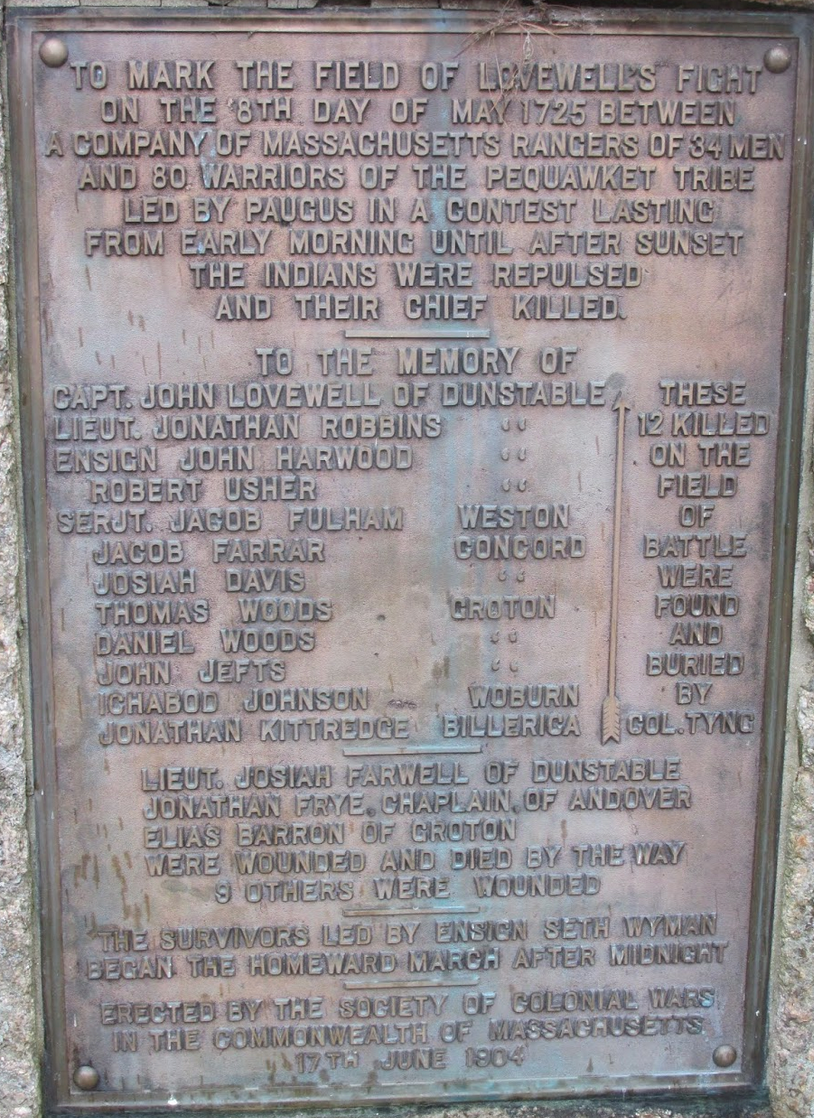
Below is a plaque commemorating Lovewell's Fight and the men who died there that day, our cousins Jonathan Kittredge and Josiah Farwell among them.
who killed Chief Paugus?
But just who killed Chief Paugus? The original account of the entire expedition given to the Reverend Thomas Symmes of Bradford by three of the survivors, our cousin Seth Wyman, Ebenezer Ayer and Abiel Asten, states that Seth Wyman shot the chief. These men attested that they were "well satisfy'd in the truth of the whole" account written down. And an early ballad, "The Song of Lovewell's Fight" by an unknown author gives Seth the "credit":
But yet our valiant Englishmen in fight were ne'er dismay'd,
But still they kept their motion, and Wyman's captain made,
Who shot the old chief Paugus, which did the foe defeat;
Then set his men in order, and brought off the retreat;
Then, about seventy-five years after the event, the story that another cousin of ours, John Chamberlain, shot Paugus began making the rounds. This story gained enough steam that an 1872 wood engraving depicted the event.

For our family, however, the sad fact remains that both men given credit for killing Chief Paugus were cousins of ours. And, for all his notoriety, Seth Wyman died an ignoble death. It was dysentery that took him while out on another mission.
Below is a rock commemorating John Chamberlain's "noble deed" of shooting Chief Paugus. The rock lays near the site of the Chamberlain Mill where our Uncle Israel (7U) stabbed his (and our) cousin Thomas Chamberlain (1C8X).
Note: We wrote about the stabbing of Thomas Chamberlain by our Uncle Israel in our "Frontier Life Part 1" post. Thomas was John Chamberlain's father. John was 17 when his father was killed.

aftermath
Lovewell's Fight took place near a pond which has ever afterwards been known as Lovewell's Pond. The Battle of Lovewell's Pond turned out to be the last major engagement in the shortlived Dummer's War. Relative peace would reign in New England for almost twenty years until the outbreak of King George's War in 1744. Lovewell's battle, however, had captured the imagination of the populace. Its importance became exaggerated over the years and it was was celebrated in song and story for many generations. Henry David Thoreau and Nathaniel Hawthorne (6C5X) both wrote accounts of the fight and Henry Wadsworth Longfellow's very first published poem was titled "The Battle of Lovell's Pond."

the "snow-shoe men"
As we've seen, frontier towns were always on high alert for fear of Native attacks. Towns in the far north were particularly vulnerable in the winter months when the deep snow drifts hampered the settlers efforts to protect their villages. in 1702, the government of Massachusetts, recognizing the danger, decided to provide "so many good Serviceable snowshoes as they shall think needful with as many Indian shoes to be Disperst & lodged in the frontier Towns..." Since the Englishmen weren't "as skillful" using this equipment as the French and Natives, many towns set out to train some of their militia in the use of snowshoes. These trained units became known as "snowshoe men."
The snowshoe men patrolled the frontier, protecting settlements from attacks. They were able to operate in all types of weather and conditions. Bob Haskell, writing for National Guard Magazine, maintains that the snowshoe men "were the nation's first commandos. They were rangers decades before Rogers' Rangers gained fame during the French and Indian War." Over time, the purpose and intent of the snowshoe men became two-fold: the protection of villages and the tracking and scalping of Natives for bounty.
One of our cousins, Robert Richardson (3C8X), became the leader of one of these snow-show companies. Cousin Robert was born in 1693 in Chelmsford. Sometime before 1724, he moved to Litchfield, then a part of Dunstable. Shortly after his arrival, Robert was given command of a trained band of snowshoe men. Included in his troop were his brother, Zachariah Richardson (3C8X), along with our cousins Benjamin Chamberlain (1C8X), John Proctor (1C8X), Nathan Proctor (1C8X) James Kidder (1C8X) and Jonathan Hildreth (1C9X). All of these men were recruited from Chelmsford and Billerica.
The news of the disaster at Lovewell's Pond incited the English into action. Col. Jonathan Tyng sent a message to Lt. Governor Dummer letting him know that he had appealed "to Robert Richardson for fifteen of his Snow Shoe men." Robert's uncle, Jonathan Richardson (2C8X), captain of the Chelmsford militia, sent a reply to Tyng's appeal:
May it Please your honores By Virtue of an order from Coll. Eleazoer Tyng I have drawn out of my company Thirteen able bodyed men well fitted with snow shoes and moggasons according to the order of ye Genral Court and I desire the money may be paid to Robert Richardson Capt. over said snow shoemen..."
Your humble Servant Jonth Richardson, Capt.
Robert and his men had been chosen to go in pursuit of the Pequawket because "they were acquainted with the haunts and habits of the Indians." I can find no account of the result of Cousin Robert's pursuit but most likely the Pequawket had already high-tailed it to Canada and the protection of the French.
The scalp-hunting snowshoe men enjoyed a full half-century in the limelight. Massachusetts governor Thomas Dudley bragged that his winter patrollers proved to "this Country as well as the Indians [that] we can beare the frost and travell with our Victualls as long as they."
Emma Coleman got it right when she remarked that scalp hunting "caused a great increase of cruelty in the savage wars..."


Comments