
Military Doctors
- westmohney

- Aug 22, 2023
- 12 min read
Updated: Jun 23, 2025
We want, my dear sir, wine above all things, for our sick are now numerous, and our cases generally putrid... ~ James Fallon at Valley Forge

Medical care in the field
Every regiment in the Continental Army received its quota of sugeons and surgeon's mates. Yet, according to historian and author Ellen McCallister Clark, "[of] the fourteen hundred medical practicioners who served in the Continental Army, only about ten percent had formal medical degrees." Most had honed their skills in apprenticeships with practicing physicians. These men provided triage on the battlefield and critical care for sick and wounded soldiers. In addition, a Hospital Department was created by Congress in July of 1775 to oversee a staff responsible for managing and supplying the network of hospitals that were established across the states. Military doctors worked in the field, at their homes and in makeshift hospitals. For their service, Congress granted army doctors officer status with all the benefits that went along with the commission.
Even more common than men wounded in battle were "debilitating and deadly" diseases that plagued soldiers out in the field. Diptheria, dysentery, typus, malaria, influenza and small pox spread rapidly through crowded camps leaving many soldiers unable to march or fight. "The scourge of smallpox" turned out to be the "war's most insidious killer." A type of vaccine for smallpox had been introduced in Boston in 1721. Though it did cause illness, sometimes severe, most of the innoculated didn't die. In 1777, the smallpox scourge was so bad in the Continental Army that Washington ordered that all his troops be vaccinated.
Bloodletting was a common treatment for almost every malady. Battlefield doctors also used opium, quinine and a host of herbal remedies to try and effect pain relief and recovery. More importantly, in the 1770s American military physicians had begun to realize that santitation, quarantine, ventilation and dry condtions were essential to the well-being of their patients. While not always possible, efforts were continually made to improve conditions for the wounded and sick.
The most common injuries the surgeons had to deal with were from musket balls and bayonets. Because of a high risk of infection, musket balls in none life threatening areas of the body remained where they were. Infections from Bayonet wounds were another story. They were dressed and, with prayers, left to heal. Shattered bones generally resulted in amutation. Since the doctors operated without anesthesia, they needed to work quickly. A new invention, the Petit tourniquet, aided them in their work.
Below is a set of surgical instruments used during the Revolutionary War.

Despite the military physicians’ best efforts, the illnesses and injuries soldiers suffered were often beyond the power of eighteenth-century medicine to cure. Death was a common and constant fact of military life. Despite the surgeons’ heroic efforts, only about a third of their
patients survived treatment
Army chaplains ranked even higher than surgeons for military pay, and they provided an essential service giving comfort to the dying as well as to the survivors mourning their fallen fellow soldiers .
Because of the large number of casualties in battle, common soldiers were often buried in mass graves. Officers, if at all possible, were buried individually with military honors. Informing families of their loss usually fell to commanding officers, but sometimes the closest associates of the deceased would write home to break the sad news.
In the Revolutionary War, 6,800 soldiers were killed, 6,100 wounded, 20,000 taken prisoner and 17,000 died of disease.
Dr. Thomas Kittredge
Our cousin Thomas Kittredge (3C7X),born in 1846 in Andover, was part of the branch of our Kittredge family that produced dozens of physicians. Thomas served as surgeon for the First Massachusetts Regiment. In that role, he found himself on a battleground littered with casualties during the battle of Bunker Hill. After the battle, he cared for the wounded in Cambridge homes that had been converted into hospitals.
A story about our cousin Thomas at Bunker Hill can be found in a book written in 1908 titled Genealogical and Personal Memoirs relating to the families of Boston and Eastern Massachusetts. The author, William Richard Cutter maintained that Thomas "was at the side of General (Joseph) Warren when he was killed (at Bunker Hill)" and further that "General Warren, himself a physician, said that Thomas Kittredge was the greatest natural surgeon that he knew." Much research on my part has proven that no one was at Warren's side when he was killed at Bunker Hill. I also can find no proof that Warren made any such statement about Cousin Thomas. Still, this story continues to make the rounds on most ancestry sites and has even been used by a respected medical library, the Historical Medical Library of the College of Physicians of Philadelphia.
Thomas continued his medical service for the army after Bunker Hill. One of his duties was to inform the military of men deemed unfit medically to serve. Below is a note, signed by Thomas, excusing Moses Dorman from service. It reads:
This Certifies that Mr. Moses Dorman of Col Lovjoys Regiment & Capt. Jacob Gootes Compan has for a long time been lamed & short sighted which I judge renders him unable for Military duty.

Thomas' home life
When his father, John Kittredge (2C8X), died in July of 1776, Thomas took over both the homestead and the medical practice in Andover. Acording to lore, he became the "leading physician and and surgeon of this section for many years."
By 1784, Dr. Thomas Kittredge had, indeed, gained wealth, fame, and a large "mansion house" in North Andover. Cutter writes that Thomas' "mansion is a reminder of the days before the revolution when New England, as well as other sections of the country, took pride in her aristocratic old families. . .Dr. Kittredge had negro slaves and lived on a magnificent scale, in comparison with many of the farmers of the neighborhood."
Thomas owned at least two slaves, Caesar and Peter, and he wasn't the only slave owner in our Kittredge family. We wrote of that sad fact in our "Slaves in Billerica" Post. An andecdote about the Kitredges in Cutter's book illustrates the light hearted treatment of slavery even in 1908:
Dr. Joseph Kittredge who was a child of nine months on the festal day when the neighbors came to help put up the frame and to put down the good things to eat and drink from the doctor's kitchen, was held up to see the raising in the arms of an old negro house servant, Caesar, that he might say in after years that he was "at the raising." And no little pride did the doctor take in that event.

After the war, Thomas took students into his house and offered them medical training.
Some of the students that he taught are related to us: Aaron Lummas (2C8X), Benjamin W. Hildreth (4C6X), Samuel P. Hildreth (4C6X) and Jacob Kittredge (4C6X). Jacob's father was Dr. Benjamin Kittredge (3C5X) whose main claim to fame was that all eight of his sons became physicians. He is listed in the Guiness Book of World Records for that feat. Two of Thomas' own sons, Joseph (4C6X) and John (4C6X) also studied with him.
One of Thomas' students, Dr. Levi Bartlett, practiced medicine in Kingston, New Hampshire. He was the son of Dr. Josiah Bartlett, one of the signers of the Declaration of Independence. Ca. 1785, Dr. Bartlett compiled a manuscript of "medical recipes." The first entry in this manuscript is an ointment recipe of Thomas' who Bartlett identifies as "Old D. Kittredge."

Dr. Thomas Kittredge died in October of 1818. The Salem Essex Register gave notice of his death:
We have received the afflictive news of the death of the Hon. Thomas Kittredge of Andover, one of the Councellors of the Mass. Medical Society, aged 72. He was soon distinguished among the members of his family by his great success in Chirurgical operations, and in his treatment of such cases of insanity as were committed to him, as well as in the general practice of physic, in which he was as often consulted as any man in this part of the State. His very agreeable and mild manners, and his style of life and hospitality, gave every aid to his talents and usefulness; so that as a citizen, a magistrate, a physician and friend, he had an uncommon share of the public confidence.
In a uniform and pure character, and by his extensive acquaintance, he had acquired a value which few men have the opportunities to possess. . .he never was in higher reputation than
at the hour of his death. The nature of his affliction had long given him notice that his malady was at the seat of life, and after several narrow escapes, without much warning, he left life, when apparently ready for all his usual duties in it. His death will be felt in Andover, and in the county, and the loss will be that of a friend, a good citizen, and most useful man.
Dr. Jacob Kittredge
Our cousin Jacob Kittredge (3C7X) had his practice in North Brookfield, MA. Josiah Temple in his History of North Brookfield writes that on Sept.30, 1776, a year and a half into the war, "the town voted to establish a small pox hospital. . ." Cousin Jacob was one of two doctors chosen to take charge of the facility.
After Jacob's death in 1813, Dr. Thomas Snell, town minister and a doctor himself, wrote this about Jacob's healing abilities:
. . .the house of worship had around it through all the week, a remarkable stillness; disturbed only by the coming and going of the sickly, the palsied, those afflicted with swellings, disjointed bones, broken limbs, and the diseased of every sort, who resorted for relief, like the multitude around Bethesda, and with much the same confidence of a cure, to your far-famed surgeon, Dr. Jacob Kittredge, whose decease in 1813 was so much lamented.
Note: Dr. Snell was referencing the Pool of Bethesda in Jerusalem which was written about in the New Testament story of Jesus who miraculously healed a paralysed man there.
Dr. Francis Kittredge
Francis Kittredge (2C8X) was born in Billerica in 1728. In 1752, he married our cousin Abigail Richardson (4C7X). Sometime before the Revolutionary War began, Francis was called to Walpole, New Hampshire to set the broken leg of a member of the Bellows family. He was so favorably impressed with the town that he moved his family and practice to that fair town.
Francis did his part in the war effort. In June of 1775, the Congress of Massachusetts decided that Francis was "desired to attend the Hospital as Surgeon till. . .informed otherwise. . ." The hospital he was assigned to was located in Cambridge and originally set up in preparation for the Battle of Bunker Hill. Francis was one of four local doctors that formed the original staff.
The Harvard Library has it its possesion a "Receipt Book" created in 1780 by Francis. The book actually contains "instructions for preparing and administering medicine for adults and children, and generalized uses for certain ingredients. . ."
Note: Francis had a son, Francis Kittredge Jr. (3C7X), born in 1758. Francis, Jr. also became a physician. Harvard Library attributes the notebook to Francis, Sr. but has noted that the author could actually be Francis, Jr.
The Harvard Library gives further description of the book:
Preparations include ointment for scurvy, bone ointment, nerve ointments, procedures to soothe a sore mouth and to stop excessive bleeding, and treatment to kill worms. The materials used to prepare bone ointment include fresh butter, hog fat, chamomile, garlic, and night shade, among other ingredients. The recipe for “simple nerve ointment” instructs the preparer to simmer half a pint of neet foot oil, a pint of rum, and one jell of oil of turpentine over a “gentle fire.” Kittredge wrote that oil of St. John’s Wort is effective in treating swelling of the legs, for cold and aches, and for burning and scalds, while oil of Elderflower is indicated for belly aches. The manuscript is housed in a binding created by the Harvard Medical School library.
My personal favorite is shown below. The recipe for Frog Ointment calls for Bull Paddocks (frogs) and fresh butter. Then you "[m]ake a Crust of rie (rye) meal & put in the paddoks Alive in Earthean pot & Back (bake) them..." Yummy!

According to Harvard Library, enclosed in Francis' notebook was a letter "of unknown provenance." The letter contains an an inventory of the estate of Antipas Brigham (3C11X), of Grafton, Massachusetts, signed by Worcester County Judge Joseph Wilder on 7 November 1749. Harvard is unclear whether this letter had any connection to Frederick O. West, who donated Francis' notebook to the college, or to our Cousin Francis. The letter is of some interest to us, however, because Anitpas Brigham is one of our cousins. Below is the inventory of his estate found in Francis' notebook:

Dr. Ebenezer Crosby
Our cousin Ebenezer Crosby (3C10X) was born in Braintree in 1753. As an army surgeon, he initially served alongside our cousin Francis Kittredge at the hospital in Cambridge. When the British evacuated Boston, Ebenezer went with General Washington to New York to serve as chief surgeon for Washington's Corps of Guards, a position he held throughout the war. The Corps was created to personally defend the commander in chief. Ebenzer was chosen as physician for the guards in 1776 when he was only twenty-three years old. A year later in 1777, while still serving in the army, he received a medical degree from Harvard College. During the war, colleges provided remote study programs for those who found it impossible to attend classes in person.
Ebenezer was still with General Washington in December of 1779 when he applied to the Massachusetts House of Representatives for certain items:
Whereas Ebenezer Crosby, Surgeon of the Corps of Guards, has represented to this Court that he has not received any clothing from this State, and that he is in great want thereof. . ."
It appears that it took poor Ebenezer almost a year to receive his clothing:
Therefore, Resolved, That the Board of War be directed, and they are hereby directed, to deliver to Ebenezer Crosby, Surgeon of the Corps of Guards, such articles of clothing as he is entitled to receive by the resolution of Congress of the 20th of November, 1780. . .
Ebenezer remained with Washington's guards until the end of the war. His service entitled him to join the Society of Cincinnati, an organization created in 1783 to commemorate the Revolutionary War. A hoity-toity club, membership included only officers who had served at least three years in the Continental Army or Navy. When Cousin Ebenzer joined, he signed the roll as "Surgeon of his Excellency's Guards."
For a few years, the prospects of Dr. Crosby seemed bright. He had married Catherine Bellow in 1781 and three sons were born to them. In 1885, he joined the staff at Columbia College as a professor of obstetrics and also appointed as one of the trustee there.
Shortly after his appointment at Columbia, Ebenezer's health began to fail him. His lungs "showed signs of weakness" which probably meant he had the dreaded consumption (tuberculosis). In November of 1787 he sailed for St. Vincent in the West Indies to get away from the frigid New England climate. The New York Journal noted his departure"
On Sunday last sailed from this port the ship Christopher, Captain Smith, for St. Vincent's. In the Christopher went as passenger Dr. Crosby of this city. The doctor was induced to this change of climate from the circumstances of his health having been for some months on the decline. We are told that the lectures on Midwifery (during Dr. Crosby's absence) are to be held at the stated seasons by Dr. Bard, senior.
Ebenezer's efforts turned out to be futile. He returned to New York in the spring of 1788. Not long after his arrival, Ebenezer's youngest son Henry (4C9X), only eleven months old, died. Ebenezer followed a month later on July 16 at the age of 35. The New York Packet gave an account of his passing:
On Wednesday afternoon, 16th instant, departed this life, greatly lamented by his friends and acquaintances, Dr. Ebenezer Crosby, after a lingering consumptive illness which he sustained with Christian fortitude, patience, and resignation. His remains are to be interred this afternoon.
And, from the New York Journal:
On Tuesday (Wednesday) last, in the midst of his usefulness to society, Dr. Ebenezer Crosby bade adieu to the transitory joys of time after a tedious decline of more than a twelvemonth. The doctor was a native of Braintree, in New England; he ever sustained an irreproachable character, was an accomplished surgeon, in which capacity he served in the late army to general satisfaction; he was esteemed by every one who knew him, and has died greatly lamented, particularly by his amiable consort. His remains will be interred this afternoon at five o'clock from Mr. Bedlow's in Wall Street. We are told that the members of the Cincinnati are to walk in procession on this solemn occasion.
Ebenezer's wife Catherine died only seven months later "after a long and painful illness," perhaps consumption as well. She left two children, John (4C9X), 4, and William (4C9X), 3. She left them in the care of her uncle, Colonel Henry Rutgers. In 1825, Queen's College in New Jersey was renamed Rutger's College in honor of the Colonel after he made a substantial donation to the school.
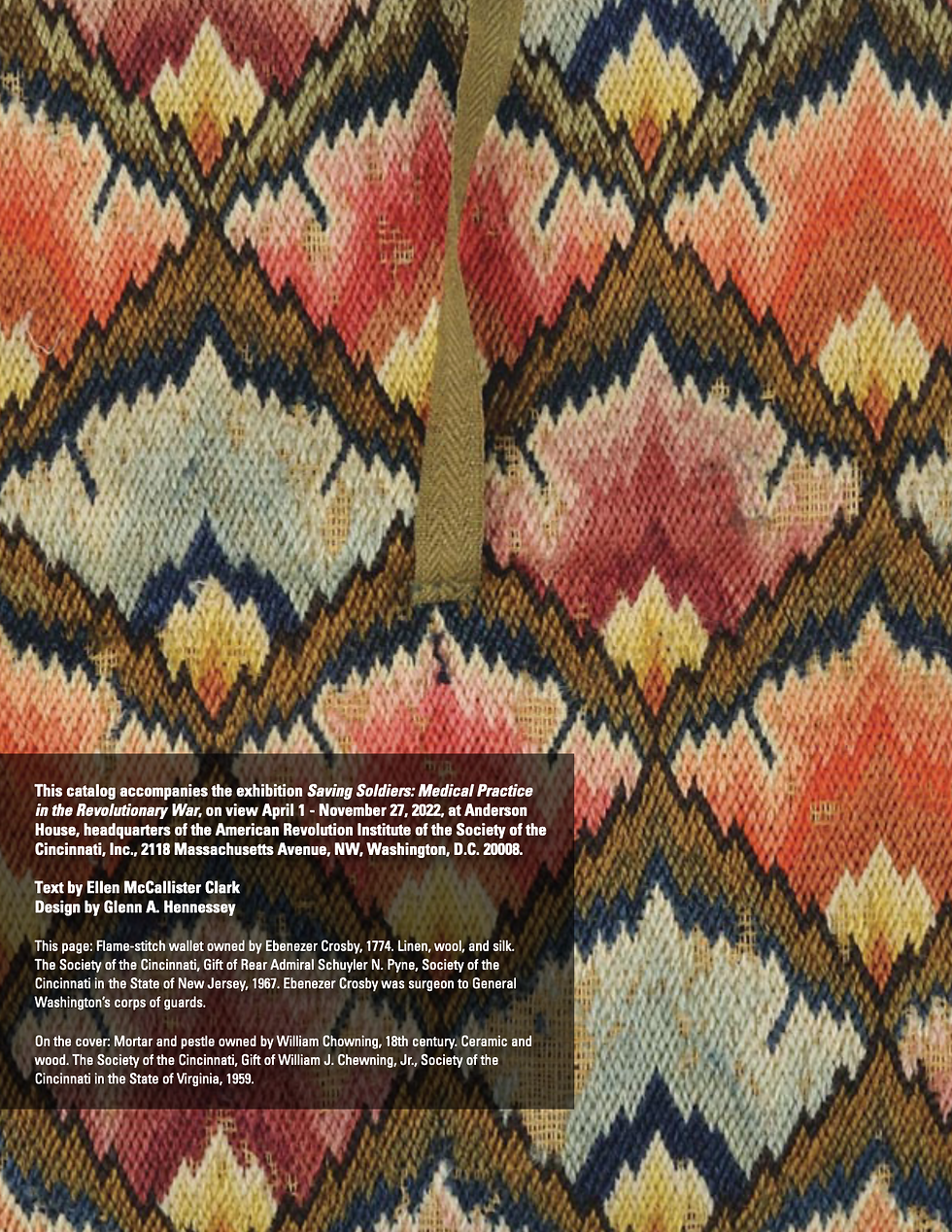
In 2020, the American Revolution Institute ran an exhibit titled "Saving Soldiers: Medical Practice in the Revolutionary War." One of the items in the exhibit was a "flame-stitched wallet" owned by Cousin Ebenezer Crosby. The wallet was also chosen as the front and back piece for the publication that went along with the exhibit.
Below is a miniature portrait of Ebenezer painted by Charles Wilson Peale who did no less than four portraits of George Washington. Peale also painted portraits of Thomas Jefferson and his famous duo, Meriweather Lewis and William Clarke.



Comments