
More Revolutionary Stories
- westmohney

- May 31, 2023
- 12 min read
My Brother returned in good health, and I went home about the last of february 1776 ~ from the memoir of our cousin Daniel Granger

Sheriff William Greenleaf
You may remember the posts on our beleaguered cousin Stephen Greenleaf (4C7X) who was sheriff of Boston during the tumultuous years before the Revolution. When Stephen was booted out of office, his Patriot brother William Greenleaf (4C7X) took his place. While Stephen had been loyal to the British government, William was a staunch Patriot. In 1772, he had been chosen to be a part of Samuel Adams' Committee of Correspondence in Boston. This committee, the first of many to come, was formed in order to distribute information on grievances against the British government. With one third of its members holding degrees from Harvard College, the Boston Committee of Correspondence was an unusually distinguished organization. At the time of his selection for the committee, Cousin William was an overseer of the poor in Boston.
Note: Also on the committee was our publisher cousin Joseph Greenleaf (4C7X) who we wrote about in our "Prelude to Revolution" post.
In July of 1775 George Washington arrived in Boston to take over the job of commander in chief previously held our cousin Artemas Ward (4C10X). Washington moved into the very nice home of a Cambridge Loyalist who had fled town. When Washington found himself in need of furniture, Cousin William was happy to help him out. William loaned the general a set of six chairs, one of which has fairly recently been on the auction block. Sloan and Kenyon Auctioneers sold the chair in February of 2006 for $51,920.
Sothby's also also auctioned one of the chairs in 2007. A seventy year old paper label with an ink inscription attached to the inside of the rear seat rail reads:
This chair is one of a set of six loaned by William Greenleaf, High Sheriff of Suffolk County, to help furnish General Washington's Headquarters when he occupied the building now known as the Longfellow House in Cambridge, Massachusetts. From July 1775 until March 1776. Washington's Headquarters were in Wadsworth House from July 1 to July 15, 1775. Wm. Greenleaf / Elizabeth Greenleaf - m. Samuel Eliot/ Wm. G. Eliot/ Thomas D. Eliot./ Margaret E. Gifford 1933
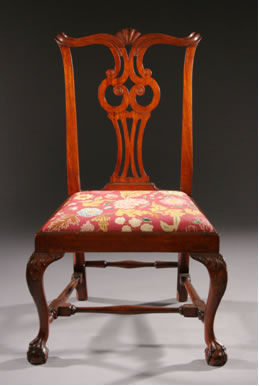
Note: William's daughter Elizabeth married Samuel Eliot. They are direct ancestors of our distant cousin T.S. Eliot (9C2X)
On Oct 31, 1775, William Greenleaf was appointed Sheriff of Suffolk County. Ten months later, he was accorded an extremely high honor. When the time came for the Declaration of Independence to be made public, Cousin William was chosen as the person to read it from the Statehouse in Boston. We'll have more on that in a future post.
In May of 1777, William somehow came into possession of a prize brigantine, the "Medway" which was captured from the British during the war. William sold the ship later that year for £3,501.
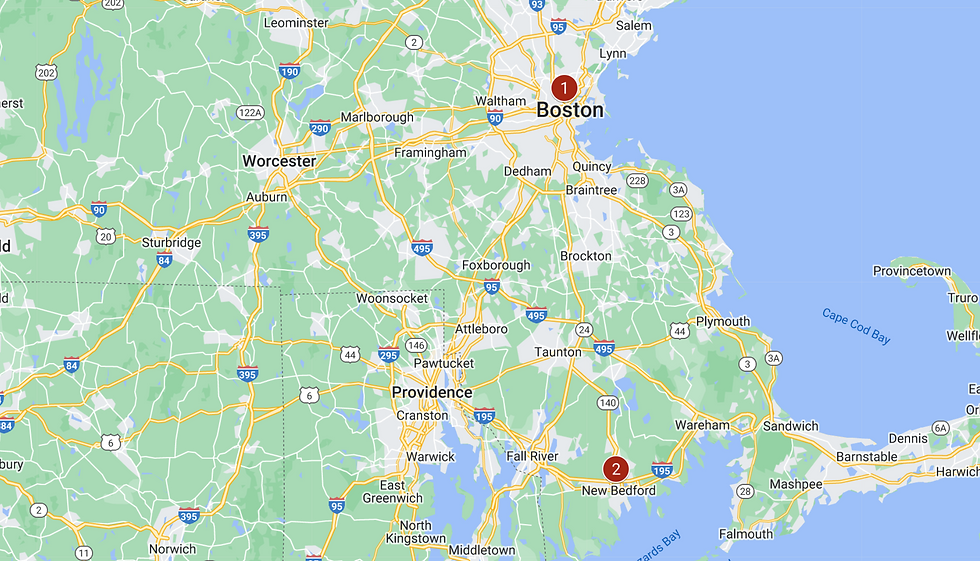
Cousin William was sheriff of Suffolk County for five years. When the war ended, he moved to New Bedford, RI where he set himself up in business.
A description of William appears in the Genealogy of the Greenleaf family by James Edward Greenleaf (8C3X):
Mr. Greenleaf was a tall, slim man, walking very erect. He dressed usually in a brown, single-breasted coat and cocked hat, after the fashion of those times. He usually carried a gold-headed cane, and wore ruffles in his bosom and on his wrists.
Below is a portrait of Willam in his brown coat and ruffles painted by Edwin Walter Dickinson.

The revolutionary recollections of our cousin Daniel Granger
Another relative that I discovered on J.L. Bell's Boston 1775 blog was our cousin Daniel Granger (4C7X) who was born in Andover, Massachusetts in 1762. He descended from our aunt Joanna Adams Granger (9A), daughter of our immigrant ancestor Robert Adams (10GGF) of Newbury. Daniel was only thirteen years old when he joined the army in the fall of 1775 as a temporary substitute for his brother Jacob (4C7X) who had become sick while serving in Boston. The thirteen-year-old ended up serving close to three months.
According to Bell, Daniel began writing his recollections in 1842 at the age of eighty and finished in 1848. In 1930, a copy of Daniel's manuscript was transcribed and published in the Mississippi Valley Historical Review, a leading U.S. history journal. Historian Milo Quaife, who was instrumental in getting Daniel's diary published, wrote that "[n]otwithstanding this lapse of time between the occurrence and the recording of the events deseribed, the author has imparted to his story a degree of vividness seldom encountered in an old man's relations; and the reader will search long for a more intimate picture of the homely details of the life of a common soldier in the American Revolution than the one here presented.
Daniel's memoir begins with his arrival in Boston:
My first services in the Revolution were on Winter Hill in the Fall and Winter of 1775. I at the age of 13 years. In the Month of December, News came up, that my Brother was sick and unable to do Duty, he was very thinly clad, as most of the Soldiers were at the time; he had taken a Cold and became sick. My parents said that I must take the Horse and go down and bring him home. But if the Officers would receive me in his sted, (and he being able to ride alone) I might stay in his room: I went down, & found him, he went with me to the Officers, to offer my services and to obtain a Furlow for himself: they questioned me a little and finally said that I might stay in his room if I thought that I could do the duty of a Soldier, & I gave my Consent, my Brother took the Horse & went home, & I took his Accoutrements and went in his Mess.
Daniel described the soldiers quarters when he arrived in camp:
The Barracks were then building, but were not finished. The Weather was extremely cold. . .
the Mess, my brother belonged to had excavated a place into the side of a Hill covered it with Timber & boards built up a fireplace & Chimney and a Door, had Straw for the flooring & bedding, where they were warm & comfortable, and were called a Mess of Cubs, who lived in a Den.
Daniel and his fellow soldiers eventually left their cave for the newly built barracks but he was underwhelmed with the result:
As soon as the Barracks were finished, we were obliged to quit the Den & go into the Barraks. but were not so warm & comfortable: the Barraks were hastily built only boarded & battened & without Windows excepting a square opening with a sliding shutter.
Washington's headquarters
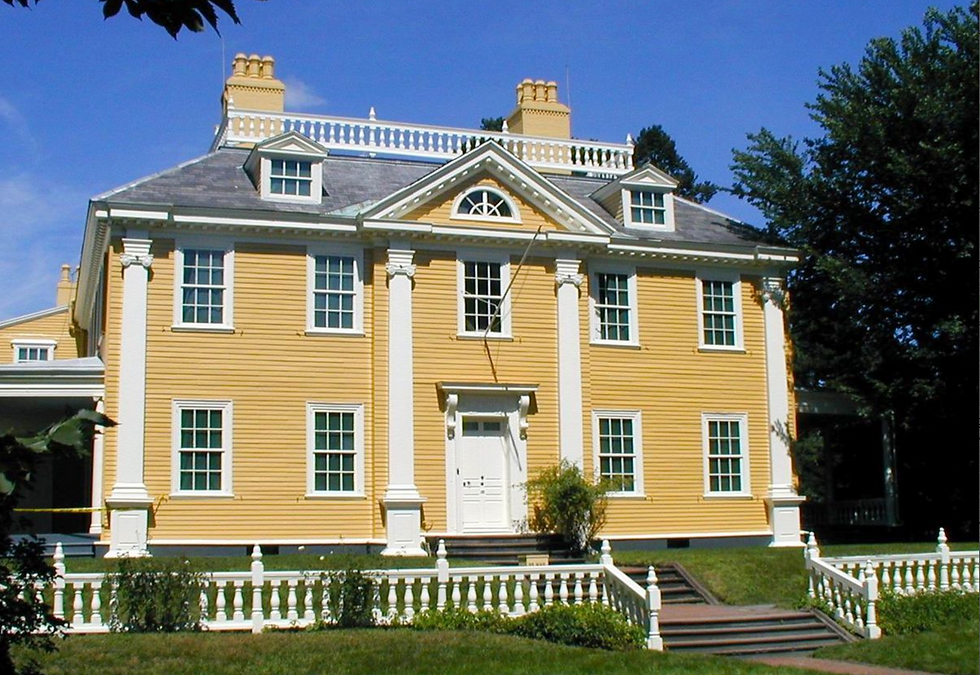
The soldier's cave dwelling and new barracks Daniel described were a far cry from the fashionable abode George Washington stayed in while overseeing the Boston seige. The house belonged to a Loyalist who fled Cambridge at the beginning of the war. It was used for a time as a hospital for soldiers after the battles of Lexington Concord. Then various officers used the house until July of 1775 when Washington moved into the building to use as his headquarters. Later, Henry Wadsworth Longfellow would buy the house and live there for four decades. In 1913, Longfellow's children established the Longfellow House Trust in order to preserve the home as a memorial to Longfellow and Washington.
Note: Longfellow's sister Mary married one of our Greenleaf cousins, James. Their home in Cambridge, not far from Longfellow's, was donated to Harvard College.
Below is the home Washington used as his headquarters and later owned by Longfellow. Our cousin William Greenleaf's chairs must have made a nice addition to Washington's furnishings there.
guard duty
Though Daniel was only thirteen, he was still entrusted with guard duty. In his memoir, he describes the drill and one of his experiences as guard:
The work of calling out the guard was, that when any Guard or Detachment was wanted, a certain Number from each Company was given to the sargent major of the Regiment every Night & he went around to every Company & notified each Soldier. . .on what guard or duty he was so detailed, and to be ready at such an Hour, in the Morning.
The Sergent Major whose name was Bell, would be out at the time with his Rattan and rap on the Barracks & halloo. . .The first time that I was detached, was on the main guard and I prepared my breakfast the Night before, so as to be ready, at the call of the little Bell, and not to get a caneing from him for negligence, as some others did, for when he began to wrap and to ball, the Soldiers would call out “there is the Bell, don’t you hear the Bell?”
It came my turn to stand Sentury, until about ten oclock at Night, and it was the most stormy and bitter cold Night that I ever felt, and I had to stand on the N.E. side of the Hill, where the Wind flew extremely cold, two long hours. . .and tramp round the old stump to Keep me from freesing, and no other Sentinal in sight of me.
about eleven or twelve oclock the Sentinal that was placed above me, heard the Ice trickle down from the Rocks as the Tide fell off, which frightened him, I heard him hale, at the Top of his voice, “who comes there” twice I beleave, and then fired off his Gun and ran off. . .I was determined not to run, nor to fire, until I should see or hear some thing to fire at.
And early the next Morning an Officer came into the guard house & enquired for the Sentury that stood down the lowest on the Point in the Night at the time of the alarm, & soon found me, and took me into the Officers Room and I recollect the Captain’s name was Clough, he took me by the hand and sat me down on his Knees, praised me a good deal for my courage and said many pleasing things to me which made me rather Proud.
Thirteen year old Daniel must have still been quite small for the captain to sit him on his knees! J.L. Bell was able to track down the date of Daniel's experience which happened on 26 Dec 1775. No mention is made of Christmas as that holiday was not really celebrated much back in the revolutionary days.
Daniel's last memory of his time on Winter Hill in Boston is brief: “My Brother returned in good health, and I went home about the last of february 1776." Daniel's career in the army wan't over, though. In a future post, we'll pick up the further adventures of Daniel and his brother Jacob.
spies and supplies
A ferry ran regularly between between Charlestown, just across the river from Boston, and Chelsea which was northeast up the Mystic River, less than three miles away.
Note: In a future post, we'll have more on Chelsea and our cousin Loammi Baldwin (3C7X) who was stationed there. Loammi was a first cousin of our journal writing cousin Jeduthan Baldwin (3C7X) who will feature in many of our upcoming posts.

British general Thomas Gage strongly suspected that the Patriots were sneaking spies into Boston via the ferry. A ferryman named Enoch Hopkins had been taken prisoner and kept on board a prison ship for just such an offense. Hopkins complained that "his fare on board was cruel viz. but half allowance of provisions; kept under deck without any thing to lodge on but the bare deck amidst the most horrid oaths and execrations, and amidst the filth and vermin &c. and left a number of prisoners in that same dismal state &c."
An informant also told Gage that "the men that go in the Fishing-boats are Equally as bad, for they will get a pass from the Admiral for a boat and Perhaps four men, they will take three Fisher-men and one Rebel, and as soon as they get below they will Land the Rebel and take another on board, so he comes up in the stead of him that they carried down, and Sees and hears what he can, and then returns the same way that he came."
A letter to our cousin Captain James Littlefield (1C10X) from Justice of the Peace William Stoddard confirms the information Gage received. Cousin James of Wells, Maine was instrumental in getting supplies to the soldiers in Cambridge. The letter, written 15 June, 1775, shows how "ferryman Hopkins and his son were conduits for messages, good and money. . .and possibly more." The letter reads in part:
Your letter and the last, dated the 13th instant, by Mr. Hopkins, I have received. . .and have got you a fishing pass for your boat and three men, to come in and out of this harbour, which I now send you. You will carefully observe the pass; you must observe to go a fishing from Salem, before you come up here, and then you may come in and go out. I hope you will not meet with any obstruction at Salem; not forgetting, if in your power, to bring up veal, green peas, fresh butter, asparagus, and fresh salmon.
I have paid some of the ferrymen, and I shall pay them all for their trouble, when I have done with them. Do not pay them any thing; if you have, let me know; keep that to yourself. . . I am obliged to you for the hint in coming out. I will let you know more when you come up from Salem. . .
Cousin James was later recommended for a post as Deputy-Commissary of the Continental Army. J.L. Bell says of him: "After all, he was good at supplying things."
Henry Baldwin's Tavern
Our cousin Henry Baldwin (3C7X) was born in Woburn in 1718. By 1755, he had moved to Shrewsbury, MA where he bought the house of another cousin of our, the recently deceased Nahum Ward (3C11X). We wrote about Nahum, Artemas Ward's (4C10X) father, in our "Cousin Artemas Ward" post.
Henry acquired 160 acres of property along with a house and other buildings for £450. Shortly afterwards, he opened a public house. According to Artemas' great-granddaughter Elizabeth Ward (7C7X), who wrote Old Times in Shrewsbury, Masssachusetts, Henry "set up a tall sign post in the yard, upon which it was announced to the wayfarer that here was to be found refreshment for man and beast. Near the sign stood the old mile stone, proclaiming that Boston was thirty-six miles away."
Below is a drawing of the house that Nahum built which eventually became Henry Baldwin's tavern.

In her book, Elizabeth Ward recounts a tale, which may or may not be true, of murder in the Baldwin Tavern:
Tradition whispers that a dark deed was committed within those walls. A certain night two travelers arrived and took lodging in the same room. In the morning one of them was missing and the other was found dead. The blood stains upon the bedstead caused it to be laid aside.
The large yard in front of the tavern was evidently used as a training ground for some members of the soon to be Continental Army. Henry did his part in the war. He marched on the alarm of April 19th as part of Cousin Artemas Ward's regiment. He then enlisted in the army serving during the siege of Boston.
Henry died in November of 1789 and left the tavern to his son Henry Baldwin, Jr. (4C6X). The very next month, Henry Jr. fell from a beam in the barn and broke his neck. The tavern was sold to Aaron Smith whose son, Ashabel, married Henry Baldwin, Jr.'s widow. Elizabeth Ward writes that "Captain Smith for some years kept up the tavern, which had become famous. People far and near had heard of its fame and travellers lenghthened or shortened a day's journey that they might see for themselves the glories of the Baldwin Tavern."
The tavern was finally shuttered ca. 1800 when Aaron Smith sold it to Samuel Bullard who had no interest in keeping a public house. After years of neglect and decay, the building was torn down in 1864.
relief provisions
Even as far away as Brattleboro, Vermont, citizens wanted to provide aid to the soldiers and citizens who were struggling in the Boston area. One of these was our cousin Stephen Greenleaf (6C5X) who owned a store in Brattleboro. Our store owner cousin was a grand-nephew of his more infamous namesake, Stephen Greenleaf (4C7X), former sheriff of Boston. Nephew Stephen had sold his merchandise in Boston for a time, until debt forced a move to Brattleboro in 1771.
Stephen is mentioned in a letter written in May of 1775 by Solomon Phelps of Vermont to his brother Charles who lived near Boston:
We have all been alarmed at the bloody news from Concord. . .Our people universally stand ready to assist you. Major Hunt, Esq. Bridgmen and Mr. Tute, give each a barrel of pork, besides considerable wheat. Mr. Greenleaf told me he was then instantly going to send 20 bushels of wheat flour for the use of the men at Roxbury or therabouts.
Cousin Stephen did his part as a soldier in the war, as well. We'll hear more about him and his application for a pension in a future post.
two families united
Cousin Samuel Kidder (2C7X) was one of the many American soldiers that contracted smallpox when it was running rampant in 1776. He died sometime before April of that year in his hometown of Dudley MA at age 42. Samuel had married his wife Sarah in 1758 and they had five children. Seven years after his death, his estate still hadn't been settled. In 1783, Sarah and the other beneficiaries of the estate, sent the following letter to the probate court:
Dudley march 21 1783
To the honorabel judge of the probate wee the subscribers ears (heirs) to the Estate of Samuel kider Late of Dudley Decesed Think it is a grate wast (waste) of Estate to Cut it in to Eight parts but think it will answer for two and beg your aprebation for so doing.
Sarah is one of the signers.
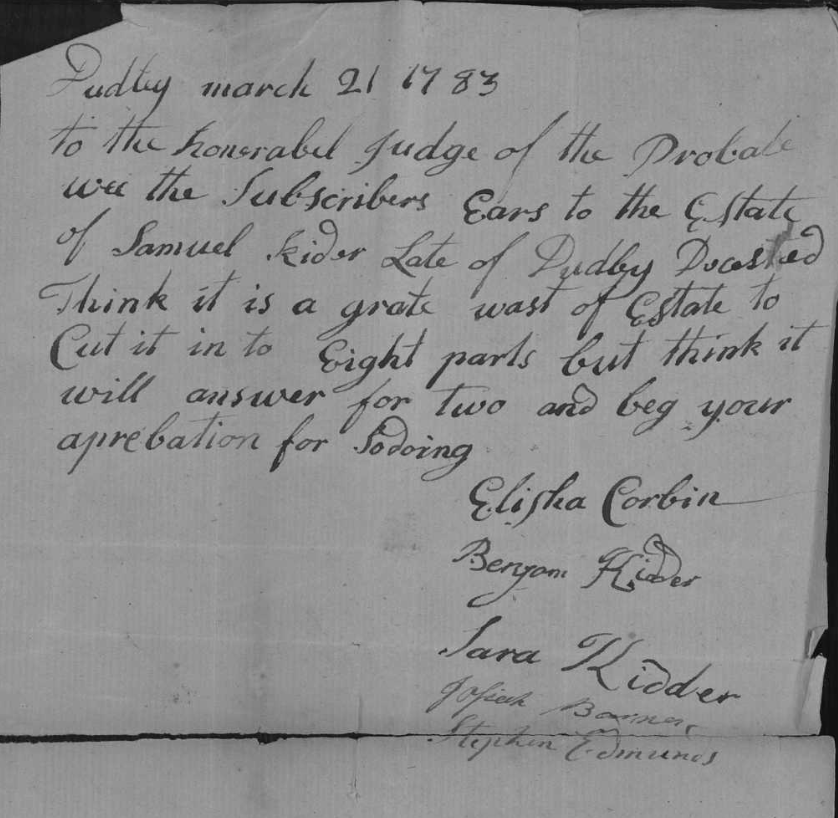
Two years after the letter was written, Sarah married another cousin of ours, Jonathan Bacon (2C7X). Jonathan's grandparents were Michael and Sarah Richardson Bacon (8A). You may remember Michael and and our Aunt Sarah from our "Another Crazy Day in Court" post. Bad boy Michael, while married to Sarah, had a dalliance with a young girl who became pregnant. Much drama ensued afterwards but Aunt Sarah stayed true to her man in spite of his transgression.
It appears that the two families, brought together by the union of Jonathan Bacon and Sarah Kidder, got along quite well. Jonathan's daughter, Zilpha (3C6X), from his first marriage, ended up marrying her step-brother, Sarah and Samuel's oldest son Samuel, Jr. (3C6X).


Comments