
Our Relatives at Bunker Hill
- westmohney

- May 19, 2023
- 10 min read
Updated: Nov 30, 2024
When the Arrows of death flew thick around me, I was preserv'd while others were suffer'd to fall a prey to our Cruel enemies...
~ Peter Brown to his Mother, June 25, 1775

Moses Parker
Moses Parker (2C8X) was a grandson of our aunt Abigail Hildreth Parker (8A). He was born in 1731 in Chelmsford. Moses served in the final French and Indian war. He was promoted to lieutenant during one of the many expeditions to Canada in the course of that war and, in 1759, he was promoted to captain. According to Wilkes Allen in his History of Chelmsford, Moses "distinguished himself as a brave soldier, and as an intrepid and dauntless officer, he was endeared to those under his care. . .Such was his reputation that... Colonel Nathaniel Twing and Colonel William Arbuthnot declared that 'they would not go without him, that he was the only Captain they had insisted upon.'"
Moses was in command of a company that marched to Lexington on the day of the Alarm, April 19, 1775. One month later, he accepted a commission from the Massachusetts Provincial Congress as a lieutenant colonel.

The following order from Joseph Warren to Moses Parker says in part: "Greeting, We, reposing especial trust and confidence in your Courage and good Conduct, Do, by these presents constitute and appoint you. . . to be Lt. Col of the Foot Regiment in the Regiment of Foot. . ."

A month after Moses' Lt. Colonel commission, the Americans began work on Breed's Hill, readying for battle. On June 16, the day before the confrontation known as Bunker Hill, Moses' company was part of Colonel Ebenezer Bridge's regiment which was ordered to help Colonel William Prescott fortify the hill. Moses was forty-four at the time and, with four military campaigns behind him, he was the regiment's veteran officer. Moses and his men helped to build the redoubt on Breed's hill on the morning of June 17th.
During the battle, Bridge's regiment suffered high casualties, 17 dead and 25 wounded. Cousin Moses, shot in the thigh, was one of these casualties. In the chaotic American retreat, he was left in the redoubt. When the British arrived on the hill, Moses was captured as a prisoner of war. He was taken to the Boston jail where conditions were "deplorable."
On the 22 of June, Cousin Moses wrote a letter to his wife telling her of his condition:
My Dear
After tendering you my most Affectionate regard---I would inform you that in the unhappy Engagement on the 17 instant, I was badly wounded in one of my thighs. The bone of which is broke, but am as well treated as I can desire and attended with great care and tenderness by Doc Whitworth, as are the rest of the prisoners.---Must desire you would procure some Linnen, Stockings, and other Clothing, with some money if possible, and direct that they be left for the care of Major Muncrief at the Lines on Boston Neck; must entreat you to do it as soon as you can---remain your loving husband Moses Parker

When Moses' wife Sarah walked on foot all the way to Charlestown to deliver supplies, the British denied her the right to see her husband. Other friends and family of the imprisoned soldiers did what they could but were also not allowed to see their loved ones. Later, one of Moses's sons testified that "[t]he British authorities took their packages, but heartlessly refused them the privilege of seeing their husbands. . .who were dying in prison for want of the very care which they had plead in vain for the privilege to bestow."
Even Abigail Adams , in a letter to her husband John, had something to say about the conditions for the prisoners:
Our prisoners were brought over to the long wharff and there laid all night without any care of their wounds or any resting place but the pavements till the next day, when they exchanged it for the jail, since which we hear they are civily treated. Their living cannot be good, as they can have no fresh provisions.
On July 3, Moses and Captain Benjamin Walker, another of the wounded prisoners, sent a letter to the the families of all the injured men who all signed the letter as well. The letter read:
Lieutanant Colonel Parker & Captain Walker acquaint their Friends that they are well & sufficiently supply'd with all Necessaries but fresh Provision, which they need daily, in ther present Condition, and which Major Moncrief has kindly promised to convey upon Receipt.
Moses Parker, Benjamin Walker
That same day, July 3, Moses' leg was amputated but it was to no avail. On July 4th, 1775, Cousin Moses died of his wounds.
On the 21st of July, the New-England Chronicle published a death notice for Moses which indicated the esteem in which he was held:
. . .through the several Commissions to which his Merit entitled him, he had always the Pleasure to find that he possessed the Esteem and Respect of his Soldiers, and the Applause of his Countrymen. In him Fortitude, Prudence, Humanity and Compassion, all conspired to heighten the Lustre of his military Virtues—
He also, at this important Day, when the Parent is stretching the Iron Hand of Power over her Children, and threatening them and their Posterity with Slavery; being possessed of the most sacred Veneration for the inestimable civil and religious Privileges of his native Country. . . steps forth to meet her restless Enemies, and thus offers himself a Victim to the Shrine of Freedom.
The Gilder Lehrman Institute has in its possession a handwritten poem written by Samuel Richardson of Chelmsford (no relation to us), which mourned the loss of Moses Parker. Samuel was married to our cousin Lucy Parker (4C6X) who was also a cousin of Moses. Below are three of Samuel's twenty-two stanzas:
Come all who have skill and Lament
and let your hearts and eyes have vent
While you to memory do call
The Valiant Colonel Parker's fall
He bravely did with courage go
To Charlestown fight to meet his foe
And in his place was Valient found
And with great boldness kept his ground
Brave Parker there must bleed and Die
To Save his friends from Slavery
It's with great grief we view thy fall
When thee to memory we call
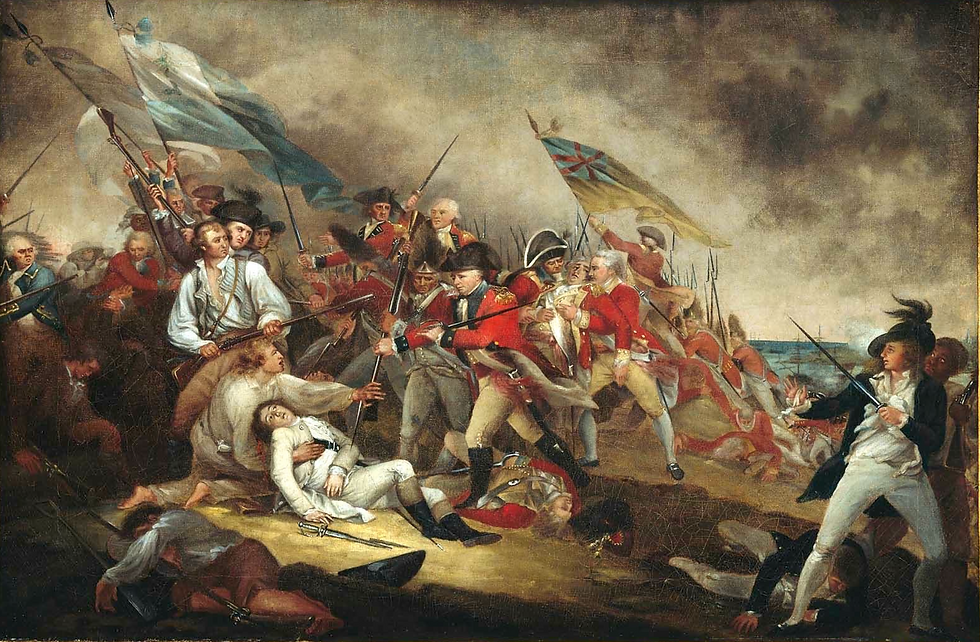
Artist John Trumbull included Cousin Moses in his painting of “The Death of Warren.” Moses is the man seated in the shadows, looking down, in the far left of the picture.
Note: Dr. Joseph Warren was a general who insisted on fighting with the common troops. He was killed at Bunker Hill. We wrote of him in our "Final Days Before Revolution" post. He bought medical supplies from out cousin John Greenleaf's apothecary shop.
Our relatives at Bunker Hill
KILLED
Isaac Adams (3C7X)
Isaac Baldwin (3C7X)
Jacob Crosby (4C9X)
Caleb Dalton (2C7X)
Samuel Hill (3C7X)
Solomon Kidder (1C7X)
Moses Parker (2C8X)
Timothy Toothaker (3C7X)
Jesse Wyman (3C7X)
Isaac Baldwin (3C7X) was a brother of our journal writing and engineer cousin Colonel Jeduthan Baldwin. (3C7X). From the memoir at the beginning of Jeduthan's published diary:
Isaac Baldwin at the very commencement of the war raised a company of men in Hillsborough, NH, and brought them to Cambridge. While there with his men a tender belonging to the enemy went aground on the Chelsea ferry ways and he went with twelve of his men in open day in the face of the enemy and burned her, after taking out her guns and sails, by throwing a pitchfork of hay on fire in the cabin windows. Having accomplished this he put his men back one by one and himself brought up the rear under the fire of the British fleet and in this way reached their quarters safely with four of his men wounded. He fought valiantly at Bunker Hill and was shot through the breast and died that night. He is said to have loaded and discharged his musket three times after he was wounded. When his men were carrying him off the field he exhorted them to fight saying 'that they would win the day, and he would be with them again directly.' He died that night."
Solomon Kidder (1C7X) was captured and, like Moses Parker, died in captivity.
Jesse Wyman (3C7X) died at home in Woburn three days after the battle.
Timothy and Allen Toothaker
Our cousin Timothy Toothaker (3C7X) was wounded at Bunker Hill. His brother Allen (3C7X) was a physician living in Merrimack, NH. Allen came all the way to Cambridge to care for his brother, but his care, like that of Cousin Moses, was to no avail. Timothy died shortly after the battle. While in Boston, Allen contracted an illness that led to a fever. He died from his malady a few weeks later after arriving home in Merrimack.
Samuel Hill
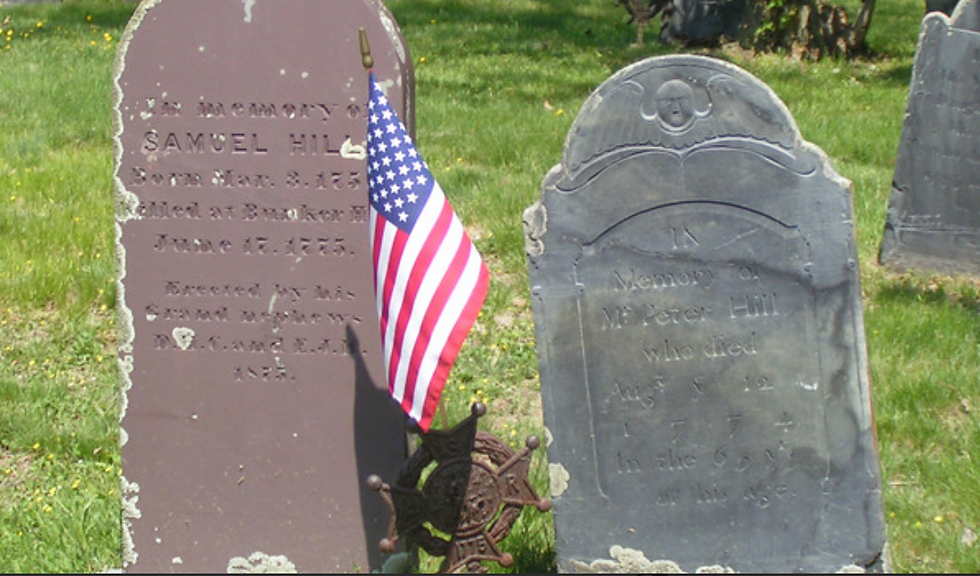
Our cousin Samuel Hill (3C7X) died on the battleground. He was probably one of the dozens of American soldiers buried in a mass grave by the British after the battle. 100 years
after Samuel's death, two of his grandnephews paid for a marker to be placed next to Samuel's father, Peter Hill (2C8X).
the Marker reads in part: "In memory of Samuel Hill born Jan 3, 1750 Killed at Bunker Hill June 17, 1775."
WOUNDED
Eleazor French
Our cousin Eleazor French (3C7X) of Dunstable had his arm shot off during the battle. Almost a year later in April of 1776, he petitioned the government for aid:
Petition of Eleazor French, setting forth the great necessity he is driven to by the unhappy misfortune of having his right arm shot off by a cannon-ball in the engagement on Bunker's Hill the 17th of June last; also lost at the same time his Gun, appraised at eight Dollars...
Eleazor also reported losing his "Cartridge-box, Bayonet, three and one-fourth pounds of Powder, one a a half pound of Ball, and one Blanket, all his own property..." Eleazor further "humbly prays the honorable Court would consider how unable the Petitioner is to subsist on his own earnings, with only his left arm, and prays there may be some provision made to relieve him in future from want and penury."
The court awarded Eleazor "the sum of three Pounds thirteen Shillings and four Pence, in full discharge of said French's loss." They also awarded him a disability payment of "four Pounds annually to commence the following April. Sadly, Eleazor did not live long enough to collect his disability. He died six months later in October of 1776 at the young age of 22.
AT THE BATTLE
We wrote about our cousin Isaac Wyman's (4C9X) tavern in our "Family Stories" post. Isaac, a captain in the American militia, lived in Keene, NH. When news of the battles at Lexington and Concord came to Keene, Isaac mustered 29 Keene militiamen and led them to Concord. A plaque on his tavern, which is now a museum, commemorates the occasion:

A mural in the Keene City Hall also commemorates the Keene Minutemen's march from Wyman's Tavern to Lexington:

Isaac then went to Cambridge where he participated in the siege of Boston and the Battle of Bunker Hill. He served in the army for two years and was ultimately promoted to the rank of colonel.
Our cousin Reuben Cummings (4C6X) marched on the day of the Alarm from Merrimack, New Hampshire. He also participated in the battle of Bunker Hill. We'll have more on Reuben in a future post.
Addison Richardson (3C7X) was a captain at Bunker Hill. In November of 1776, he was taken prisoner at Fort Washington, New York. His story will also be told in a future post.
Captain Josiah Crosby (4C9X) was forty-five when war broke out. He had already fought in the final French and Indian War. On the day of the Alarm, he commanded a company from Amherst, NH. After the battle of Bunker Hill, Josiah was ordered to make a list of "things at the battle" that were lost by is company. In June of 1776, his son Joseph (5C8X) was at Peekskill, NY, guarding the military the storehouse there when he contracted smallpox. Josiah went to get his son and bring him home to Amherst. Son Joseph survived his illness and went back to his company.
Abel (3C7X), Andrew (3C7X), Josiah (3C7X) and Israel Richardson (3C7X) were four brothers who all fought at Bunker Hill. Israel died in New York fourteen months later, two days after the Battle of Brooklyn, possibly from wounds incurred there. We'll have more on that battle in a future post.
Timothy Hildreth (2C8X) fought at Bunker Hill and continued service afterwards. From Worcester County Memoirs edited by Ellery Crane we get this information on Timothy's war experience.
Timothy Hildreth responded to the call to arms April 19, 1775, and went to Boston with the Westford company. After the battle of Bunker Hill he was ordered to drive a yoke of oxen hauling fascines (rods) for the American breastworks at Nooks Hill on the peninsular.
Note: Our cousin Jeduthan Baldwin (3C7X) as chief engineer would have been in charge of the breastwork operation.
The work required great patience and endurance as it had to be done at night over bad roads. The drivers could not even speak to the oxen. In after years he admitted that he shed youthful tears of vexation over the hardships of the work there. At the same time he expressed the greatest indignation at the transformation of Faneuil Hall by the Beritish shodiers into a theatre for amateur performances and the use of Old South Church for a riding school. After his service he returned to Westford, where he married (his (and our) cousin) Hannah Hildreth (3C7X).
We had two grandfathers at the Battle of Bunker Hill. One was Grandpa Isaac Stickney (5GGF). The other was Grandpa Daniel Sherwin (5GGF) who fought along with his son Daniel, Jr. (4U). Both are included in our "Another Four Grandfathers" post.
Benjamin Baldwin (1C7X)
Abner Brigham (4C7X)
Stephen Brigham (4C7X)
Stephen Crosby (3C7X)
Benjamin Cummings (4C6X)
Philip Cummings (3C7X)
Enoch Cummings (4C6X)
Nehemiah Cummings (4C6X)
Peter Cummings (4C6X), brother of Nehemiah
Samuel Cummings (4C6X)
Jonas French (3C7X)
Samuel French 4C6X)
Jonathan Greenleaf (5C6X)
Nathaniel Haseltine (3C9X)
Jeremiah Haseltine (2C10X), uncle of Nathaniel
Jonas Haseltine (2C8X)
Levi Hildreth (3C7X)
Samuel Hildreth (3C7X)
Daniel Kidder (3C6X)
Josiah Kidder (3C6X)
Francis Kittredge (3C7X)
Solomon Kittredge (3C7X)
William Kittredge (3C7X)
Ezra Lunt (5C6X)
Joshua Parker (2C8X) First cousin of Moses Parker (2C8X), above
Gershom Proctor (3C6X)
Silas Proctor (3C6X)
Abiathar Richardson (4C6X)
Barnabus Richardson (3C7X)
David Richardson (4C6X)
John Richardson (4C6X)
Stephen Richardson (4C6X)
Thomas Richardson (4C6X)
Wyman Richardson (4C6X)
Paul Richardson (4C7X)
Joseph Stickney (3C8X)
Lemuel Stickney (3C8X)
Our cousin Ebenezer French, Sr. (3C7X) was married to our aunt Rebecca Kidder (5A). It's impossible to know whether it was Ebenezer, Sr. or his son Ebenezer French, Jr. (1C6X) who fought at Bunker Hill. Since Massachusetts Soldiers and Sailors lists Ebenezer as a drummer, it seems more likely that it was the son, who would have been fifteen in 1775, and not the father, who was in his forties. Ebenezer French, Jr. was later killed in 1778 in Nova Scotia.
William Stickney, (3C8X) brother of Joseph Stickney (listed above), missed the battle because of blistered feet.
Oliver Cummings (3C7X) missed the battle because of illness. He was made captain shortly afterward.
In all, forty-three of our relatives that I know of participated in the Battle of Bunker Hill.


Comments