
OUR WALL FAMILY
- westmohney

- Sep 23, 2022
- 8 min read
Updated: Nov 20, 2022
I dearly wish I could explain how he (John Wall) came to be so prominent but the records–such as they are–simply give us no clue. ~ Cousin Lou Poole

the move to Brunswick County
Our distant cousin Lou Poole (5C) has done an amazing job of collecting information on the Wall family in Virginia. Most of the information I have on the southern branch of our family comes from his efforts. We most probably have four grandfathers named John Wall. The first came to Virginia ca. 1636 and settled on the banks of the James River near our grandfather Francis Eppes' (9GGF) Hopewell estate. His son, John Wall, Jr. (7GGF), continued living in the same spot on his inherited land.
John Wall III (6GGF) was born ca. 1690 in Prince Charles County Va. Cousin Lou has no less than 63 pages of records and other information on John Wall III and his son, John Wall IV (5GGF). Since the lives of John Wall III, his brother Michael (6U) and his son John Wall IV are all intertwined in the records, we'll attempt to make some sense of the multitudinous records Lou found for the three of them that spanned thirty-seven years.
When he was about 25, John Wall III made a land purchase which would motivate a move southward away from the home plantation in Prince George County. "31 Oct 1715. John Wall, on S. side of Nottoway River, on both sides of Waquiyough Creek. 185 acres." The land John Wall III acquired would eventually become part of the newly formed County of Brunswick, VA.
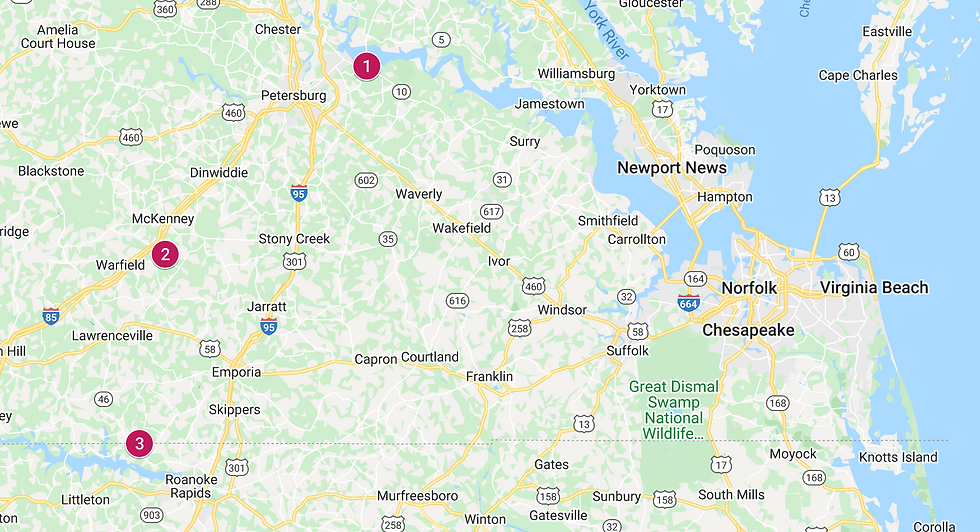
It's possible that when he made that first land purchase, John Wall III was still living on his father's plantation. It was around this time that he married and began his family. John was married at least twice. Nothing is known of his first wife who was the mother of at least four of his children, including our grandfather John Wall IV. From records which indicate when John Wall IV would have come of age, Lou surmises that he was born ca. 1715 and was the first born child of John Wall III.
In 1717, two years after his Brunswick County purchase, John Wall III's father, John Wall, Jr., died. He named only two sons in his will, John III and Michael but, from a patent found by Lou Poole, we know he had at least one more son, James (6U). Our grandfather, John III, inherited the home plantation but that wasn't enough to keep him in Prince George County.
Whatever became of the home plantation is unknown, but it appears that John Wall III never lived there after the death of his father. Just two months after his father's will was probated, John III received another piece of land in southern Virginia:
John Wall, of Pr. Geo. Co.; 100 acs. on S. side of Maherin River; near lower end of the Dutchman’s Meadow; 17 Dec. 1717. For service performed towards making the new settlement for the Saponie Indians at Christianna, &c.
It's likely that John III was part of a military company that had helped to relocate the Saponi tribe to their new home. The land that he received was "part of that tract of land whereon the Saponie Indians lately dwelt & which they have surrendered in exchange for a like quantity assigned them at Christanna" and "in consideration of divers services performed toward making the new settlement for the Saponie Indians at Christanna, pursuant to a treaty with that Nation."
the Saponi story
The story of the Saponi exemplifies the fate of weaker Native tribes at that time throughout the south. The Saponi, a small group of corn farmers and hunters, originally lived near present day Charlottesville. Time and time again, however, they were forced to relocate due to encroachment of white settlers and pressure from their more powerful Native enemies. By the early 1700's, they had moved south into North Carolina. Unfortunately, the Tuscarora War, which began 1711, made life there impossible for the tribe.
Note: We wrote about the Tuscarora War in our The Virginians post.
In 1714, the Saponi entered into a treaty agreement with Virginia. The agreement stipulated that, in exchange for protection, the tribe would serve the Virginia government as frontier scouts. Their home was to be a six square mile reservation at Fort Chrisitiana on the Meherrin River. At the same time, The Virginia Indian Company, "a joint stock company open to all Virginians then engaged in the Indian trade," was established with headquarters at Christiana.
The proximity of John Wall's land in Brunswick County to Fort Christianna makes it clear why he wanted to be involved in the settlement of the Natives.

Although the fort was home to the Saponi, it was regulated by the Virginia militia. All Natives were required to surrender their arms whenever they entered, leaving them defenseless. In 1717, a group of Seneca and Tuscarora invaded the fort, killing five Native people, wounding two and carrying off five as prisoners. The Saponi, understandably outraged, threatened to leave the fort but were persuaded to stay after being promised heightened protection by the Virginia Indian Company. The Tuscora War, however, had escalated to the point that no man wanted to take on the job of guarding trade caravans, let alone the Saponi Natives.
With no protection for the trade caravans, the Saponi trade market dried up. Consequently, the Act for Better Regulating the Indian Trade was repealed and the Virginia Indian Company dissolved. The Saponi were now superfluous to the Virgina government. In May of 1718, the General Assembly decided not to keep up the fort where the Saponi lived and on which they relyed for protection. Still, the Saponi stayed for ten long years, taking on their own support and defense. During those years, passports were required for any Native person wanting to leave the fort for any reason. By 1729, the tribe had had enough. The journals of the Executive Council, in October 1729, state that ‘the Sapony … have lately deserted their settlement …[in Virginia] and joined the…Cattawba Indians.’
Sadly, at that point, the Saponi tribe fragmented. Some joined the Catawba tribe in South Carolina while others migrated to New York and joined the Cayuga of the Iroquois Nation. Some even assimilated themselves into English settlements. After the Saponi left the region, all their former lands were given away in grants. The site of the Fort Christiana became known as Fort Hill Plantation.
The Saponi story is a vivid example of the disintigration of Native tribes that would continue happening all across the American Continent. The Saponi, happily, eventually survived as a tribe. Today, the Haliwa-Saponi is a small, state-recognized tribe with headquarters in the town of Hollister in Halifax County, Virginia.
in Brunswick County
John Wall III was committed to his move south. All further records show him to be in southern Virginia. Lou Poole posits that "John Wall, somehow, was associated with political interests outside Prince George County, that he was probably in the militia at that time." It's entirely likely that John's "interests outside Prince George County" revolved around the Indian trade centered at Fort Christiana.
Possibly with funds from the sale of his father's homestead, John continued to acquire property in Brunswick County on both sides of the Meherin River. In July of 1719, he purchased another 200 acres. His initial land acquisitions were only the beginning. Over the next forty years, John Wall would transact land purchases of over 12,000 acres.
By 1724, it appears that John's brother Michael was also committed to the move south.
In December of that year, John and Michael petitioned the Council to survey two thousand acres on the south side of the Roanoak River. Following a rule that limited acquired acreage to 1,000 acres, the Council decided that they could each have 1,000, but not 2,000 jointly. Since John Wall was becoming such an important personage in Brunswick County, the council did, however, concede that if "his Majty shall think fitt to allow a greater Quantity than one thousand acres to be granted in one Tract that then the Petre have Liberty to include the sd two thousand acres of Land in one joint Patent."
In the Virginia land records at this time, the name of another possible brother of John III pops up. Daniel Wall received a grant for 75 acres of land on the very same day in the very same area that John Wall purchased 970 acres on the south side of the Nottoway River. Lou says that "[i]t seems apparent that the two were related."
Another patent definitely reveals a brother not named in their father's will. The record names William Wall (6U) of Prince George County who bought 80 acres "on S. side of Nottoway Riv., & on both sides of Waquiyough Cr., adj. his brother John Wall; 7 Jul 1726."
John and Michael also had at least one sister, Agnes (6A), who is mentioned in Michael Wall's will.
John Wall, Indian trader
Lou Poole's research led him to believe that John Wall III, like our Poythress relatives from our last post, was an Indian Trader:
As I continue my research on the Wall family, and become familiar with the names that appear in association with them, I am beginning to piece together the picture that John Wall and cronies were Indian traders. David Crawley and Robert Hicks definitely were, as was Peter Poythress (6U). Capt...If these men were all part of an organized company of merchants whose principal business was trade with the Indians, it would all fit. The fact that William Lucas claimed John Wall as a headright could very well mean that John Wall left the colony, and returned, on company business. Interestingly, this pattern could also explain the family’s move to Anson County, N.C. In the 1750’s, Anson County was frontier, and many of the earlier settlers to this area were, in fact, Indian traders. The fact that the Walls seemed to frequently return to their home in Virginia from North Carolina, may indicate that these trips were part of the business, i.e., they were periodically returning to Virginia for trading supplies.
John Wall's close association with Fort Christiana and the Saponi tribe is another indication of possible Indan trading ties.
Parish and civic life
When John Wall III first arrived in Brunswick County, the closest minister was the Reverend John Cargill, of Southwark Parish, soon to become St. Andrews, John's parish. In 1724 Reverend Cargill described the parish as "twenty miles in width and one hundred in length, being a frontier Parish. It has 394 families. The school for Indians is on the borders of my parish. There are one church and two chapels and seventy or eighty communicants."
The year 1732 was indicative of the stature John Wall had achieved in Brunswick County. First, he was was given an appointment as one of the initial justices for the Court of Brunswick County. And, according to Lou, "only a day after taking the oath as a Justice, he was appointed as one of the church wardens of St. Andrew’s Parish." For his service as church warden, John was paid a handsome 1000 pounds of tobacco. In October, he rose to the rank of captain in the militia, a title he would hold for two years before being promoted to major. And, finally, John was appointed member of a committee to oversee the building of a bridge over the Nottoway River.
In 1734, John was on the committee to oversee the building of two new chapels and was authorized to "employ workmen." Then he was given the authority to "[e]lect the place where it (the chapel) is to be built." And a record from November of 1735 said that "John Wall, Gent., is the cheapest builder of the church on North Side of the Meherin river." Compliment?
John Wall's prominance in Brunswick county is evident from the hundreds of records Lou has found in which his name is mentioned. These records include court cases, land purchases, civic appointments, will administrations and guardianships to name a few. Since the Walls had never been in the same league as the Eppes and Poythress families, Lou wonders about John Wall III's obvious rise in stature. He writes:
I dearly wish I could explain how he came to be so prominent but the records–such as they are–simply give us no clue. It might be possible that his unknown wife was of one of the leading families and it was through her connections that he attained such prominence so relatively early in life.
Note: The original Wall plantation in Prince George County lay between the Eppes property on one side and the Poythress on the other. From this vantage point, they must have hob-nobbed on and off with at least some of the elite.
Up next: More about the Wall family in our next post.


Comments