
SALEM
- westmohney

- Sep 4, 2020
- 6 min read
Updated: Oct 18, 2022
...a secluded place on a peninsula by a wide river with good harbors, in the territory called by the Indians Naumkeag ~ Sydney Perley
beginnings
Salem was the fifth town founded in the Massachusetts Bay Colony. In 1626, the fishing port of Cape Ann, 23 miles northeast of Salem, turned out to be a losing proposition. Most of the fishermen working there sailed back to England. Roger Conant, however, decided he wasn't ready to throw in the towel and traveled with a group of men to a bay that pleased them. The indigenous people called it Naumkeag. The Englishmen who settled there liked the Hebrew word for peace better and Shalom became Salem.
The first two years were difficult for Conant's party. But they had a bit of luck and, just in the nick of time, the Massachusetts Bay Company sent relief to the struggling town. John Endicott brought with him a group of settlers who were to lay the groundwork for a wave of thousands who came afterwards in what would become the Great Migration.
Note: This is the same John Endicott who would lead the Massachusetts Bay Militia into Connecticut to battle the Pequot.
While Salem's main claim to fame might always be the infamous witch trials held there in 1692, in 1637 it was a bustling port town of 900 inhabitants. That year, our Payne family sailed to America and decided on Salem as a goodly place to settle. The Paynes were long gone before the chaos that ensued. Still their story is worth the telling. Our grandfather Thomas Cole (9GGF) came later to Salem with a far less interesting story but both his sons had wives who would play a part in the future witch upheaval.
a rare document
Most of the information I've gleaned about the Payne family has been from a book, Thomas Payne of Salem and his Descendants, by Nathaniel Emmons Payne (7C5x), a distant cousin of ours. In 1878, a remarkable piece of Payne family history was purchased by Nathaniel's father.
The document is a record of the marriages, births and deaths of the Thomas Payne I (12GGF) family. Beginning in 1578, the document chronicles two generations ending in 1636 with the death of nine year old Nathaniel Payne (12U), son of Thomas Payne II (11GGF). This death occurred only one year before the family sailed for America.

The above document reads in part:
In the year of our Lord. 1580: In the year of the reign of Queen Elizabeth the. 24: By me T.F.
A trewe and perfight note of the birth day and hower (hour) of the children of Thomas Payne and Katheren his wyffe: And allso the day of their marriage.
Whom God hath joined together, let not man put asunder.
Let it be remembered, that I Thomas, have taken as my as my wife katheren harssant daughter of Thomas harssant of Cranfford: near Cooklie, on Sunday, which was the twentieth day of the month of July, in the twentieth year of the reign of the Lady Elizabethe, now Queen of England: and in the year of our Lord 1578.
The record continues with the births of all of Thomas I's (12GGF) children ending with his youngest, Thomas Payne II (11GGF).
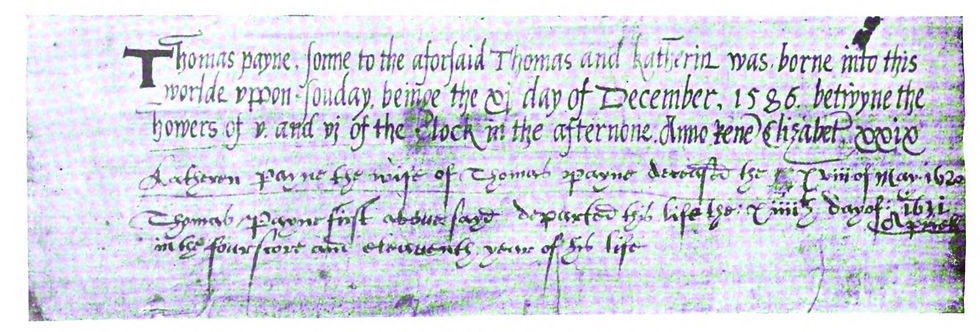
The handwriting changes after the birth of Thomas II. Experts who have examined the document believe the earlier writing was done by a scribe. Probably Thomas II's own hand wrote the rest of the record. His first duty was to note the death of his parents:
Katheren Payne the wife of Thomas Payne deceased the 18th of May: 1620
Thomas Payne first above sayd departed this life the 14th day of: Apriell 1631 in the four score and elevventh year of his life.
The final section of the document, continuing in the new hand, records the marriage of Thomas II (11GGF) to Elizabeth (11GGM) (alas, he gives no last name!) and the birth dates of all his children ending with Nathaniel (11U) born in 1626, "who departed this life the first of Aprill 1636 of the age of nine years : going for ten." A year after Nathaniel's death, the family sailed for America.

This record is believed to have been brought to America with Thomas Payne II and passed down through many Payne generations until it reached Caroline Whiting.
The Payne family lived in Wrentham, Suffolk, England until the religious upheaval in that country led to their migration across the ocean.
Grandpa Payne buys a ship!
By 1635, more than half the population of Wrentham had turned away from the Church of England. They had become Congregationalists and they were Puritans. Thomas Payne II (11GGF) and his family were part of this group. They did what many of their friends and family were doing. They decided to leave England.
In The Great Migration and the Great Migration Begins we find this passage:
When in the reigne of Charles I an endevour was made to supresse the Puritans, a ship call'd the Mary Anne was fitted out at Yarmouth, by a merchand named Payne, for the conveyance of the persecuted to New England, he himself being one of the number...
And thus it would appear that our grandfather Thomas Payne II (11GGF), a weaver, happened to be quite a successful businessman at the time he sailed for America. He left his mill in the hands of one of his kinsman and, on his newly purchased ship, sailed with his family and others who booked passage to the Massachusetts Bay Colony.
The Mary Anne of Yarmouth, with William Goose as its master, sailed from Ipswich, England in May, 1637, conveying sixty-eight passengers. Before boarding, all passengers were required to obtain the King’s license to travel and to swear an Oath of Allegiance to the Crown. From The Transcript of Three Registers of Passengers from Great Yarmouth to Holland and New England :
...The examinaction of Thomas Paine: of Wrentom in Suffolcke weavear ageed 50 yeares and Elizabeth: his wife ageed 53 yeares with 6 children Thomas: John: Marey: Elizabeth, Dorethey: and Sarah: are desirous to goe for Salame in New England to inhabitt.
Missing from this group is Thomas and Elizabeth's son Peter, (11U) born in 1616. He would have been 21 years of age in 1637 and possibly booked passage on his own sometime later. That he came to the New World is proven by the mention of Peter in Thomas II's will and we find him later in Southold, New York where a faction of the Payne family eventually moved.
The Mary Anne arrived in Boston on 20 June, 1637. Thomas and Elizabeth settled with their children in Salem.
in Salem town
On 21 Aug 1637, Thomas Payne was received as an inhabitant of Salem. At a town meeting a week later, Thomas "asked for the grant of a little parcel of land next to his house..." In December of 1637, he was granted one acre of land. Sadly, these are the only records of Thomas Payne II in Salem. His will was written 11 Feb 1638. His widow, Elizabeth, received a land grant of 40 acres on 21 Jan 1639, so poor Thomas died some time in that eleven month period. Sidney Perley's History of Salem includes a copy of his signature "taken from his will, which was signed when he was sick and weak."

Also in his will, Thomas II mentions the mill "left in the hands of Henry Blomfield my kinsman." He instructs his executors to sell the mill and divide the proceeds equally amongst his wife and children.
Only four of his seven children are mentioned in Thomas' will so it is surmised that Elizabeth, (11A) Dorothy (11A) and Sara (11A) died either aboard ship or shortly after their arrival in Salem.
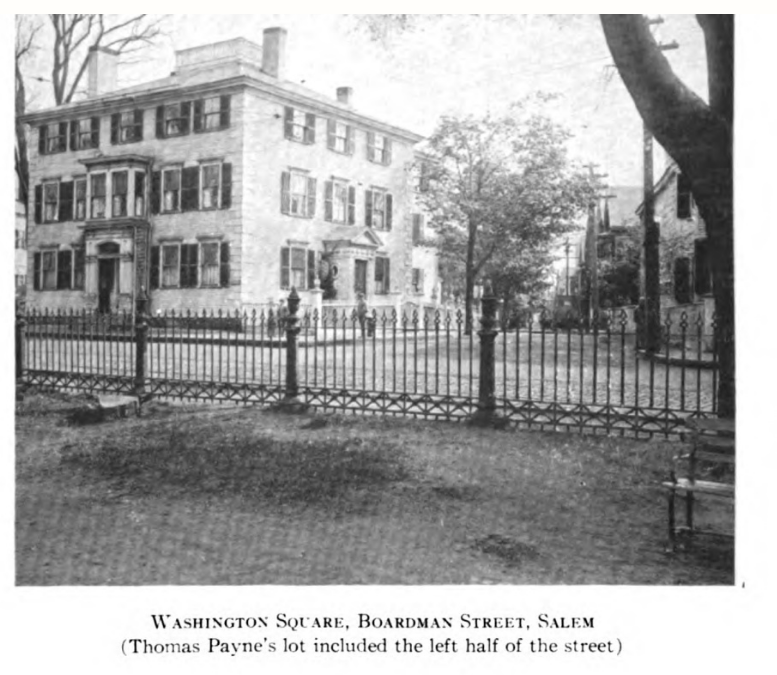
Below is the house that sits on Thomas Payne's former property in Salem. The house in the picture (taken in the late 1800's) is still there.
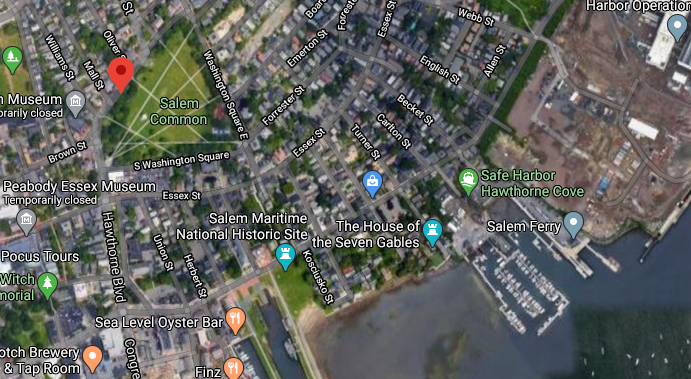
Note: Salem Common has been public land since the town was founded. Originally the Common was used as grazing lands for livestock In 1635, the first muster took place on this Common, establishing a militia. Regular drills have been held since then. In 1714, it was voted that the land should be "forever kept as a training field for the use of Salem." Because the first muster took place there, Salem was designated the home of the National Guard in 2010.
Shortly after his father's death, our grandfather Thomas Payne III (10GGF) moved to Dedham where he lived for the rest of his life. His siblings, John, (11U) Peter, (11U) and Mary (11A), eventually moved with their mother Elizabeth (11GGM) to Southold, NY.
an uneventful life
It is unclear when our grandfather Thomas Cole (9GGF) came to America. Thomas Cole lived an uneventful life and died in Salem in 1679 and his wife Anne followed in 1681. They had two children, Abraham (9U) and John (8GGF), both of whom had wives accused of witchcraft. The Salem curse had long tentacles. Those stories will be saved for a future post.


Comments