
PRELUDE TO REVOLUTION
- westmohney

- Mar 4, 2023
- 12 min read
Updated: Aug 7, 2023
The madness of mobs or the insolence of soldiers, or both, when too near to each other, occasion some mischief. ~ Benjamin Franklin

The Boston Massacre
A fierey, tense atmosphere prevailed in Boston after the death of Christopher Seider. The 2,000 British soldiers camped around town further complicated an already volatile situation. Eleven days after the boy's death, on March 5, 1775, a handbill was posted around town making it clear that the British soldiers intended to defend themselves from the rabble rousers. Some historians feel there is a high probability that the handbills were actually tacked up by the Sons of Liberty to further inflame the citizens. A rumor spreading that the soldiers were preparing to cut down the Liberty Tree didn't help matters.
The handbill so enraged the populace that a large crowd stormed the barracks of the 29th Regiment. The mob was driven away and and the soldiers wisely remained in their barracks. The crowd then turned their attention to a single sentry posted outside the Customs House on King Street. Thomas Preston, captain of the 29th Regiment, was told of the of the sentry’s predicament by a British sympathizer. Preston quickly arrived on the scene with seven armed soldiers in an attempt to rescue the guard.
This crowd just happened to be naively and dangerously aware of their rights. According to the Riot Act, passed by the British government in 1715, constabulary and soldiers weren't allowed to fire their weapons until the Act was read and, equally important, the crowd had an entire hour to disperse. The Riot Act said that:
Our Sovereign Lord the King chargeth and commandeth all persons, being assembled, immediately to disperse themselves, and peaceably to depart to their habitations, or to their lawful business, upon the pains contained in the act made in the first year of King George, for preventing tumults and riotous assemblies. God Save the King!
With a false sense of security, the crowd began taunting the soldiers, pelting them with snow, ice and oyster shells. Some in the crowd even dared the soldiers to shoot. As has happened time and time again in the annals of history, one of the spooked soldiers eventually fired his musket, possibly into the air. Others, believing the command to shoot had been ordered, fired into the crowd. Three men in the crowd were killed instantly. Of the eight people wounded, two later died.
Quickly onto the scene were Governor Thomas Hutchinson and his trusty sheriff, our cousin Stephen Greenleaf (4C7X). Preston and his men were ordered back to their barracks. Hutchinson then did the only sensible thing he could do. He made his way to the balcony of the Old State House, and attempted to calm the mob with promises that "justice would be done."
The morning after the shooting, Captain Preston, his seven soldiers and the sentry they had been sent to rescue were all placed under arrest and sent to the Boston jail.
"The Fruits of Arbitrary Power"
The death of Christopher Seider and the shooting on King Street couldn't have come at a better time for the Sons of Liberty. They immediately got busy, milking both events for all they were worth. The Boston Gazette, firmly in the hands of the Whigs, characterized the event as “a horrid massacre.” The Gazette used the testimonies of no fewer than ninety-six "eyewitnesses," who all agreed that what happened could only be considered murder.
A British officer, Colonel Dalrymple, wrote his own version of the event based on thirty-one testimonies collected by his officers. His version titled “A Fair Account of the Late Unhappy Disturbance at Boston in New England” told a very different story than what was being presented in the Boston Gazette. From his jail cell, a very unhappy Captain Preston wrote his own version, defending the actions of his under duress soldiers.
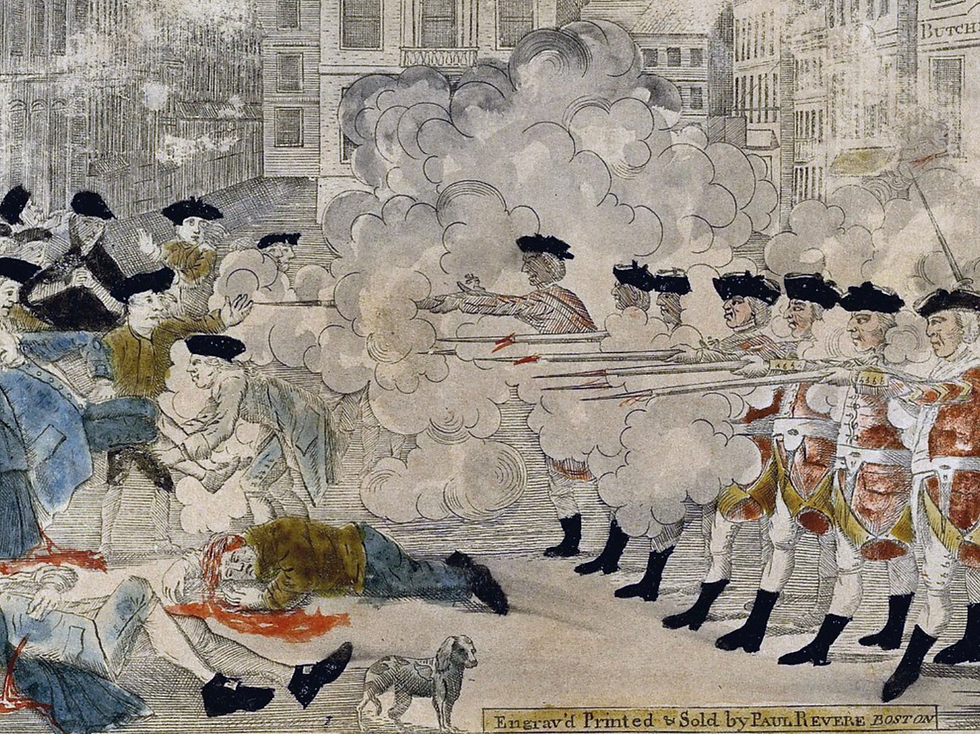
Meanwhile, the Sons of Liberty were busy distributing broadsides, poems and illustrations dealing with the event all over town. The most famous of these was not only inaccurate, but was, in essence, stolen by none other than Paul Revere.
Henry Pelham, a loyalist Boston engraver, created an image he called "The Fruits of Arbitrary Power," which showed the soldiers in formation firing their muskets. Paul Revere "borrowed" Pelham's illustration to create a poster that became the most famous image of the "massacre." Below are Pelham's original illustration and the strikingly similar poster created by Paul Revere.


incarceration
For their own safety and the safety of the Boston citizens, the two British regiments were moved to a less conspicuous, and more fortified, location on Castle Island. Previously they had been housed in the heart of the city around the Boston Commons.

Boston was placed on high alert. Customs officials hightailed it out of town. Sheriff Greenleaf warned of possible jailbreaks by the incarcerated soldiers so the town agreed to cover the cost of more watchmen. Poor Captain Preston was so in fear of being lynched by a mob that, according to an account written by a town committee investigating the event, "he accordingly applied to Mr. Sheriff Greenleaf for special protection on that account. But the sheriff assuring him there was no such disposition appearing among the people..."
Preston was right to be worried. In the opinion of Judge Oliver, who was going to preside over the case, “had a Trial been refused, it was rather more than an equal chance that the Prisoners [i.e. Preston and the soldiers as well as (Cousin Ebenezer) Richardson] would have been murdered by the Rabble; and the Judges been exposed to Assassinations.”
As it turned out, the soldiers involved in the shooting on King Street were jailed very near to our cousin Ebenezer Richardson who had shot young Christopher Seider. Ebenezer and four of the soldiers signed a petition stating that they saw a guard knock down a pregnant woman who was bringing food for her imprisoned husband.
the trial
The most pressing issue for Captain Preston and his soldiers was the matter of finding defense attorneys willing to take the case. James Forest, a British sympathizer and friend to Preston, had tried to no avail to get council for them. Forest finally approached Josiah Quincy who agreed to take the case only if John Adams was also part of the defense team. Adams, a staunch Son of Liberty, agreed only because of his belief that everyone deserved a fair trial.
Ironically, Josiah Quincy would be pitted against his own brother, Samuel Quincy, a loyalist who agreed to join Robert Treat Paine on the prosecution team. Those two men had also been the prosecutors in Cousin Ebenezer's trial for the murder of Christopher Seider.
Fortunately for Captain Preston and six of his soldiers, John Adams put on a brilliant performance during the trial. Adams maintained that no one knew for sure who, if anyone, had given a command to fire. He emphasized the chaos and confusion and fear of the moment and managed to convince the jury that there had been no malice on the part of the soldiers. Only two of the soldiers were found guilty, Matthew Kilroy and Hugh Montgomery. The rest were released scot free.
At their sentencing on December 14, 1770, Kilroy and Montgomery faced the death penalty but, luckily for them, Britain had enacted a myriad of escape clauses for anyone they deemed worthy of saving. Kilroy and Montgomery were allowed to "pray the benefit of clergy." All they had to do to beat the rap was prove they could read or recite Psalm 51, verse 1:
Have mercy upon me, O God, according to thy lovingkindness: according unto the multitude of thy tender mercies blot out my transgressions.
Both men passed with flying colors.
One of Cousin Stephen's duties as sheriff that hasn't yet been mentioned is the branding of convicted criminals. In the case of Kilroy and Montgomery, branding was called for because the clergy defense was only a one time benefit. So Cousin Stephen got out his hot iron and duly branded Kilroy and Montgomery on the right thumb with an "M" for murderer.
In 1822, John Adams wrote about the branding of the two men:
I never pitied any men more than the two soldiers who were sentenced to be branded in the hand for manslaughter. They were noble, fine-looking men; protested they had done nothing contrary to their duty as soldiers; and, when the sheriff approached to perform his office, they burst into tears.
Adams, however, did not pity the men so much that he discontinued his efforts toward ensuring a new independent nation. The mood in Boston had changed after the "massacre." The Sons of Liberty took their advantage and ran with it.
a ruckus in Marlborough
The politcal turmoil in Boston had begun to spread to other towns throughout the colonies.
In July of 1770, the conflict reached Marlborough, home to many of our Brigham cousins.
The root of the conflict there was a loyalist importer, Henry Barnes, who had refused to sign the widely favored non-importation agreement. While Barnes was looked upon with disgust by the majority of Marlborough citizens, he did have a few loyalist supporters. On July 17, Barnes decided to show his appreciation by doling out liquor to those that had remained sympathetic to him.
On hand to partake of Barnes' generosity were three of our Brigham cousins. Nathan (4C10X), John Gott (5C9X) and Solomon Brigham (4C10X) were Loyalists who continued to stand behind Henry Barnes. The event our cousins attended was a rabble rousing success. Sufficiently boozed up, some of Barne's friends, took themselves into town "with clubs &c." to demonstrate their ongoing loyalty to the King of England. One of these men was our nineteen-year-old cousin John Gott Brigham. The group came upon Waldo Woods whose father, Alpheus, was part of a committee created to enforce the non-importation agreement.
The story was reported in the Boston Evening Post:
One struck him with his fist,——but two others made several passes at his throat with edged weapons, and stab’d him in his shoulder thro’ his shirt; he then cried out murder and said they had stab’d him; whereupon others came running to his relief from being murdered outright on the spot; he pleaded with them to let him go home: but Hale and Brigham would not let him and hall’d him along by Barn’s to Simon How’s, the man that had kept open doors & dealt out the liquor that evening.
Mr. How expressed himself very sorry and said he tho’t they had carried matters a little too far.—Two of them said they would detain him and lick him to death if he would not promise not to prosecute them. . .Some of their company not being much liquor’d procured his liberty to go home.
The young lad is like to recover, though his life has been in imminent danger. And his father is prosecuting the affair, and it is hoped that the civil authority will prevent the repetition of such a horrid Tragedy as that of the 5th of March in Boston. (The Boston Massacre)
The story didn't end there. The Sons of Liberty couldn't let the matter rest there. A group of them set out for revenge. According to a story obviously written by a Loyalist in the Boston Gazette:
…the said mob alias sons of liberty knowing their cause to be bad. . .sent out a scout of about five in number well arm’d to reconnoitre the street, among which was Waldo Woods, the young fellow said to be wounded, as ill-bred a fellow as ever existed, who came foremost armed with a tomhawk [sic] and his mouth full of oaths, imprecations and curses, and assaulted John Gott Brigham, and swore he would split out his brains, and would bring 200 people in half an hour, upon which said Brigham told him he had better go home and be peaceable or he would flog him.
Then said Woods drew out a sharp pointed knife, and swore he would stab him to the heart, and made a pass at his belly, upon which Brigham seized him by the arm, and took the knife out of his hand and thereby saved his own life; but it seems in the scuffle of taking away the knife, Woods bro’t the point of it against his own shoulder, and made a scratch equal to the scratch of a pin, not one drop of blood lost, and then he cry’d murder and run home with wet breeches, and no other person than Brigham offered to meddle with him: and neither Brigham nor any other person who was at said Simon How’s that night, had any sort of weapon, either wood or iron with them, nor did any of them attempt to meddle with or molest any Person that pass’d the street that evening.
Tensions in Marlborough were eased a bit by October of 1770 when the non-importation rules were relaxed. Our feisty cousin John Gott Brigham, even with his Loyalist leanings, made it through the war years unscathed. He died in Marlborough in 1818 at age 65.
publishers join the fight
With the newly inflamed environment around the colonies, our cousin Joseph Greenleaf (4C7X) was one of the men who jumped right into the fray. Joseph, a third cousin to Sheriff Stephen Greenleaf, owned a farm in Abington, MA, 20 miles south of Boston. In 1749, he had married Abigail Paine, sister of Robert Treat Paine, who was the prosecuting attorney for both the Ebenezer Richardson and the Boston Massacre trials. Paine is considered one of the founding fathers of the United States.
In March of 1770, Joseph wrote a set of sixteen "resolves" which were overhwelmingly adopted by the citizens of Abington. The Resolves basically stated that all nations and all men are "naturally free" with the right to defend themselves when their civil liberties are threatened. Further, the resolves made it clear that the recent Acts of Parliment constituted "an infrigement" of America's "national and constitutional liberty." These sixteen resolves became known as "The Noble Resolves." Joseph didn't stop there. Shortly afterward, he wrote a "strongly worded" article criticizing Britain's new tax policies which was published in various newspapers around the colonies.
When reading Joseph's Resolves, it's clear to see that he was right in step with the main Patriot rabble rousers like Samuel Adams and John Hancock. The resolves particularly praised the merchants of Boston who were honoring the nonimportation agreements. Joseph called their actions "a superlative instance of self denial and public virtue which we hope will be handed down to posterity, even to the latest generation, to their immortal honor." He went a step further writing "[t]hat people not adhering to the importation agreement, ought to be by us held in the utmost contempt. . .their names shall stand recorded to be posted up in all public places. . .as enemies of their country."
The Resolves became popular not just in Abington, but throughout the colonies. The Boston Essex Gazette posted a letter from New York that said: "The Resolves of those illustrious, and immortal Friends to the RIGHTS OF MEN—The Abington Resolves, have given their Brethren here, INFINITE PLEASURE, and I imagine some others as much Pain."
According to the authors of the textbook Reasoning with Democratic Values 2.0, Joseph "quickly became famous." This new found fame led him to sell his farm and move to Boston, the scene of all the action. There he wrote extensively for Isaiah Thomas' anti-administration paper, the Massachusetts Spy. The paper's office "became a meeting place for rebellious colonial leaders, including Samuel Adams and John Hancock."
Governor Thomas Hutchinson, not impressed with the Massachusetts Spy, would eventually fire Joseph from his appointed position as Justice of the Peace. Joseph, likewise, was not much enamored of Governor Hutchinson. The two eventually entered into a major battle over a proclamation Hutchinson issued on 24 Oct 1771. The proclamation called for work to be put aside for a day that the people might thank God for their peace and prosperity as well as their "civil and religious Privileges." Hutchinson wrote that all citizens should express thanks for the "life and Health of our Sovereign Lord the King."
Since publishers could be held liable for material in their publications, many newspaper articles were written under pseudonyms. A rebuttal to Governor Hutchinson's proclamation was written under the name "Mucius Scaevola." While it has never been entirely proven, Thomas Hutchinson, himself, as well as most historians feel that Mucius Scaevola was none other than our cousin Joseph Greenleaf. J.L. Bell devotes an entire blog post supporting the theory that Cousin Joseph was "Mucius."
On November 4th a piece by "Mucius" appeared in the spy attacking Hutchinson's proclamation. In addition to referring to the general populace of America as "slaves," he went on to say:
. . .fools they must think us, if they can imagine that we can complain of loss of liberty in one breath, and with the next solemnly thank God for the preservation of it. . .An Englishman should never part with a penny but by his consent, or the consent of his agent, or representative, especially as the money thus forced from us, is to hire a man to TYRANNIZE over us, whom his Master calls our Governor. This seems to be Mr. Hutchinson’s situation; therefore I cannot but view him as a usurper, and absolutely deny his jurisdiction over this people. . .A ruler, independent on the people, is a monster in government; and such a one is Mr. Hutchinson; and such would George the third be, if he should be rendered independent of the people of Great-Britain.
It's no wonder this article should be written anonomously. Calling the governor a usurper and mentioning the king in the same breath comes very close to being a treasonable offense. The governor was not happy. The Council summoned Cousin Joseph to "discuss" the "Mucius Scaevola" essay. Joseph sent regrets. He later wrote about his reason:
On the 15th of November last I received a polite message from the Governor and Council, by Mr. Baker, desiring my attendance at the Council Chamber, this I have no fault to find with: The distress of my family, on account of a sick child, who died that day, was such that I could not possibly attend, and I excused myself in the most polite manner I was capable of.
It's true that Joseph's son Joseph, Jr. (5c6X), 18, died very that day. Still, Hutchinson wasn’t satisfied with the excuse. He had Joseph, and others associated with The Spy, indicted for seditious libel. The local grand jury, however, refused to take any action.
Joseph continued his with his publications throughout the war. In 1773, he opened his own printing office where he and his son Thomas (5C6X) published pamphlets and books. Then, in 1774 he started his own magazine, The Royal American.
After the war, Joseph was still at it. He began writing articles criticizing the corruption in the newly formed Federalist government. These articles were published in a Boston newspaper, The Independent Chronicle. In 1790, Joseph and Thomas began another publication called The New York Journal and Patriotic Register where they continued their anti-Federalist articles.
After a long and provocative publishing career, Cousin Joseph died in 1810 at age 90.


Comments