
REVOLUTIONARY STORIES III
- westmohney

- Jul 13, 2023
- 11 min read
Updated: Feb 29, 2024
In the end, it’s the family stories that are worth the storage ~ Ellen Goodman

our Tory cousin Philip Richardson
Philip Richardson (2C8X) was born in 1725 in Leicester, MA. He married a woman named Catherine Briggs shortly before he went off to fight in the final French and Indian War. In 1756, Philip was the captain of a company of soldiers serving at Fort William Henry. The commander of his regiment was Colonel Timothy Ruggles. Ruggles would prove influencial in Philip's life twenty years later during the Revolution years.
In 1673, Philip is listed as a rope-maker in the sale of some property in Maine left to Catherine by her father. The purchasers were none other than our cousins, father and son Michael (1C9X) and Tristram Dalton (2C8X) of Newburyport. We'll hear more of Tristram in a future post. Shortly after the sale, Catherine died. Philip and Catherine had three children, all under ten at the time of their mother's death. Not too long afterwards, Philip, now living in Boston, married Esther Webster.
Esther Webster may have had some money of her own. About the time of their marriage, Philip sold his rope business and it appears the couple lived quietly in Boston until the ruckus began in 1775. Here is where Philip's relationship with his old commander, Timothy Ruggles came into play. Ruggles was a noted, fervid Loyalist and Philip followed the colonel's lead. The Richardson's were probably perfectly happy living in Boston while the British were ensconced there during the siege. A year later, when the British were forced out, Loyalists were definitely not welcome. The Richardsons and Ruggles families sailed with the British army up to Nova Scotia and settled in an area that would become the town of Wilmot.

William Calnec, in his History of the County of Annapolis, mentions Philip:
It was in June, 1777, that lots. . .containing two thousand acres were granted to Philip Richardson, one of the oldest, if not the oldest grantee, of Wilmot. . . his name appears among the eight justices. . .in the county in 1780. These lots lie adjoining each other...going
west from the Ruggles Road...
So close were their ties that Timothy Ruggles was Philip's next door neighbor in Wilmot. There appears to be no more information on Cousin Philip after he settled in. We only know that he died sometime before his wife Esther's death in 1801. After Philip's death, his son Joseph (3C7X) from his first marriage, kindly brought his step-mother Esther back from Nova Scotia to live with him in New Hampshire.
Joseph, unlike his father, was a Patriot soldier extraordinaire who served from 1776 until 1780 and participated in most of the major events of the war. We'll have Joseph's story in a future post.
tainted drugs
Soon after the British were forced out of Boston in April of 1776, our apothecary cousin John Greenleaf (4C7X) was back in business. We wrote about the deaths of John's three young children in our "The Greenleafs" post. John also had the distinction of having two Sheriff of Boston brothers, Stephen (4C7X) and William (4C7X).
One of John's best customers was the Committee of War for the state of Massachusetts. John's ledger shows that, on May 25th, the committee purchased almost £4 of "Sundry Medicines." And the government would have further need of John's services.
As the store of medicines housed in Boston were examined more closely, there was an "outcry that the British had poisoned the supply of drugs left behind." According to George B. Grifenhaben in his article, "Drug Supplies in the American Revolution," the Boston Gazette reported that "it is absolutely fact that the Doctors of the diabolical ministerial butcher when they evacuated Boston, intermixed and left 26 weight of Arsenick with the medicines which they left in the Alms House."
On June 20, the Massachusetts Assembly resolved that "Dr. John Greenleaf of Boston be requested to supply the Chief Surgeon. . .with medicines as may be necessary. . ." The Assembly advanced "up to £50 to Greenleaf for purchasing such medicines as he cannot supply from his own store.” Though John was advanced the money, his ledgers show that he wasn't able to receive a full supply of needed drugs until the fall of 1776. Below is a page of John's ledger titled "United American States."

Luckily for the Continental Army, there was still a fairly good supply of untainted medicine left in Boston. Our cousin Ebenezer Crosby (3C10X), one of the surgeons at the military hospital in Cambridge, reported that "at the evacuation of Boston. . .all the Mates of the Hospital that could be spared from Cambridge. . .were employed in packing up and sending off drugs, medicines and other hospital stores, collected by order of Dr. Morgan, the quantity of which appeared great."
Note: We'll have more on Ebenezer Crosby in a future post.
According to Grifenhaben, "Inasmuch as few medicines were listed in the inventory of stores left by the British on the wharfs and in the scuttled ships in the harbor, it appears that most of these drugs obtained in Boston were confiscated from the homes, offices, and shops of the Loyalists who fled when the British evacuated." This was an extremely fortunate find that helped sustain the Continental Army in the interim until new drugs could be obtained.
Cousin John Haseltine and the Salisbury blast furnace
Half of the cannons and shot for the Revolutionary War were made in a blast furnace which was built by our cousin John Haseltine (3C9X) in partnership with Ethan Allen, the leader of the Green Mountain Boys in Vermont. We wrote about Ethan and his Boys in our "Final Days before Revolution" post.
Cousin John was born in Bradford, MA, the town founded by our grandfather Robert Haseltine (10GGF) and his brother John (10U). In 1762, Cousin John was in Upton, MA plying his trade as an iron worker in a leased iron works plant. It's probable that John became acquainted with Ethan Allen through his son Paul Haseltine (4C8X). Paul and Ethan had both fought in the Battle of Lake George in 1757 during the final French and Indian War.
In 1762, Ethan Allen was in Cornwall CT, running his deceased father's farm, when he learned of a rich lode of iron ore that had been found in Salisbury, only fifteen miles from his property. Salisbury lay in the corner of Connecticut which bordered New York and Massachusetts. Ethan immediately realized that this could be a real money making proposition. He must have remembered his old friend Paul Haseltine whose father had extensive experience as an iron worker. Ethan obtained the necessary property and mineral rights, John committed himself to the project and, with two other men as partners, the Salisbury blast furnace came into being.
Ethan, who appeared to have itchy feet most of his life, didn't stay in the business long. By 1765 he was off to the greener pastures of a lead mine in Northampton MA and later to rabble rouse in the days before revolution. The other three men, including Cousin John, stayed the course until 1768 when the furnace was sold to Richard Smith of Boston.
Luckily for the Patriots, Richard Smith turned out to be a Loyalist. When the Revolutionary War broke out in 1775, Smith left for England and the furnace that Cousin John had helped build was taken over by the newly formed U.S. government. It became one of the principal arsenals for the Continental armies with about sixty men employed there. Almost eighty percent of the cannon produced for the war were made at the Salisbury Furnace. Local historians dubbed the site the “Arsenal of the Revolution.” Below is a picture of the site.

Cousin John returned to Massachusetts, settling in Uxbridge about 10 miles from Upton. In his life, he had acquired wealth with his iron buisness and property dealings but things must have gone awry toward the end. When John died in 1777, Joshua Wood sued his estate for £1,500. John's sons Asa (4C8X) and Peter (4C8X) petitioned the court to disallow the suit and the estate was declared insolvent.
the bad seed son-in-law
J.L. Bell, in his Boston 1775 blog, relates a quirky story about the family of our cousin Daniel Symonds (1C9X). Though the story has been widely told, I've been unable to find exact dates for some of the events. I've put together what I think is the most likely chronology.
Cousin Daniel lived with his family in Lexington. In 1756, his daughter Sarah (2C8X) married Alexander Merriam. Over the course of fifteen years or so, it appears that Alexander was having difficulty supporting his growing family of five children. We know that in 1771, he borrowed £100 from a man named Benjamin Waldo. Alexander must have been fairly desperate for money because the conditions of the bond stipulated that he pay back the £100 with interest within a year or he would be liable for £200. Cousin Daniel was one of the witnesses to the loan. Below is a copy of the bond with Daniel's signature at the bottom.
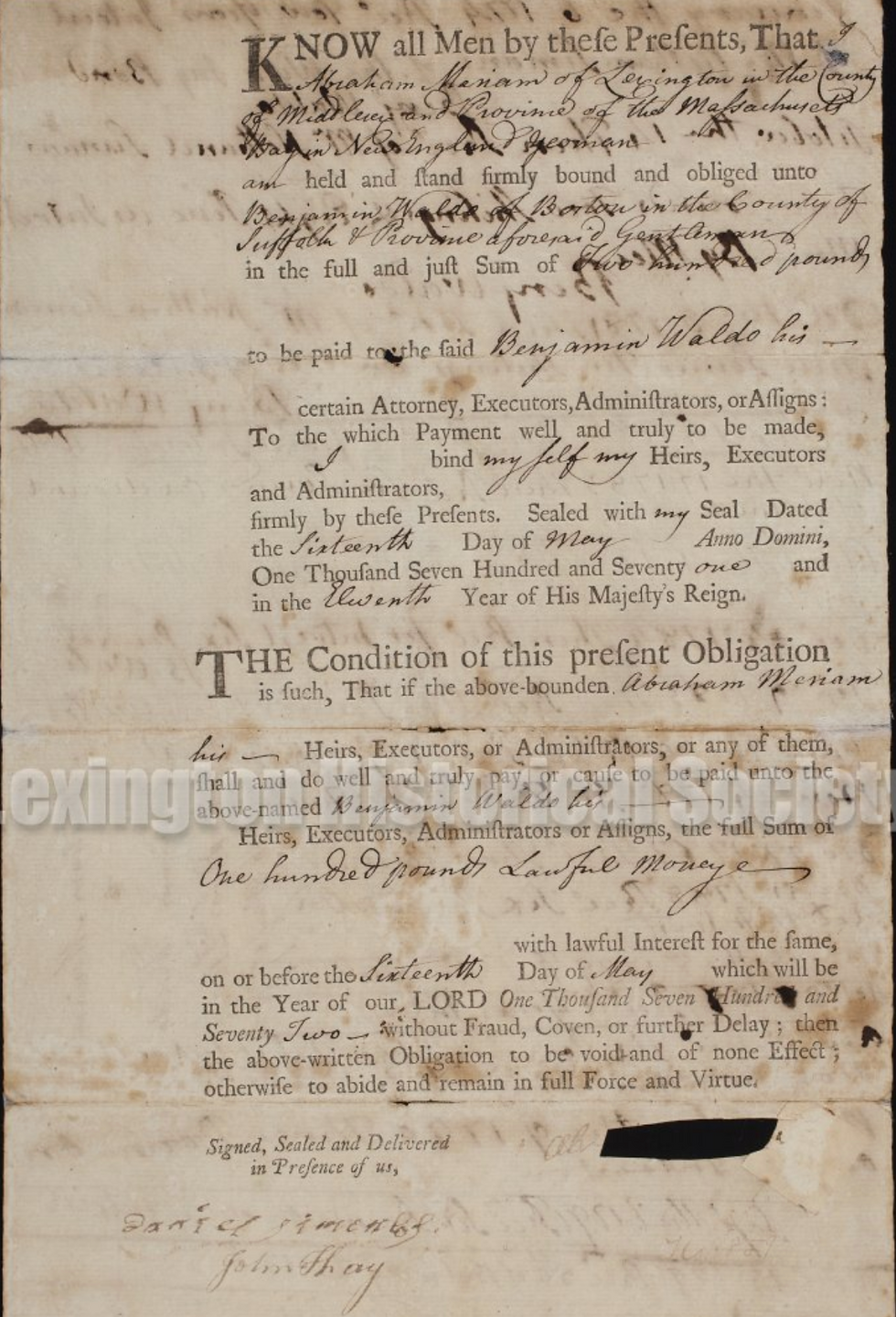
On the reverse side of that document are listed payments that Waldo received. None of the payments were received on time and none came from Alexander. The payments came, instead from Daniel's son, our cousin Nathaniel Symonds (2C8X). It's impossible to know if Nathaniel was making the payments himself or acting as intermediary for his brother-in-law.
Then, probably sometime in late 1772 or early 1773, Cousin Daniel's house was robbed. The identity of the thief was unknown until October of 1773 when a man named Levi Ames confessed to the crime:
I stole ten or eleven dollars from Mr Symonds, of Lexington, whose son-in-law, Mr. (Alexander) Meriam, while I was in prison, informed me where the money was and how to get it, but he never received any of it; I supposed he gave me this information through envy against his father-in-law, through whose means he was then confined for debt.
From the statement of the robber Levi Ames, we gather that Alexander had been unable to pay the money he owed to Benjamin Waldo. As a witness to the bond, perhaps Cousin Daniel was liable for the money. In any case, it appear that Daniel had his son-in-law thrown into the pokey for debt. That couldn't have been helpful as the Merriam's now had six children to feed. Even worse, after Ames' confession Daniel then knew that his son-in-law was responsible for the robbery at his house.
Money matters did not improve for poor Alexander. In a report compiled for the Lexington Historical Society, historian Mary B. Fuhrer lists Abraham Merriam as one among the “Truly Poor Men in Lexington’s 1774 Valuation.” Fuhrer wrote of a possible excuse for Abraham's troubles:
Abraham Merriam, 40, was one of six sons. His father Jonas was still alive in 1774, but appears to have sold his land. Since all of Abraham’s brothers moved away by 1774, it is probable that his father sold his estate and divided it equally among his many sons to allow them to purchase frontier estates elsewhere. . .This appears to be a case where there were simply too many sons to allow any one to be favored with the homestead and still have enough resources left to provide for all the others.
That seems a feeble excuse given that many men in similar circumstances found ways to support their families. It appears, however, that the war, which began the very next year, might have proved a boon to Alexander. He and his son, Abraham, Jr., served quite a few stints in the militia and even took money from men who were willing to pay for replacements.
Cousin Daniel died in April of 1776 and Abraham's father died a few months later. It's possible the couple may have received some money from both parents. Cousin Sarah stuck by her man and, in 1776 their last child, Zadock, was born. Possibly to get away from gossiping neighbors, the Merriam's made a move to Mason, New Hampshire. Daniel died there in 1797 at age 63. Sarah died six year later at age 66.
The robber Levi Ames wasn't so lucky. After his capture, he was sentenced to death for his thievery. In October of 1773, he gave a quite lengthy dying confession to Reverend Samuel Mather. In it he confessed to twenty-two crimes. One was, of course, our Cousin Daniel. The first theft Ames reported as an adult was a gun he stole from our cousin Josiah Richardson (4C7X) of Woburn. He also stole a watch from Cousin Daniel's nephew, our cousin Joseph Symonds (2C8X).
Though it appears that Levi truly repented of his sins, it was to no avail. We'll leave the last word on poor Levi Ames to historians Eric Getz and Alex Cain:
On October 21st, hundreds of spectators gathered to witness Ames’ execution. After being hauled in chains through the streets of Boston in a cart and then led up onto the scaffold, the condemned thief cautioned young onlookers against following in his tragic path. “Ye youth! who throng this fatal plain, And croud th' accursed Tree: O! shun the paths that lead to shame, Nor fall like wretched me.” He was then hung from the neck.
Cousin Elizabeth Symonds Chapman's letter
Our cousin Elizabeth Symonds (3C7X) was a 2nd cousin 2X removed to Daniel Symonds. She was born in Leominster in 1748. In 1770, she married a man named Nathaniel Chapman. The couple had two young children when Nathaniel, a minuteman from Leominster, marched to Lexington and Concord on the alarm of April 19, 1775. Then it seems that Nathaniel decided to make a career out of the army. He served at Bunker Hill in June of 1775 and left with Washington when the army went north to New York in March of 1776.
We know that Nathaniel had a sojourn at home in Leominster in the fall of 1775 because the couple's last child, Nathaniel Jr. (4C6X), was born in June of 1776. Three weeks before Nathaniel's birth, Cousin Elizabeth wrote a letter to her husband who was with the army in New York
Leominster, Massachusetts
June 3rd 1776
Loving Husband ~
These lines come with my affectionate regards to you hoping they will find you in helth, tho I still continue in a very weak and low condition. I am no better than I was when you left me but rather worse, and I should be very glad if you could come and see me for I want to see you. Our children are both well thro the Divine goodness. I have received but two letters from you since you went away--neither knew where you was till last Friday I had one and Sabathday evening after, another, an I rejoice to hear that you are well and I pray you may thus continue and in God's due time be returned in safety. I send this letter by Mr. Mullins and I hope it will reach you and I should be glad if you would send me a letter back by him. I have wrote that I should be glad you could come and see me if you could, but if you cannot, I desire you should make yourself as easy as possbile for I am under the care of a kind Providence who is able to do more for me than I can ask or think, and I desire humbly to submit to His Holy Will with patience and resignation, patiently to bear what he shall see fitt to lay upon me. My cough is something abated, but I think I grow weaker. I desire your prayers for me that I may be prepared for the will of God that I may so improve my remainder of life that I may answer the great end for which I was made, that I might glorify God here and finally com to the enjoyment of Him in a world of glory, thro the merits of Jesus Christ. Remember, i beseech you, that you are a mortall and that you must submit to death sooner or later and consider that we are always in danger of our spiritual enemy. Be, therefor, on your guard continually, and live in a daily preparation for death--and so I must bid you farewill and if it should be so ordered that I should not see you again, i hope we shall both be as happy as to spend an enternity of happiness together in the coming world which is my desire and prayer. So I conclude by subscribing myself, your Ever loving and affectionate wife Elizabeth Champman.
Brother Zebedee is well and is in Boston. Father's family is all as well as common
I have not bought a cow for they are very scarce and dear and I think I can do without, and I would not have you uneasy about it or about any money for I have as much as i need for the Present.
To Mr. Nathaniel Chapman in New York in Capt. Pollard's Company of Carpenters.
Sadly, neither Elizabeth nor her child, born Jun 26th, lived long after the birth. Mother and child both died less than a month later on July 18th.
The two older children, Elizabeth (4C6X), 5 and John (4C6X), 2, probably went to live with family members. Nathaniel Chapman continued his military service, joining Continental Army in 1777 and serving until 1780. In 1805, when all his children with Elizabeth were grown, he made a move to the newly created state of Ohio.
Nathaniel and Elizabeth's second child, our cousin John Chapman (4C6X), has become better known as Johnny Appleseed. We'll have more of John's story in a future post.


Comments