
Samuel Blodgett, Jr. and the Amoskeag Canal Legacy
- westmohney

- Aug 19, 2024
- 12 min read
Updated: Jul 25, 2025
So completely did he drop out of public affairs that his death in a Baltimore hospital on April 11, 1814 received no notice in the Washington papers. ~ from Samuel's bio in the Matthiesen Gallery

Sam Jr.,serves his country
Samuel Blodget, Jr. (3C7X), born in 1757 in Goffstown, New Hampshire, was the second son of our canal-building cousin, Samuel Blodget, Sr. (2C6X). In 1775, at the outbreak of the Revolutionary War, Samuel, Jr. volunteered for the New Hampshire Militia and was commissioned captain. He was only 18 at the time. During the course of his time in the military, Samuel was promoted to major and served for a time as a member of General George Washington's staff. In 1777, with his health failing, Samuel resigned his commission and went into the trade business. His sword from his time in the military is shown below.

I found the photos and a description of the sword on the Christie's Auction House site:
Made during the first years of the Revolutionary War and surviving with its original leather scabbard, this silver-mounted sword is an outstanding relic of American history. It is marked on the hilt and signed on the scabbard by John Bailey, a prominent New York sword smith and cutler.
As suggested by inscriptions on the scabbard, the sword was owned by S. Blodget and D. Jewell. Blodget was most likely the first owner as his name appears at the top of the scabbard. . .and the descent of the sword in the Jewell family indicates that Jewell was the later owner. . .Furthermore. . .Blodget's resignation in late 1777 coincides neatly with the 1778 date on the Jewell engraved mount and it is possible that on his way home from active duty, Blodget gave or sold his sword to Jewell.
Bailey (also) made the famous "Battle sword" carried by George Washington through the remainder of the War. . .Bailey's sword is easily recognizable in period paintings. . .and survives today in the collection of the Smithsonian.
Two portraits
In 1779, while his father was busy building his own empire, Samuel forged out on his own to begin a business enterprise with his brother William (3C7X) and his brother-in-law Samuel Gilman. The three men entered into the East India trade business and made a substantial fortune for themselves.
It was during this period of plenty that Samuel commissioned two paintings of himself by the soon-to-be-famous artist John Trumbull. Trumbull had already done a portrait of George Washington in 1780.
The first portrait, of a style popular in the day, was of Samuel lounging at home in fine attire. Trumbull painted this one ca. 1784.

A few years later, Trumbull did another portrait of Samuel. The "Portrait of Captain Samuel Blodget in Rifle Dress" is housed in the Matthiesen Gallery in London. The Gallery's description of the painting reads in part:
Blodget's pose in Rifle dress, painted almost a decade after he had resigned his commission, was evidently intended to commemorate the military service of this talented man whose own career, with its early triumphs and subsequent disappointments, in some ways resembled Trumbell's own.

The Gallery went on to theorize about a possible link to Samuel's portrait and another more famous Trumbull work:
In 1786, Trumbull completed The Death of General Warren at the Battle of Bunkers Hill. Benjamin West called it the “best picture” of a modern battle scene ever painted. . .The animated pose of Lieutenant Thomas Grosvenor in the Death of General Warren has some similarities to the pose of Captain Blodget, perhaps because, as noted by Theodore Sizer, editor of Trumbull's autobiography, Blodget's portrait may have been done in London in the same year.
We featured The Death of General Warren in our "Relatives at Bunker Hill" post. Our cousin Moses Parker (2C8X) who died of wounds suffered at the battle was portrayed by Trumbull in that painting. Moses is the man in the shadows at left looking down at his injured knee. The man standing at right in the painting strikes a pose similar to that of our cousin Samuel:

Samuel paid Trumbull fifteen guineas for his portrait. The United States government had a chance to buy the painting "for a sum not to exceed $700" but they passed on the opportunity. The painting resurfaced in 1986 in a southern England collection and the Matthiasen Gallery acquired it.
Riding High for a fall
During the 1780s, the decade of his two portraits, Samuel found himself a wealthy man. Ca. 1790, he decided to make a move from Boston to the then capital of the United States, Philadelphia, PA. There he landed a job as director of the Insurance Company of North America. In 1792, he married Rebecca Smith, daughter of William Smith, provost of University of Pennsylvania. She was described as “a notable beauty and wit whose irrepressible remarks on her husbands comical looks are borne out by his portrait in the office of the superintendent of the Capital in Washington.” That portrait may have been the one of him in rifle dress.
All might have gone well for Samuel had he not taken a page from our cousin Tristram Dalton's (2C8X) book and invested money in the proposed capital city, Washington, D.C. We wrote about Tristram's financial woes in our "Tristram Dalton" post.
In 1792, as Samuel's father, Samuel Blodget, Sr., was in New Hampshire just beginning work on his Amoskeag Canal, Samuel, Jr. had very different ideas. When plans for the sparkling new capital city in Maryland began to take shape, Samuel, Jr. found himself caught up in "federal city fever." His past association with President George Washington during the Revolutionary War most probably helped to land him the chairmanship of a committee chosen to design the new city.
In addition to his chairmanship duties, Samuel invested heavily in Washington property to the tune of $100,000, half of which he gave to the government to be used for the Capitol building and the president's house. These investments probably led to his appointment as Superintendant of Buildings in 1793.
Riding high and possibly flush with his own perceived importance, Samuel came up with a plan that would be his ruination. Samuel's idea, which he sold to the president and the rest of his commitee, was to hold a lottery to attract investors for the new city. His proposal was to sell fifty thousand tickets at $7 apiece. There would, of course be prizes and with these, he went big: a cash prize of $25,000 and a grand prize of “1 superb hotel with baths, out houses, etc. to cost $50,000.” Below is one of the lottery tickets signed by Samuel:

The lottery turned out to be a dismal failure. Tickets didn't sell as expected and, when the drawing was finally held, the committee found itself $21,000 short of the promised $25,000 payout. Ironically, in four years time, Samuel's father would try a similar scheme for his canal project with the same disastrous results.
Samuel's hotel
In spite of the initial lottery problems, plans went ahead for the $50,000 hotel lottery. Stephen A. Hanson in his "Washington Chronicles," wrote an article on the building that would come to be called Blodget's Hotel:
The original hotel was built on the "F Street Ridge," the high ground above Pennsylvania Avenue that served as the main route between the White House and the Capitol building at the time. . .With a planned frontage of 120 feet, it would far exceed the size of any building at the time in America and would be the largest privately-owned building in Washington. . . James Hoban, the architect of the White House, won the competition to design the hotel, further increasing its attractiveness as the big lottery prize.
In 1793, a reported 1,500 people attended the ground breaking for the construction of the hotel, more than four times the population of the city at the time. But the groundbreaking was mostly for show. Blodget did not have the resources to finish the construction of the hotel, and for several years the “Grand Hotel” stood only as an empty shell. In 1796, the Washington Gazette printed a comment by a stage coach passenger: “In riding through your city this morning, my eye was struck at a great distance with the word 'HOTEL' inscribed in red letters upon the front of magnificent building, half finished."
The proposed hotel went unused until 1800 when the United States Theater moved into the unfinished building and became the first theater company in the city. As it turned out, the building never fulfilled its original purpose. When finally completed in 1810, it was purchased by the federal government to house the U.S. Post Office and Patent Office. During the War of 1812, when the British invaded the Washington, Superintendent of Patents Dr. William Thornton convinced the British that the models in the patent office were private property and not owned by the United States government. The Patent Office became the only building "left untorched" in the city. Congress was able to use the building as a temporary home after the Capitol building was destroyed. In 1836, the building, which had caused Samuel so much embarrassment and finacial woe, was destroyed in a fire. Though it never served as its original purpose as a hotel, it was always known as Blodget's Hotel.

An English traveler visiting Washington City at the turn of the century noted that the “the public buildings so far are the President’s House, the Capitol, and a large Hotel, the latter being a large brick building ornamented with free-stone and stands between the other two.”Below is a drawing, done ca. 1803, "showing a pastoral view of Washington with the President's House, Gales' House, and Blodget's Hotel to the right:"

architectural interests
Samuel's failure to complete the hotel on time led to his dismissal as Superintedent of Buildings. Down but not out, he turned his attention to another interest. Among his many other talents, Samuel was something of an amateur architect. In 1792, he had submitted a drawing for the Capitol building but later withdrew it. In 1794, in spite of his growing financial woes, Samuel decided to offer a design for the First Bank of the United States.
After the Revolutionary War, the United States faced overwhelming debt which led to the civil unrest culminating in Shay's Rebellion in 1787. Washington's Secretary of the Treasury, Alexander Hamilton, came up with a plan to give the federal government more authority over fiscal matters by creating a national bank. According to the National Park Service:
Among the plan’s most vocal opponents was Secretary of State Thomas Jefferson. Jefferson advocated for a strict interpretation of the U.S. Constitution, which didn’t explicitly state that the federal government could create a national bank. On the other hand, Hamilton argued, the Constitution also didn’t prohibit the formation of such a bank. Even after both the House and the Senate approved the bill, Jefferson urged President Washington to veto it. Instead, Washington gave Hamilton a week to address Jefferson’s arguments. Hamilton delivered a 15,000-word rebuttal that swayed Washington.
The First Bank opened in 1791 and was initially housed in Carpenters’ Hall in Philadelphia. Samuel's design for a brand new bank building was accepted by the government and work began on the project in 1795. By 1797, First Bank had a gleaming new home:
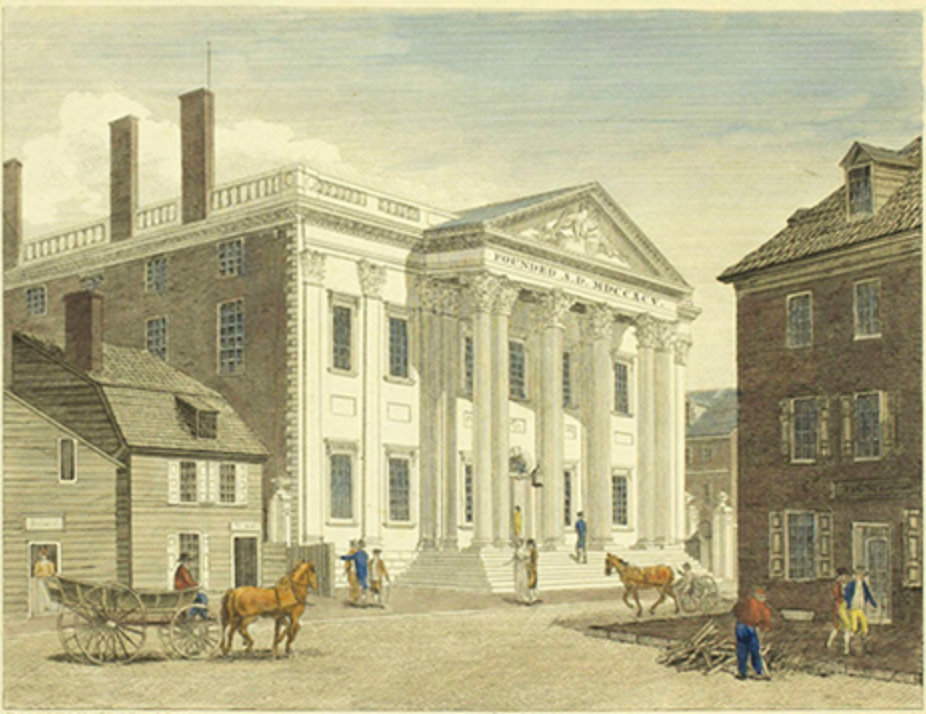
When First Bank's charter ended in 1811, Samuel's building was purchased by Stephen Girard and became Girard's Bank. Other corporate banks owned the building until 1955 when the National Park Service acquired it. The bank, undergoing preservation, has been closed to the public since the 1970s. Plans to renovate the building and develop a museum have been in the works since June of 2023 when Independence National Historical Park received $22 million from the Great American Outdoors Act. The restored building is slated to open in 2026.

Ca. 1800, shortly after the President's House (now the White House) was built, Samuel did a drawing of the north front of the building. From the White House Historical Association:
This architectural sketch of the North Front of the White House was drawn by Samuel Blodget, Jr., a merchant and amateur architect and artist. A fainter inscription, possibly added by a different individual, indicates the sketch was made "in the Presidency of Jefferson and Madison" or sometime between 1801-1817. Blodget added the carved laurel branches, which were not in place at the time of the sketch.

hard times
In spite of his difficulties, Samuel soldiered on. In the early 1800s, just before his financial woes reached the boiling point, he began work on a home, called Greenville, for himself and his family in Philadelphia. At about the same time, Samuel published a pamphlet titled "Thoughts on the Increasing Wealth and National Economy of the United States of America." His own increasing wealth, however had come to an end.
In 1802, the courts found Samuel legally responsible for the failed hotel lottery project. Since he was found unable to pay the $21,500 required to complete its construction, Samuel was thrown into debtor's prison for the last six months of 1803. While in prison, however, he continued his ardent support for the capital city. In 1803, he delivered "a memorial to congress. . .advocating for a combined national university and monument to George Washington."
When Samuel was released from prison, work continued slowly on the Greenville house and the family was eventually able to move in to the partially finished building. Sadly, the project was still not complete ten years later when Samuel died in 1814. Below is Samuel's mansion house as it looks today:

From the Nomination for the building to be added to the Philadelphia Register of Historic Places:
Originally constructed by Samuel Blodget, Jr., the habitable, but unfinished Greenville was eventually completed in 1814–1815, after which it was bought at sheriff’s sale and held in trust for Rebecca “Becky” Smith Blodget (4C6X) and passed on to her daughter, Julia Ann Allen Blodget Britton (5C5X). Greenville was enlarged between 1841 and 1866. . .
The Blodget heirs owned the house until 1853. Greenville was then purchased by the Protestant Episcopal Church and served as the “Mission House of the Protestant Episcopal Church of the United States.” The house was later used by the Quakers as a meetinghouse and eventually became part of a conglomerate of building used as the Pennsylvania Working Home for the Blind, shown below.

the passing of the Amoskeag Canal torch
While Samuel Jr. toiled in Philadelphia and Washington, falling ever further into debt, his father overcame his own travails and finally saw the completion of his canal in 1807. When Samuel, Sr. died only four months afterwards, his son was in no fit state to take over the running of the operation. That honor went to Samuel's grandson, our cousin Thomas Stickney (4C6X), "a promising young man then living in Boston."
In 1810, the state of New Hampshire gave the Blodget Canal Company permission to hold yet another lottery "for the benefit of the Blodget heirs that they might finish the work begun by him." Possibly aided by money from that lottery, Cousin Thomas was instrumental in beginning the first manufacturing industry on the canal and also chosen chairman of the committee that changed the name of Derryfield to Manchester.
Poor Thomas, however, wasn't able to do as much as he would have liked to further his grandfather's vision. He was, sadly, "suffering from an acute disease which terminated his life in 1814" at age 47.
Samuel, Jr's death and his father's canal legacy
Samuel's national univerisity idea, dreamed up while still in prison, became his main interest for the rest of his life. Even so, he did live a rather reclusive life. From the Matthiesen Gallery biography on Samuel we learn that after his imprisonment, “[s]o completely did he drop out of public affairs that his death in a Baltimore hospital on April 11, 1814 received no notice in the Washington papers.”
Samuel died in April of 1814 at age 57. It was only three months later that his (and our) cousin Thomas Stickney, overseer of the Amoskeag Canal, also passed away. After these two deaths, there was no one left to look after the family interest in the canal. Operations then passed to the Merrimack Boating Company of Boston.
The Libaray of Congress holds 122 photos of the canal and manufactory buildings in the surrounding area that were built as a result of the canal. Below is just one of them:

In 1948, artist Charles Sheeler did his own version of the canal that hangs in the Currier Museum of art in Manchester, NH.

In 1839, Henry David Thoreau paddled up and down the Merrimack River with his brother, John Thoreau, over the course of a fortnight. His recorded and collected thoughts on the trip were published in the book A Week on the Concord and Merrimack Rivers, published in 1849:
Just above the mouth of this river we passed the artificial falls where the canals of the Manchester Manufacturing Company discharge themselves into the Merrimack. They are striking enough to have a name, and, with the scenery of a Bashpish, would be visited from far and near. The water falls thirty or forty feet over seven or eight steep and narrow terraces of stone, probably to break its force, and is converted into one mass of foam. This canal-water did not seem to be the worse for the wear, but foamed and fumed as purely, and boomed as savagely and impressively, as a mountain torrent, and, though it came from under a factory, we saw a rainbow here.
Beware the canals of Amoskeag
Samuel Blodget, Sr.'s canals are no more. They were filled in with dirt in the 1960s. From the site "Manchester Stories", I found an interesting article by John Clayton about that subject titled "Beware the Canals of Amoskeag:"
There are a lot of old-timers (like me) who wish the canals had been preserved —they were filled in during an outbreak of urban renewal in the late ’60s —but as my recent hair-raising research will soon illustrate, many of us may be alive today simply because the canals are gone. Apparently, from the very day that Samuel Blodget hatched his plan to build the city’s first canal, the people of Manchester — by accident, by design or via some sort of individual personal derangement — began hurling their bodies into the city’s man-made channels.
At one point in the 19th century, bodies were being hauled out of the canals with such frequency that headline writers were strapped to come up with new phrases to describe the watery mayhem. “Body Found in Canal” was seen as often as “Dog Bites Man,” so the headline writers tried to make things more personal. Thus, we got headlines in The Manchester Union and The Daily Mirror and American such as “Unsound Mind; Martin Burke Sought and Found a Watery Death,” or “A Despondent Woman; Mrs. Glancy Attempts Suicide by Jumping in Canal.”
The journalistic forensics were made easier when people left notes before jumping into the canals. Such was the case with Samuel Foss way back on Sept. 14, 1869, who left “almost illegible pencillings” that said, “My money is gone; I have no friends. Good bye! My body will be found near the bridge. I am not drunk. Farewell! I join my friends in the other world.”
As Clayton went on to describe a few more bodies found in the teeming waters, he ended his article with these words:
You know, maybe I don't miss those canals so much after all.


Comments