
NEWBURY
- westmohney

- Nov 5, 2020
- 6 min read
Updated: Jul 19, 2021
Quascacunquen is allowed by the court to be a plantation...and shall hereafter be called Newbury ~ from Newbury historical records

the Great Marsh
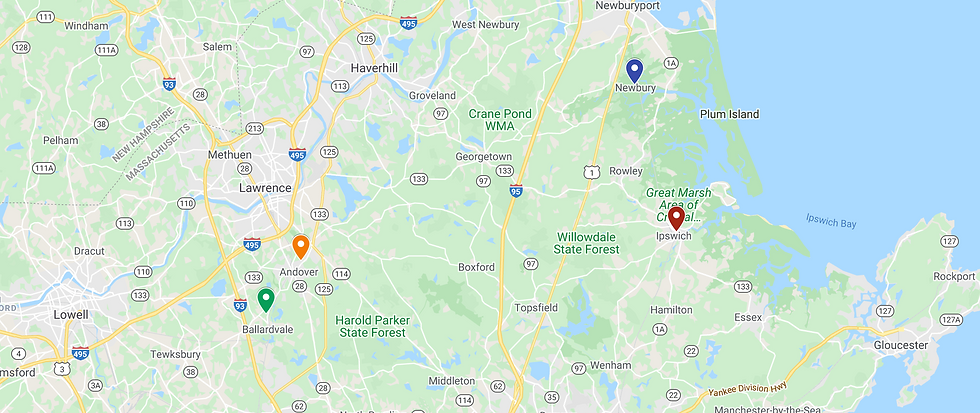
Between the towns of Ipswich (where our grandfathers Howlett, French and Clarke settled) and Newbury (where our grandfathers Phelps, Adams and Ballard settled) lies an extensive area of marshland. Many of the townspeople from Ipswich and Newbury received sizable grants in these wetlands, Thomas Howlett (9GGF) among them.
In the early days of settlement, one of first things the settlers did was to clear the forests for homes and agriculture and build dams to run their mills. These dams created large “staircases", which drained the marshland water out of the valleys. Further damage was done to these areas as populations increased.
Today, environmental groups work to restore these lands to their natural state. Included in the wetlands between Ipswich and Newbury is an area known as The Great Marsh Area of Critical Environmental Concern. The ACEC was created to protect important lands with historical, cultural, environmental and scenic value. The agency also works to protect fish, wildlife and other natural resources. Though Frodo might not agree, these marshlands are not only beautiful but also extremely serviceable to humankind and wildlife.
Note: Shout out to Hana who has worked extensively on river and waterway restoration projects. Yay Hana!

Settling Newbury
Newbury lies smack in the middle of an area riddled with rivulets. It also lies in the far northeastern corner of Massachusetts. While overcrowding was a main reason for founding new towns, protection of existing towns was another. Massachusetts Bay felt threatened not only from attack by Native Americans, but also the encroaching French coming from the Northwest. Defending what rightfully belonged to the colony was one of the reasons Newbury was "allowed by the courts to be a plantation."
Many of Newbury's first settlers came across to New England together on the Ship "Mary and John." Our grandfather William Ballard (9GGF) was among them. The newcomers landed in Boston in May of 1634. Thomas Parker, minister and leader of the group, took his flock, about 100 people, to Ipswich. There they remained through the following winter and in the spring of 1635 appealed to the court for permission "to settle on the Quascacunquen river."
According to John Currier, author of History of Newbury, Mass, "Tradition asserts that they came by water from Ipswich, and landed on the north shore of the Quascacunquen (now Parker) river..."

Edmund Greenleaf
Edmund Greenleaf (H10A) married our aunt Sarah Moore (10A) in 1611 when they were still living in England. He was one of the 18 principal settlers to come by water from Ipswich to Newbury in 1636.
Note: Sarah's brother, our grandfather Francis Moore (9GGF) came to America ca. 1637 and settled in Cambridge.
In 1638, when the Newbury militia was formed into four companies, Edmund was chosen as leader of one. He was also chosen, in 1652, as superintendent of the all important saltpeter stock. Sarah died in 1663 at 75 years in Boston. Edmund died in 1670 at 81 years in Boston. They had nine children.
Note: Saltpeter is the most important ingredient in gun powder and every town in the Massachusetts Bay Colony was required to keep a stock of saltpeter.
Note: Two of Edmund and Sarah's great-great-grandsons were sheriff of Suffolk County, based in Boston, around the time of the Revolutionary War.
The Ballard Family
William Ballard (9GGF) was born in England ca. 1617. He is listed on the roster of the ship "Mary and John," which sailed on 26 Mar 1634 from Plymouth, England to the port of Hull, across the bay from Boston. He was only 17 when he made the voyage. Twenty other passengers from the "John and Mary" also settled in Newbury, and were probably all known to one another. His young age and the lack of property records for him in Newbury suggest that he came over as a servant.
The first record we have of William is in The History of Newbury. He is listed as one of the first inhabitants of that settlement. He married Grace (last name unknown) (9GGM) in 1641 in Newbury. William was no mover and shaker. There is no other mention of him until he is named as one of the Newbury residents who left to found the city of Andover in 1644. He would have been 27 years old then.
In 1643, William's name appears in the records of Dedham, MA. Evidently he gave bond to pay fines imposed upon two men convicted of "mutinous and turbulent speeches." (My favorite kind!)
Note: There are many records of our ancestors "giving bond." for people unable to pay their fines. There is scant information on the internet about that subject, but bond in colonial days was credit. Many times a bond was paid for friendship or charity. It is also possible that monied people like William lent funds, at interest, to people in trouble and made a little on the side.
William and Grace spent the rest of their lives in Andover. William's name appears on a list of "the names of all free house houlders" in order as they came. His is the sixteenth name on the Andover list, second to the last on the page below.

From a deposition in 1662, we learn that William and Grace were pretty hospitable people. "...a bought (about) sixe weekes senc the houes of Job Tiler being burned he (William) gave the sd. Tilers wife leave to com with her family for a time and live at his houes... which accordingly shee did and there remaynes to this time."
William died in 1689 at age 72. Grace died in 1694 at about 78 years. They had nine children. Their first born, Joseph (8GGF) married Edward Phelps' (9GGF) daughter Elizabeth (8GGM). These two played a large part in the Andover witch trials of 1692.
Note: Andover was founded in 1646. It was a frontier town on the edge of vast wilderness. Historians write about packs of wolves invading the village. Attack from the native people was also a constant fear of these outlying settlers. Home lots there were assigned by the family's status and some who didn't make the cut could be miles away from the center of town, a dangerous place to be. The Ballards lived outside the city in an area that is today known as Ballardvale.
the Adams family
Robert Adams (10GGF), was born in England ca. 1602. According to A Genealogical History of Robert Adams and his Decendents, he came first to Ipswich in 1635 with his wife Eleanor (10GGM), but I can find no record of him there. A tailor and farmer by trade, he is recorded in 1638 as a landowner in the town of Salem.
It's possible that Robert (as opposed to his fellow townsman William Ballard (9GGF)) was a tad uncharitable and a wee bit argumentative. In 1640, the court at Salem sentenced him "to be set by the heels in the stocks for being uncharitable to a poor man in distress, taking his canoe, for charging court with injustice, etc." In 1641 there was yet another canoe incident. Robert sued George Haries for taking his canoe. A neighbor testified that "the defendant (George Haries) was not at home when the canoe was taken and the kellek (anchor) was broken," inferring it was Robert's own damn fault he lost his canoe. In 1645, John Kitchen sued Robert Adams for defamation. Elinore Downing testified that "Robert Adams called John Kitchen a false fellow." Robert was fined an additional five shillings for saying that the case should be thrown out. Finally, in 1648, he had to answer to Mary Oliver for "taking away a ladder."
By 1651, Robert had left the woes of Salem behind. In that year he received a "farm in Newbury over the Litle River with all the house, barne, Hovills, fences, timber... containing about 150 acres of upland, also 50 acres of meadow...." His past altercations with the court may have hindered his progress because it was almost 20 years after his move to Newbury that he finally became a freeman.
In 1651, the same year Robert purchased his farm, his daughter Elizabeth (9GGM) married the tame Edward Phelps (9GGF), also of Newbury. Remember Edward's brother's, Henry and Nicholas, the notorious Quaker meeting-holders in Salem.
In 1656 Massachusetts had enacted a law against the "cursed sect of heretics lately risen up in the world, which are commonly Quakers..." Newbury passed its own law against the sect in 1658. Robert Adams probably heard about the Quaker meetings from his son-in-law. His interest was piqued. While it doesn't appear that he ever adopted the Quaker faith, Robert was once again fined by the court in 1658, this time for attending one of Nicholas Phelps' (10U) Quaker meetings. Curiosity killed the cat.
Robert and Eleanor had nine children. Eleanor died in 1677 at age 70 and Robert married Sarah Glover. Robert and Sarah had no children. Robert died in 1682 at about age 80. In his will he left "to his daughter Elizabeth, wife of Edward Phelps, one cow."
Below is a tree showing the relationship of the Phelps, Adams and Ballard families.

a memorial to some...but not all
The Sons and Daughters of the First Settlers of Newbury erected a memorial to honor Newbury's first settlers. You'll find Robert Adams (10GGF) and Edmund Greenleaf (H10A) on this memorial. Noticeably absent is Edward Phelps (9GGF) who came in 1641. And, in particular, where is William Ballard (9GGF) who was one of the original founders of Newbury in 1635! Alas, it seems that only the ancestors of families that donated money for the memorial made the final cut. Shame on you Sons and Daughters!



Comments